
NEW
Font size
S
M
L
XL
 Worksheets
'25-26 Biology- Cell Test
Total questions: 54
Worksheet time: 27mins
Name
Class
Date
1.
Which list describes the organization within multicellular organisms from least complex to most complex?
a)
Proteins, cells, organelles, organisms
b)
Proteins, organelles, cells, organisms
c)
Cells, organelles, proteins, organisms
d)
Organelles, cells, proteins, organisms
2.
The phrase “are not living cells but have the ability to reproduce within living cells” can be used to describe
a)
Algae
b)
Yeasts
c)
Bacteria
d)
Viruses
3.
Which of these statements about enzymes is TRUE?
a)
Enzymes are lipid molecules.
b)
Enzymes are carbohydrate molecules.
c)
Enzymes change chemically after each biochemical reaction.
d)
Enzymes are specific for each biochemical reaction.
4.
A skin cell and a muscle cell from the same person have the same
a)
Proteins
b)
DNA
c)
Number of mitochondria
d)
Shape and structures
5.
Which of the following is NOT a class of proteins?
a)
Transport
b)
Enzyme
c)
Indicator
d)
Storage
6.
What statement about what happens during mitosis is TRUE?
a)
2 genetically identical daughter cells are formed
b)
2 genetically non-identical daughter cells are formed
c)
4 genetically identical daughter cells are formed
d)
4 genetically non-identical daughter cells are formed
7.
What is a function of a neuron?
a)
It carries oxygen to other cells
b)
It removes foreign particles from the bloodstream
c)
It secretes digestive enzymes
d)
It sends and receives signals from the internal and external environments
8.
The diffusion of water is also called
a)
Endocytosis
b)
Osmosis
c)
Exocytosis
d)
Active transport
9.
Cyanide is a poison that prevents the cell from using oxygen. Which organelle is directly affected?
a)
Endoplasmic reticulum (ER)
b)
Golgi apparatus
c)
Mitochondria
d)
Nucleus
10.
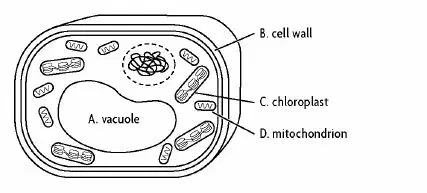
Which plant organelle is used to make sugars?
a)
Vacuole
b)
Cell wall
c)
Chloroplast
d)
Mitochondrion
11.
Which diagram best represents the cell membrane?
a)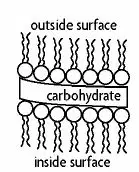
a
b)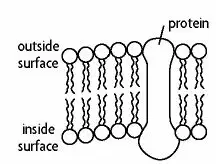
B
c)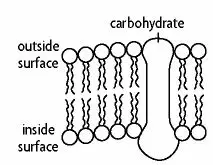
C
d)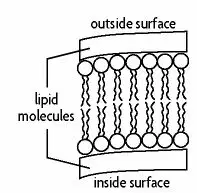
D
12.
The cell membrane consists mainly of
a)
Water and carbon dioxide
b)
Cellulose and lactose
c)
Phospholipids and proteins
d)
Carbohydrates and sugars
13.
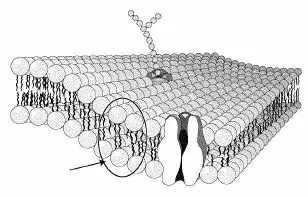
What part of the cell is the arrow pointing to?
a)
Peripheral proteins
b)
Carbohydrate side chains
c)
Protein channels
d)
Phospholipids (lipids)
14.
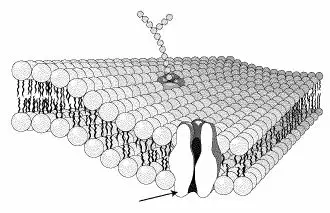
What kind of molecule is this structure in the cell membrane?
a)
Phospholipid (lipid)
b)
Sugar
c)
Protein
d)
Nucleic acid
15.
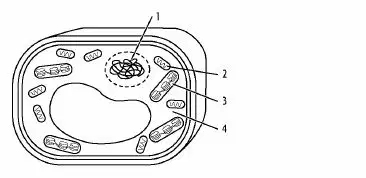
In the picture of a cell below, which label indicates the part of the cell that contains most of the cell's genetic material?
a)
1
b)
2
c)
3
d)
4
16.
What is the function of DNA? It
a)
forms part of the nuclear membrane.
b)
helps the nucleus recognize other cell organelles.
c)
uses oxygen to break down sugars and release energy.
d)
contains information to make proteins.
17.
What is the function of a muscle cell?
a)
Carry oxygen to other cells
b)
Secrete digestive enzymes
c)
Receive and send signals from the internal and external environment
d)
Help the organism move
18.
The exchange of oxygen and carbon dioxide between the body and the air occurs in the cells of the alveoli in the lungs. What part of the cell is the location of this exchange?
a)
Cell membrane
b)
Nucleus
c)
Cell wall
d)
Ribosomes
19.
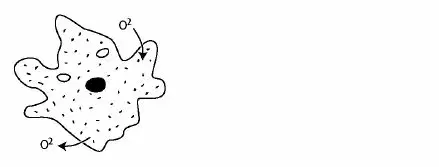
What process moves gases such as oxygen through the cell membrane, as shown in the drawing below?
a)
Osmosis
b)
Diffusion
c)
Active transport
d)
Facilitated diffusion
20.
The fundamental unit of life is the
a)
Organism
b)
Cell
c)
Protein
d)
Tissue
21.
Which of the following is (are) found in plant cells but not in animal cells?
a)
Cytoplasm
b)
Mitochondria
c)
Cell wall
d)
Ribosomes
22.
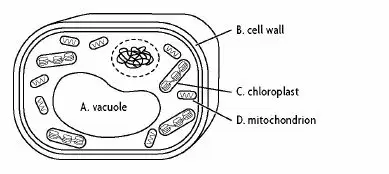
Which plant organelle stores sugars and water?
a)
vacuole
b)
cell wall
c)
chloroplast
d)
mitochondrion
23.
Viruses
a)
Option 1
b)
Are killed by antibiotics
c)
Are the smallest known cell
d)
Infect only animals and humans
e)
Are particles of protein and nucleic acid
24.
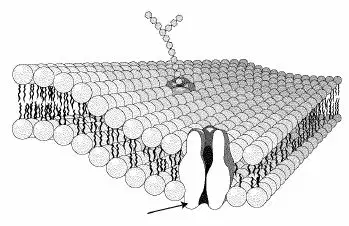
What part of the cell membrane is the arrow pointing to?
a)
Phospholipids (lipids)
b)
A protein channel
c)
A peripheral protein
d)
A carbohydrate side chain
25.
What is the major function of the cell membrane?
a)
To control what substances move in and out
b)
To synthesize lipids and fatty acids
c)
To control production of DNA and RNA
d)
To move chromosomes during cell division
26.
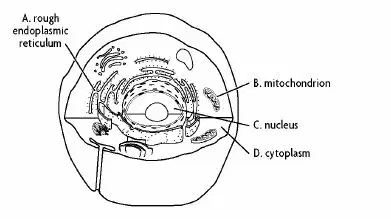
Which structure in the cell contains most of the cell’s genetic information?
a)
Rough endoplasmic reticulum
b)
Mitochondrion
c)
Nucleus
d)
Cytoplasm
27.
DNA is important for cellular activities because DNA
a)
Codes for the production of proteins
b)
Increases the solubility of nutrients
c)
Is the major component of cytoplasm
d)
Is a structural component of cell membranes
28.
DNA replication occurs during the ____ phase of the cell cycle.
a)
G1
b)
G2
c)
M
d)
S
29.
Which of the following is NOT a protein?
a)
A cell membrane transporter
b)
An enzyme
c)
Glucose
d)
Hemoglobin
30.
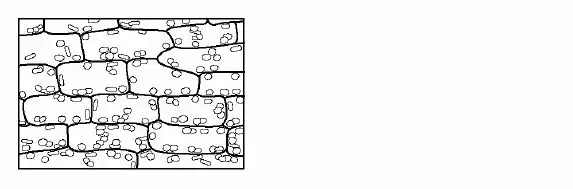
Which title is most appropriate for this drawing from a photomicrograph?
a)
Plant Cells
b)
Human Muscle Cells
c)
Cells of the Immune System
d)
Human Sperm Cells
31.
Which function is associated with macrophages in the blood?
a)
Forming blood clots
b)
Transporting dissolved nutrients
c)
Carrying oxygen
d)
Engulfing bacteria
32.
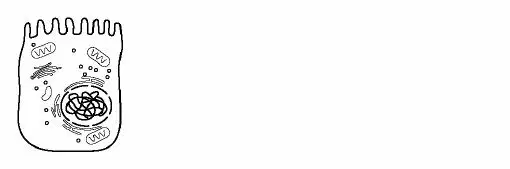
What is the function of the intestinal epithelial cell shown in the drawing below?
a)
Absorb nutrients from the intestine
b)
Help the organism reproduce
c)
Carry carbon dioxide to the lungs
d)
To fight disease in the body
33.
What is the main function of red blood cells?
a)
To fight disease in the body
b)
To carry oxygen to all parts of the body
c)
To remove glucose from the blood
d)
To produce materials that cause the blood to clot
34.
A student examines a cell under the microscope and observes that the cell contains many mitochondria. This is evidence that the cell uses lots of
a)
Proteins
b)
DNA
c)
Lipids
d)
Energy
35.
Which of the following shows a path from where insulin (a protein) is made to where it is released from the cell?
a)
rough ER---> vesicles---> mitochondria---> plasma membrane
b)
rough ER---> Golgi apparatus---> vesicles---> plasma membrane
c)
Golgi apparatus---> vesicles---> rough ER---> plasma membrane
d)
Golgi apparatus---> mitochondria---> plasma membrane---> vesicles
36.
Which of the following does NOT change during cell differentiation?
a)
The cell’s physical characteristics
b)
The cell’s response to environmental signals
c)
The DNA sequence in the cell
d)
The composition of proteins within the cell
37.
The uncontrolled division of certain body cells, which then invade the surrounding tissues and interfere with the normal functioning of the body, is known as
a)
cancer
b)
cytokinesis
c)
mitosis
d)
cleavage
38.
A scientist is trying to discover a new treatment to stop cancer cells from dividing. In the cancer cells, which of these processes will stop if the treatment is successful?
a)
Mitosis
b)
Exocytosis
c)
Active transport
d)
Passive transport
39.
Diffusion is best described as
a)
The change of an enzyme’s shape during biochemical reactions.
b)
The movement of molecules from an area of high concentration to an area of low concentration.
c)
The process by which the cell membrane surrounds and engulfs a food particle from the environment.
d)
The process by which a membrane receptor binds to a signal molecule.
40.
What is the major function of a cell’s selectively permeable membrane?
a)
To regulate energy production in the cell
b)
To keep the cell’s shape
c)
To maintain a free flow of molecules
d)
To control materials entering and leaving the cell
41.
What would happen to a saltwater protozoan if it is removed from its normal habitat and placed into a freshwater pool?
a)
Loss of water through diffusion
b)
Loss of water through active transport
c)
Gain of water through osmosis
d)
Gain of water through protein channels
42.
What is the first cell function to be affected if the Golgi apparatus is damaged?
a)
The cell will not be able to export proteins.
b)
The cell will not be able to store water.
c)
The cell will not be able to produce energy.
d)
The cell will not be able to move or divide.
43.
Which structure is not present in animal cells?
a)
Cell membrane
b)
Nucleus
c)
Chloroplast
d)
Cytoplasm
44.
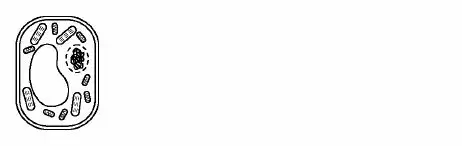
Which drawing best illustrates how this plant cell will appear after it is placed in a solution that has a higher concentration of dissolved substances than the cell?
a)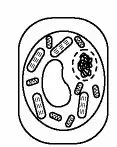
A
b)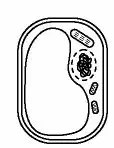
B
c)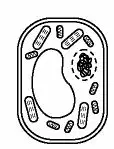
C
d)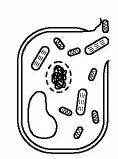
D
45.
Which statement best describes a key role of lipids (phospholipids) within a cell?
a)
They cause DNA to replicate
b)
They move RNA into the cytoplasm
c)
They catalyze chemical reactions within the cell
d)
They are the main structural component of membranes
46.
Researchers have discovered a toxin that stops cells from releasing stored energy. Cells exposed to this toxin cannot carry out many of their normal processes. When cells are exposed to this toxin, which of these processes is least affected?
a)
cell division
b)
osmosis
c)
aerobic respiration
d)
active transport
47.
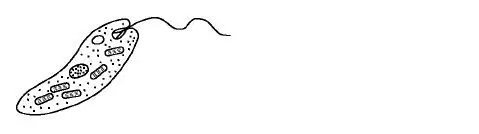
Refer to the diagram below of the single-celled, eukaryotic organism, Euglena. Euglena uses which of these to move?
a)
Cilia
b)
A vacuole
c)
A flagellum
d)
Pseudopodia
48.
Eukaryotes are different from prokaryotes (bacteria), because eukaryotes
a)
Have a nucleus
b)
Have ribosomes
c)
Reproduce by sexual reproduction
d)
Reproduce by asexual reproduction
49.
Which of the following arguments could be made by someone who claims that viruses are not living organisms?
a)
Viruses cannot reproduce outside a living organism.
b)
Viruses do not contain genetic material.
c)
Viruses do not contain proteins.
d)
Viruses do not contain organic compounds.
50.
The ability of the human body to regulate the level of blood glucose is an example of:
a)
Osmosis
b)
Homeostasis
c)
Binary fission
d)
Aerobic respiration
51.
A cell with 5% salt concentration is placed in a beaker with a 1% salt concentration. What will happen to the cell over time?
a)
The cell with gain water and expand.
b)
The cell will lose water and shrink.
c)
The cell will both gain and lose equal amounts of water; thus it will remain the same size.
d)
The cell will neither gain nor lose water.
52.
Stem cells are best described as ____
a)
cells that can produce a variety of types of specialized cells
b)
cells that are likely to cause disease
c)
cells in uncontrolled cell division
d)
cells that destroy foreign cells in the immune system
53.
What type of human cell does HIV target?
a)
Red blood cell
b)
B cell
c)
T cell
d)
Skin cell
54.
What type of microbe causes malaria?
a)
Plasmodium
b)
Paramecium
c)
Amoeba
d)
Elodea
Reset

