
 Worksheets
Jazz on Stage, in the Air, and on Screen
Total questions: 64
Worksheet time: 32mins
Which early Broadway musical comedy featured the song 'Give My Regards to Broadway' as a salute to the theater district?
No, No, Nanette
Little Johnny Jones
Shuffle Along
Runnin' Wild
In the early 1900s, which type of Broadway show most often featured lively music and dancing and showcased the latest musical styles?
Operettas
Musical comedies
Silent dramas
Vaudeville sketches
According to the section, becoming a Broadway success is compared to what achievement?
Winning a Grammy Award
Being selected to compete in the Olympics
Publishing a best-selling novel
Conducting a symphony orchestra
Which technique in the 1923 recording helps spotlight soloists by creating brief silences on the downbeat, often marked by a cymbal crash on the off-beats?
Heterophony
Stop-time
Rubato
Staccato
Which texture is highlighted when multiple instruments play similar melodies at the same time with slight variations, as heard in parts of 'The Charleston'?
Monophony
Homophony
Heterophony
Polyphony
Gerald Bordman described 'The Charleston' as the dance that expressed and symbolized the whole gaudy era about to explode. Which era does Scott E. Brown later call 'the theme song' of?
The Progressive Era
The roaring twenties
The Great Depression
World War II
Which 1925 musical is identified as perhaps the greatest musical-comedy triumph of the decade?
No, No, Nanette
Little Johnny Jones
Shuffle Along
Runnin' Wild
Before Runnin’ Wild premiered, what misunderstanding did Flournoy Miller have about George White’s attitude toward 'The Charleston'?
He believed White thought the song was too difficult to play.
He believed White disliked the dance, not realizing White wanted to premiere it with his own performers.
He believed White wanted to change the lyrics to suit Broadway.
He believed White planned to cancel the entire show due to budget issues.
Which musical first featured the song “Tea for Two”?
No, No, Nanette
Oh James!
My Lady Friends
Tahiti Trot
Who were the composer and lyricist credited with creating “Tea for Two”?
Vincent Youmans and Irving Caesar
George Gershwin and Ira Gershwin
Otto Harbach and Frank Mandel
Dmitri Shostakovich and Kurt Gänzl
Producer Harry Frazee changed his mind about hiring Vincent Youmans after what event?
Youmans’s mother offered to back the show financially
Youmans won a major Broadway award
The show’s first tryout was a hit in New York
Otto Harbach insisted on Youmans for the job
During the tryout process, why did Youmans and Caesar quickly add new songs to No, No, Nanette?
Frazee wanted fresh material after lukewarm early reviews
The orchestra requested more dance numbers
A guest star demanded a solo
The theater required extra songs to fill time
Irving Caesar first wrote a “dummy lyric” for “Tea for Two.” What did Frazee decide about this lyric?
Keep it exactly as it was
Replace it with a more serious poem
Set it aside for a future show
Translate it into French for a Paris run
Which statement best captures why many listeners loved the “Tea for Two” lyric, according to the passage?
Its almost idiotic simplicity expressed the optimism and light-heartedness of the 1920s
Its complex vocabulary showcased high poetic artistry
Its political references reflected post-war realities
Its historical details taught audiences about Chicago
After the Chicago success, what strategy did Frazee use for No, No, Nanette?
He kept the show in Chicago for nearly a year to capitalize on the hit
He immediately opened on Broadway without more tryouts
He moved the show to London and ended the U.S. run
He cancelled the show to focus on a different musical
What was notable about the first recording of “Tea for Two”?
It featured solely a jazz orchestra and reached Number 5 on the Billboard charts
It was recorded live during the New York premiere
It featured a solo piano and did not chart
It was banned from radio play due to strict licensing
How did some New York critics react when No, No, Nanette opened in September 1925?
They acted as if they were tired of it due to overexposure
They hailed it as the greatest musical ever
They criticized the cast’s singing
They focused only on the set design
Which comment describes the jazz-influenced dance numbers in London?
They seemed shockingly new to British audiences, with brass mutes emphasizing the melody
They were traditional waltzes familiar to Londoners
They were quiet and avoided brass instruments
They relied mainly on choirs and string quartets
In the Soviet Union, the tune of “Tea for Two” became known by which title?
Tahiti Trot
Moscow March
Jazz Waltz
Baltic Blues
The lyrics of 'Tea for Two' emphasize alternating 'oo' and 'ee' sounds. Which description matches this feature?
Internal rhyme scheme focusing on oo and ee
Alliteration of consonant clusters like st and tr
Onomatopoeia imitating teacup clinks
Free verse without organized rhyme
Which dance style is the A-section ostinato especially suitable for, according to the analysis?
Waltz
Soft-shoe tap
Tango
Breakdance
According to the listening guide for 'Tea for Two,' which sequence best describes the song’s overall structure?
Verse–Chorus–Intro
Intro–Verse–Chorus
Chorus–Verse–Bridge
Intro–Bridge–Chorus
In the introduction of 'Tea for Two,' what musical feature is highlighted before the chorus phrase is foreshadowed?
Ostinato in the strings
Chromatic mediant modulation
Ritardando (slowing of tempo)
Return to the tonic key
Which statement best reflects Jerome Kern’s philosophy about songs in a musical?
Songs should be separate episodes for dancers to showcase.
Songs should carry the action and represent the singers’ personalities, suited to the action and mood.
Songs should only feature trained vocalists and waltz melodies for orchestras.
Songs should stop the plot to provide comic relief.
Which lyricist shared Jerome Kern’s views on integrating songs into a show’s storyline and co-wrote Rose-Marie (1924)?
Richard Rodgers
George Gershwin
Oscar Hammerstein II
Cole Porter
During the 1920s, what did the new hybrid genre on Broadway blend?
Jazz and ballet only
Features of musical comedies and operettas
Opera and spoken drama without songs
Silent film techniques and vaudeville
According to the passage, how did many musical comedies of the 1920s treat songs within the plot?
They were integrated into the action at key moments.
They were often irrelevant interruptions inserted simply for singing and dancing.
They always advanced the drama with complex subtext.
They were performed only by the chorus, never the leads.
Which statement describes the focus of the blended musical theater genre often called “musicals”?
Emphasis on separate dance numbers and lighthearted plots
Intermixed aspects of older forms with clearer storylines and music that conveys those stories
Complete removal of comedy to favor tragedy
Only solo songs with minimal orchestration
What unusual topics did Show Boat (1927) address for its era?
Science fiction and fantasy worlds
Only comic misunderstandings and weddings
Unhappy relationships, the situation of African Americans, and interracial marriage laws
Sports competitions and celebrity culture
Who wrote the 1926 novel that served as the property for Show Boat and initially feared Broadway would trivialize her story?
Edna Ferber
Zora Neale Hurston
Agatha Christie
Louisa May Alcott
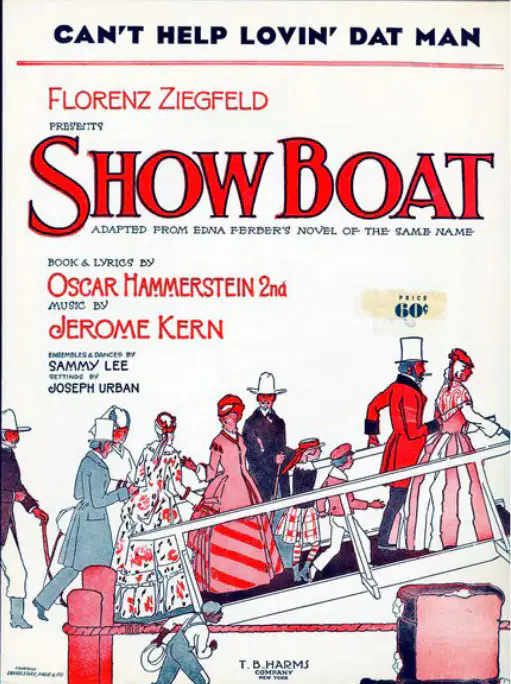
Which song is highlighted as an example of music acting as an identifier and subtext in Show Boat?
“Ol’ Man River”
“Can’t Help Lovin’ Dat Man”
“Blue Skies”
“Summertime”
In the storyline, what secret about Julie leads to conflict and her departure from the show boat?
She is secretly a rival performer from another troupe.
She is half-Black, making her marriage to Steve illegal in parts of the South at the time.
She refuses to sing any jazz pieces.
She is the owner’s daughter concealing her identity.
How does the melody of “Can’t Help Lovin’ Dat Man” first function in the show before its words are heard clearly?
As a full ensemble finale
As background underscoring without words tied to Queenie’s brooch scene
As a loud overture theme
As a dance break for the chorus
Why is Queenie startled when she overhears Julie singing the tune “Can’t Help Lovin’ Dat Man”?
It is a patriotic anthem that only soldiers sing.
It is a Black song that white people normally wouldn’t sing, hinting at Julie’s background.
It is written in a foreign language Queenie doesn’t understand.
It is a lullaby meant for children only.
Which description best captures the breadth of musical styles within Show Boat as noted in the passage?
Only ragtime numbers are used throughout.
The show moves from “old-fashioned” nineteenth-century styles to “modern” 1920s jazz pieces.
It features exclusively classical opera arias.
It relies only on folk songs from the Mississippi region.
In this song’s bluesy style, what specific feature did Kern include to reflect the blues without using the twelve-bar blues harmony?
Syncopated march rhythms
A steady ostinato bass line
Blue notes that waver between conventional and flattened scale tones
A modal drone on D
Which statement best explains how music conveys subtext in this song, beyond the surface story?
The tempo changes randomly to show confusion.
The perfect fourth ‘river’ motif subtly links natural force and the theme of enduring love.
Only the chorus is sung, so the meaning is hidden.
The melody avoids repetition to keep listeners guessing.
Which description best explains how Tin Pan Alley got its nickname according to the passage: "A visiting journalist felt the racket from all the neighboring businesses was deafening; he remarked that the pianos sounded like a bunch of tin pans being clanged together—thus the area was nicknamed Tin Pan Alley."
It was named after a local factory that made tin pans for music stores.
Crowds in the alley used metal pans to keep time during street concerts.
A journalist compared the noise of many pianos to clanging tin pans, inspiring the nickname.
Publishers sold sheet music printed on metallic paper that looked like tin.
Which role did song-pluggers primarily serve for music publishers?
They built pianos for the shops.
They demonstrated songs to help sell sheet music to customers.
They worked as radio announcers who introduced bands.
They composed music for Broadway revues.
Which strategy did song-pluggers use as radio grew after World War I?
They stopped giving free copies of songs to performers.
They targeted orchestra conductors with weekly radio broadcasts to persuade them to perform new pieces on the air.
They focused only on selling sheet music to private home pianists.
They avoided relationships with nightclub singers.
Which statement about Ben Bernie's early life and career is supported by the text?
He was born into wealth and began as a radio host.
He started as a violin performer in vaudeville and later led an orchestra.
He first became famous as a Broadway dancer.
He refused to work with publishers from Tin Pan Alley.
Why did NBC consider Ben Bernie a strong asset for its first national broadcast?
His orchestra had already toured Europe extensively.
His speaking voice and "easy-going, witty microphone manner" suited radio, and his ensemble was ready for broadcast.
He was the only bandleader available in New York at the time.
He had composed the most popular Tin Pan Alley song of the decade.
Which event helped launch Ben Bernie and the Hotel Roosevelt Orchestra to coast-to-coast fame?
Their appearance in a Hollywood film musical.
NBC’s first nationwide broadcast on November 15, 1926, via remote pickup.
Winning a national songwriting contest in 1925.
Recording the first electrical disc in New York City.
Who is credited with composing the song "Sweet Georgia Brown" and what is one notable detail about him from the passage?
George Gershwin; he wrote it while working as a theater usher.
Maceo Pinkard; he was a multi-talented African American who initially built his career in the Midwest and later moved to New York.
Ben Bernie; he composed it during his medical studies.
Kenneth Casey; he was best known as a jazz trumpeter.
Which combination of people is associated with the lyrics and authorship credit of "Sweet Georgia Brown" on the sheet music?
Jerome Kern as lyricist and Ben Bernie as publisher.
Kenneth Casey credited on lyrics and Ben Bernie listed as an author, though his exact role is uncertain.
Paul Whiteman credited as lyricist and Maceo Pinkard as arranger.
Vincent Youmans credited as sole writer and performer.
Which statement best summarizes how commercial radio influenced song-pluggers and popular music promotion?
Radio reduced the need for performers to learn new songs.
As airtime grew more valuable, song-pluggers persuaded radio orchestra conductors to feature new songs, expanding promotion beyond in-store demonstrations.
Radio caused Tin Pan Alley publishers to stop printing sheet music.
Song-pluggers focused exclusively on Broadway revivals after radio emerged.
Which characteristic links 'Sweet Georgia Brown' (1925) to early jazz styles before swing fully emerged?
Use of electronic instruments
Riff-focused lines and sectional writing reminiscent of pre-swing bands
Strict classical counterpoint
Absence of brass instruments
The piece alternates textures. Which pair correctly matches the textures and their associated styles as described?
Homophony—New Orleans style; Heterophony—Chicago style
Polyphony—Chicago style; Monophony—New Orleans style
New Orleans-style heterophony; Chicago-style homophony
Monophony—New Orleans style; Polyphony—Chicago style
Which description best matches the 'Charleston' rhythm as it appears in the guide?
A syncopated pattern associated with dance, noted during a return to the tonic
A steady march beat with accents on every downbeat
A slow waltz pattern emphasizing three beats per bar
A rapid tremolo used for dramatic effect
According to the passage, why was live music performed to accompany early silent films? Choose the best answer.
Cameras could capture sound but theaters preferred live music
Cameras had no mechanism for recording sounds, so films were silent
Audiences demanded jazz in every screening
Projectors automatically played recorded music
Which statement describes a custom score for silent movies?
A collection of improvised tunes played differently each night
Music newly written to suit the scenes of a specific film
A random mix of popular songs chosen by theater owners
Only classical pieces by composers like Beethoven and Wagner
What challenge did filmmakers face with custom scores in the 1910s and 1920s?
Theaters had too many trained orchestras to choose from
Local theater orchestras sometimes lacked the skills to play them, or theaters had no orchestra at all
Synchronized sound made custom scores unnecessary immediately
Audiences disliked any newly written music
Which technology did Warner Brothers use to synchronize recorded music with film images?
Sound-on-film using a magnetic track
Vitaphone, a sound-on-disk machine with a turntable and disk
Digital audio tape synchronized by light cues
A phonograph placed behind the screen
Which description best contrasts sound-on-film and sound-on-disk approaches mentioned in the passage?
Sound-on-film used a disk; sound-on-disk used a reel
Sound-on-film embedded musical sound in a track along the film edge; sound-on-disk used a separate disk played on a turntable
Sound-on-film required live musicians; sound-on-disk needed no equipment
Sound-on-film produced richer resonance than sound-on-disk
Before 1927, why were feature films still regarded as “silent” even when using new sound technologies?
Actors refused to speak on camera
Only music was recorded; characters did not speak
Directors banned dialogue for artistic reasons
The equipment could capture voices but audiences disliked them
Which event is identified as the debut of the first “talkie” feature film?
Don Juan (1926) with spoken dialogue
The Jazz Singer (1927) featuring Al Jolson’s ad-libbed spoken lines
Bombo (1921) with live stage narration
A Broadway musical recorded on disk
What inspired Samson Raphaelson to write a story and play that led to The Jazz Singer?
A film of an orchestra using Vitaphone
A live performance by Al Jolson that reminded him of the emotional power of Jewish cantors
A lecture on sound technology
An interview with Warner Brothers executives
Which earlier Warner Brothers film used Vitaphone equipment but had music only and no spoken dialogue?
The Jazz Singer (1927)
Don Juan (1926)
Bombo (1921)
April Showers (1922)
In The Jazz Singer contract, what was Al Jolson originally required to do?
Speak scripted lines between every song
Sing six songs recorded with the synchronization equipment, with acceptable substitutes allowed
Play piano during silent scenes only
Record dialogue but not music
Which song did Al Jolson add to The Jazz Singer that he had popularized since 1922?
Dirty Hands, Dirty Face
Toot, Toot, Tootsie! (Goo’ Bye)
California, Here I Come
April Showers
What unexpected choice by Jolson during filming led Warner Brothers to retain spoken dialogue in The Jazz Singer?
He refused to sing any songs
He improvised a few spoken words between two jazz songs, including “Wait a minute! You ain’t heard nothin’ yet!”
He added a violin solo without permission
He read lines from the script exactly as written
Which outcome followed the release of The Jazz Singer in 1927, according to the passage?
It failed at the box office and ended jazz in movies
It earned three million dollars as a low-budget film and helped popularize the new phenomenon of jazz
It was banned for using recorded sound
It made Vitaphone obsolete immediately
Which statement about early theater music for silent films is accurate based on the passage?
Every theater played the same standardized score
Musicians chose from existing popular and classical music to suit the mood of the scenes, leading to varied experiences from theater to theater
Only organists were allowed to perform
Music was never changed once selected
Which line most clearly marks the moment Al Jolson became the first actor to speak in a “talking” film?
“Your bride is up here—come and get her!”
“Wait a minute! Wait a minute! You ain’t heard nothin’ yet!”
“California, Here I Come”
“The Day of Atonement”

