
 Worksheets
DNA, RNA, Protein Synthesis
Total questions: 255
Worksheet time: 8hrs 1mins
This enzyme is capable of breaking Hydrogen bonds found between the bases of DNA
Topoisomerase
DNA Helicase
DNA Polymerase
Exonuclease
Each DNA molecule created contain one NEW strand and one OLD strand
True
False
Okazaki fragments are found on the _______________ strand
Leading
Lagging
CAT TCA CTG

Place the following in sequential order
1. Two new strands, each with old and new
2. Helicase "unzips" DNA by breaking H bonds
3. Primase shows Polymerase where to add nucleotides
4. Ligase joins new fragments together
Which of the strands will have okazaki fragments?

Helicase
The unzipper
Primase
Tells where to start
DNA Polymerase
Builds the new strand
Ligase
Glues fragments together
Match the following DNA strands to their complementary strands:
5' - TTTA - 3'
5' - AAAT - 3'
5' - CTAG - 3'
5' - GATC - 3'
5' - AGCC - 3'
5' - TCGG - 3'
5' - AGGA - 3'
5' - TCCT - 3'
5' - TCGA - 3'
5' - AGCT - 3'
In DNA Replication, the enzyme (a) unzips the DNA and the enzyme DNA (b) base-pairs (c) nucleotides. (d) glues two new ladders together.
Label the parts!
Helicase
Primase
RNA primer
Replication fork
Which of the following units are repeatedly joined together to form a strand of DNA?
Amino Acids
Nucleotides
Fatty Acids
Polysaccharides
In what phase of the cell cycle does DNA replication take place?
G1
S
G2
Prophase
The process of DNA replication is called semi conservative because it results in
none of these
Two DNA molecules. One original molecule and one with two new strands
two exact copies with new strands
two DNA molecules, each with 1 original strand and one new.
Why does DNA replicate?
To create a duplicate copy in case the original gets damaged
New cells will have a copy of the DNA
To create a new copy to replace the damaged original
Nitrogen bases are joined by which type of bond?
polar bonds
hydrogen bonds
phosphate bonds
deoxyribose bonds
Adenine bonds with _____
Cytosine
Thymine
Guanine
Uracil
Why is DNA important?
it is very small and very complicated
it's in everything
it serves as the blueprint for traits of all living things
because we eat it every day for energy
Cytosine bonds with ____
Adenine
Thymine
Guanine
Uracil
What does DNA stand for?
Deoxyribonucleic acid
Denitrogenous acid
Deribonucleic acid
Diribonucleic acid
What is needed for DNA replication to unzip at the hydrogen bonds?
phosphates
enzymes
deoxyribose (sugar)
hydrogen
What is a mutation?
Adenine
a change/mistake in DNA
a copy of the original DNA
Guanine
What causes mutations?
the environment
random assortment
chemicals
independent assortment
This is an example of -
THE DOG HID THE TOY (ORIGINAL)
THE DOH IDT HET OY? (NEW)
addition
substitution
deletion
This is an example of -
THE DOG HID THE TOY (ORIGINAL)
THE DOG SHI DTH ETO Y??
addition
deletion
substitution
This is an example of -
THE DOG HID THE TOY (ORIGINAL)
THE DOG HIM THE TOY (NEW)
addition
deletion
substitution
Frameshift mutations result from -
additions
substitutions
deletions
all of these
Point mutations result from -
none of these
substitutions
additions
deletions

The picture below shows the steps of DNA replication beginning with step one and ending with step three.
Because you are reusing the old, or parent, DNA strand DNA replication is said to be
Semi- Conservative
Semi-discontinuous
Continuous
Fully-Conserveative

The picture below shows an enzyme unwinding and unzipping DNA.
What is the name of this enzyme?
DNA Helicase
DNA Ligase
DNA polyermase
RNA Polymerase
Match he nucleotide with its complementary nucleotide. (DNA to DNA).
Adenine -
Thymine
Guanine
Cytosine
Which enzyme is responsible for adding the free nucleotides to the replicating DNA?
DNA Helicase
DNA Ligase
DNA polyermase
RNA Polymerase
Which is the first step?
DNA Helicase unwinds original DNA strand
RNA Primase lays down RNA primer for new nucleotide bases.
DNA polymerase builds new strands by bring in new nucleotide bases.
Ligase knits together fragments on lagging strand
Which is the second step?
DNA Helicase unwinds original DNA strand
RNA Primase lays down RNA primer for new nucleotide bases.
DNA polymerase builds new strands by bring in new nucleotide bases.
Ligase knits together fragments on lagging strand
Which is the third step?
DNA Helicase unwinds original DNA strand
RNA Primase lays down RNA primer for new nucleotide bases.
DNA polymerase builds new strands by bring in new nucleotide bases.
Ligase knits together fragments on lagging strand
Which is the fourth step?
DNA Helicase unwinds original DNA strand
RNA Primase lays down RNA primer for new nucleotide bases.
DNA polymerase builds new strands by bring in new nucleotide bases.
Ligase knits together fragments on lagging strand

Which letter in the picture below depicts the leading strand in DNA replication?
A
C
B
None of the above
Which letter in the picture below depicts the lagging strand in DNA replication?
A
C
B
None of the above

What is "C"?
Nucleotide
Deoxyribose Sugar
Nitrogenous base
Phosphate
What is "B"?
Nucleotide
Deoxyribose Sugar
Nitrogenous base
Phosphate
What is "A"?
Nucleotide
Deoxyribose Sugar
Nitrogenous base
Phosphate

What is DNA made up of?
nucleotides
cytoplasm
RNA
cells

What makes up the SIDES of a DNA ladder?
nitrogen bases
sugars & phosphates
genes & chromosomes
RNA
label the following parts of the DNA Molecule.
Nucleotide
Hydrogen Bonds
Phosphate
nitrogen bases
sugars

The weak bonds between base pairs is a ___
Covalent Bond
Polar Bond
Non Polar Bond
Hydrogen
What three parts make up 1 nucleotide?
Phosphate
Sugar
Nitrogen containing base
Lipid
If the left side of DNA contains the following bases: ATCGATCG, what would the right side contain?
CGATCGAT
TAGGTAGG
TAGCTAGC
ATCGATCG
What is the end result of DNA replication?
2 semi-conservative strands of DNA
1 semi-conservative strand of DNA
Half of a semi-conservative strand.
Nothing is created
Chargaff's rules state that....
The amount of A's always = the amount of C's and the amount of T's always = the amount of G's.
The amount of A's always = the amount of A's and the amount of C's always = the amount of C's.
The amount of A's always = the amount of G's and the amount of C's always = the amount of T's.
The amount of A's always = the amount of T's and the amount of C's always = the amount of G's.
What was Rosalind Franklin's contribution to the discovery of DNA?
She built the first 3D model of DNA
She took the first X-Ray image of DNA
She discovered the nitrogen containing bases
She discovered the covalent bond in DNA
What does the term semi-conservative mean?
DNA consists of half an old strand and half a new strand and the code stays conserved.
DNA consists of two old strands and the code stays conserved.
DNA consists of two new strands and the code stays conserved.
DNA consists of half an old strand and half a new strand and the code changes each time.
What does DNA Polymerase do?
It helps breakdown the new strand in DNA replication and it proofreads the strands.
It helps build the new strand in DNA replication and it proofreads the strands.
It helps unwind the double helix.
It forms bonds
What contribution did Watson & Crick make to DNA?
They took the first X-Ray image of DNA
They built the first 3D model of DNA
They discovered the pairing of the nitrogen containing bases.
They discovered the type of bond that is found in DNA

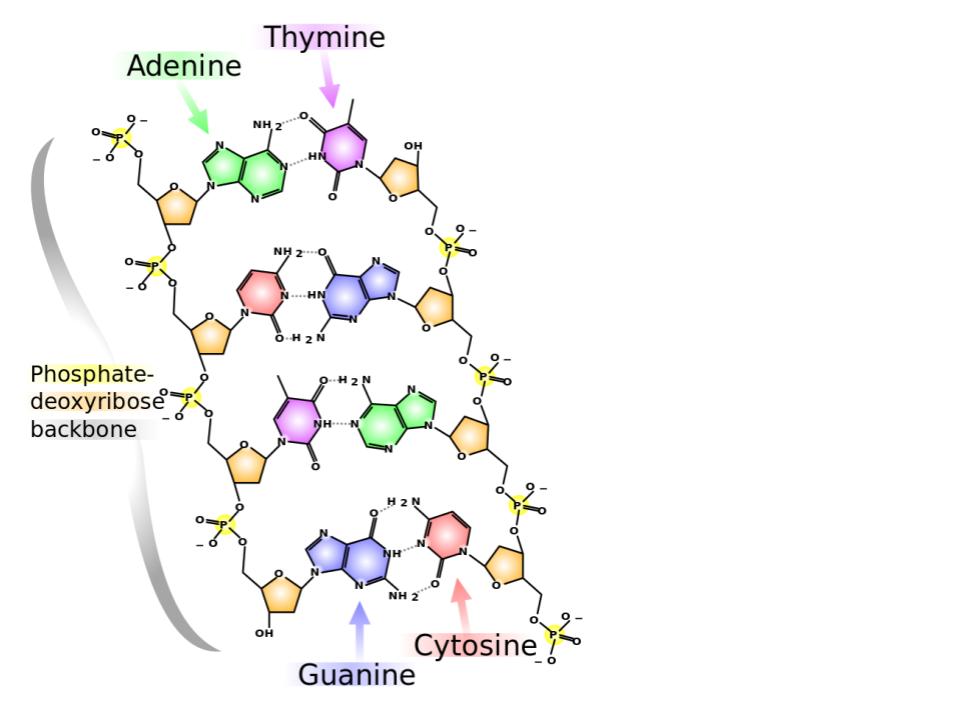
Look at the image of DNA, what do the circles represent?
Sugars
Phosphates
Bases
Covalent Bonds

Look at the image of DNA, what do the pentagons represent?
Sugar
Phosphate
Nitrogen Containing Base
Covalent bond

Look at the image of DNA, what type of bond connects the phosphate and the sugar in the backbone?
Covalent Bond
Hydrogen Bond

Look at the image of DNA, there are molecules with the letters A & G in them, what are these molecules?
Sugars
Phosphates
Nitrogen containing bases
Covalent Bonds

Look at the image of DNA, notice there are lines between the nitrogen containing bases, what do those lines represent?
Covalent Bonds
Hydrogen Bonds
What is the process called in which a cell duplicates its DNA?
Transcription
Mitosis
Translation
Replication
What rule does DNA replication follow to produce two new complementary strands?
Rule of independent assortment
Rule of segregation
Rule of base pairing
Rule of dominance
What is the result of DNA replication?
Two completely new DNA molecules
One DNA molecule and one RNA molecule
Two DNA molecules identical to each other and to the original molecule
Two DNA molecules different from each other
Which enzyme is responsible for 'unzipping' the DNA molecule during replication?
Primase
Helicase
RNA polymerase
DNA ligase
What is the principal enzyme involved in DNA replication?
DNA polymerase
Helicase
Topoisomerase
Single-strand binding protein
What is the role of telomerase in DNA replication?
Unzipping the DNA helix
Proofreading the new DNA strand
Joining Okazaki fragments
Adding short, repeated DNA sequences to telomeres
How does DNA replication differ in prokaryotic and eukaryotic cells?
Prokaryotic cells replicate DNA in the nucleus, while eukaryotic cells replicate DNA in the cytoplasm
There is no difference in DNA replication between prokaryotic and eukaryotic cells
Prokaryotic cells replicate DNA from a single point, while eukaryotic cells replicate DNA from multiple points
Prokaryotic cells replicate DNA from multiple points, while eukaryotic cells replicate DNA from a single point
What triggers the beginning of DNA replication in most prokaryotic cells?
Regulatory proteins binding to a single starting point on the chromosome
The unwinding of the DNA helix by helicase
The cell entering prophase of mitosis
The presence of telomerase enzyme
During DNA replication, if the base on the old strand is adenine, what is added to the newly forming strand?
Cytosine
Guanine
Thymine
Adenine
What happens to the chromosomes produced by replication in eukaryotic cells before cell division?
They are degraded and synthesized anew
They immediately separate and move to opposite poles of the cell
They remain closely associated until the cell enters prophase of mitosis
They fuse together to form a single chromosome
This enzyme is capable of breaking Hydrogen bonds found between the bases of DNA
Topoisomerase
DNA Helicase
DNA Polymerase
Exonuclease
Each DNA molecule created contain one NEW strand and one OLD strand
True
False
Okazaki fragments are found on the _______________ strand
Leading
Lagging
CAT TCA CTG
Place the following in sequential order
1. Two new strands, each with old and new
2. Helicase "unzips" DNA by breaking H bonds
3. Primase shows Polymerase where to add nucleotides
4. Ligase joins new fragments together
Which of the strands will have okazaki fragments?
Helicase
The unzipper
Primase
Tells where to start
DNA Polymerase
Builds the new strand
Ligase
Glues fragments together
Match the following DNA strands to their complementary strands:
5' - TTTA - 3'
5' - AAAT - 3'
5' - CTAG - 3'
5' - GATC - 3'
5' - AGCC - 3'
5' - TCGG - 3'
5' - AGGA - 3'
5' - TCCT - 3'
5' - TCGA - 3'
5' - AGCT - 3'
In DNA Replication, the enzyme (a) unzips the DNA and the enzyme DNA (b) base-pairs (c) nucleotides. (d) glues two new ladders together.
Label the parts!
Helicase
Primase
RNA primer
Replication fork

The separation of the two single strands of DNA creates a ‘Y’ shape?
enzyme
unzip
A replication fork
Which enzyme proofreads and removes RNA Primase
Ligase
Polymerase 1
Polymerase 3
Helicase



What step in the protein synthesis process is this showing?
(a)
Match the following terms...

mRNA

tRNA

rRNA
Proteins are important for all of the following except...
building structures like mucsles
helping the immune system
speeding up reactions
coding for your traits

In Protein Synthesis,
(a) happens first.
(b) happens last.
mRNA
carrying instructions from DNA
tRNA
carries an amino acid
rRNA
the ribsome where proteins are made
The mRNA reads CCA: what amino acid will the tRNA be carrying?

The mRNA reads UAG, what will the tRNA carry?
(a)

What is the amino acid sequence for the following mRNA strand:
UGG-ACU-CGA
Write your answer like this: ___-___-___
(a)
What is the amino acid sequence for the following mRNA strand:
AUU-AAG-UGC
Write your answer like this: ___-___-___
(a)
What is the amino acid sequence for the following mRNA strand:
CCA-GAG-UAG
Write your answer like this: ___-___-___
(a)

What is the amino acid sequence for the following mRNA strand:
UCG-GAA-CAU
Write your answer like this: ___-___-___
(a)

What is the amino acid sequence for the following mRNA strand:
AGG-UUC-CUG
Write your answer like this: ___-___-___
(a)

What is the amino acid sequence for the following mRNA strand:
AUG-GAC-UAG
(a)

Label this image:
1= (a)
2= (b)
4= (c)
7= (d)
Each codon found on a strand of mRNA codes for a single amino acid. The amino acid is identified on which characteristic of the codon?
the number of nucleotides
the sequence of nitrogen bases
the amount of thymine present
the type of sugar found in each nucleotide

The assembling of new molecules, especially polymers.
Homeostasis
Meisosis
Mitosis
Synthesis

Assembling proteins via instructions from DNA.
Replication
Mutations
Protein synthesis
Homeostasis

A single strand of nucleotides made by DNA that is used to communicate genetic code outside the nucleus.
RNA
DNA
Ribosomes
Amino acid chain

DNA makes RNA → RNA makes proteins →
Proteins make life.
Homeostasis
Mendelian Genetics
Central Dogma
Myocardial Infarction

Double stranded DNA is unzipped, and one strand is used as a template to form Messenger RNA.
Translation
Transcription
Replication
Mitosis

Messenger RNA travels out of the nucleus to ribosomes
and is used as a template to assemble a protein.
Translation
Transcription
Replication
Homeostasis

A single strand of nucleotides coded by DNA
which travels to the ribosomes in the cytoplasm to give instructionsfor building proteins.
tRNA
DNA
mRNA
rRNA

A small section of RNA that transports amino acids
to the ribosome for synthesis into proteins.
tRNA
mRNA
rRNA
DNA

A nucleotide base that takes the place of Thymine in RNA.
Uracil
Thymine
Adenine
uRNA

The enzyme that codes mRNA from DNA instructions.
DNA Polymerase
RNA Polymerase
Helicase
Lipase

A ←→ U
C ←→ G
T → A
Homeostasis
Mitosis
Base Pairing Rules for Replication
Base Pairing Rules for Transcription

The order of the nucleotide bases in DNA or RNA.
Numerical sequence
Amino acid sequence
Base Sequence
Anti codon

Units of 3 nucleotide bases in mRNA which code for a single
amino acid.
Mitosis
Base Pairing
Anti codon
Codon

The reverse codon found on the tRNA.
Codon
Anticodon
Mitosis
Meiosis

A chart that shows the relationship between
codons and the amino acids they code for.
Homeostasis chart
Anticodon
Codon Chart
EKG Chart

Three nucleotide bases that code for the beginning
of a strand of protein.
Uracil
Stop Codon
Anticodon
Start Codon

Three nucleotide bases that code for the end
of a strand of protein.
Anticodon
Start Codon
Stop Codon
tRNA

Most of a ribosome is made of rRNA.
Anticodon
mRNA
tRNA
Ribosomal RNA (rRNA)
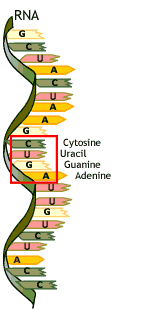
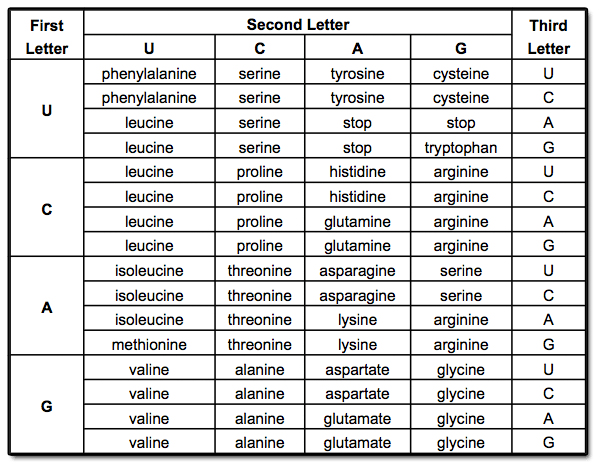
TGGCAAGTACGT
ATG GGA ACT CCA
enzyme that adds new RNA nucleotides to make mRNA
Helicase
RNA Polymerase
DNA Polymerase
Helicase Polymerase


What is the correct order to make a protein?
Protein, DNA, RNA
RNA, DNA, Protein
DNA, RNA, Protein
Protein, RNA, DNA
RNA has what base that is instead of thymine?
guanine
adenine
thymine
uracil

Which organelle is the location where protein is made?
Ribosome
Nucleus
Cytoplasm
Nucleotide

When these bond together, they form a protein
Amino Acids
Peptide Bonds
Ribose
Nucleotides
Which of the following is the complementary mRNA sequence to this DNA strand: AACTGAA
UUGACUU
TTGACTT
AACTGAA
AACUGAA

What brings the amino acids to the ribosome to assemble a protein?
DNA
How many nucleotides code for 1 amino acid?
1
2
3
4
What mutation has occurred here?
T-G-A-C-C-A
T-G-A-G-C-A
Substitution
Deletion
Insertion
Frameshift
Which of the following would result in a frameshift mutation?
Insertions only
Substitution only
Deletion only
Insertions and Deletions
DNA molecule segment is : TTACGCAAG
The mutated DNA segment is TTCGCAAG. This is an example of ___ mutation.
Substitution
Deletion
Insertion
Inversion

A substitution mutation that has no effect
on amino acids sequence
Insertion Mutation
Translocation
Silent Mutation
Deletion Mutation
What base is found only in RNA?
Guanine
Cytosine
Thymine
Uracil
Where in the cell does translation occur?
In the nucleus
In the ribosome
In the cytoplasm
In the DNA
Transcribe the following DNA strand into mRNA: ATCGAC
UACGUG
TAGCTG
UAGCUG
UAGCTG
What is the role of the RNA polymerase in protein synthesis?
RNA polymerase will unzip the DNA strand and transcribe an mRNA strand.
RNA polymerase will transcribe the mRNA strand.
RNA polymerase will unzip the DNA strand.
RNA polymerase will unzip the RNA strand and transcribe an mRNA strand.
Where does protein synthesis first begin?
In the endoplasmic reticulum.
In the ribosomes.
In the cytoplasm.
In the nucleus.
What is an anti-codon, what RNA type has anti-codons?
An anti-codon is the complementary bases to a codon of tRNA. This occurs in mRNA.
An anti-codon is a set of 3 nucleotide bases complementary to a codon of DNA. This occurs in tRNA.
An anti-codon is the complementary bases to a codon of mRNA. This occurs in tRNA.
An anti-codon is a codon of mRNA.
Translate the following mRNA strand into tRNA: UAGCUG
TUCGTC
AUCGAC
ATCGAC
AUCGTC
What type of RNA do we use to read a codon chart?
rRNA
tRNA
RNA polymerase
mRNA
What are the amino acids for the following codons: AUG CCU UAA?
Methionine Proline Stop
Methionine Proline Tyrosine
Methionine Histidine Stop
Stop Proline Methionine
What would we call a chain/group of attached amino acids?
tRNA
A gene
A protein
codons

What type of mutation is shown above:
Inversion
Insertion
Substitution
Deletion
The body expresses the gene that makes lactase when there is lactose in the body. After drinking milk, would the gene for lactase be turned on or off?
On
Off

What type of mutation is shown above?
Inversion
Insertion
Deletion
Substitution
Would the cells in the liver express the same genes as cells in the heart?
Not all the time
No
Yes

What type of mutation is shown above?
Substitution
Insertion
Deletion
Frame-shift mutation
What is produced as a result of gene expression?
genes
DNA
mRNA
Proteins

What type of chromosomal mutation is this?
Inversion
Duplication
Translocation
Deletion

Is this an example of a gene or chromosomal mutation?
Gene mutation
Chromosomal mutation
Not a mutation
What is the correct order for protein synthesis?
DNA -> RNA -> codons
proteins -> RNA -> DNA
DNA -> RNA -> proteins
RNA -> DNA -> proteins
How many chromosomes would a human have with monosomy?
1
46
45
47
Label the diagram using the words provided by putting them in the correct box:
DNA
Transcription
mRNA
Translation
Protein
Label the steps in protein synthesis.
Label the diagram
Label the Following Diagram
Amino acid
Protein
Codon
Anticodon
DNA
mRNA
Ribosome
tRNA
Tap on the amino acid chain (protein)
Match the letter from the diagram with the correct part of the protein synthesis process.
codon
cytoplasm
nucleus
transcription
translation
Anticodon
mRNA
Amino Acid
Polypeptide
DNA
Match the following
mRNA
carries the message to the ribosome
rRNA
part of the ribosome structure
tRNA
carries the amino acid to the ribosome
DNA
primary genetic material
In protein synthesis, the gene from the DNA is (a) into RNA. mRNA leaves the nucleus and then the RNA is (b) by a ribosome to make a polypeptide.
The "central dogma" of molecular biology says that DNA is (a) into mRNA, which is then (b) into a protein.


If the mRNA codon is AUG, what amino acid would the tRNA bring?
Met
GLu
Ala
Phe
Which enzyme is responsible for joining Okazaki fragments during DNA replication?
Primase
DNA Polymerase
DNA Ligase
DNA Helicase
What is the complementary base pair for guanine in DNA?
Uracil
Cytosine
Thymine
Adenine
During DNA replication, which strand is synthesized continuously?
Sense strand
Leading strand
Lagging strand
Template strand

What describes a change in the DNA sequence?
Transcription
Translation
DNA replication
Mutation
Apoptosis
What describes programmed cell death?
Transcription
Translation
DNA replication
Mutation
Apoptosis

What type of mutation involves substituting a DNA base with a different base?
point mutation
frameshift mutation
silent mutation
chromosomal mutation

What type of mutation involves substituting a DNA base with a different base but still forms the same protein?
point mutation
frameshift mutation
silent mutation
chromosomal mutation
What type of mutation involves adding or deleting bases from the DNA, which results in new codons (a shift in the reading of the codons)?
point mutation
frameshift mutation
silent mutation
chromosomal mutation
Original DNA = TAC GAC TTG AAT
Mutated DNA = TAC GAC TCG AAT
What type of mutation has occurred?
Chromosomal mutation
Point mutation
Frameshift mutation
No mutation occurred
Original DNA = TAC GAC TTG AAT
Mutated DNA = TAC GTA CTT GAA T
What type of mutation has occurred?
Chromosomal mutation
Point mutation
Frameshift mutation due to adding extra base
Frameshift mutation due to deletion of base
Original DNA = TAC GAC TTG AAT
Mutated DNA = TAC GAC TTG AAT
What type of mutation has occurred?
Chromosomal mutation
Point mutation
Frameshift mutation
No mutation occurred

What type of chromosomal mutation occurred?
chromosomal insertion/duplication
chromosomal deletion
chromosomal inversion
chromosomal translocation

What type of chromosomal mutation occurred?
chromosomal insertion/duplication
chromosomal deletion
chromosomal inversion
chromosomal translocation

What type of chromosomal mutation occurred?
chromosomal insertion/duplication
chromosomal deletion
chromosomal inversion
chromosomal translocation

What type of chromosomal mutation occurred?
chromosomal insertion/duplication
chromosomal deletion
chromosomal inversion
chromosomal translocation
Original DNA = TAC GAC TTG AAT
Mutated DNA = TAC ACT TGA AT
What type of mutation has occurred?
Chromosomal mutation
Point mutation
Frameshift mutation due to addition of base
Frameshift mutation due to deletion of base

What are considered "negative" mutations?
mutations in the DNA sequence that changes the resulting protein and harms the organism
mutations in the DNA sequence that changes the resulting protein and benefits the organism
mutations in the DNA sequence that produces the same protein
all mutations are considered bad and harm the organisms
What are considered "positive" mutations?
mutations in the DNA sequence that changes the resulting protein and harms the organism
mutations in the DNA sequence that changes the resulting protein and benefits the organism
mutations in the DNA sequence that produces the same protein
all mutations are considered bad and harm the organisms

What are considered neutral mutations?
mutations in the DNA sequence that changes the resulting protein and harms the organism
mutations in the DNA sequence that changes the resulting protein and benefits the organism
mutations in the DNA sequence that produces the same protein
all mutations are considered bad and harm the organisms
Mutation
a change in the DNA sequence
Point mutation
a type of mutation where one to few bases are substituted with different bases
Frameshift mutation
a type of mutation caused by adding or deleting bases, affecting all the codons after the change
Silent mutation
a type of mutation that doesn't result in a change in the amino acid sequence (same protein)
Chromosomal mutation
a type of mutation where large sections of the chromosome are affected
What mutation has occurred here?
T-G-A-C-C-A
T-G-A-G-C-A
Substitution
Deletion
Insertion
Frameshift
Which of the following would result in a frameshift mutation?
Insertions only
Substitution only
Deletion only
Insertions and Deletions
DNA molecule segment is : TTACGCAAG
The mutated DNA segment is TTCGCAAG. This is an example of ___ mutation.
Substitution
Deletion
Insertion
Inversion
A mutation is defined as:
A change in the cell's structure
Anything that changes in an embryo
Any change in the physical features of a human
A change in the DNA sequence
ATTTGAGCC- Original
ATTGAGCC - Mutated
The example above is an example of a
Insertion- Frameshift
Deletion- Substitution
Deletion -Frameshift
All of the above
What mutation has occurred here?
T-G-A-C-C-A
T-G-A-G-C-A
Substitution
Deletion
Insertion
Frameshift
Why are insertion and deletion (frameshift) mutations so harmful?
They change all of the codons from the mutation on down the line, which changes the amino acid sequence
They insert things that an organism doesn't need.
They often delete things that organisms need.
Insertion and deletions are not any more harmful than substitution mutations.
Identify the DELETION mutation form the following:
ATG CCA AAT
ATG TCA AAT
ATG CCT AAA T
ATC CA AT
ATG CCA AAT

Which mutation will cause translation to stop?
Mutations 1 and 3 only
Mutation 1 only
Mutation 2 only
Muations 1, 2, 3

Which type of mutation does the model demonstrate?
Deletion
Substitution
Insertion
Translocation
What mutation has occurred here?
T-G-A-C-C-A
T-G-A-G-C-A
Substitution
Deletion
Insertion
Frameshift
Which of the following would result in a frameshift mutation?
Insertions only
Substitution only
Deletion only
Insertions and Deletions
DNA molecule segment is : TTACGCAAG
The mutated DNA segment is TTCGCAAG. This is an example of ___ mutation.
Substitution
Deletion
Insertion
Inversion
A mutation is defined as:
A change in the cell's structure
Anything that changes in an embryo
Any change in the physical features of a human
A change in the DNA sequence
ATTTGAGCC- Original
ATTGAGCC - Mutated
The example above is an example of a
Insertion- Frameshift
Deletion- Substitution
Deletion -Frameshift
All of the above
What mutation has occurred here?
T-G-A-C-C-A
T-G-A-G-C-A
Substitution
Deletion
Insertion
Frameshift
Identify the DELETION mutation form the following:
ATG CCA AAT
ATG TCA AAT
ATG CCT AAA T
ATC CA AT
ATG CCA AAT

A substitution mutation occurs when
a base pair is missing from the DNA strand
a base pair is added to the DNA strand
a base pair is replaced with a different base pair
An insertion/additon mutation occurs when
a base pair is missing from the DNA strand
a base pair is added to the DNA strand
a base pair is replaced with a different base pair
A deletion mutation occurs when
a base pair is missing from the DNA strand
a base pair is added to the DNA strand
a base pair is replaced with a different base pair
T-G-A-C-C-A
T-G-A-C-C-A-A
The mutated DNA segment is TTACGCAAC. This is an example of ___ mutation.

Use the DNA code provided and fill in the complementary DNA strand. (Answer in ALL CAPS and NO spaces between letters)
(a)
Which mutation will cause translation to stop?
Mutations 1 and 3 only
Mutation 1 only
Mutation 2 only
Muations 1, 2, 3

