
 Worksheets
Piano Chord Diagrams Quiz
Total questions: 44
Worksheet time: 22mins
What is the main purpose of piano chord diagrams?
To show what notes go along with a certain chord and sometimes have a picture and the fingering.
To teach how to play the piano by ear.
To display the history of piano music.
To list famous piano players.
Why are picture-based piano chord diagrams considered helpful?
They show the actual image of the piano and make it easy to find the notes.
They provide audio examples of chords.
They explain music theory in detail.
They list all possible chord progressions.
Which of the following best describes a piano chord diagram that uses pictures?
It shows an actual picture of the keyboard and represents which notes go along with that chord.
It only lists the names of chords.
It provides written instructions for playing chords.
It displays sheet music for piano pieces.
How can piano chord diagrams be represented?
In many different ways, but the main concept stays the same.
Only as written instructions.
Only as audio recordings.
Only as sheet music.
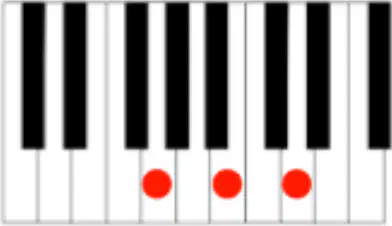
Which of the following notes make up the C major chord on the piano?
C, E, G
C, D, F
C, F, G
C, D, E
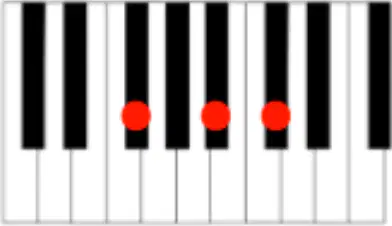
If you want to play a D major chord, which combination of notes should you use?
D, F#, A
D, G, B
D, E, A
D, F, A
Compare the notes in the F major chord and the G major chord. What is the difference in their root notes and how does this affect the sound of the chord?
The F major chord starts on F, while the G major chord starts on G, resulting in a higher pitch for the G major chord.
The F major chord starts on G, while the G major chord starts on F, resulting in a lower pitch for the G major chord.
Both chords start on the same note, so there is no difference in sound.
The F major chord uses only black keys, while the G major chord uses only white keys.
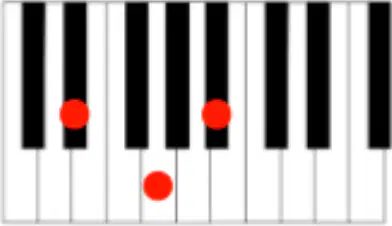
Which major chord contains the notes F#, A#, and C#?
F#/Gb major chord
G major chord
D major chord
E major chord
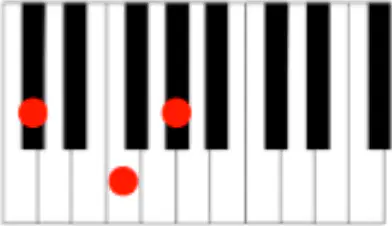
If you are given the notes E, G#, and B, which major chord are you playing?
E major chord
D major chord
F major chord
C major chord
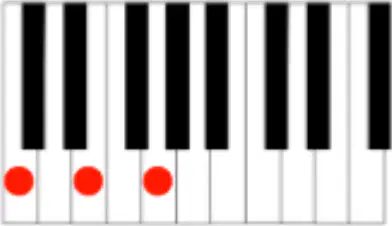
Strategically, if you want to modulate from C major to G major in a song, which common note can you use to smoothly transition between these chords?
G
C
E
D
Which of the following is a minor chord?
Cm
C
G
F
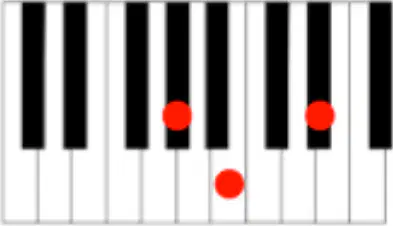
What notes are played in the Dm minor chord on the piano?
D, F, A
D, F#, A
D, G, B
D, E, G
If you want to play an F#m/Gbm minor chord, which set of notes would you use?
F#, A, C#
F#, A#, C#
F#, G#, C#
F#, A, D
Compare the notes in the Em and Gm minor chords. What is the main difference between these two chords?
Em uses E, G, B while Gm uses G, Bb, D
Em uses E, F#, B while Gm uses G, B, D
Em uses E, G#, B while Gm uses G, Bb, E
Em uses E, G, D while Gm uses G, B, E
Which minor chord contains the notes A, C, and E?
Am
Abm
Bm
Cm
If you are asked to play the A#m/Bbm minor chord, which notes should you press?
A#, C#, F#
A#, C#, F
A#, D#, F
A#, C, F
Strategically, if you want to transition smoothly from Em to Fm minor chord, which note changes in the chord structure?
The root note changes from E to F
The third changes from G to Ab
The fifth changes from B to C
The third changes from G to F
Which of the following pairs are enharmonic equivalents in minor chords?
C#m and Dbm
Dm and D#m
Fm and F#m
Am and Abm
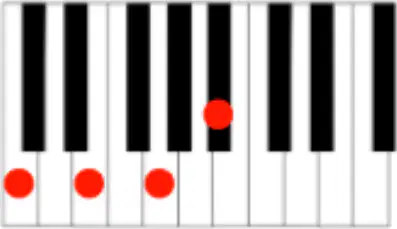
Which of the following is a seventh chord that includes the notes C, E, G, and Bb?
C7
D7
F7
G7
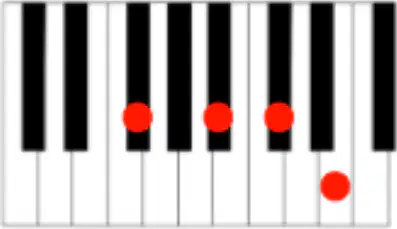
If you want to play a G7 chord on the piano, which notes should you include?
G, B, D, F
G, B, D, E
G, C, E, F
G, A, D, F#
Which chord is enharmonically equivalent to Db7?
C#7
D#7
F#7
G#7
Analyze the pattern of seventh chords shown. What is the interval between the root notes of each consecutive chord in the sequence: C7, C#7/Db7, D7, D#7/Eb7, E7, F7, F#7/Gb7, G7, G#7/Ab7, A7, A#7/Bb7, B7?
Half step
Whole step
Minor third
Perfect fourth
Which of the following chords contains the notes F#, A#, C#, and E?
F#7/Gb7
G7
E7
A7
If you are asked to play an A#7 chord, which other chord name could you use for the same notes?
Bb7
B7
Ab7
C7
Which of the following is the correct definition of an augmented chord?
A chord made by raising the fifth note of a major chord by a half step.
A chord made by lowering the third note of a major chord by a half step.
A chord made by raising the root note of a major chord by a whole step.
A chord made by lowering the fifth note of a major chord by a whole step.
If you play the notes C, E, and G# together on the piano, which augmented chord are you playing?
C+
D+
F+
A+
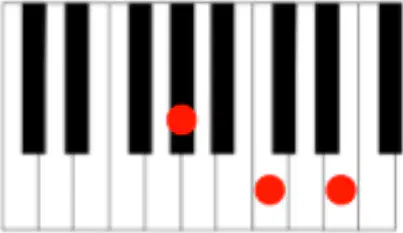
Which of the following sets of notes forms the F# augmented chord (F#+)?
F#, A#, D
F#, A, C#
F#, A#, C##
F#, A, D#
How does the structure of an augmented chord differ from a major chord?
The fifth note is raised by a half step in an augmented chord.
The third note is lowered by a half step in an augmented chord.
The root note is raised by a whole step in an augmented chord.
The fifth note is lowered by a whole step in an augmented chord.
Which of the following is NOT an augmented chord shown in the image?
C+
G+
D minor
A#+
If you want to play a G# augmented chord, which notes should you play?
G#, B#, D##
G#, B, D#
G#, C, E
G#, B, F
Which of the following chords is NOT shown in the diagram of diminished chords?
C°
F°
G°
Dm°
What is the purpose of using the number system to display chords, according to the text?
To help beginners learn piano notes
To assist advanced piano players who already know piano scales
To teach guitar players chord progressions
To simplify music for children
If a piano player knows the number system, how might this benefit their understanding of chords?
It allows them to play chords without knowing scales
It helps them identify chord progressions more easily
It makes reading sheet music unnecessary
It teaches them how to tune a piano
(DoK Level 1) What are the notes in the C Major scale?
C, D, E, F, G, A, B
C, D, E, F, G, A, Bb
C, D, E, F, G, Ab, B
C, D, Eb, F, G, A, B
(DoK Level 2) If E is the third note in the C Major scale, what number would be assigned to G?
4
5
6
7
(DoK Level 2) In the chord formula for a Minor chord, which notes are used from the scale numbering?
1, 3, 5
1, b3, 5
1, 4, 5
1, b3, b5
(DoK Level 3) If you want to construct a C7 chord using the scale numbering method, which notes from the C Major scale would you select?
C, E, G, B
C, Eb, G, Bb
C, E, G, Bb
C, E, G, A
(DoK Level 3) Explain how the numbering system helps in identifying the notes for an Augmented chord in any major key.
It assigns numbers to notes, allowing you to select the 1st, 3rd, and raised 5th notes for the chord.
It tells you which notes to avoid in a chord.
It helps you play only the root note of the chord.
It is used only for minor chords.
What does the "b" symbol represent in a piano chord diagram?
A flat note or a lowered half step
A sharp note or a raised half step
The root note of a chord
The octave of a note
In the key of C major, which notes would you play to form a major chord?
G, E, and C
C, D, and E
F, A, and C
G, B, and D
If you assign numbers to the notes in the key of G, what number is assigned to the note D?
5
3
2
7
To find the notes in a minor chord for the key of G, which notes do you need?
1st note, b flat 3rd, and 5th
1st note, 3rd, and 5th
2nd note, 4th, and 6th
1st note, sharp 3rd, and 5th
Which notes make up a G minor chord?
G, Bb, and D
G, B, and D
G, C, and E
G, A, and F#
Why is it helpful to use piano chord diagrams when learning chords?
They help you quickly remember the notes of any chord on the piano
They make the piano sound louder
They teach you how to read sheet music
They show you how to play scales faster

