
 Worksheets
science 3pt2
Total questions: 26
Worksheet time: 13mins

Wyatt uses a globe and a flashlight to make the model below. Wyatt slowly spins the globe. He notes that at this time of year, Morocco would have longer days and shorter nights. What should Wyatt do to model the time of year when Morocco has shorter days and longer nights?
Wyatt should spin the globe faster.
Wyatt should move the flashlight closer to the globe.
Wyatt should change the direction that the globe is spinning.
Wyatt should move the flashlight to the other side of the globe.

A student creates a model to demonstrate day and night on Earth. The diagram shows the model. Using the model, what would most likely happen if Earth were not tilted on its axis?
Earth would take much longer to revolve around the Sun.
The lengths of day and night on Earth would always be equal.
The Sun would shine more directly on the Northern Hemisphere.
One side of Earth would always be dark and the other always light.
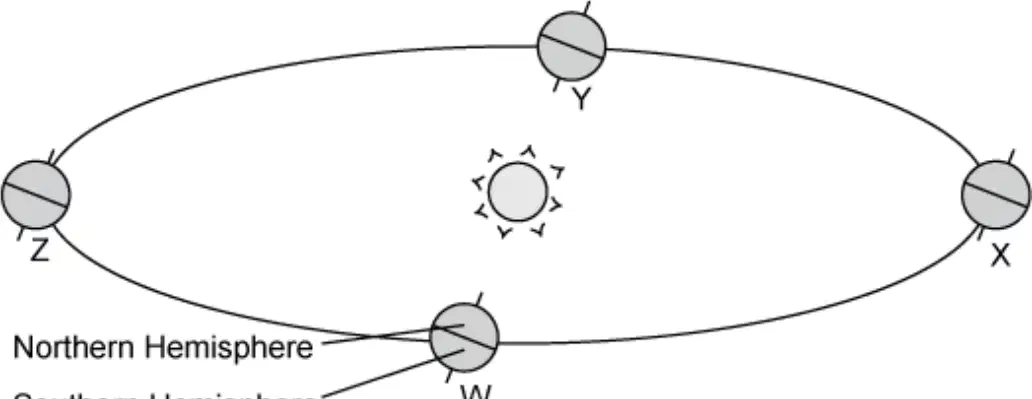
The picture shows a model of Earth orbiting the Sun. Which letter shows the location where the Northern Hemisphere has the longest days and shortest nights?
W because Earth is at its closest distance from the Sun during its elliptical orbit
X because the Southern Hemisphere has direct sunlight for a longer time period
Y because Earth is at its farthest distance from the Sun during its elliptical orbit
Z because the Northern Hemisphere has direct sunlight for a longer time period
Aaliyah would like to demonstrate why the length of day and night change throughout the year. She has a globe and a flashlight. Which two factors are most important for Aaliyah to use in her model?
The tilt of Earth on its axis and Earth's orbit around the Sun.
The direction of Earth's rotation and the speed of Earth's rotation.
The speed of Earth's rotation and the distance of Earth from the Sun.
The distance of Earth from the Sun and Earth's orbit around the Sun.
How long does it take Earth to make one full rotation on its axis?
24 hours
1 week
1 month
365 days
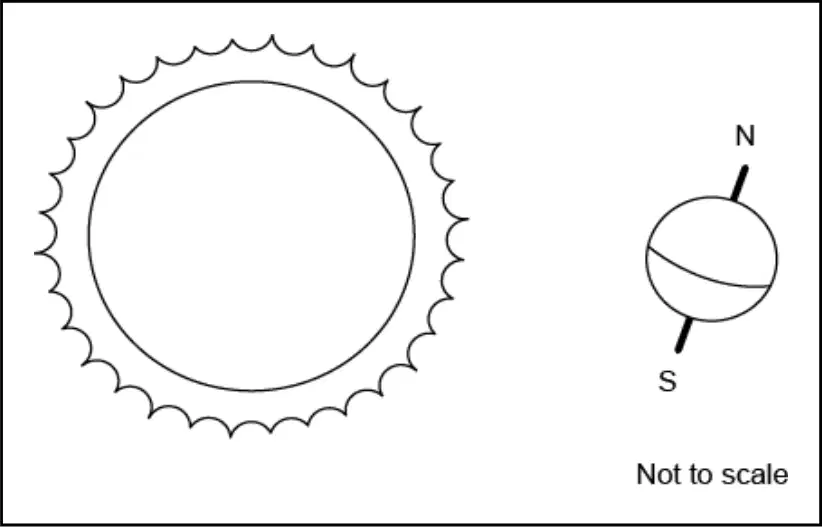
Why don't all parts of Earth have day and night at the same time?
The Sun revolves around Earth, and it can only shine on half of Earth at one time.
Earth rotates on its axis, and only the part of Earth facing the Sun experiences day.
The Moon revolves around Earth, and it blocks the Sun from certain parts of Earth at different times.
Earth revolves around the Sun on an axis, and it is day only when that part of Earth is tilted toward the Sun.
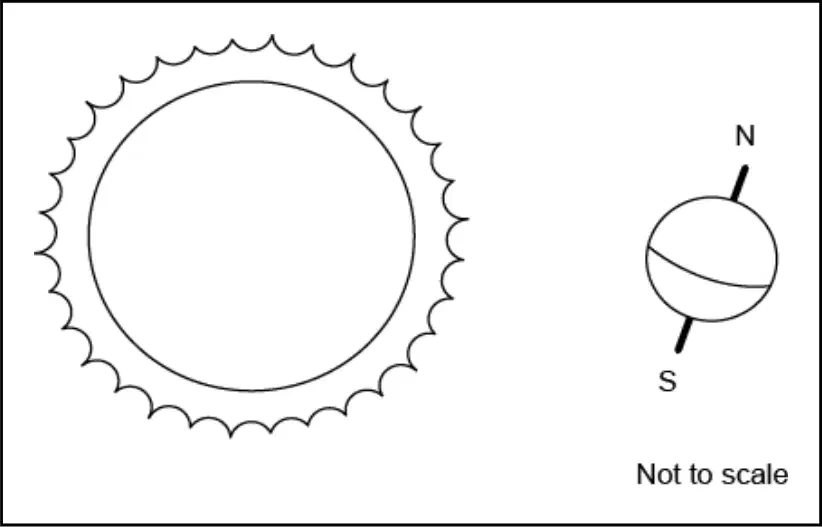
Which is caused by Earth's orbit around the Sun and the tilt of Earth's axis?
weather
gravity
eclipses
seasons
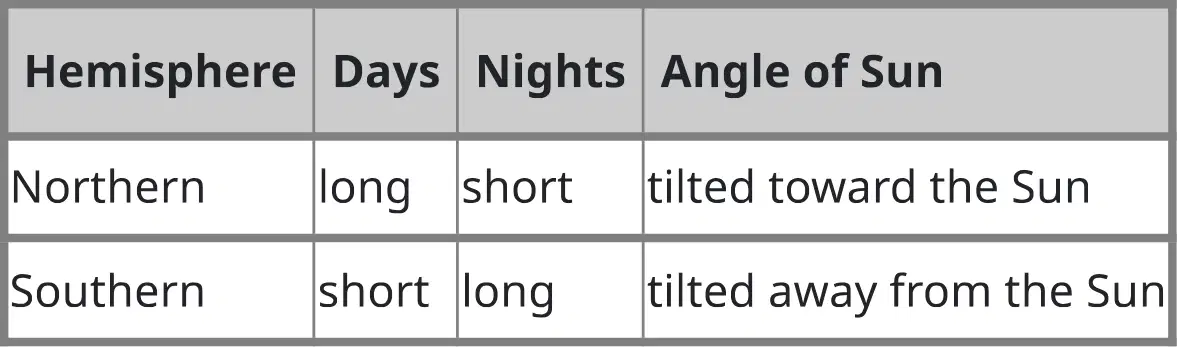
Which seasons are the hemispheres experiencing?
It is summer in the Northern Hemisphere and winter in the Southern Hemisphere.
It is winter in the Northern Hemisphere and spring in the Southern Hemisphere.
It is fall in the Northern Hemisphere and summer in the Southern Hemisphere.
It is winter in the Northern Hemisphere and fall in the Southern Hemisphere.
What is the most important cause of Earth's seasons?
the distance between Earth and the Sun
Earth's tilt
the distance between Earth and the Moon
the atmosphere

At which position is it winter in the Southern Hemisphere and summer in the Northern Hemisphere? Why?
position J because the Southern Hemisphere is tilted away from the Sun while the Northern Hemisphere is tilted toward it
position K because the Southern Hemisphere is tilted away from the direction of Earth's orbit while the Northern Hemisphere is tilted toward it
position L because the Southern Hemisphere is tilted toward the Sun while the Northern Hemisphere is tilted away from it
position M because the Southern Hemisphere is tilted toward the direction of Earth's orbit while the Northern Hemisphere is tilted away from it
When would the Northern Hemisphere receive more sunlight than the Southern Hemisphere?
autumn
summer
winter
summer solstice
autumnal equinox
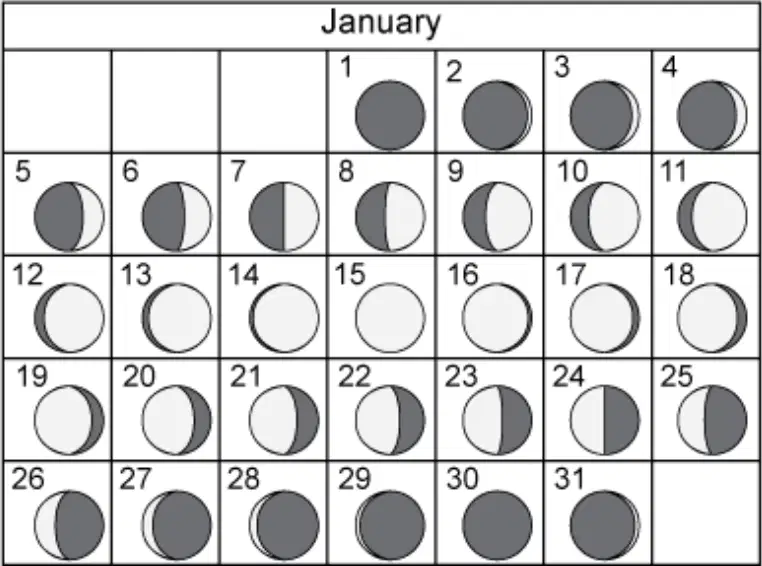
The calendar shows the phases of the Moon each day in January, 2014. Based on the calendar, about how often is there a full moon?
approximately every seven days
approximately every fourteen days
approximately every thirty days
approximately every ninety days
What happens to the Moon when it changes phases?
Pieces of the Moon fall off and become asteroids.
Pieces of the Moon light up at different times.
The Sun's light shines on a different part of the Moon.
Earth's light shines of different parts of the Moon.
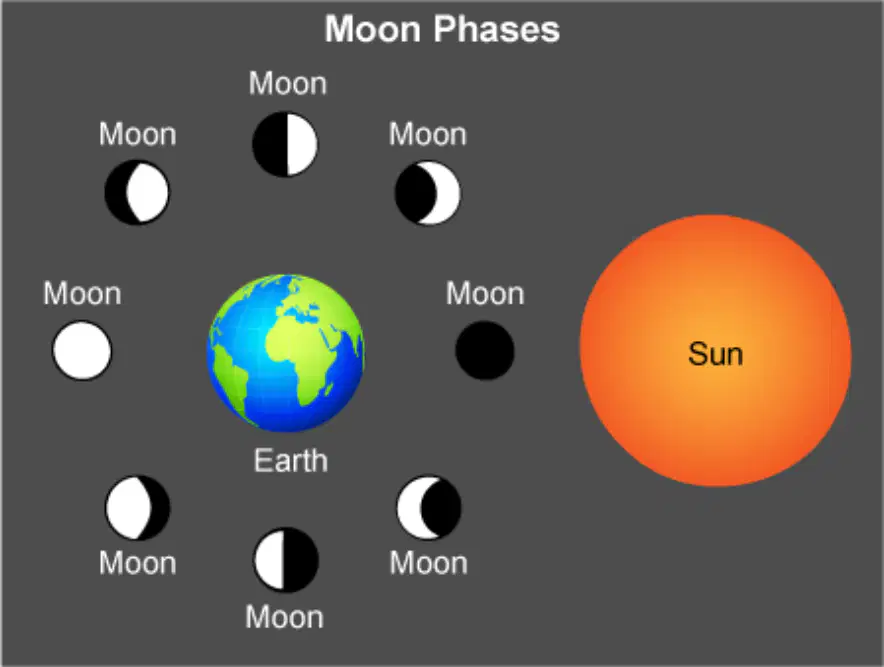
Kya created a model of the phases of the Moon. How could Kya's model be improved?
She could draw arrows to show the orbit of Earth around the Moon.
She could draw arrows to show the orbit of the Moon around Earth.
She could show how the Moon's phases change as the Moon orbits the Sun.
She could show how the Moon's phases change as the Sun orbits the Moon.
Approximately how often does the Moon orbit Earth?
once a day
once a week
once a month
once a year

The diagrams show four students' models of the Moon's position around Earth for each of the Moon's phases, viewed from above the North Pole. Which student's model is correct?
Marcus
Asia
Tamika
Damon
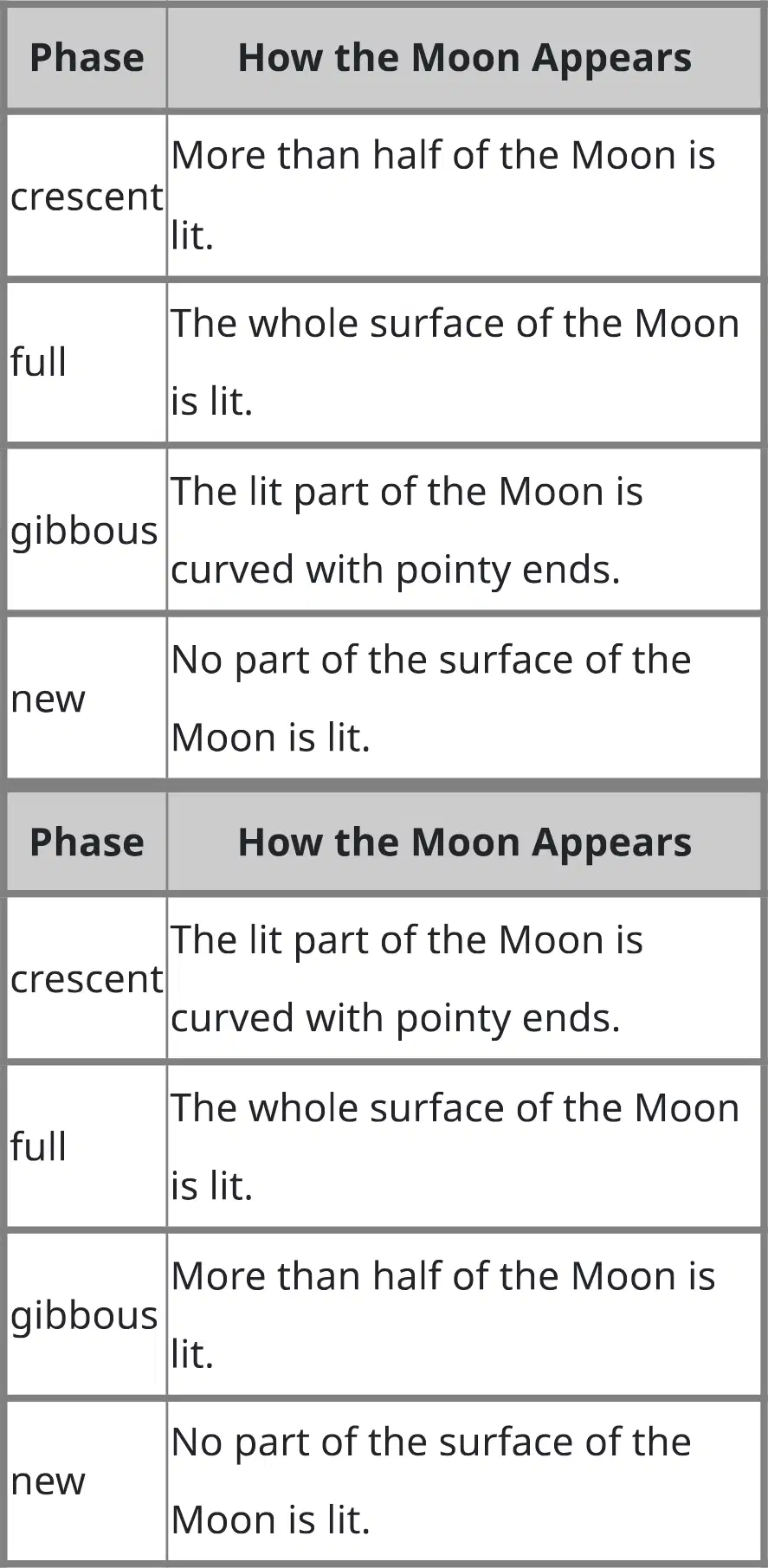
Ladonna is creating a model of the Moon's phases. She wants to make sure that she labels each phase correctly. Ladonna knows that during a first quarter moon, the Moon appears to be lit on the right side and dark on the left. She knows that during a third quarter moon, the right side appears to be dark and the left side is lit. Which table correctly describes the other phases?
Table A
Table B
Which phase of the Moon is described as: 'The lit part of the Moon is curved with pointy ends.'?
crescent
full moon
gibbous
new moon
Which phase of the Moon is described as: 'No part of the surface of the Moon is lit.'?
Full Moon
New Moon
First Quarter
Waning Gibbous
Which phase of the Moon is described as: 'More than half of the Moon is lit.'?
gibbous
crescent
new moon
quarter
Which phase of the Moon is described as: 'The whole surface of the Moon is lit.'?
new
full
crescent
gibbous
Which phase of the Moon is described as: 'More than half of the Moon is lit.'?
crescent (Note: This appears to be an error in the table; the correct answer should be 'gibbous', but as per the table, it is 'crescent'.)
new moon
first quarter
full moon
Which phase of the Moon is described as: 'No part of the surface of the Moon is lit.'?
Full Moon
New Moon
First Quarter
Waxing Gibbous
Which phase of the Moon is described as: 'The lit part of the Moon is curved with pointy ends.'?
gibbous (Note: This appears to be an error in the table; the correct answer should be 'crescent', but as per the table, it is 'gibbous'.)
full moon
new moon
quarter
Which phase of the Moon is described as: 'The whole surface of the Moon is lit.'?
new (Note: This appears to be an error in the table; the correct answer should be 'full', but as per the table, it is 'new'.)
crescent
gibbous
quarter
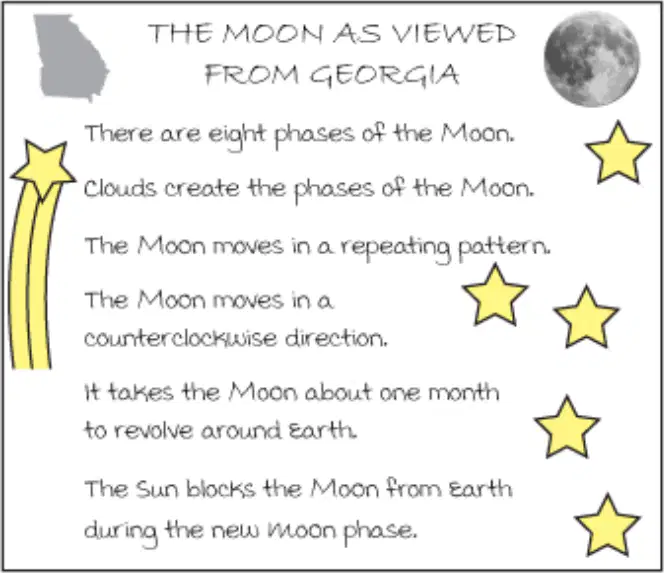
The picture shows the poster Ansleigh created on the phases of the Moon. Ansleigh made two mistakes on her poster. Pick two sentences that will correct her mistakes.
Clouds do not affect the phases of the Moon.
The Moon is between Earth and the Sun in the new moon phase.
There are only four phases of the Moon.
The Moon always moves in a random pattern.
In Georgia, the Moon moves in a clockwise direction.

