wayground logo

Free Printable Worksheets

Font size

S
M
L
XL
Worksheets

CP HUMAN GEOGRAPHY UNIT 3 TEST

Total questions: 45

Worksheet time: 23mins
Name
Class
Date
1.
Language mutually understood and commonly used in trade by people who have different native languages.
a)
Cultural convergence
b)
Lingua franca
c)
Buddhism
d)
Creolization
2.
Religion that attempts to appeal to all people, not just those who live in a particular location.
a)
Multiculturalism
b)
Universalizing religion
c)
Missionary
d)
Colonialism
3.
Spread of an idea from persons or nodes of authority or power to other persons or places
a)
Stimulus diffusion
b)
Sequent-occupance
c)
Hierarchical diffusion
d)
Centripetal force
4.
Different cultures in a society deserve value and respect for unique differences
a)
Dialect
b)
Language branch
c)
Multiculturalism
d)
Hierarchical diffusion
5.
Most commonly used language family, it is spoken by half the world's people; dominates in Europe; English belongs
a)
Assimilation
b)
Indo-European
c)
Afro-Asiatic
d)
Ethnic Neighborhood
6.
When people move, they bring their traditions, beliefs, and culture with them.
a)
Relocation diffusion
b)
Hierarchical diffusion
c)
Cultural Ecology
d)
Ethnic Neighborhood
7.
Form of expansion diffusion in which numerous places or people near the point of origin become adopters.
a)
Ethnocentrism
b)
Traditional Architecture
c)
Contagious Diffusion
d)
Creolization
8.
Buildings, furniture, clothing, and musical instruments are examples of what cultural concept?
a)
Material culture
b)
Local culture
c)
Foodways
d)
Indigenous cultures
9.
A person who is fluent in Spanish, French, Italian, and English could be classified with what geographic term?
a)
Indigenous
b)
Polyglot
c)
Monolinguist
d)
Religious zealot
10.
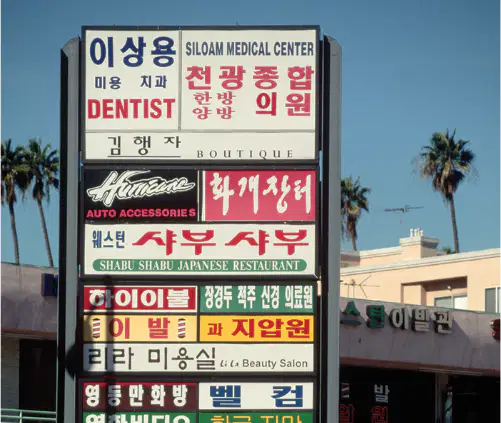
The following photo was taken from Koreatown in Los Angeles. This image demonstrates which geographic concept?
a)
Ethnic landscape
b)
Monolingual culture
c)
Sacred spaces
d)
Racial separation
11.
Which of the following is the best example of a centripetal force within a country related to culture?
a)
A constitutional governance
b)
An equitable economic system
c)
A multiethnic society
d)
A similar language
12.
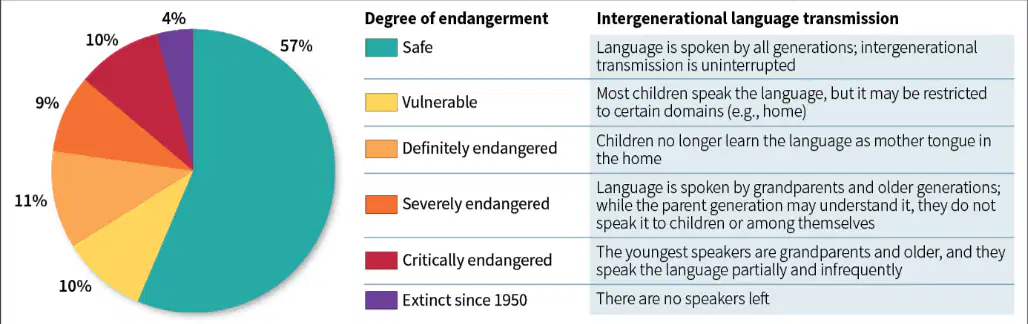
Based on the following graph, which statement is true regarding languages?
a)
Upwards of 40 percent of languages are in danger of becoming extinct.
b)
The world has lost 20 percent of its languages since 1950.
c)
The vulnerable languages in the world outnumber the safe languages.
d)
Safe languages are expanding more rapidly because of the death of elders.
13.
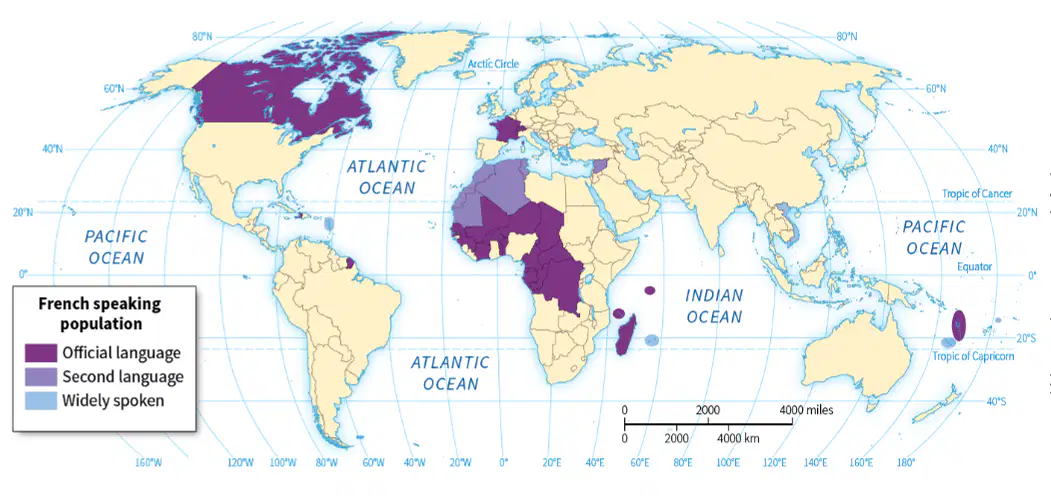
Use the following map to answer this question. The fact that French is spoken on almost every continent in the world BEST indicates which concept?
a)
Bilingualism
b)
Permeable barriers
c)
Creole language
d)
Lingua franca
14.
Which of this is not a part of the cultural landscape?
a)
The local architecture
b)
The weather
c)
How the environment is being used by locals
d)
How many schools there are
15.
Ethnocentrism means that someone is being open minded about other cultures
a)
True
b)
False
16.
Culture that spans across a large population, often across a heterogeneous group, is called
a)
Folk culture
b)
A culture club
c)
Popular culture
d)
The people's culture
17.
Areas with cultural differences can have factors that lead to political disintegration and make it difficult to unify the community. These factors are called
a)
disintegrating influences
b)
centrifugal forces
c)
shatterbelt regions
d)
zones of separation
18.
Migrants to the US often keep their food traditions and language at home but begin to learn English for interactions at work and school. This reflects the process of
a)
acculturation
b)
globalization
c)
acclimatization
d)
homogenization
19.
Many religions, when they expand into a new region, begin to incorporate some of the elements of the previous religious customs of the new adherents. This process is called
a)
globalization
b)
syncretism
c)
acculturation
d)
assimilation
20.
What does the term "cultural landscape" refer to in geography?
a)
The natural environment including forests, shorelines, and mountains
b)
The earth's surface as modified by human action
c)
Areas untouched by human influences
d)
The study of different cultures around the world
21.
What does the term "ethnicity" refer to?
a)
A legal bond between an individual and a country
b)
A group of people who share religious beliefs
c)
A group of people who share characteristics such as ancestry, language, customs, and history
d)
A type of government system
22.
What do geographers map to track the movement of religious and ethnic groups?
a)
Cultural hearth
b)
Geographic boundaries
c)
Population density
d)
Economic activities
23.
Which of the following is an example of an ethnic religion?
a)
Buddhism
b)
Christianity
c)
Judaism
d)
Islam
24.
What is an example of hierarchical diffusion?
a)
Fashion trends spreading from global cities to smaller settlements
b)
A small business expanding from a small town to a large urban city
c)
A viral video spreading to everyone quickly
d)
McDonald's adapting its menu for different countries
25.
What is an example of contagious diffusion?
a)
A viral video that everyone starts talking about
b)
A small business expanding to a large urban city
c)
Fashion trends spreading from global cities to smaller settlements
d)
McDonald's adapting its menu for different countries
26.
What is stimulus diffusion?
a)
The spread of a cultural element from one place to another
b)
The movement of people from one place to another
c)
The expansion of a cultural trait to more people
d)
The change in a cultural trait as it spreads
27.
Cell phones have contributed to
a)
possibilism
b)
networks
c)
time-space compression
d)
regionalism
e)
density
28.

What is the best definition of 'folk culture'?

a)

Culture that is only found in urban areas

b)

Culture that is spread rapidly through mass media

c)

Culture practiced by a small, homogeneous, rural group living in relative isolation

d)

Culture that is adopted by people from many different backgrounds

29.

Which of the following is a characteristic of a universalizing religion?

a)

It does not encourage conversion

b)

It is based on ethnic heritage

c)

It is practiced only in one country

d)

It seeks to appeal to people globally, not just those in a specific location

30.

Which of the following best describes the process by which a minority group gradually adopts the customs and attitudes of the prevailing culture, while denying their own?

a)

Assimilation

b)

Acculturation

c)

Cultural divergence

d)

Ethnocentrism

31.

A neighborhood in a city where people of the same ethnicity cluster together and maintain their cultural traditions is known as a(n)

a)

Cultural landscape

b)

Popular culture zone

c)

Ethnic enclave

d)

Shatterbelt region

32.

Which of the following best describes the concept of 'cultural diffusion'?

a)

The creation of new languages

b)

The process by which a culture becomes extinct

c)

The spread of cultural traits from one society to another

d)

The isolation of cultural groups

33.

What is a common result when multiple cultures interact in the same geographic area?

a)

Formation of a single language

b)

Complete assimilation of all groups

c)

Emergence of a multicultural society

d)

Elimination of local traditions

34.

What is a lingua franca?

a)

A common language that people who have a different native language can all understand

b)

When different groups of people come in contact with one another

c)

When the dominant culture adopts a new culture

d)

When diffusion occurs in history

35.

What major historical event contributed to the spread of Spanish language worldwide?

a)

The Colombian Exchange

b)

The Atlantic Slave Trade

c)

The Silk Road

d)

Colonialism and Imperialism

36.

What is the term used to describe the dispersion of people from their original homeland?

a)

Assimilation

b)

Diaspora

c)

Acculturation

d)

Creolization

37.

What is creolization of language?

a)

The adoption of a foreign language for trade

b)

The process by which a language becomes a global lingua franca

c)

The creation of a new language when two or more languages combine

d)

The spread of a language through hierarchical diffusion

38.

The principle that an individual human's belief and activities should be understood by others in terms of that individual culture.

a)

Cultural relativism

b)

Ethnocentrism

c)

Xenocentrism

d)

Multiculturalism

39.

Which of the following statements does not show ethnocentrism?

a)

Using chopsticks at every meal is a waste of time. You should just use a fork.

b)

Some cultures will eat with their hands.

c)

Why does their food smell so bad?

d)

I can not believe that they eat insects. That is so gross.

40.

Which is an example of sequent occupance?

a)

the forced movement of Native Americans from their homelands to reservations

b)

the Diaspora of the Jews after being banished from their homeland by the Romans

c)

the decision by Amish immigrants to settle in rural areas rather than in urban enclaves

d)

an ethnic group that is completely surrounded by another ethnic group

e)

the shift in a neighborhood population from Germans to Poles to Koreans

41.

What is a sense of place?

a)

A unique feeling or perception people have of a place

b)

The dominant religion in an area

c)

The ethnic breakdown of an area

d)

The types of architecture commonly used

42.
loss of uniqueness of place in the cultural landscape so that one place looks like the next
a)
postmodern architecture
b)
cultural traits
c)
gender
d)
placelessness
e)
cultural divergence
43.
domination by one country of the political, economic, or cultural life of another country or region
a)
imperialism
b)
toponym
c)
cultural convergence
d)
sequential occupancy
e)
ethnicity
44.
the process of creating a physical environment that is comfortable and reflects one's values, experiences, and tastes. Physical environment is part of relational culture, which is the nucleus of intimacy.
a)
linguistics
b)
placemaking
c)
time-space convergence
d)
Nativist
e)
sense of place
45.
a collection of languages related to each other through a common ancestor long before recorded history.
a)
cultural relativism
b)
expansion diffusion
c)
assimilation
d)
toponym
e)
language family