
 Worksheets
India Unit Part 1
Total questions: 27
Worksheet time: 16mins
Name
Class
Date
1.
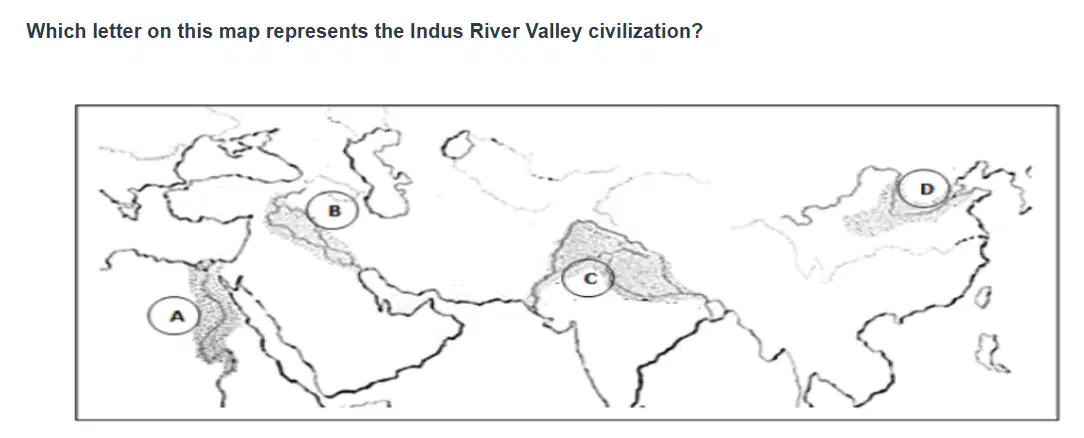
Which letter on this map represents the Indus River Valley civilization?
a)
A.
b)
B
c)
C
d)
D
2.
The Indus River Valley Civilization was in which two countries?
a)
India and Iran
b)
Pakistan and Iran
c)
India and Afghanistan
d)
India and Pakistan
3.
What is the cause of the flooding of the Indus River?
a)
hurricanes
b)
monsoon winds
c)
snow melting from the mountains
d)
From heavy rainfall in the south where rainforests are located.
4.
How did monsoon winds affect the development of civilization in the Indus River Valley?
a)
They helped it by bringing rain that caused rivers to overflow and deposit rich silt on the plains.
b)
They harmed it by preventing rain that would have allowed agriculture to flourish.
c)
They harmed it by bringing rain that caused rivers to overflow and flood the surrounding plains.
d)
They helped it by preventing rain that would have caused rivers to overflow and flood the surrounding plain
5.
What were the effects of having good soil and heavy rains from the monsoon winds?
a)
It created a great environment for agriculture where surpluses of food could be grown
b)
It created an unlivable environment.
c)
It created a great environment for maritime trade.
d)
It created an environment that was acceptable to invasion.
6.
What was special about the design of Harappa and Mohenjo-daro?
a)
first cities ever built
b)
planned communities on a grid
c)
only cities to have granaries
d)
only cities to have walls around the city
7.
Why were the geographical landforms like the Himalaya Mountains, Thar Desert, and Indian Ocean important to the development of the Indus River Valley Civilization?
a)
The landforms were used for their natural resources.
b)
The landsforms helped increase trade.
c)
The landforms provided a beautiful setting for the formation of a civilization.
d)
The landforms acted as natural barriers that help prevent invasion.
8.
How do archaeologists know that the Harappan civilization in the Indus River Valley was advanced?
Choose 2 answers
a)
Their cities were built next to a cemetery called the Hill of the Dead and had elaborate military defense systems.
b)
Their cities had a monotheistic religion, a monarchy, and a system of writing using letters.
c)
Their cities had architecture built with bricks and roads arranged in grid-systems.
d)
Their cities were able to survive monsoon winds that destroyed crops by relying on trade rather than agriculture.
e)
Their cities had running water, pipes, plumbing, bathrooms, and a sanitation system.
9.
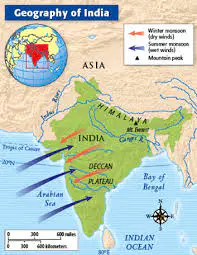
In the summer when the monsoon winds blow over the Arabian Sea what type of weather does India and Pakistan receive?
a)
Little precipitation because the winds are blowing from east over the Himalayas.
b)
Heavy rain because the winds are blowing from the east over the Bay of Bengal.
c)
Moderate rainfall because the winds are blowing from the south over the Indian Ocean
d)
Heavy rain because the winds are blowing from the west over the Arabian Sea
10.
Why is the Harappan civilization significant to Indian history?
a)
It allowed Buddhism to spread outside of India.
b)
It prevented international trade in India.
c)
It was the first permanent agricultural civilization in India.
d)
It was the first monotheistic civilization in India.
11.
How are the Ganges River and Indus River similar?
a)
They both flow into the Atlantic Ocean.
b)
They both flow out of the Zagros Mountains.
c)
They are both located in Egypt.
d)
They are both located in India.
12.
What plant was first used by the Indus River Valley civilization to make textiles?
a)
flax
b)
papyrus
c)
cotton
d)
wool
13.
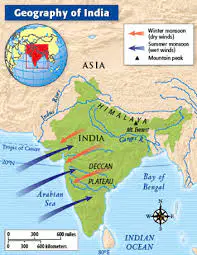
In the winter when the monsoon winds blow over the Himalayan Mountains what type of weather does India and Pakistan receive?
a)
Little to no precipitation because the winds are blowing from the east over the Himalayas.
b)
Heavy rain because the winds are blowing from the east over the Bay of Bengal.
c)
Moderate rainfall because the winds are blowing from the south over the Indian Ocean
d)
Heavy rain because the winds are blowing from the west over the Arabian Sea
14.
Which answer choices are theories of why the Harappan civilization came to an end? (4 answers)
a)
Earthquakes caused some of the tributaries of the Indus River to change course
b)
Climate change resulted in the disappearance of monsoons bringing in heavy rains which resulted in droughts.
c)
Aryan invasions resulted in the destruction of the Harappan civilization
d)
Extreme flooding resulted in the Harappans moving out of the Indus River Valley and settling somewhere new.
e)
They moved to Mesopotamia and established the Babylonian Empire.
15.
How does the caste system impact Indian culture?
a)
It divides culture into strict social classes.
b)
It decreases the influence of religion on society.
c)
It increases opportunities for social mobility.
d)
It allows for the exchange of ideas between cultures.
16.
How was the importance of social classes demonstrated in Ancient Indian culture?
a)
Social mobility was supported by the monarchy.
b)
The caste system was supported by religious teachings.
c)
Local governments passed laws to make all social classes equal.
d)
Military leaders were drafted from all levels of the caste system.
17.
How did the caste system typically affect everyday life in ancient India?
a)
People could move up from the lowest classes if they worked hard.
b)
People were placed in castes which determined what jobs each person would do
c)
People could choose their own jobs and that choice would determine their caste.
d)
All people were in the same caste and learned the same job as their parents.
18.
What was the Indo-Aryans written and spoken language and how is this dead language still used today?
a)
Sanskrit, it is used in their religious text and influenced the development language of India
b)
Hieroglyphics, it is used in their religious text, and influenced the development language of India
c)
Cuneiforms, it is used in keeping government records, and influenced the development language of India
d)
Pictographs and it is used only in keeping records of business transaction
19.
What two parts of the Aryan culture and religion became part Hinduism and the culture of India? (2 answers)
a)
Government policies
b)
How to conduct business transaction
c)
The Vedas, the religious text of the Aryans
d)
The system of collecting taxes.
e)
The caste system which is a social structure hierarchy
20.
Which answer choices best describes the Aryans? (2 answers)
a)
Foreign invaders that settled in the Indus River Valley and Ganges River Valley
b)
They started the first civilization in India and Pakistan
c)
Created the very first civilization in the world
d)
They were originally nomadic cattle herders who counted their wealth in cattle
e)
They were peaceful and their culture did not influence the culture of India
21.
Reorder the following
a)
Settlers begin farming in the Indus River Valley
b)
Successful farming allows Harappans to specialize.
c)
A barter economy develops in the Indus River Valley.
d)
First true cities are built using advanced engineering techniques.
e)
Harappan civilization disappears.
1)
2)
3)
4)
5)
22.
Reorder the following
a)
Brahmin
b)
Kshatriyas
c)
Vaisyas
d)
Shudras
e)
Dalits
1)
2)
3)
4)
5)
23.
Kings, Nobles, Warriors
a)
Brahmins
b)
Shudras
c)
Vaisyas
d)
Kshatriyas
e)
Dalits
24.
Farm Laborers and Unskilled Workers
a)
Dalits
b)
Shudras
c)
Ksahrtriyas
d)
Brahmin
e)
Vaisyas
25.
Priest and Religious Teachers
a)
Kshatriyas
b)
Dalits
c)
Shudras
d)
Brahmin
e)
Vaisyas
26.
Dirty Jobs
a)
Dalits
b)
Brahmin
c)
Vaisyas
d)
Shudras
e)
Kshatriyas
27.
Merchants & Farm Owners
a)
Dalits
b)
Brahmin
c)
Shudras
d)
Kshatriyas
e)
Vaisyas
100 %

