
 Worksheets
French 2 - Unit 6: En ville
Total questions: 61
Worksheet time: 31mins
Where is Noah from?
Paris, France
Bougival, France
Tokyo, Japan
Versailles, France
Noah is _________. (Fill in the blank with the correct nationality)
franco-japonais (French-Japanese)
américain (American)
canadien (Canadian)
italien (Italian)
Bougival is famous for its beautiful walks along which river?
Loire
Seine
Rhône
Garonne
Match the French places where you buy food with their English equivalents:
butcher shop
la boucherie
bakery
la boulangerie
delicatessen
la charcuterie
dairy shop
la crèmerie
grocery store
le supermarché
Match the French useful expressions with their English equivalents:
to go
aller
to need
avoir besoin de
It's inexpensive.
C’est bon marché.
It's expensive.
C’est cher.
It's not expensive.
C'est pas chèr.
What does the French pronoun 'on' most frequently mean?
You (in a general sense) or people
We
He
She
Fill in the blank: Quand on veut du pain, on va à la _________.
boulangerie
pharmacie
bibliothèque
école
Fill in the blank: On va au _________ pour acheter beaucoup de nourriture.
supermarché
cinéma
hôpital
école
Where do you go to buy bread?
à la boulangerie
à la pâtisserie
à la boucherie
au fast-food
Where do you go to buy desserts?
à la crèmerie
à la pâtisserie
à la charcuterie
à la boucherie
Where do you go to buy fresh meat?
à la charcuterie
à la crèmerie
à la boucherie
au fast-food
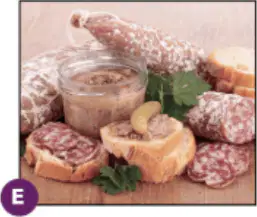
At which shop can you find pâtés, sausages, and ham?
à la charcuterie
à la boulangerie
à la crèmerie
au fast-food
If you need cheese, where do you go?
à la crèmerie
à la pâtisserie
à la boucherie
au fast-food
Where do you go for a quick meal?
à la boulangerie
au fast-food
à la crèmerie
à la charcuterie
What is a small supermarket called in French? Fill in the blank: Une ______ ou une supérette est un tout petit supermarché.
épicerie
boulangerie
pharmacie
librairie
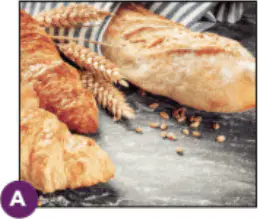
Tell a non-French friend where to go in Paris to buy the item shown in image A (bread). Use the model: Pour acheter du [item], on va à [place].
Pour acheter du pain, on va à la boulangerie.
Pour acheter du pain, on va à la pharmacie.
Pour acheter du pain, on va à la bibliothèque.
Pour acheter du pain, on va au musée.
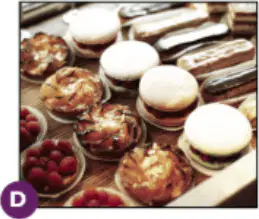
Tell a non-French friend where to go in Paris to buy the item shown in image B (pastries/desserts). Use the model: Pour acheter des [item], on va à [place].
Pour acheter des pâtisseries, on va à la pâtisserie.
Pour acheter des pâtisseries, on va à la boucherie.
Pour acheter des pâtisseries, on va à la pharmacie.
Pour acheter des pâtisseries, on va à la librairie.
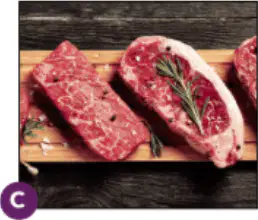
Tell a non-French friend where to go in Paris to buy the item shown in image C (meat). Use the model: Pour acheter de la [item], on va à [place].
Pour acheter de la viande, on va à la boucherie.
Pour acheter de la viande, on va à la boulangerie.
Pour acheter de la viande, on va à la pharmacie.
Pour acheter de la viande, on va à la librairie.
Tell a non-French friend where to go in Paris to buy the item shown in image D.
Pour acheter des macarons, on va à la pâtisserie.
Pour acheter des macarons, on va à la pharmacie.
Pour acheter des macarons, on va à la bibliothèque.
Pour acheter des macarons, on va au musée.
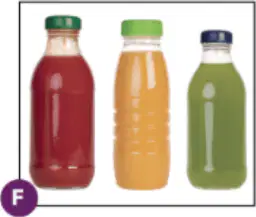
Tell a non-French friend where to go in Paris to buy the item shown in image F.
Pour acheter des boissons, on va au supermarché.
Pour acheter des boissons, on va à la pharmacie.
Pour acheter des boissons, on va à la boulangerie.
Pour acheter des boissons, on va à la bibliothèque.
What does the word 'pour' mean when placed before an infinitive in French?
It means 'in order to'
It means 'to'
It means 'for'
It means 'with'
According to the passage, why do French people visit their boulangerie every day?
To buy bread; over 30 million baguettes are purchased each day in France.
To meet friends for coffee.
To buy pastries for special occasions only.
To attend baking classes.
Which of the following is outlawed in France according to the facts about food shopping?
Single-use plastic bags
Reusable shopping bags
Shopping baskets
Collapsible trolleys
Most shoppers in France use which type of shopping bag?
Single-use plastic bags
Reusable eco-friendly shopping bags
Paper bags
No bags
What do shopping baskets at larger markets in France usually require to use?
A euro coin
A membership card
A receipt
A shopping list
Refrigerators in French homes are noticeably ______ than those in American homes.
smaller
larger
cheaper
older
En français, il y a ___________________________ verbes modaux qui sont très importants.
trois
quatre
cinq
deux
1. ___________________________ = can, to be able to
pouvoir
vouloir
savoir
devoir
2. ___________________________ = must, to have to
devoir
pouvoir
vouloir
savoir
3. ___________________________ = to want
vouloir
manger
parler
finir
En français, on ____________ le verbe modal selon le ___________________________. Après, on utilise typiquement un deuxième verbe à l’___________________________, c’est-à-dire, on ne le conjugue pas. Les verbes ___________________________ sont les verbes auxiliaires.
conjugue, sujet, infinitif, modaux
conjugue, temps, participe, réguliers
accorde, sujet, subjonctif, transitifs
utilise, verbe, présent, pronominaux
Pouvoir = ___________________________
can, to be able to
must, to have to
want, to wish
know, to be aware of
Je ___________________________ (conjugate 'pouvoir')
peux
peut
pouvons
pouvez
Tu ___________________________ (conjugate 'pouvoir')
peux
peut
pouvons
pouvez
Il/Elle/On ___________________________ (conjugate 'pouvoir')
peut
peux
pouvons
pouvez
Nous ___________________________ (conjugate 'pouvoir')
pouvons
pouvez
peux
peut
Vous ___________________________ (conjugate 'pouvoir')
pouvez
pouvons
peux
peut
Ils/Elles ___________________________ (conjugate 'pouvoir')
peuvent
pouvez
peux
peut
Devoir = ___________________________
must, to have to
can, to be able to
want, to wish
know, to be aware of
Je ___________________________ (conjugate 'devoir')
dois
doit
devons
devez
Tu ___________________________ (conjugate 'devoir')
dois
doit
devons
devez
Il/Elle/On ___________________________ (conjugate 'devoir')
doit
dois
doivent
devons
Nous ___________________________ (conjugate 'devoir')
devons
devez
doivent
dois
Vous ___________________________ (conjugate 'devoir')
devez
devons
doivent
dois
Ils/Elles ___________________________ (conjugate 'devoir')
doivent
doive
doivons
doivez
Fill in the blank with the correct conjugation of 'vouloir' for 'Je'. Vouloir = to want Je __________________________
veux
veut
voulons
voulez
Fill in the blank with the correct conjugation of 'vouloir' for 'Tu'. Vouloir = to want Tu __________________________
veux
veut
voulons
voulez
Fill in the blank with the correct conjugation of 'vouloir' for 'Il/Elle/On'. Vouloir = to want Il/Elle/On __________________________
veut
veux
voulons
voulez
Je veux acheter des tartes! Où dois-tu aller?
À la pâtisserie
À la boucherie
À la poissonnerie
À l'épicerie
What is the English translation of 'la librairie'?
bookstore
library
stationery shop
grocery store
What is the English translation of 'le magasin de technologie'?
technology store
bookstore
clothing shop
bakery
What is the English translation of 'le magasin de vêtements'?
clothing store
shoe store
bookstore
bakery
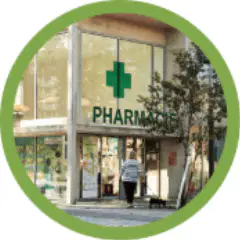
What is the English translation of 'la pharmacie'?
pharmacy
library
bakery
school
What is the English translation of 'la poste'?
post office
library
school
hospital
What is the English translation of 'le journal'?
newspaper
magazine
book
letter
What is the English translation of 'le kiosque à journaux'?
newsstand
library
bakery
school
What is the English translation of 'gratuit/gratuite'?
free
expensive
difficult
quick
What is the English translation of 'la livraison'?
delivery
reservation
payment
address
What is the English translation of 'une banque'?
bank
school
library
restaurant
What is the English translation of 'un distributeur automatique'?
ATM
Vending machine
Ticket counter
Cash register
What is the English translation of 'à côté (de)'?
next to
under
behind
in front of

