
Font size
 Worksheets
Routing Tables and Path Selection
Total questions: 84
Worksheet time: 42mins
Which of the following is a main parameter that defines a routing entry?
Protocol
Subnet Mask
Firewall
Encryption
Fill in the blank: One of the main parameters that defines a routing entry is _________
Destination
Protocol
Bandwidth
Latency
Which parameter in a routing entry specifies the network interface used for forwarding packets?
Protocol
Interface
Gateway/next hop
Destination
Fill in the blank: The _________ or next hop is a main parameter that defines a routing entry.
Gateway/next hop
Subnet mask
IP address
MAC address

Which type of routing table entry refers to routes that are directly connected to the router?
Directly connected routes
Static routes
Dynamic routes
Default routes

Which type of routing table entry refers to routes that are not directly connected to the router but are reachable through another router?
Remote routes
Direct routes
Static routes
Default routes

Which type of routing table entry refers to routes that are specific to a single host?
Host routes
Network routes
Default routes
Gateway routes

Which type of routing table entry is used when no other route matches the destination IP address?
Default route
Static route
Dynamic route
Host route
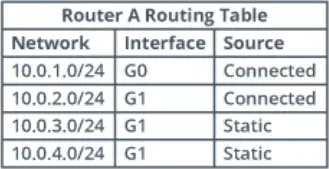
What is the interface for the network 10.0.1.0/24 in Router A's routing table?
G0
G1
F0
E0

What is the source for the network 10.0.2.0/24 in Router B's routing table?
Connected
Static
OSPF
RIP
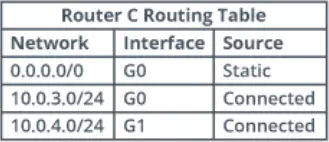
Which network is connected to interface G1 in Router C's routing table?
10.0.4.0/24
10.0.1.0/24
10.0.2.0/24
10.0.3.0/24
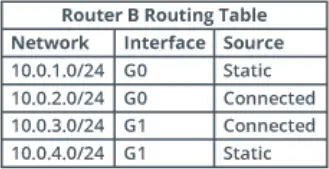
Which of the following is a static route in Router B's routing table?
10.0.1.0/24
10.0.2.0/24
10.0.3.0/24
10.0.4.0/24

What is the default route in Router C's routing table?
0.0.0.0/0
192.168.1.0/24
10.0.0.0/8
172.16.0.0/16
Fill in the blank: The first step in packet forwarding is to _________?
Receive the packet
Send the packet
Drop the packet
Encrypt the packet
Fill in the blank: After receiving the packet, the next step is to _________.
Examine the packet
Ignore the packet
Delete the packet
Forward the packet
Fill in the blank: After examining the packet, the next step is to _________.
Consult the routing table
Encrypt the packet
Discard the packet
Compress the packet
Fill in the blank: After consulting the routing table, the next step is to _________?
Make a forwarding decision
Reboot the router
Delete the routing table
Encrypt the packet
Fill in the blank: The final step in packet forwarding is to _________?
Forward the packet
Drop the packet
Encrypt the packet
Queue the packet
Which of the following is NOT a step in the packet forwarding process?
A) Receive the packet
B) Examine the packet
C) Encrypt the packet
D) Consult the routing table
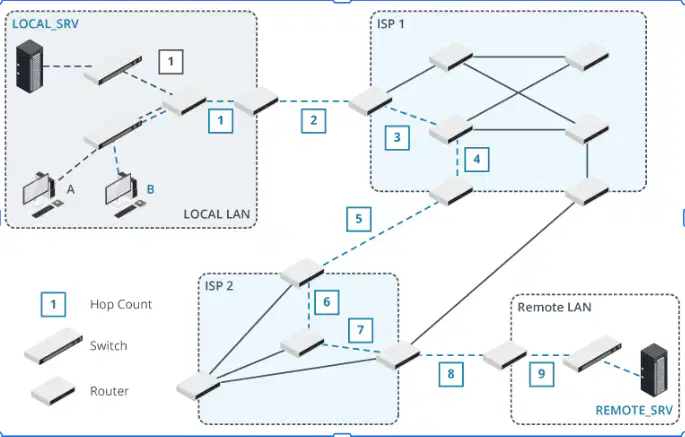
How many hops are there from LOCAL_SRV to REMOTE_SRV?
9
5
7
11
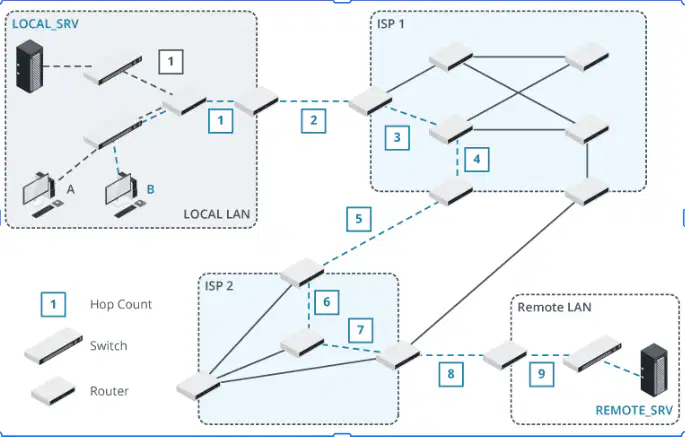
In the network diagram, which symbol represents a router?
(rectangular, flat)
(smaller, flat)
(tall, server-like)
Router placement: Same subnet or IP network must not be separated by a router. Is this statement True or False?
True
False
Router placement: Different subnets or IP networks must be separated by a router.
True
False

Which subnet is associated with the IP range 198.51.100.32/28?
The first subnet
The second subnet
The third subnet
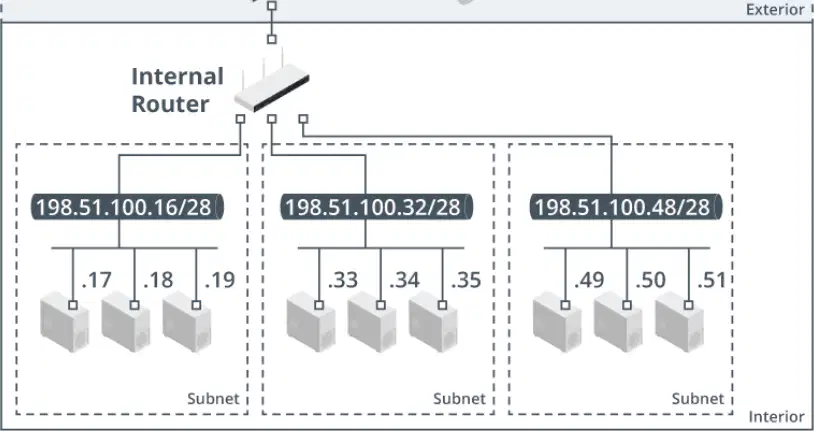
Fill in the blank: In the diagram, the IP address 198.51.100.49 belongs to the subnet _________.
198.51.100.48/28
198.51.100.32/28
198.51.100.64/28
198.51.100.0/28
Which routing tool displays the routing table?
show route
ping
traceroute
configure terminal
Which routing tool lists current ARP table entries?
show arp
show ip route
show interfaces
show version
Which routing tool shows the IP routing table of a host?
route
ping
traceroute
netstat
Which routing tool tracks a packet’s path to destination?
traceroute
ping
netstat
ipconfig
Which type of routing is manually configured?
Static Routing
Dynamic Routing
Fill in the blank: Dynamic Routing is ________ and adapts in real-time.
Flexible
Rigid
Static
Unchanging
Which type of routing is ideal for larger, more complex networks with frequent changes?
Static Routing
Dynamic Routing
What is the definition of dynamic routing protocols?
Algorithms that manually update route information
Algorithms that automatically update route information and adjust the paths between network nodes by distributing network topology information
Protocols that do not update route information
Protocols that only work in static networks
Which of the following is an advantage of dynamic routing protocols?
Scalability
Adaptivity to network changes
Reduced network administration overhead
All of the above
Fill in the blank: Dynamic routing protocols require more ________ and memory.
processing power
bandwidth
storage space
network cables
Proper configuration of dynamic routing protocols is critical for security and efficiency.
True
False
What is the definition of the RIP Protocol?
A legacy dynamic routing protocol that finds the best path between the source and destination networks.
A modern static routing protocol for local networks.
A protocol used for wireless communication only.
A protocol for encrypting network traffic.
Which metric does RIP Protocol use for path selection?
Bandwidth
Hop count
Latency
Cost
What is the maximum number of allowed hops in RIP Protocol?
10
15
20
25
RIP Protocol is not ideal for large networks because of the _________
hop count limit
bandwidth requirement
encryption overhead
complex configuration
RIP Protocol is slow to ________ in response to network changes.
converge
transmit
disconnect
initialize
What is Enhanced IGRP (EIGRP)? Fill in the blank: Enhanced IGRP (EIGRP) is _________.
An advanced distance-vector protocol that is used on a computer network for automating routing decisions and configurations.
A protocol used for encrypting data on wireless networks.
A network protocol for assigning IP addresses dynamically.
A protocol for managing network switches and VLANs.
Which metrics does EIGRP use for path selection?
Bandwidth, delay, load, reliability
Cost, hop count, bandwidth
Delay, jitter, cost
Load, hop count, reliability
Does EIGRP support both IPv4 and IPv6 without needing separate configurations?
True
False
Is EIGRP more complex to configure compared to other protocols?
True
False
Which company developed the proprietary protocol EIGRP? Fill in the blank: EIGRP is a ________ proprietary protocol.
Cisco Systems
Juniper Networks
Huawei Technologies
Arista Networks
Fill in the blank: OSPF is a dynamic ______ protocol that efficiently exchanges routing information within an autonomous system using the Shortest Path First algorithm.
link-state
distance-vector
static
hybrid
Which of the following is a feature of OSPF?
Computes the shortest path first
Uses distance-vector algorithm
Does not support complex network topologies
Is a static protocol
Fill in the blank: OSPF supports ______ network topologies.
complex
simple
linear
star
Which of the following is a consideration when using OSPF?
Simple planning and configuration
Can be complex planning and configuration
Requires less bandwidth than distance-vector protocols
Does not require bandwidth
Fill in the blank: OSPF requires more ______ than distance-vector protocols.
bandwidth
memory
processing power
security
What is the definition of Border Gateway Protocol (BGP)?
A) A protocol for encrypting data
B) Gateway protocol that enables the Internet to exchange routing information between autonomous systems
C) A protocol for wireless communication
D) A protocol for managing DNS records
Fill in the blank: One feature of BGP is that it is scalable to the Internet’s size, handling ________ of routes.
thousands
dozens
hundreds
tens
Which protocol does BGP use for establishing routing decisions?
Link state protocol
Path vector protocol
Distance vector protocol
Static routing protocol
Fill in the blank: BGP supports ________, allowing for efficient IP address management and route aggregation.
CIDR
NAT
DHCP
ARP
____________________ are algorithms that automatically update route information and adjust the paths between network nodes by distributing network topology information.
Dynamic routing protocols
Static routing protocols
Encryption algorithms
Access control lists
____________________ is a protocol that enables the Internet to exchange routing information between autonomous systems.
Border Gateway Protocol (BGP)
Transmission Control Protocol (TCP)
File Transfer Protocol (FTP)
Simple Mail Transfer Protocol (SMTP)
____________________ is a legacy dynamic routing protocol that finds the best path between the source and destination networks.
Routing Information Protocol (RIP)
Open Shortest Path First (OSPF)
Enhanced Interior Gateway Routing Protocol (EIGRP)
Border Gateway Protocol (BGP)
____________________ is a dynamic link-state protocol that efficiently exchanges routing information within an autonomous system using the Shortest Path First algorithm.
Open Shortest Path First (OSPF)
Border Gateway Protocol (BGP)
Routing Information Protocol (RIP)
Enhanced Interior Gateway Routing Protocol (EIGRP)
What does Network Address Translation (NAT) do? Fill in the blank: NAT modifies the network address information in ______ while in transit.
packet headers
data payload
routing tables
firewall rules
What does Network Address Translation (NAT) do? Fill in the blank: NAT enables multiple devices on a local network to share a single ______.
public IP address
MAC address
private IP address
subnet mask
Why is Network Address Translation (NAT) needed? Fill in the blank: NAT increases network security by hiding internal IP addresses from ______.
external networks
internal users
local devices
private servers
Why is Network Address Translation (NAT) needed? Fill in the blank: NAT conserves ______ addresses.
public IP
private IP
MAC
domain
Fill in the blank: Dynamic NAT maps internal addresses to a pool of external addresses ________.
dynamically
statically
manually
sequentially
Fill in the blank: Dynamic NAT allows a larger number of devices to share the same ________ IP address.
external
internal
private
local
Fill in the blank: Static NAT translates one internal IP address to one ________ IP address.
external
private
dynamic
local
Fill in the blank: Static NAT allows inbound connections initiated from ________ the network.
outside
inside
the same
local
Fill in the blank: An edge router is located ___ .
at the boundary of a network that connects to external networks (e.g., the Internet)
in the core of a data center network
inside a user's local area network (LAN)
within a server rack for internal communication
Fill in the blank: An edge router manages the flow of data between the ______ and ______ networks.
internal; external
public; private
wired; wireless
core; access
Fill in the blank: An edge router routes data to its destination, performs NAT and applies ______ measures.
security
routing
performance
compression
What is the location of a Customer Edge (CE) router?
Located at the edge of a customer's network.
Located at the core of the service provider's network.
Located inside the customer's data center only.
Located at the edge of the service provider's network.
What is the location of a Provider's Edge (PE) router?
Located at the edge of a provider's network.
Located in the customer premises.
Located at the core of the provider's network.
Located in the data center.
What is the main function of a Customer Edge (CE) router?
Connects customer's internal network to provider's network, acting as a security barrier for the customer's network.
Manages routing between multiple service providers within the provider's core network.
Acts as a firewall for the provider's backbone network.
Handles DNS resolution for the customer's internal devices.
What is the main function of a Provider's Edge (PE) router?
Focuses on maintaining the integrity and confidentiality of customer data as it travels across the provider's network.
Acts as a firewall to block unauthorized access to the provider's internal network.
Manages the routing of data between different Internet Service Providers (ISPs).
Handles the physical connection between customer premises and the provider's backbone network.

What is the Inside Local IP address used by the NAPT Firewall?
10.0.0.1
217.45.253.5
77.72.206.10
10.0.0.101
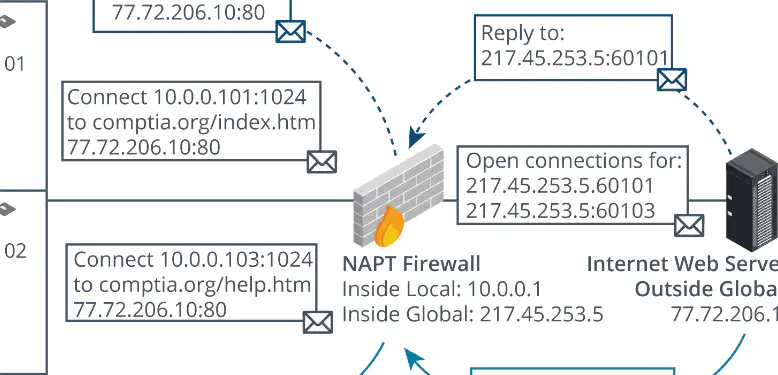
Refer to the diagram on Port Address Translation. What is the Inside Global IP address used by the NAPT Firewall?
10.0.0.1
217.45.253.5
77.72.206.10
10.0.0.102

Refer to the diagram on Port Address Translation. Fill in the blank: The Internet Web Server Outside Global IP address is _________.
77.72.206.10
192.168.1.10
10.0.0.5
172.16.0.1
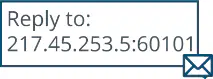
Refer to the diagram on Port Address Translation. Which port is used for the open connection for 10.0.0.101?
60101
60103
1024
80
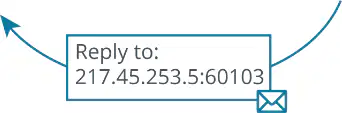
The reply to 10.0.0.103 comes from which port?
60101
60103
1024
80
Which of the following conserves public IP addresses?
Static NAT
Dynamic NAT
PAT
NAT
CE
Which of the following maps internal addresses to a pool of external addresses?
Dynamic NAT
CE
Static NAT
NAT
PAT
Which of the following maintains the confidentiality of a customer's data as it travels across the provider's network?
Dynamic NAT
Static NAT
PAT
NAT
PE

Refer to the exhibit. From the perspective of users behind the NAT router, what type of NAT address is 209.165.201.1?
outside global
outside local
inside local
inside global

Refer to the exhibit. NAT is configured on RT1 and RT2. The PC is sending a request to the web server. What IPv4 address is the source IP address in the packet between RT2 and the web server?
192.0.2.2
203.0.113.10
172.16.1.254
192.168.1.5
209.165.200.245

