
 Worksheets
Holiday Review Assignment
Total questions: 18
Worksheet time: 3hrs 17mins
1-10.
Answer the questions below after watching the video
What is the result of adding two equations if none of the variables cancel out?
No variables are eliminated
The equations become undefined
Both variables are eliminated
One variable is eliminated
What is the first step in solving a system of equations by elimination?
Multiply one or both equations
Add the two equations directly
Graph the equations
Substitute one variable into the other equation
What does a solution like (2, 3) represent in a system of equations?
The point where the two lines are parallel
An error in calculation
The point where the two lines overlap
The point where the two lines intersect
What does it indicate if adding two equations results in a statement like 0 = 22?
The equations are undefined
The system has one solution
The system has no solution
The system has infinite solutions
What indicates that two lines are parallel when solving systems of equations?
Ending up with an equation like 0 = 22
Ending up with an equation like 0 = 0
Both variables being eliminated simultaneously
Getting a solution like x = 2
What does it mean when two equations result in 0 = 0 after elimination?
The lines are parallel
The lines are the same, leading to infinite solutions
The lines intersect at one point
The equations are incorrect
In the context of systems of equations, what does an infinite number of solutions imply?
There is a mistake in the calculation
The equations form parallel lines
The equations are inconsistent
The equations represent the same line
How do you find the lowest common multiple for eliminating a variable in a system of equations?
Add the coefficients of the variables
Multiply the coefficients of the variables
Find a number both coefficients divide into evenly
Subtract the coefficients of the variables
How can you verify the solution of a system of equations?
By substituting the solution back into one equation
By substituting the solution back into both equations
By graphing the equations
By checking if the equations are parallel
What does it mean if after eliminating one variable, you can solve for the other variable?
The equations are inconsistent
The system has infinite solutions
The system has exactly one solution
The system has no solution
11-20.
Answer the questions below after watching the video
What is the first step in solving equations using the elimination method?
Multiply one equation to make coefficients match
Add the two equations directly
Isolate one variable in both equations
Substitute one variable from one equation into the other
After applying the elimination method, how do you find the value of the second variable?
Multiply the equations
Substitute the found value into one of the original equations
Divide one equation by the other
Add the equations again
Why do we sometimes need to modify equations before using the elimination method?
To make all coefficients positive
To make the coefficients of one variable opposite
To simplify the equations
To eliminate both variables at once
What is the result of adding the modified equations in the second elimination method example?
A single-variable equation
A new system of equations
An identity
A contradiction
In substitution method, what do you do after finding the value of one variable?
Substitute it back into one of the original equations
Solve for the same variable using the other equation
Add the value to both equations
Multiply the original equations by the found value
How do you start solving a system of equations using substitution when one equation is already solved for one variable?
Multiply the equations
Isolate the variable in the second equation
Add the two equations
Substitute the expression of the solved variable into the other equation
What is the purpose of distributing in the substitution method?
To prepare the equation for addition
To simplify the equation for easier solving
To eliminate a variable
To combine like terms
When using substitution, what indicates you need to manipulate one of the equations first?
There are no like terms
The variables are not already isolated
The equations are too complex
The coefficients are too large
What is the final step in solving for variables using the substitution method?
Substitute the found value into any of the original equations
Substitute the found value of one variable into the modified equation
Divide both sides by the coefficient of the isolated variable
Add the two original equations
How do you verify the solution of a system of equations solved by substitution?
By graphing the equations and checking the intersection point
By multiplying the solution by the coefficient of one variable
By adding the two original equations
By substituting the solution back into both original equations
x + 2y = 3
What are x and y?
y = 2x + 1
y = 4x - 1
y = 2x -11
-3y = -6x -15
Solve by elimination.
6x - y = 2
-3x - 6y = 12
(2,0)
no solution
(0,-2)
infinite solutions
25-44.
Answer the questions below after watching the video
When solving using substitution we want to create
Solve for both variables simultaneously
1 equation with 1 variable that we can solve for
Both variables to equal the same number
Graph both equations
The 2nd equation tells us that x =
y - 4
x + 7
2y - 7
y
After substituting x with y - 4, what is the next step?
Graph the equation
Solve for x
Solve for y
Substitute y with x + 4
What is the value of y after substitution and simplification?
4
-1
3
2
Can the substitution method be applied in reverse, starting with y?
No, it's not possible
Yes, but it gives a different solution
Yes, and it gives the same solution
Only in certain cases
What confirms that the solution (x, y) = (-1, 3) is correct?
It satisfies both original equations
It only satisfies the first equation
It results in a negative value for x
It is the only possible solution
If x = y -4, then in the first equation what can I substitute for x (replace x with)
(a)
The top equation becomes 2 y =
(a)
If I combine my like terms on the right (the constants) I get
(a)
If I then subtract y from each side the result is
(a)
Since we know that x = y - 4, we substitute in y = 3 and get the equation
(a)
Simplifying we get a solution for x
(a)
Putting the solution into a coordinate point (x, y) you get
(a)
How did Mr Khan change x = y - 4 to become y = x + 4
Magic (really? math is logic not magic!)
He subtracted y from each side
He subtracted 4 from each side
He added 4 to each side
So, since 2y = x + 7, we can substitute in y = x + 4 and get the equation
(a)
So now, if you distribute the 2(x + 4) on the left we get the equation
(a)
Using the equation 2x + 8 = x + 7 if you subtract x from both sides you get the equation
(a)
From the equation x + 8 = 7, if you subtract 8 from each side you get the solution
(a)
Now that we know that x = -1, we can substitute that into y = x + 4 and get
(a)
And our solution for y is that y = -1 + 4 or
(a)
45-52.
Answer the questions below after watching the video
What is the y-intercept of the line y = 3x - 4?
3
-4
4
-3
If a line has a slope of 2, what is the rise over run?
2 over 1
1 over 2
2 over 2
1 over 1
When graphing y < 2x - 3, what type of line should be used?
Dotted line
Curved line
Dashed line
Solid line
Which test point is commonly used to determine shading in graphing inequalities?
(1,1)
(0,0)
(2,2)
(-1,-1)
What happens to the inequality symbol when you divide by a negative number?
It disappears
It becomes an equal sign
It flips direction
It stays the same
In Desmos, what does shading below the line indicate for the inequality y < 2x - 3?
y is greater than 2x - 3
y is less than 2x - 3
y is not related to 2x - 3
y is equal to 2x - 3
When graphing the system of inequalities, where is the solution set found?
Where the shaded regions overlap
Where the lines intersect
Above both lines
Below both lines
What is the first step in solving the inequality 2x - y ≥ 2 for y?
Subtract 2x from both sides
Add 2 to both sides
Divide by 2
Multiply by -1

Aria and Liam are exploring a magical function world! They found a mysterious function g(x) defined below. Help them discover the magic number by finding g(7)!
-17
-13
13
17

Aria and Liam are exploring a mysterious graph. Can you help them find out what f(-3) is from the graph they discovered?
-3
-1
1
3

Grace and Aria are solving a puzzle involving a mysterious function. They need to find out what f(-2) is to unlock the next clue. Can you help them figure it out?
4
1
1
DNE


Ethan and Evelyn are exploring a mysterious function graph. Can you help them find the value of f(-2)?
-2
2
-1
0
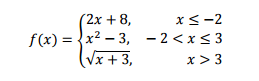
Charlotte and Zoe are exploring a mysterious function f(x) defined below. They are curious to find out, what is f(13)? Can you help them solve this mystery?
34
4
166
cannot be determined
59-64.
Answer the questions below after watching the video
For x = 5, what is the value of G(5) if G(x) = x^2 + 7 for x ≥ 3?
14
10
32
16
What is the value of f(-7) if the function is defined as f(x) = -1 for x < 0?
1
-1
0
-5
What is the key step in evaluating a piecewise function?
Directly substituting the value of x
Using all parts of the function
Checking which condition x satisfies
Ignoring the conditions
For x = 3, which condition of the piecewise function is satisfied?
None of the above
x < 0
x ≥ 3
0 ≤ x < 3
Why is it called a piecewise function?
Because it is a single equation
Because it has only one condition
Because it is continuous
Because it is defined in pieces
What does a piecewise function depend on to determine its output?
The input value only
The output value only
The input value and the defined conditions
Random selection
65-74.
Answer the questions below after watching the video
What happens when you multiply numbers with the same base but different exponents?
Divide the exponents
Subtract the exponents
Add the exponents
Multiply the bases
If you have 4^2 * 4^3, what is the simplified result?
4^5
4^6
12^5
16^5
How do you simplify an expression with a power raised to another power?
Divide the powers
Subtract the powers
Multiply the powers
Add the powers
What is the result of (2^2)^3?
2^5
4^3
8^2
2^6
When multiplying bases with the same exponent, what do you do?
Divide the bases
Multiply the exponents
Multiply the bases and keep the exponent
Add the bases
What is the simplified form of 2^2 * 3^2?
5^2
6^2
12^2
6^4
How do you simplify a fraction raised to an exponent?
Raise both the numerator and denominator to the power of the exponent
Multiply the exponent with the numerator and denominator
Subtract the exponent from the numerator and denominator
Add the exponent to the numerator and denominator
What is (1/2)^3 simplified?
1/6
1/8
1/4
3/8
How do you handle exponents when dividing with the same base?
Subtract the exponent of the denominator from the numerator
Multiply the exponents
Divide the exponents
Add the exponents
What is the result of 3^5 / 3^3?
3^2
3^8
6
9
75-84.
Answer the questions below after watching the video
What does the variable 'x' represent in the function y=3^x?
The coefficient of the exponential function
The exponent in the exponential function
The base of the exponential function
The constant term of the exponential function
What is the value of y when x=0 in the function y=3^x?
3
0
9
1
How does the value of y change as x increases in the function y=3^x?
Y decreases
Y remains constant
Y increases exponentially
Y increases at a constant rate
What happens to the value of y as x becomes a large negative number in the function y=3^x?
Approaches infinity
Approaches zero
Becomes a large negative number
Remains constant
What is the graphical shape of the function y=3^x?
A straight line
An exponential curve
A parabola
A hyperbola
In the chain letter example, how many people receive the letter in week 3?
30
100
1000
10000
What is the pattern of growth in the number of people receiving the chain letter each week?
Logarithmic growth
Exponential growth
Quadratic growth
Linear growth
How many people have received the chain letter by the sixth week?
600
1 million
60
6000
Why might the actual spread of a chain letter not follow the exponential model perfectly?
Everyone would want to keep the letter
People might not send it to 10 new people
People might send it to more than 10 people
The letter could get lost in the mail
What would happen by the ninth week of the chain letter being sent?
The entire population would receive it
100 million people would receive it
1 billion people would receive it
No one would receive it
85-94.
Answer the questions below after watching the video
What is the first step in adding and subtracting polynomials?
Combine like terms
Rewrite the polynomial without parentheses by distributing
Order the polynomial in descending order
Distribute the positive and negative signs
How do you handle the parentheses in polynomial operations?
Combine them with other terms
Ignore them
Distribute the signs across the terms inside
Multiply them
Why is it important to distribute the positive and negative signs in polynomial operations?
To increase the degree of the polynomial
To make the polynomial unsolvable
To simplify the equation
To introduce new variables
What results from combining -5x^2 and +2x^2?
3x^2
7x^2
-3x^2
-7x^2
After distributing signs and combining like terms, what is the next step?
Introduce new variables
Solve the polynomial
Rewrite the polynomial in ascending order
Write the polynomial in descending order
In the second example, what does distributing a negative sign across -8x and +9x result in?
-8x and -9x
+8x and +9x
-8x and +9x
+8x and -9x
How do you combine y and 8y?
16y
8y^2
9y
y^2
What is the correct order for terms when writing the polynomial in descending order?
Alphabetical order of variables
Based on the coefficients
Highest to lowest degree of terms
Random order
What is the result of combining -7x and -9x?
16x
-16x
2x
-2x
What does the phrase 'kindness multiplies kindness' imply in the context of learning math?
Mathematical operations can be kind
Kindness has no place in math
Sharing knowledge helps everyone grow
Math problems become easier with kindness

