
 Worksheets
Engineering Safety and Hazard Identification
Total questions: 28
Worksheet time: 14mins
The process of identifying the dangers of using a tool or piece of machinery in the workshop, and the control measures involved in working safely, is known as:
Risk assessment
Tool maintenance
Inventory management
Quality control
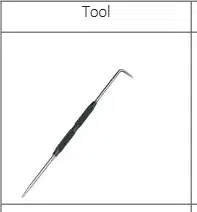
Shown below are three tools used in the production of the dustpan. Complete the table below by correctly naming the tool and stating its use. Tool 1 (shown in the image):
Tool name: Scriber Use: Used to mark lines on metal surfaces.
Tool name: Hammer Use: Used to drive nails into wood.
Tool name: File Use: Used to smooth rough edges on metal.
Tool name: Pliers Use: Used to grip and bend wires.
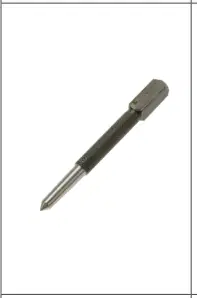
Shown below are three tools used in the production of the dustpan. Complete the table below by correctly naming the tool and stating its use. Tool 2 (shown in the image):
Tool name: Centre punch Use: Used to make an indentation in metal to guide a drill.
Tool name: File Use: Used to smooth rough edges on metal.
Tool name: Hacksaw Use: Used to cut metal pieces to size.
Tool name: Scriber Use: Used to mark lines on metal surfaces.
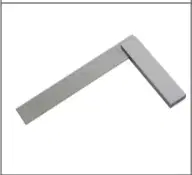
Shown below are three tools used in the production of the dustpan. Complete the table below by correctly naming the tool and stating its use. Tool 3 (shown in the image):
Tool name: Engineer's square Use: Used to check and mark right angles on metal workpieces.
Tool name: Hack saw Use: Used to cut wood pieces to length.
Tool name: Ball pein hammer Use: Used to drive nails into wood.
Tool name: File Use: Used to smoothen wooden surfaces.
Complete the table below, stating the type of physical property needed for the named bike part. Part: Spokes Physical property needed: ____________
High tensile strength
Low electrical conductivity
High thermal expansion
Low density
Complete the table below, stating the type of physical property needed for the named bike part. Part: Tyre Physical property needed: ____________
Flexibility or elasticity
Conductivity
Transparency
Magnetism
Complete the table below, stating the type of physical property needed for the named bike part. Part: Gear cogs Physical property needed: ____________
Hardness or wear resistance
Elasticity
Thermal conductivity
Electrical conductivity
A jig has been used in the process of bending the frame. Why is this important?
It ensures consistent and accurate bends in the frame.
It speeds up the cooling process after bending.
It reduces the weight of the frame.
It prevents rust from forming on the frame.
Select two structural features of a standard road bicycle.
Lightweight frame and drop handlebars
Wide tires and upright handlebars
Heavy frame and flat pedals
Suspension fork and knobby tires
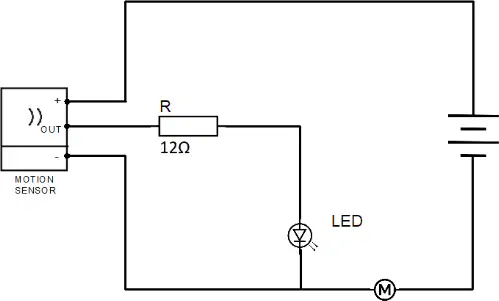
What is the purpose of the motion sensor in this circuit?
To detect movement and activate the circuit
To provide power to the LED
To increase the resistance
To store electrical energy
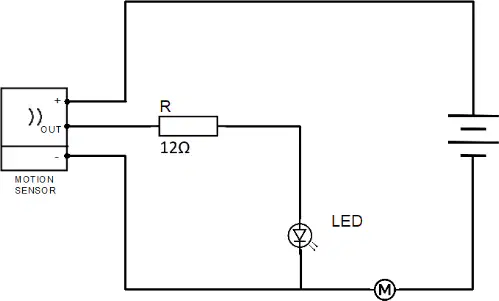
Fill in the blank: The value of the resistor (R) in the circuit is ____ ohms.
12
8
15
20
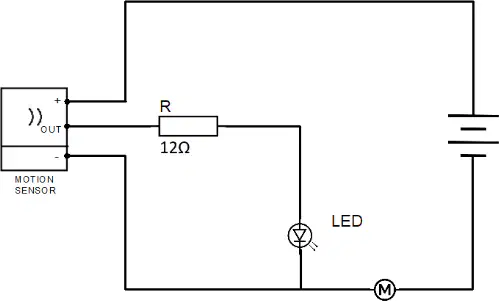
What happens in the circuit when someone walks past the motion sensor?
The circuit is activated and a response is triggered.
The circuit turns off completely.
The motion sensor is disabled.
No change occurs in the circuit.
Malleability refers to:
The ability of a material to be hammered or rolled into thin sheets without breaking.
The ability of a material to conduct electricity.
The ability of a material to resist scratching.
The ability of a material to dissolve in water.
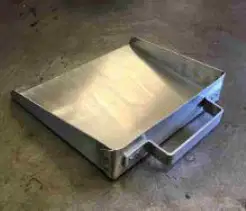
Name a suitable metal to use to make the dustpan and state two properties that make it a suitable material.
Aluminium; lightweight and corrosion resistant
Copper; high electrical conductivity and softness
Lead; heavy and toxic
Gold; expensive and malleable
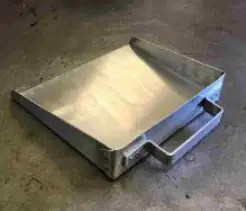
Name a suitable tool to cut the sheet metal to the correct size.
Tin snips
Hacksaw
File
Screwdriver
Explain, using examples, how the funfair could dispose of the items that are no longer needed in a way that limits environmental impact.
By recycling and donating items to reduce waste
By burning all items on-site
By dumping items in a nearby river
By burying items in the ground without sorting
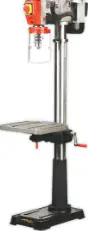
The picture below shows a typical machine, usually seen in an engineering workshop. Name the machine shown and describe its primary purpose.
Lathe machine: Used for shaping and machining metal or wood.
Drill press: Used for making holes in materials.
Milling machine: Used for cutting and shaping solid materials.
Grinder: Used for grinding and finishing surfaces.
Using Ohm's Law, calculate the voltage needed to run the circuit. Show your workings.
Voltage (V) = Current (I) x Resistance (R). Resistance is not given, so the answer cannot be fully determined from the information provided. If resistance is assumed or given elsewhere, V = 0.5 x R.
Voltage (V) = Resistance (R) / Current (I). Therefore, V = R / 0.5.
Voltage (V) = Current (I) + Resistance (R). Therefore, V = 0.5 + R.
Voltage (V) = Current (I) - Resistance (R). Therefore, V = 0.5 - R.
Calculate how many 30mm x 40mm boards can be manufactured from a single blank circuit board.
25 boards.
30 boards.
20 boards.
15 boards.

Calculate the overall cost to produce one electronic circuit. The circuit includes all components listed in the table above and a blank circuit board. Show your workings.
$3.50
$2.75
$4.20
$5.00
The difference between a destructive test and a non-destructive test is:
Destructive tests damage or destroy the material being tested, while non-destructive tests do not cause harm.
Destructive tests are always more expensive than non-destructive tests.
Non-destructive tests require more time to perform than destructive tests.
Destructive tests are only used for metals, while non-destructive tests are used for all materials.
Describe, using diagrams and notes, the testing process that has been carried out on the bike spoke for its tensile strength.
A tensile testing machine is used to pull the bike spoke until it breaks, measuring the force required.
The bike spoke is bent repeatedly to test its flexibility.
The bike spoke is dropped from a height to test its impact resistance.
The bike spoke is heated to test its thermal expansion.

Recent developments in technology have impacted the development of smart speakers and their possible impacts in the home. Which of the following is a major impact of these advancements?
Enhanced voice recognition and integration with smart home devices
Reduced connectivity and limited functionality
Decreased user privacy and security features
Limited compatibility with other devices
The pan and handle are assembled together using a temporary fixing. Name a suitable temporary fixing for this process.
Screw clamp (or G-clamp)
Rivets
Welding
Adhesive
Which method is commonly used as a temporary fixing to join two pieces of sheet metal together?
Using screws and nuts
Using welding
Using adhesive tape
Using soldering
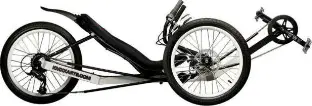
The main frame of the recumbent bike is manufactured from square section mild steel. State two reasons for using square section mild steel to manufacture the frame.
It is strong and durable.
It is lightweight and flexible.
It is expensive and rare.
It is prone to rust easily.
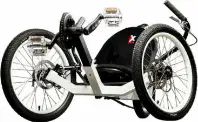
The main frame of the recumbent bike is manufactured from square section mild steel. State two reasons for using square section mild steel to manufacture the frame.
It is easy to weld and fabricate.
It is highly resistant to corrosion.
It is lighter than aluminum.
It is difficult to shape and bend.
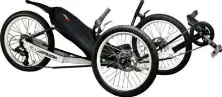
State the classification of material that mild steel belongs to.
Ferrous metal
Non-ferrous metal
Polymer
Ceramic

