
 Worksheets
Rhetorical Appeals and Adichie
Total questions: 109
Worksheet time: 1hrs 25mins
Which rhetorical appeal relies on the credibility or character of the speaker?
Pathos
Ethos
Logos
Diction
What is the meaning of the word "juxtaposition" as used in literary analysis?
The repetition of initial consonant sounds
The placement of two elements side by side for contrast
The use of exaggerated statements
The attribution of human qualities to non-human things
Which term refers to the emotional appeal used to persuade an audience?
Logos
Pathos
Ethos
Syntax
What does the word "concession" mean in the context of argument writing?
A statement that refutes the opposing argument
An acknowledgment of a valid point from the opposing side
A call to action for the audience
The main claim of the argument
In the sentence, "The conceivable solution was not accepted," what part of speech is the word "conceivable"?
Noun
Verb
Adjective
Adverb
Which word in the following sentence provides a clue to the meaning of "paradox"? "The statement 'less is more' is a paradox because it seems contradictory yet makes sense."
Statement
Contradictory
Sense
More
What is the central idea of a text?
The author's use of figurative language
The main point or message the author wants to convey
The structure of the text
The tone of the text
Which term describes the repetition of a word or phrase at the beginning of successive clauses?
Anaphora
Antithesis
Allusion
Hyperbole
Which word change pattern is shown in the transformation from "conceive" to "conception"?
Verb to noun
Noun to adjective
Adjective to adverb
Noun to verb
Based on the context, what does "loaded language" most likely mean in persuasive writing?
Language that is neutral and objective
Language that carries strong emotional connotations
Language that is difficult to understand
Language that is repetitive
Given the sentence, "The author’s use of parallel structure emphasizes the importance of each idea," what is the function of parallel structure in this context?
To confuse the reader
To highlight and give equal importance to ideas
To create a rhyme scheme
To introduce a counterargument
Read the following sentence: "Her understated response to the crisis calmed the audience." What does "understated" mean in this context?
Exaggerated
Presented with little emphasis
Aggressive
Confusing
Which of the following best describes the interaction of two central ideas in a text?
They are presented separately without any connection.
They develop independently and never overlap.
They influence each other and contribute to the overall meaning.
Only one idea is developed throughout the text.
How does the author’s diction contribute to the tone of a persuasive essay?
By using technical jargon to confuse the reader
By selecting words that evoke specific emotions
By avoiding any descriptive language
By repeating the same word throughout
Which sentence uses context clues to help determine the meaning of "analogy"?
The analogy between the heart and a pump helped clarify the concept.
The analogy was confusing and unclear.
The analogy is a type of metaphor.
The analogy is not important in this essay.
Analyze how the author’s use of rhetorical questions in a speech can affect the audience’s engagement.
It makes the audience passive listeners.
It encourages the audience to think critically about the topic.
It distracts the audience from the main point.
It provides factual evidence.
Evaluate how the author’s tone shifts throughout a passage and explain its impact on the development of the central ideas.
The tone remains the same and does not affect the ideas.
The tone shift highlights changes in the author’s perspective, deepening the complexity of the central ideas.
The tone shift confuses the reader and weakens the central ideas.
The tone shift is unrelated to the central ideas.
Given a passage where the author uses both ethos and logos, analyze how these rhetorical appeals interact to strengthen the author’s claim.
Ethos and logos contradict each other, weakening the claim.
Ethos establishes credibility while logos provides logical reasoning, making the claim more persuasive.
Only ethos is effective; logos is unnecessary.
Both appeals are irrelevant to the claim.
Strategically annotate a text to identify evidence supporting the author’s claim and explain how this evidence contributes to the overall argument.
Highlight random sentences without explanation.
Identify and note specific evidence, explaining its relevance to the claim and argument.
Ignore evidence and focus only on the author’s opinion.
Annotate only the introduction.
Analyze how the interaction between the subject and occasion in a text influences the author’s purpose.
The subject and occasion are unrelated to the author’s purpose.
The interaction helps shape the author’s purpose by providing context and relevance.
Only the subject determines the author’s purpose.
Only the occasion determines the author’s purpose.
Which term refers to the use of excessive conjunctions in a sentence for rhetorical effect?
Asyndeton
Polysyndeton
Chiasmus
Hyperbole
What is the function of a counterargument in persuasive writing?
To ignore opposing views
To strengthen the author’s position by addressing opposing views
To confuse the reader
To repeat the main claim
In the sentence, "The speaker’s call to action inspired the audience to participate," what does "call to action" mean?
A summary of the main points
A request for the audience to do something
A concession to the opposing side
A rhetorical question
Which word in the following sentence provides a clue to the meaning of "hyperbole"? "His claim that he could run faster than a cheetah was clearly hyperbole."
Claim
Faster
Clearly
Cheetah
How does the use of imagery in a text contribute to its effectiveness?
It provides factual evidence
It creates vivid mental pictures that enhance understanding
It confuses the reader
It repeats the main idea
Which term describes a statement that seems self-contradictory but reveals a deeper truth?
Paradox
Antithesis
Analogy
Allusion
What does the word "subject" refer to in the SOAPSTone strategy?
The author’s attitude
The main topic or focus of the text
The intended audience
The occasion for writing
Which of the following best explains the effect of parallelism in persuasive writing?
It makes the writing monotonous
It emphasizes key points and improves readability
It confuses the audience
It weakens the argument
Analyze how the author’s use of allusion can enhance the meaning of a text.
It provides a direct explanation
It connects the text to well-known references, adding depth and resonance
It distracts from the main idea
It simplifies the argument
Evaluate how the use of antithesis in a passage can clarify the author’s point of view.
It creates confusion by presenting opposing ideas
It highlights contrast, making the author’s stance clearer
It repeats the same idea
It weakens the argument
What did the discovery of African books do for the author?
It made her realize that people like her could exist in literature.
It made her stop reading American and British books.
It made her want to write her own books.
It made her feel disappointed in her previous reading choices.
What was the unintended consequence of reading American and British books for the author?
She became disinterested in literature.
She did not know that people like her could exist in literature.
She started writing her own stories.
She felt disconnected from her own culture.
What did the author’s mother say when she didn’t finish her dinner?
"Finish your food! Don’t you know? People like Fide’s family have nothing."
"Finish your food! There are people starving in the world."
"Finish your food! It’s not good to waste."
"Finish your food! Think of the less fortunate."
What did the author’s American roommate ask her when she was shocked?
Where she had learned to speak English so well.
Why she was listening to tribal music.
Why she was studying in the United States.
Where she was from.
Define the term "Impressionable" as used in the text.
Easily influenced
Difficult to persuade
Unchangeable
Resistant to change
What was the default position of the roommate towards the author as an African?
A kind of patronizing
A kind of admiration
A kind of fear
A kind of indifference
What did the author’s roommate think about Africa?
A place of beautiful landscapes and animals
A place of catastrophe
A place of technological advancement
A place of cultural richness
How did the author feel about being identified as African in the U.S.?
Proud and happy
Indifferent
Irritated and embraced
Confused and lost
What did the author realize about their American roommate?
She had a deep understanding of African culture
She had seen and heard different versions of a single story about Africa
She had never heard about Africa
She was indifferent towards Africa
Who is the author of the Jungle Book mentioned in the text?
John Lok
Rudyard Kipling
Chinua Achebe
Wole Soyinka
What is the significance of the Igbo word "nkali" in the context of the passage?
It represents power and control.
It signifies love and compassion.
It denotes wisdom and knowledge.
It symbolizes peace and harmony.
According to the passage, power influences the telling of stories by:
Shaping the narrative to favor those in power
Ensuring all perspectives are equally represented
Limiting the number of stories that can be told
Encouraging diverse viewpoints
What does the word "fleece" mean as used in the passage?
Strip of money or property by fraud or extortion
Sunk to or existing in a low state or condition
Deprive someone of land, property, or other possessions
The quality of being genuine, real, or legitimate
What does the word "abject" mean as used in the passage?
Strip of money or property by fraud or extortion
Sunk to or existing in a low state or condition
Deprive someone of land, property, or other possessions
The quality of being genuine, real, or legitimate
What does the word "dispossess" mean as used in the passage?
Strip of money or property by fraud or extortion
Sunk to or existing in a low state or condition
Deprive someone of land, property, or other possessions
The quality of being genuine, real, or legitimate
A term used to refer to the Nigerian film industry
Bollywood
Nollywood
Hollywood
Chinawood
What is the central idea of the text?
Literature primarily shapes the understanding of children, while adults are less likely to construct their views of the world based on a single story.
By only exposing ourselves to a single story, we run the risk of constructing overly-simplistic understandings of other people and places.
By only reading a single story, we cheat ourselves of experiencing different cultures from different perspectives.
Literature is reflective of the stories that are most popular and that people are most likely to identify with.
What connection does the author draw between British, American and African stories?
British and American stories are more readily available across the world, while African writers and their stories are less accessible in other countries.
British and American stories are more popular because more people can identify with them, while African stories do not provide identifiable experiences.
British and American stories are more popular because most people are unwilling to read something different, like the works of African writers.
British and American stories discuss a greater variety of experiences, while African stories are limited.
What is the author's purpose in the text?
Adichie wants to show people how she has managed to avoid being influenced by a single story, so that they can do the same.
Adichie wants to warn people who primarily consume stories of Western culture, that they have likely been influenced by a single story.
Adichie wants to show how important it is to acknowledge more than a single story in order to fully understand what you are unfamiliar with.
Adichie wants to prove how limited the United States' understanding of other cultures is, as most of her experiences with single stories have been in the U.S.
How do paragraphs 22-24 contribute to the development of ideas in the text?
They illustrate the damage that single stories can cause to groups of people.
They emphasize the vigilance of those in power to circulate single stories.
They demonstrate that anyone can fall victim to believing single stories.
They show the consequences of believing single stories.
What does Chimamanda Ngozi Adichie mean by the phrase "a single story"?
A book that tells only one point of view
A stereotype or incomplete understanding of a person or group
A story that is repeated multiple times in different cultures
A story that has only one main character
What example does Adichie give of her own ‘single story’ about her houseboy, Fide?
She believed he was rich because he worked for her family.
She assumed he didn’t go to school because he was poor.
She thought he and his family had nothing because she had only heard about their poverty.
She assumed he was not Nigerian because he spoke a different language.
How did Adichie's perception of American literature change when she discovered African writers?
She stopped reading books by American authors.
She realized that stories could reflect her own culture and experiences.
She decided to write only fantasy novels.
She found that African literature was more difficult to understand.
Why does Adichie say that "power" is important in the creation of single stories?
Because the person or group in power controls which stories are told.
Because only powerful people can create stories.
Because powerful countries have more books published.
Because stories give power to those who read them.
What does Adichie say about the portrayal of Africa in Western literature?
It is diverse and accurately represents all African countries.
It often focuses only on poverty, war, and suffering.
It mainly features strong and successful African leaders.
It is mostly written by African authors.
What experience made Adichie realize that others had a single story about her as a Nigerian?
Her college roommate was surprised that she spoke English and listened to Mariah Carey.
Her professor refused to read her stories about Nigeria.
She was told that Nigerians don’t have access to books.
A journalist misquoted her in an interview.
According to Adichie, what is the danger of a single story?
It can lead to misunderstandings and stereotypes.
It prevents people from reading books from different cultures.
It makes it harder to write personal stories.
It encourages people to listen to only one perspective.
How can we avoid the danger of a single story, according to Adichie?
By reading and listening to a variety of perspectives.
By only telling stories from our own culture.
By ignoring stereotypes completely.
By avoiding media and books from other cultures.
How did Adichie’s visit to Mexico challenge her own ‘single story’ about the country?
She realized that Mexico was exactly as it was portrayed in the news.
She saw that Mexicans were hardworking, joyful, and living normal lives, not just struggling with immigration issues.
She discovered that Mexico had no poverty or crime.
She found that everyone she met in Mexico wanted to move to the United States.
ethos definition
the ethical appeal is based on the credibility and reliability or authority of the writer
the emotional appeal; appeals to an audience's needs, values, and emotional sensibilities.
uses facts, logic, organization, statistics, data, and/or more to convince
pathos definition
the ethical appeal is based on the credibility and reliability or authority of the writer
the emotional appeal; appeals to an audience's needs, values, and emotional sensibilities
uses facts, logic, organization, statistics, data, and/or more to convince
logos definition
the ethical appeal is based on the credibility and reliability or authority of the writer
the emotional appeal; appeals to an audience's needs, values, and emotional sensibilities
uses facts, logic, organization, statistics, data, and/or more to convince
ethos example
Doctors have been recommending this type of medication ever since 1956.
History has shown time and again that absolute power never fails to corrupt a person.
After so many years of this type of disrespect from your boss, countless hours wasted, birthdays missed, health sacrificed... it's time that you took a stand!
Pathos Example
After so many years of this type of disrespect from your boss, countless hours wasted, birthdays missed, health sacrificed... it's time that you took a stand!
Trust me, I didn't go to medical school for 10 years to not know how to perform a basic check-up.
People who reported using sunscreen when they were younger now have less wrinkles and less dark spots compared to someone that refused to wear sunscreen.
Logos Example
People who reported using sunscreen when they were younger now have fewer wrinkles and less dark spots compared to someone that refused to wear sunscreen.
As a professional hairdresser for celebrities, I can say that this hair product works for all hair types.
You will never be satisfied in life if you don't seize this opportunity. Do you want to live the rest of your years yearning to know what would have happened if you just jumped when you had the chance?
ethos example
If you really care about the well-being of these animals, then you should donate to our shelter.
As of 2016, about 28% of all traffic-related deaths are caused by driving while intoxicated, so it's best if you have someone drive you home after a night out.
As your mother, I must insist that you obey my rules and be home before curfew.
pathos example
9 out of 10 doctors recommend using this medicine to lower your risk of heart disease.
When you give a $5 donation, you will help feed one hungry child.
Almost 85% of students prefer using textbooks then e-books.
logos example
Caring for the environment may not
change your life, but it will change the
lives of your children.
Dentists all over the world are telling
their patients the same things. You must
floss regularly.
Research shows that exfoliating your skin more than two or three times a week can severely damage it.
There are two kinds of fruit on the table ___ oranges and apples.


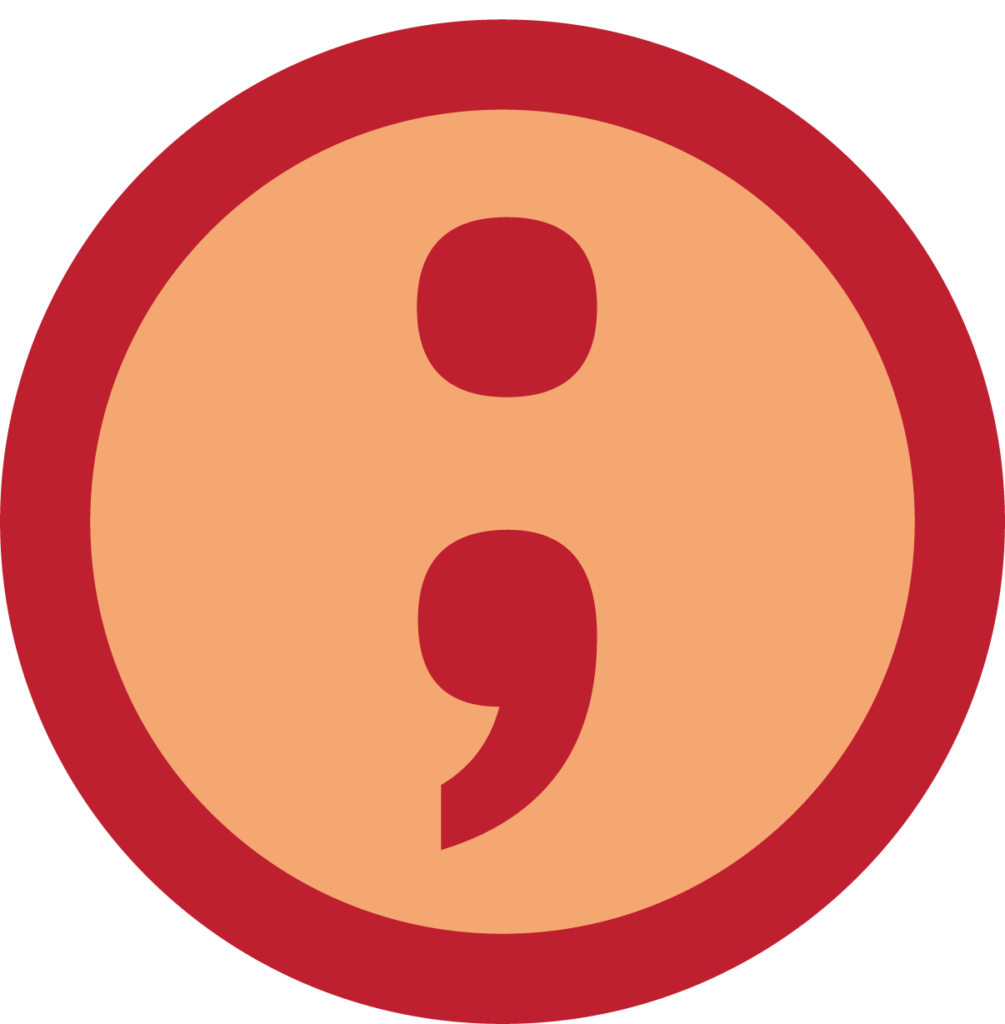
no punctuation needed
Zack came to class breathless and tired ___ he had just come from baseball practice.
no punctuation needed
The book was written by ___ Peter Jay Montreville.
no punctuation needed
The tables at the party had wonderful decorations ___ flowers, ribbons, balloons, and crystal birds.
no punctuation needed
The play was excellent! All of the actors were lively ___ and the set was beautifully decorated.
no punctuation needed
I do my homework every night ___ because that's how you get a good grade.
no punctuation needed
The artist preferred to paint in oils ___ he did not like water colors.
no punctuation needed
Even when the house looks clean ___ there is usually dirt swept under the rugs.
no punctuation needed
I know the perfect job for her ___ a politician.
no punctuation needed
Computers do many calculations at once ___ however, they cannot think.
no punctuation needed
Nate, who works as a software engineer, majored in computer science.
correct
incorrect
Because Jesse is my friend; I invited him to my party.
correct
incorrect
Although, I want to go to Hawaii for Joe’s wedding I have to work.
correct
incorrect
Unable to focus because of the loud construction work outside, Harry went to the library to study.
correct
incorrect
During spring break, my days will consist of: eating, watching Netflix, and sleeping.
correct
incorrect
Dorothy failed her test, it was extremely difficult.
correct
incorrect
Dorothy failed her test, but it was extremely difficult.
correct
incorrect
Last week, Theodore, who is an extremely conscientious student, won a $10,000 scholarship; his parents are incredibly proud.
NO CHANGE
student won
scholarship: parents
scholarship, parents
Julie was thoroughly confused: she couldn’t figure out where she put her car keys.
NO CHANGE
confused, she
confused she,
confused she
Fill in the blank with the correct punctuation:
We plan on arriving at school at 7 ___ 45 in the morning.
; (semicolon)
: (colon)
. (period)
- (hyphen)
Fill in the blanks with the correct punctuation:
The small dog is incredibly loud ___ it's surprising.
; (semicolon)
: (colon)
. (period)
- (hyphen)

