
 Worksheets
Expansion of Trade Networks (1200-1450) Quiz
Total questions: 100
Worksheet time: 50mins
Which of the following was a key factor in the expansion of trade between 1200 and 1450?
The decline of powerful empires
The isolation of regions
Technological and commercial innovations
Decreased demand for luxury goods
What was one major consequence of the growing trade networks between 1200 and 1450?
The end of cross-cultural exchanges
The rapid spread of deadly diseases like the bubonic plague
The decline of technological diffusion
The isolation of Afro-Eurasia
Which empire played a significant role in promoting trade along the Silk Roads during this period?
Roman Empire
Mongol Empire
Byzantine Empire
Ottoman Empire
How did improvements in commercial practices contribute to the expansion of trade networks?
By reducing the volume of trade
By limiting the geographical reach of trade
By facilitating larger networks of exchange through forms of credit
By discouraging the demand for luxury goods
Which of the following luxury goods was in high demand and contributed to the growth of trade?
Cotton from India
Silk and porcelain from China
Potatoes from South America
Coffee from Arabia
What was a significant effect of merchants and other travelers moving from place to place along trade routes?
The spread of only economic ideas
The introduction of religious beliefs and technological developments to new communities
The decline of cross-cultural exchanges
The isolation of powerful cities
Why did the rise of powerful states and empires between 1200 and 1450 help expand trade networks?
They discouraged trade to maintain control
They increased the volume and geographical reach of trade networks
They isolated their regions from others
They banned the use of luxury goods
How did the Mongol Empire contribute to the development of trade networks in Eurasia?
By closing the Silk Roads to foreign merchants
By promoting trade and creating a vast commercial network
By discouraging technological innovation
By limiting the movement of people
Analyze how the spread of deadly diseases, such as the bubonic plague, was connected to the expansion of trade networks during this period.
Trade networks isolated regions, preventing disease spread
Increased movement of people and goods along trade routes facilitated the rapid spread of diseases
Trade networks only spread technological innovations, not diseases
The spread of disease was unrelated to trade networks
Explain how the transfer of ideas and technologies, such as paper making and gunpowder, impacted societies along the trade routes.
It led to the decline of all societies involved
It had no significant impact on societies
It contributed to cultural and technological advancements in new communities
It caused societies to become more isolated
Which topic focuses on explaining the causes and effects of the growth of networks of exchange after 1200 along the Silk Roads?
Topic 2.1: The Silk Roads
Topic 2.3: Exchange in the Indian Ocean
Topic 2.4: Trans-Saharan Trade Route
Topic 2.5: Cultural Consequences of Connectivity
What is one of the main learning objectives for Topic 2.2: The Mongol Empire and the Modern World?
Explain the causes of the growth of networks of exchange after 1200.
Explain the process of state building and decline in Eurasia over time.
Explain the environmental effects of networks of exchange in Afro-Eurasia.
Explain the similarities and differences among various networks of exchange.
Which topic asks students to explain the role of environmental factors in the development of networks of exchange from c. 1200 to c. 1450?
Topic 2.6: Environmental Consequences of Connectivity
Topic 2.3: Exchange in the Indian Ocean
Topic 2.5: Cultural Consequences of Connectivity
Topic 2.1: The Silk Roads
How did the expansion of empires influence trade and communication over time according to the learning objectives?
It led to the decline of all trade routes.
It influenced trade and communication by expanding networks and facilitating exchange.
It had no effect on trade and communication.
It only affected cultural exchange, not trade.
What is the focus of Topic 2.5: Cultural Consequences of Connectivity?
Explaining the causes of the growth of networks of exchange.
Explaining the intellectual and cultural effects of various networks of exchange in Afro-Eurasia from c. 1200 to c. 1450.
Explaining the environmental effects of networks of exchange.
Explaining the process of state building and decline.
Compare the similarities and differences among the various networks of exchange in the period from c. 1200 to c. 1450. What topic covers this objective?
Topic 2.7: Comparison of Economic Exchange
Topic 2.1: The Silk Roads
Topic 2.4: Trans-Saharan Trade Route
Topic 2.2: The Mongol Empire and the Modern World
Why is the Mongol Empire significant in larger patterns of continuity and change according to the learning objectives?
Because it was the only empire in Eurasia.
Because it influenced trade, communication, and state building over time.
Because it had no impact on exchange networks.
Because it only affected the Indian Ocean trade.
What are students expected to explain regarding the Trans-Saharan Trade Route?
The causes and effects of the growth of Trans-Saharan trade.
The environmental effects of trade in Afro-Eurasia.
The intellectual effects of exchange networks.
The similarities among all trade routes.
Which topic requires students to explain the environmental effects of various networks of exchange in Afro-Eurasia from c. 1200 to c. 1450?
Topic 2.6: Environmental Consequences of Connectivity
Topic 2.2: The Mongol Empire and the Modern World
Topic 2.3: Exchange in the Indian Ocean
Topic 2.5: Cultural Consequences of Connectivity
If you were to analyze the effects of the growth of networks of exchange after 1200 in the Indian Ocean, which topic would you refer to?
Topic 2.3: Exchange in the Indian Ocean
Topic 2.1: The Silk Roads
Topic 2.4: Trans-Saharan Trade Route
Topic 2.7: Comparison of Economic Exchange
What was a key factor that led to the revival of the Silk Roads in the 8th and 9th centuries?
The invention of the steam engine
The collapse of the Roman Empire
Arab merchants from the Abbasid Empire reviving the land route
The discovery of America
Which of the following was NOT a luxury good in high demand along the Silk Roads?
Silk
Tea
Gold
Coal
How did the Crusades contribute to the growth of exchange networks?
By destroying trade routes
By bringing back fabrics and spices from the East
By inventing paper money
By closing the Mediterranean Sea to trade
Why did interregional trade on the Silk Roads flourish in the 14th and 15th centuries?
The use of steamships
Increased demand for luxury goods and safer travel methods
The discovery of the Cape of Good Hope
The fall of the Han Empire
Which innovation did the Chinese develop to help manage increasing trade on the Silk Roads?
The compass
Paper money
The printing press
Gunpowder
Explain how the rise of new empires contributed to the revival of the Silk Roads after the 8th and 9th centuries.
New empires closed all trade routes
New empires, such as the Abbasid Empire, revived land and sea routes, increasing global trade
New empires banned the use of luxury goods
New empires focused only on local trade
Strategically, why was the Silk Roads network important for Europe and China during the period after 1200?
It allowed for the exchange of only agricultural products
It provided a route for luxury goods, increased global trade, and connected distant regions
It was used exclusively for military campaigns
It was a route for European explorers to reach America
Which empire had the most significant impact on the expansion of trade along the Silk Roads during the 13th and 14th centuries?
Roman Empire
Mongol Empire
Ottoman Empire
Han Empire
What was one major improvement in transportation technology that helped increase the weight camels could carry on the Silk Roads?
Use of iron wheels
Design of better saddles
Construction of paved roads
Introduction of steam engines
During the Han Dynasty, which two inventions helped aid navigation and ship control along the seas?
Steam engine and anchor
Magnetic compass and rudder
Telescope and propeller
Sextant and hull
The Chinese junk, developed during the Han Dynasty, was notable for which of the following features?
It was powered by steam
It had multiple sails and was divided into compartments
It was made entirely of metal
It was used only for warfare
What was a significant effect of the expansion and stability of the Silk Roads?
The decline of trade in Asia
The development of cities and oases along the routes
The isolation of China from other regions
The end of maritime trade
Why did cities along the Silk Roads become thriving centers of trade?
They were located in cold, mountainous regions
They were watered by rivers, making them suitable for trade
They were isolated from other trade routes
They only traded with Europe
Which city is located at the western edge of China where the northern and southern routes of the Silk Roads crossed?
Beijing
Kashgar
Shanghai
Samarkand
How did the Mongols increase the safety of travel on the Silk Roads?
By building walls along the roads
By improving roads and punishing bandits
By closing the trade routes
By limiting travel to only Mongol citizens
What was the purpose of dividing the hull of a Chinese junk into compartments?
To store more cargo
To strengthen the ship for rough voyages and reduce the risk of sinking
To allow passengers to travel in luxury
To make the ship faster
Which of the following best describes the role of oases along the Silk Roads?
They were military outposts
They provided water and became centers of trade in arid regions
They were used only for religious ceremonies
They marked the end of the Silk Roads
Which city was known for its artisans and as a center of Islamic scholarship along the Silk Roads?
Kashgar
Beijing
Istanbul
Delhi
What was Samarkand famous for during the time of the Silk Roads?
Its gold mines
Its cultural exchange and decorated mosques
Its naval fleet
Its mountain fortresses
Which religions were present in Samarkand according to archaeological remains?
Christianity, Buddhism, Zoroastrianism, and Islam
Hinduism, Judaism, Taoism, and Islam
Christianity, Hinduism, Sikhism, and Islam
Buddhism, Shinto, Jainism, and Islam
What is a caravanserai?
A type of silk fabric
An inn for travelers and their animals along trade routes
A religious temple
A government office
Why were caravanserais typically spaced about 100 miles apart along the Silk Roads?
That was the distance camels could travel before needing water
It was the distance between major cities
It was required by law
It was the distance traders preferred for safety
How did China manage increasing trade along the Silk Roads?
By using barter systems only
By developing new financial systems and using money
By closing the trade routes
By only trading with Europe
What problem did China face with copper coins during the Silk Roads era?
They were too valuable
They became too unwieldy to transport
They were not accepted by traders
They were made of gold
What was the primary purpose of caravanserais, as described in the text?
To serve as military forts for soldiers
To provide stalls for animals and chambers for people traveling
To act as government offices for tax collection
To function as marketplaces for local farmers
What was "flying cash" in the context of trade and banking?
A type of coin used in ancient Rome
A system of credit allowing merchants to deposit paper money in one location and withdraw it in another
A method of sending gold by carrier pigeons
A form of barter using silk and spices
Which innovation became the model for modern banks in the 1300s?
Hanseatic League
Banking houses
Caravans
Guilds
What is a "bill of exchange" as described in the text?
A document promising payment of a set amount on a set date
A list of goods traded between cities
A type of coin used in medieval Europe
A contract for building ships
How did the Hanseatic League contribute to trade in northern Europe during the 13th century?
By building roads across Asia
By forming a commercial alliance to control trade and drive out pirates
By inventing new types of ships
By establishing new forms of currency
Why did the Hanseatic League eventually decline in the mid-17th century?
The league ran out of resources
National governments became strong enough to protect their own merchants
Pirates destroyed all league ships
The league lost interest in trade
Analyze how the development of banking houses and the use of bills of exchange might have encouraged and supported trade in medieval Europe.
By making trade more convenient and stable through secure financial transactions
By increasing the number of pirates on trade routes
By forcing merchants to use only gold coins
By limiting trade to only local markets
According to Matthew Paris, what impact did the Mongols have on the eastern parts of Europe?
They brought peace and prosperity.
They brought terrible devastation, razed cities, and killed townspeople.
They established new trade routes and built gardens.
They converted everyone to their religion.
What essential question does the text suggest about Eurasian empires?
How did Eurasian empires influence art and music?
How did Eurasian empires grow over time, and how did their expansion influence trade and communication?
How did Eurasian empires conquer Africa?
How did Eurasian empires develop new languages?
What was the reputation of the Mongols during the 13th century?
They were known for their peaceful negotiations.
They were famous for their architectural achievements.
They were feared for their slaughter and destruction.
They were respected for their religious tolerance.
How did the Mongol conquests affect interregional connection and exchange?
They isolated regions from each other.
They sparked a period of interregional connection and exchange at a level not experienced in a thousand years.
They destroyed all trade routes.
They made communication impossible.
Where did the Mongols live in the 12th century?
In the rainforests of South America.
North of the Gobi Desert in East Asia.
In the mountains of Europe.
On islands in the Pacific Ocean.
What was a key aspect of Mongol culture regarding skills and values?
Only men were allowed to ride horses.
Everyone was expected to become skilled horse riders and value courage in hunting and warfare.
They discouraged hunting and warfare.
They focused only on farming and fishing.
Which tribes and kingdoms did the Mongols covet for their relative wealth?
Tribes located closer to the Silk Roads.
Tribes in the Amazon rainforest.
Tribes in southern Africa.
Tribes in western Europe.
Why did the Mongols have easier access to luxury goods such as silk clothing and gold jewelry?
Because they were skilled farmers.
Because they lived near the ocean.
Because they were located closer to the Silk Roads.
Because they traded only with Europe.
Who was Temujin better known as?
Genghis Khan
Kublai Khan
Attila the Hun
Timur
What was the name of the meeting where Temujin was elected khan of the Mongolian Kingdom?
Kuriltai
Khanate
Shogunate
Senate
Which empire did Genghis Khan attack in 1210?
Jin Empire
Roman Empire
Ottoman Empire
Byzantine Empire
What was the capital of the Jin Empire that Genghis Khan attacked?
Zhongdu
Samarkand
Baghdad
Moscow
By 1227, Genghis Khan’s khanate reached from the North China Sea to which region?
Eastern Persia
Western Europe
Southern India
Northern Africa
Why did Genghis Khan sometimes appoint nonfamily members to positions over family members?
He valued talent and loyalty over family ties
He disliked his family
He wanted to avoid nepotism charges
He had no family members available
How did Genghis Khan help improve communication between units in his army?
He created a messenger force that rode for days without stopping
He used carrier pigeons
He relied on smoke signals
He sent written messages by boat
What weapon were Mongolian soldiers especially proficient with?
Short bow
Long sword
Spear
Crossbow
How did stories of Genghis Khan’s brutality affect his military campaigns?
They induced some leaders to surrender before an attack
They made his soldiers afraid of him
They caused his enemies to unite against him
They led to peace negotiations
What role did special units that mapped the terrain play in Genghis Khan’s army?
They helped the army navigate and plan attacks more effectively
They were responsible for cooking meals
They managed the horses
They negotiated with enemy leaders
Which of the following best compares the leadership strategies of Genghis Khan with those of another historical leader?
Answers will vary, but should include reasoning and evidence comparing Genghis Khan’s focus on loyalty, talent, and ruthlessness with another leader’s strategies.
Only Genghis Khan was ruthless.
All leaders used the same strategies.
Genghis Khan did not value loyalty.
Factors that contributed to the rapid expansion of Genghis Khan’s empire included:
Weak enemies and luck
Strong soldiers, efficient command structure, use of brutality, and strategic planning
Only the use of horses
Only the use of short bows
What military strategy did the Mongols often use to confuse and outflank their enemies?
Direct frontal assault
Feigned retreat followed by ambush
Naval blockade
Siege by starvation
Which of the following best describes the Pax Mongolica?
A period of constant warfare in Eurasia
The Mongol policy of religious intolerance
A period of peace and stability in Eurasia during the 13th and 14th centuries
The Mongol conquest of China
What was one way Genghis Khan kept contact with the far reaches of his empire?
By sending carrier pigeons
By creating a type of pony express for oral messages
By using smoke signals
By building telegraph lines
Which alphabet did Genghis Khan attempt to adapt for the Mongol language?
Latin alphabet
Cyrillic alphabet
Uyghur alphabet
Arabic alphabet
How did the Mongols benefit from the expertise of conquered peoples?
They ignored local technologies
They forced everyone to become soldiers
They recruited skilled workers and engineers to improve their military technology
They destroyed all local knowledge
Which of the following was a social policy of Genghis Khan that was unusual for the 13th century?
Religious tolerance throughout the empire
Mandatory military service for all citizens
Complete isolation from other cultures
Abolishing all forms of trade
Why did Genghis Khan’s soldiers take charge of protecting the Silk Roads?
To prevent trade with Europe
To make the roads safe for trade and encourage economic growth
To collect taxes from travelers
To block the spread of new religions
How did the Mongol Empire’s control of the Silk Roads impact trade between Asia, Africa, and Europe?
It decreased trade due to constant warfare
It made trade more dangerous
It increased trade by making routes safer and establishing new channels
It led to the collapse of all trade networks
Analyze how Genghis Khan’s policy of religious tolerance might have contributed to the stability of the Mongol Empire.
It caused frequent rebellions among conquered peoples
It encouraged unity and cooperation among diverse groups within the empire
It led to the decline of Mongol power
It had no effect on the stability of the empire
What strategic advantage did the Mongols gain by incorporating the technology and skills of conquered peoples into their military?
They became less innovative
They were able to develop improved siege weapons and military tactics
They lost control over their own army
They abandoned all traditional Mongol practices
Who was Batu, and what significant military action did he lead in 1236?
Batu was the son of Khan's oldest son and led a Mongolian army into Russia.
Batu was a Russian prince who defended Kiev from the Mongols.
Batu was a Chinese general who invaded the Mongol Empire.
Batu was a Persian leader who allied with the Mongols.
What was the Golden Horde?
A Mongolian army led by Batu that conquered Russian kingdoms and forced them to pay tributes.
A group of European knights who fought against the Mongols.
The ruling dynasty of China during the 13th century.
A trade alliance between Mongol and Russian merchants.
What happened to the city of Kiev in 1240?
It was looted and destroyed by the Golden Horde.
It became the capital of the Mongol Empire.
It formed an alliance with Batu.
It was protected by Western European knights.
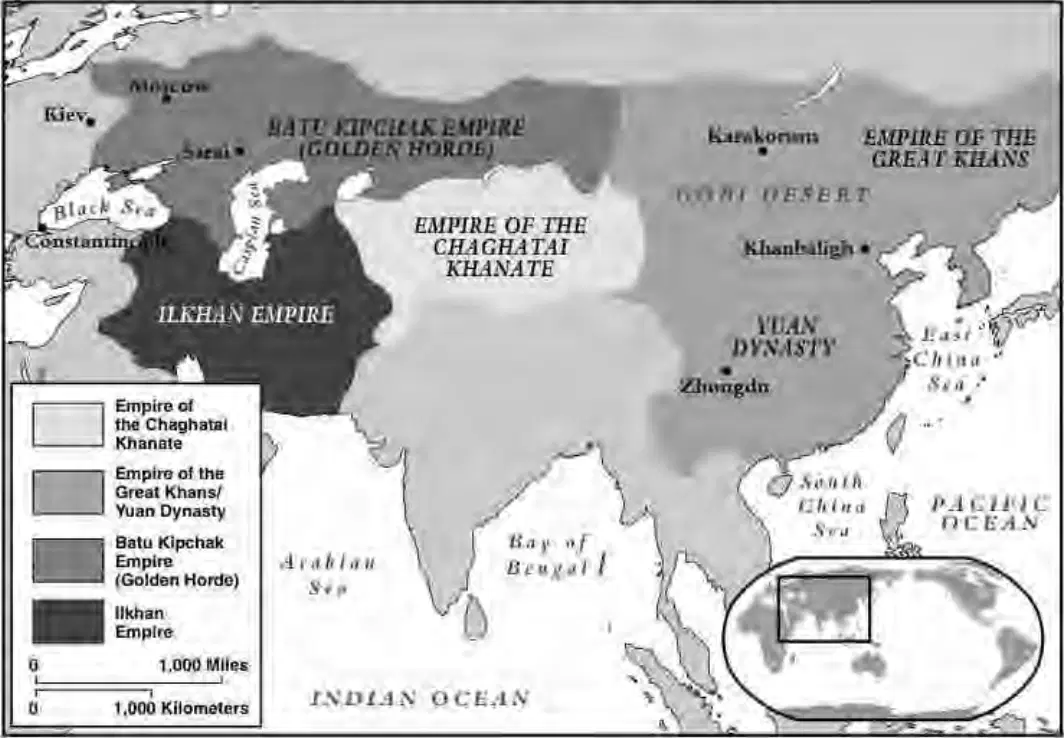
Which of the following empires is NOT shown on the map of Mongol Empires in the 13th Century?
Roman Empire
Ilkhan Empire
Empire of the Chaghatai Khanate
Batu Kipchak Empire (Golden Horde)
Why did Western European sympathy for the Mongols evaporate after the Golden Horde conquered Russia?
Because the Golden Horde conquered a Christian region.
Because the Mongols promoted religious toleration.
Because the Mongols allied with Western Europe.
Because the Mongols withdrew from Russia.
What was the outcome of the Battle of Kulikovo in 1380?
The Golden Horde was defeated, and Mongol influence in Russia began to decline.
The Mongols conquered all of Western Europe.
The Mongols established a new capital in Moscow.
The Golden Horde expanded its territory into China.
How did the Mongols rule northern Russia after their conquest?
By working through existing Russian rulers who sent regular tributes.
By directly governing every city-state themselves.
By destroying all Russian cities and replacing them with Mongol settlements.
By forming alliances with Western European kingdoms.
What strategic action did the rulers of Moscow take to resist Mongol rule?
They set aside tributes to develop an army and built an anti-Mongol coalition.
They allied with the Mongols to conquer Western Europe.
They moved their capital to China.
They paid higher tributes to avoid conflict.
Why did Batu call off his attacks on Italy and Austria?
Ogodei Khan, the Great Khan’s successor, died and Batu returned home to attend the funeral.
He was defeated by Hungarian knights.
He lost interest in military campaigns.
He was captured by Western European forces.
Which Mongol leader led the conquest of the Abbasid territories and the destruction of Baghdad in 1258?
Hulegu
Kublai Khan
Batu Khan
Genghis Khan
What was the name of the Mongol kingdom in Central Asia that stretched from Byzantium to the Oxus River?
Il-khanate
Golden Horde
Yuan Dynasty
Chagatai Khanate
What was a significant result of three centuries of Mongol rule in Russia?
Russia developed a more distinctly Russian culture
Russia became part of the Mongol Empire permanently
Russia adopted Mongolian as its official language
Russia converted to Buddhism
After the Mongols converted to Islam in the Il-khanate, what change occurred in their treatment of other religions?
They supported massacres of Jews and Christians
They continued to tolerate all religions
They converted everyone to Buddhism
They banned all religious practices
Which dynasty did Kublai Khan establish after conquering China?
Yuan Dynasty
Song Dynasty
Ming Dynasty
Tang Dynasty
How did Kublai Khan's policies toward religion differ from those of the Song Dynasty?
He was more tolerant of various religions, including Buddhists, Daoists, Muslims, Jews, and Christians
He banned all religions except for Mongolian shamanism
He forced everyone to convert to Islam
He persecuted Buddhists and Daoists
Why did the Mongols find it effective to have Persians serve as ministers and officials in the Il-khanate?
It resulted in maximum tax collection
It allowed for easier conversion to Islam
It helped them conquer more territory
It reduced the power of the Mongol leaders
Analyze how the Mongol invasions and subsequent rule influenced the development of Russian culture and statehood.
It led to a more centralized leadership and a distinct Russian culture
It caused Russia to become part of Western Europe
It resulted in Russia adopting Mongolian customs entirely
It made Russia a Buddhist nation
Evaluate the impact of Kublai Khan’s religious policies on the stability and prosperity of the Yuan Dynasty.
His religious tolerance inspired loyalty and contributed to stability and prosperity
His intolerance led to frequent rebellions
His policies caused economic decline
His focus on only one religion weakened the dynasty
Which of the following statements best describes the role of Mongol women compared to women in other societies of their time?
Mongol women were mostly confined to household duties and could not own property.
Mongol women led more independent lives, tended flocks, wore leather trousers, and could initiate divorces.
Mongol women were not allowed to ride horses or remarry after being widowed.
Mongol women were required to follow strict religious practices and could not work outside the home.

