
 Worksheets
UNIT 2 EXAM: Cells (APbio 25-26)
Total questions: 20
Worksheet time: 10mins
Which of the following cell components are found in prokaryotic cells
(A) Rough ER
(B) Nucleus
(C) Cell Membrane
(D) Mitochondria
(E) Lysosomes
Why are plant cells a good source of evidence for the Endosymbiotic Theory?
A. Plants have the largest organelles in eukaryotic cells.
B. Plants contain both organelles, mitochondria and chloroplasts, which have similar circulatory
DNA as bacteria cells and ribosomes
C. Plants have a cell wall that demonstrate how to keep your shape
D. Plants do not have centrioles needed for cell division
Which organelle in plant cells is primarily involved in maintaining cell rigidity and storing nutrients, water, and waste products?
Endoplasmic Reticulum
Lysosome
Vacuole
Mitochondria
Which of the following statements about organelle functions is NOT accurate?
Mitochondria: responsible for converting energy from the sun into chemical energy
Peroxisome: involved in the breakdown of fatty acids and detoxification of harmful substances
Rough Endoplasmic Reticulum: studded with ribosomes and primarily involved in protein synthesis
Vacuole: stores nutrients, waste products, and helps maintain turgor pressure in plant cells
Which organelle is responsible for packaging and modifying proteins for transport within or outside the cell?
Golgi complex
Lysosome
Mitochondria
Chloroplast
In an animal cell, where is cholesterol primarily found?
(A) Within the plasma membrane
(B) Floating freely in the cytoplasm
(C) Inside the nucleus
(D) Attached to mitochondria
While investigating ion regulation in freshwater fish, Evelyn discovers that the sodium-potassium pump in gill cells is crucial for maintaining sodium ion concentrations. Which of the following statements about this pump is INCORRECT?
(A) It moves sodium ions by passive diffusion.
(B) It requires ATP to function.
(C) It contains binding sites for both sodium and potassium ions.
(D) It is embedded in the cell membrane as a protein.
(E) It helps maintain ion gradients across the membrane.
Which of the following processes is an example of active transport across a cell membrane?
Sodium ions being pumped out of a cell
Oxygen diffusing into a cell
Glucose moving down its concentration gradient
Water entering a cell by osmosis
Cholesterol is transported in the bloodstream as cholesterol-protein complexes, which are taken up by animal cells and incorporated into their membranes. If an animal’s body cells are defective in endocytosis, what is the most likely consequence?
(A) The animal’s body cells will have excess cholesterol in their membranes.
(B) The animal’s blood will have elevated levels of cholesterol.
(C) The animal’s body cells will produce more cholesterol internally.
(D) The animal’s body cells will have increased phospholipid content.
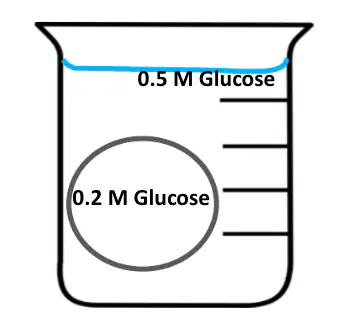
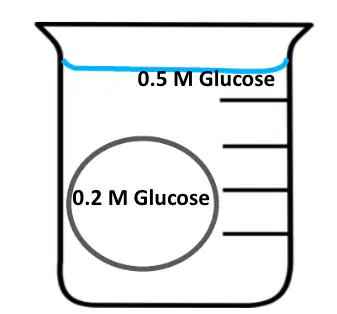
A cell containing 0.2 M glucose is placed in a beaker containing 0.5 M glucose, as shown in the image. What type of environment is inside the cell?
Hypotonic
Hypertonic
Isotonic
Turgid
A cell with a water potential of -0.6 MPa is placed in a solution with a water potential of -0.8 MPa. What will happen to the movement of water?
Water will move into the cell
Water will move out of the cell
Water will move equally in and out of the cell
No movement of water will occur
Aquaporins are integral membrane proteins that facilitate water movement across cell membranes. Researchers are investigating the role of aquaporins by comparing plant cells with functional aquaporins to those with mutated, nonfunctional aquaporins. Both cell types are placed in a hypotonic solution. Which of the following observations would indicate that water can still enter the cell even when aquaporins are nonfunctional?
(A) Cells with mutated aquaporins remain flaccid and do not change in volume.
(B) Cells with mutated aquaporins swell slightly, showing a small increase in turgor pressure.
(C) Cells with functional aquaporins lose water and become plasmolyzed.
(D) Cells with functional aquaporins show no change in turgor pressure.
What is the solute potential of a 1M glucose solution at 30 degrees Celsius?
(R=0.00831 and Glucose does not ionize so i=1)
-0.74 MPa
-1.48 MPa
-2.96 MPa
-0.37 MPa
How does the surface area to volume ratio change as a cell becomes smaller?
The SA:V ratio increases
The SA:V ratio decreases
The SA:V ratio stays the same
The SA:V ratio fluctuates unpredictably

In an experiment, the efficiency of oxygen exchange across the plasma membrane is being assessed in four artificial red blood cells. The table included lists some properties of those artificial cells. Other conditions being equal, which artificial cell is predicted to be the least efficient in exchanging oxygen with the environment by diffusion?
Which of the following processes allows small, nonpolar molecules to move directly through the phospholipid bilayer without the aid of membrane proteins?
Facilitated diffusion
Active transport
Endocytosis
Simple diffusion
A plant cell is placed in a solution with a higher water potential than the cell's cytoplasm. What is the most likely outcome?
The cell will burst due to lack of a cell wall
No net movement of water will occur
Water will move out of the cell, causing plasmolysis
Water will move into the cell, increasing turgor pressure
Which organelle is primarily responsible for packaging and sorting proteins for secretion or delivery to other organelles?
Ribosome
Golgi apparatus
Vacuole
Nucleus

