
 Worksheets
Single Slit Diffraction
Total questions: 50
Worksheet time: 34mins
Two beams of coherent light travel different paths, arriving such that they destructively interfere on the screen. The two beams must
arrive in phase
arrive 45-degrees out of phase
arrive 90-degrees out of phase
arrive 180-degrees out of phase
Which would have the widest-spaced fringe pattern for light traveling through a diffraction grating?
large wavelength and a small slit spacing
small wavelength and small slit spacing
large wavelength and a large slit spacing
small wavelength and a large slit spacing
what is diffraction
is a soild liquid gass
is a beam of light that is spread out and passes through an object
a beam of light
A wave of constant wavelength diffracts as it passes through an opening in a barrier. As the size of the opening is increased, the diffraction effects
decrease
increase
remain the same

What happens to the frequency of a wave as it passes through a gap?
Increases
Decreases
No change
None of above
Does the wave speed change after diffraction?Explain it.
Yes. It slows down.
Yes. It speeds up.
No. There is nothing change about the medium.
No. Because the frequency doesn't change.
how does diffraction work
it goes through water and air
is a beam of light stopping at a wall
it bounces off of light
is the bending of light as it passes around the edge of an object
Which diagram best represents the shape and direction of a series of wave fronts after they have passed through a small opening in a barrier?
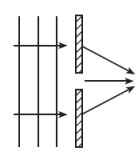
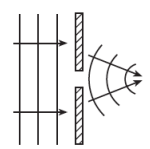
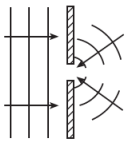
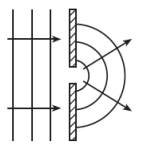

This diagram shows a series of straight wave fronts produced in a shallow tank of water approaching a small opening in a barrier.


For destructive interference, the path difference is:
odd number of half wavelengths
even number of half wavelengths
whole number of wavelengths
even whole number of wavelengths
What principle is responsible for light spreading as it passes through a narrow slit?
refraction
polarization
diffraction
interference
What principle is responsible for alternating light and dark bands when light passes through two or more narrow slits?
refraction
polarization
diffraction
interference
Two light sources are said to be coherent if they
are of the same frequency.
are of the same frequency, and maintain a constant phase difference.
are of the same amplitude, and maintain a constant phase difference.
are of the same frequency and amplitude.

What would you call this?
Bounce back
Reflection
Diffraction
Refraction

In an experiment, water waves in a ripple tank are incident on a gap, as shown.
Some diffraction of the water waves is observed.
Which change to the experiment would provide a better demonstration of diffraction?
Increase the amplitude of the waves.
Increase the frequency of the waves.
Increase the wavelength of the waves.
Increase the width of the gap.
Water waves in a ripple tank are made to pass through a small gap, as shown.
Which diagram shows the waves after they have passed through the gap?


A wave on the surface of water passes through a gap between two barriers and is diffracted, as shown.
What happens when the frequency of the wave is halved?
Less diffraction is observed.
More diffraction is observed.
There is no diffraction.
The same amount of diffraction is observed.
In which situation does diffraction occur?
A wave bounces back from a surface.
A wave passes from one medium into another.
A wave passes through a gap in a barrier.
Waves from two identical sources are superposed.
A sound wave of wavelength 0.50 m passes through a doorway of width 1.0 m between two rooms. Which change increases the amount of diffraction that takes place?
Double the amplitude of the sound wave.
Double the width of the doorway.
Halve the frequency of the sound wave.
Halve the period of the sound wave.
The diagrams show the diffraction of water waves in a ripple tank as they pass through a gap between two barriers. Which diagram is correct?


What is diffraction?
The reflection of a wave off a surface
The bending of a wave as it moves around an obstacle or passes through a narrow opening
The increase in wave amplitude when two waves meet
The change in direction of waves at the boundary between two different media
When does a wave diffract more?
When its frequency is lower than the size of an opening or obstacle
When its wavelength is shorter than the size of an opening or obstacle
When its wavelength is large compared to the size of an opening or obstacle
When its amplitude is higher than the size of an opening or obstacle
What happens to a wave when it passes through a narrow opening?
It reflects and changes direction.
It diffracts, or spreads out.
It stops and does not continue.
It increases in frequency.

The diagram shows a series of wave fronts approaching an opening in a barrier. Point P is located on the opposite side of the barrier. The wave fronts reach point P as a result of
resonance
refraction
reflection
diffraction
A wave is diffracted as it passes through an opening in a barrier. The amount of diffraction that the wave undergoes depends on both the
amplitude and frequency of the incident wave
wavelength and speed of the incident wave
wavelength of the incident wave and the size of the opening
amplitude of the incident wave and the size of the opening
Parallel wave fronts incident on an opening in a barrier are diffracted. For which combination of wavelength and size of opening will diffraction effects be greatest?
short wavelength and narrow opening
short wavelength and wide opening
long wavelength and narrow opening
long wavelength and wide opening
Which one is the intensity distribution for single slit diffraction only?


In single slit diffraction the longer the wavelength
the more the number of slits
the harder it is for light to propagate
the thinner the principal maximum
the wider the pattern
In single slit diffraction, the central maximum
has the same width as the secondary maxima
has thrice the width of the secondary maxima
has twice the width of the secondary maxima
is quite intense compared to the secondary maxima

Diagram shows diffraction of wave.
Which quantity decreases when the water waves diffract?
Speed
Period
Amplitude
Wavelength
In single slit diffraction the longer the wavelength
the more the number of slits
the harder it is for light to propagate
the thinner the principal maximum
the wider the pattern
In a single-slit diffraction experiment, the width of the slit through which light passes is reduced. What happens to the width of the central bright fringe in the resulting diffraction pattern?
The central bright fringe disappears
It becomes narrower
It becomes wider
It stays the same
A single slit is used to create an interference pattern on a screen using light. Consider the statements that follow with respect to the pattern generated:
I. A longer wavelength of light generates a wider central maximum.
II. When using white light, the outer fringes are coloured.
III. A narrower slit generates a wider central maximum.
Which of the above statements is/are correct?
I only
I and II only
I and III only
I, II, and III
II only
A single slit is used to create an interference pattern on a screen using light. Consider the statements that follow with respect to the pattern generated:
I. A longer wavelength of light generates a wider central maximum.
II. When using white light, the outer fringes are coloured.
III. A narrower slit generates a wider central maximum.
Which of the above statements is/are correct?
I only
I and II only
I and III only
I, II, and III
II only
When violet light of wavelength 415nm falls on a single slit, it creates a central diffraction peak that is 9.2 cm wide on a 2.55m away screen. How wide is the slit?
3 X 10^-8 meters
3.8 X 10^-7 meters
2.3 X 10^-7 meters
4.2 X 10^-6 meters
None of the Above
A single slit 1.0mm wide is illuminated by 450nm light. What is the central maximum (in cm) width in the diffraction pattern on a screen 5.0m away?
3 cm
0.8 cm
0.45 cm
0.5 cm
Light of wavelength 2.50 × 10² nm is incident on a slit. If the second order of dark band corresponds to sin θ= 2.50 × 10⁻³, find the slit width ?
0.02 x 10⁻³m
1.2 x 10⁻⁴m
2 x 10⁻⁴m
2.5 x 10⁻⁴m
A student and his lab partner create a single slit by carefully aligning two razor blades to a separation of
0.300mm. When a helium–neon laser at 660nm illuminates the slit, a diffraction pattern is observed on a screen 1.25m beyond the slit.Calculate the angle θdark the second minimum in the diffraction pattern.
0.11o
0.21o
0.22o
0.27o
In a single-slit diffraction experiment , a beam of monochromatic light is diffracted by a single slit of width 0.200mm. The diffraction pattern forms on a wall 1.20m beyond the slit. The width of the central maximum is 4.00mm.Calculate the wavelength of the light.
0.008 x 10⁻⁶m
0.8 x 10⁻⁶m
4.0 x 10⁻⁶m
8.0 x 10⁻⁶m
When light with a wavelength of 900nm passes through a slit, it forms a second-order dark fringe (m = 2) at θ= 20°.What is the width of the slit?
3.4 x 10⁻⁴m
4.0 x 10⁻⁵m
4.7 x 10⁻⁶m
5.3 x 10⁻⁶m
A slit of width a is used to observe a diffraction pattern on a screen at a distance L from the slit.If the width of the slit were doubled, the width of the central bright band would
decrease by a factor of 4
decrease by a factor of 2
increase by a factor of 2
increase by a factor of 4
Light of wave length 3.5x10² nm is incident on a slit of width 0.5mm . Which of the following expressions corresponds to the angle at which the second order minimum is formed
sinθ= 2.2 x 10 -4
sinθ= 3.5 x 10 -4
sinθ= 1.1 x 10 -3
sinθ= 1.4 x 10 -3
Light of wavelength 2. 5 x 10 2nm is incident on a slit of width 0.3 mm. What order of dark band corresponds to
sinθ = 2. 5 x 10 -3
4
3
2
1
Diffraction occurs when light passes through a single slit. Rank the following three choices in decreasing order, according to the extent of the diffraction that occurs (largest diffraction first)
1- Blue light, narrow slit / 2- Red light, narrow slit / 3- Blue light, wide slit
1,2,3
2,1,3
3,1,2
1,3,2
A single slit diffraction pattern is formed on a distant screen. Assuming the angles involved are small, by what factor will the width of the central bright spot on the screen change if the wavelength of the illuminating light is doubled?
It will be cut to one -quarter its original size
It will be cut in half
It will double
It will become four times as large
A single slit diffraction pattern is formed on a distant screen . Assuming the angles involved are small, by what factor will the width of the central bright spot on the screen change if the slit width is doubled ?
It will be cut to one -quarter of its original size
it will be cut in half
it will double
It will become four times as large

The figure shows the diffraction pattern by a single slit which has a slit size of 0.017 mm and is placed 80 cm from the screen. The light used has a wavelength of 600 nm. what is the width of the central bright band?
5.65 cm
7.21 cm
6.65 cm
8.34 cm
Light of wavelength 554 nm passes through a single slit of width 5.5 μm. At what angular deviation, as measured from the middle of the central maximum, would the 1st order dark fringes appear on a screen that is 4 meters away?
2.89 degrees
5.78 degrees
1.44 degrees
8.69 degrees
Light of wavelength 554 nm passes through a single slit of width 5.5 μm.
What is the width of the central maximum on the screen that is 4 meters away?
0.20 m
0.40 m
0.81 m
1.21 m

