
 Worksheets
SECTION A: Choose and circle the correct answer (10 Marks)
Total questions: 40
Worksheet time: 20mins
The first calculating machine developed in China was:
Pascaline
Abacus
Napier's Bones
Difference Engine
Which generation of computers used vacuum tubes?
First generation
Second generation
Third generation
Fourth generation
A group of 8 bits is called:
Nibble
Byte
Kilobyte
Megabyte
RAM stands for:
Read Access Memory
Random Access Memory
Rapid Access Memory
Ready Access Memory
The process that starts the operating system when you turn on a computer is called:
Processing
Loading
Booting
Starting
Which type of memory is volatile in nature?
ROM
RAM
Hard disk
Flash drive
BIOS stands for:
Basic Input Output System
Binary Input Output System
Basic Internet Output System
Binary Internet Output System
A compiler is used to translate:
Assembly language to machine language
High-level language to machine language
Machine language to assembly language
Binary to decimal
Pressing the Restart button while the computer is already on is called:
Cold boot
Warm boot
Soft boot
Hard boot
Which operating system provides a graphical environment?
DOS
CUI
Windows (GUI)
Command line
The _________ was invented by Blaise Pascal in 1642.
Pascaline
Abacus
Analytical Engine
Difference Engine
The brain of the computer is the _______.
CPU
Monitor
Keyboard
Mouse
A group of 4 bits is called a _______.
Nibble
Byte
Word
Kilobyte
_______ memory is permanent and non-volatile in nature.
ROM
RAM
Cache
Register
An operating system that supports multiple users at the same time is called a _______ operating system.
Multi-user
Single-user
Batch
Real-time
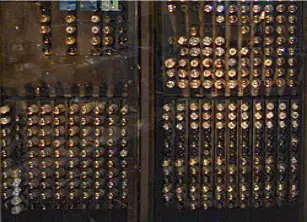
Identify the generation of computer shown:
First Generation
Second Generation
Third Generation
Fourth Generation
Which of the following diagrams correctly shows the functional components of a computer?
A diagram with Input Unit, Output Unit, Memory Unit, and Central Processing Unit (CPU) labeled.
A diagram with Monitor, Keyboard, Mouse, and Printer labeled.
A diagram with Software, Hardware, User, and Network labeled.
A diagram with RAM, ROM, Hard Disk, and USB labeled.
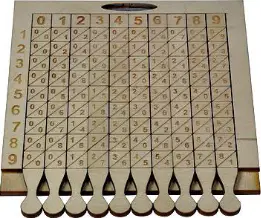
Identify the early calculating device shown in the picture:
Abacus
Slide Rule
Pascaline
Napier's Bones
The difference between RAM and ROM is:
RAM is volatile memory, ROM is non-volatile memory.
RAM stores permanent data, ROM stores temporary data.
RAM is used only for storage, ROM is used for processing.
RAM can only be read, ROM can be both read and written.
Select two characteristics of first generation computers.
They used vacuum tubes and were very large in size.
They used microprocessors and were portable.
They used transistors and were energy efficient.
They used integrated circuits and were very fast.
Booting refers to the process of starting a computer. What are the two types of booting?
Cold booting and Warm booting
Soft booting and Hard booting
Primary booting and Secondary booting
Initial booting and Final booting
The difference between a compiler and an interpreter is:
A compiler translates the entire program before execution, while an interpreter translates and executes line by line.
A compiler executes code line by line, while an interpreter translates the whole program before execution.
Both compiler and interpreter execute the program at the same time.
A compiler and an interpreter perform the same function.
Which of the following are functions of an operating system?
Memory management and process management
Web browsing and email sending
Document editing and printing
Hardware manufacturing and sales
Unscramble the term: 'CITMPOUER'
COMPUTER
COMPUTE
COMPILER
CUMPTIER
Unscramble the term: 'OSYTEMTNI'
SYSTEM
MISTONE
STYMENO
TONYMES
The purpose of an operating system is:
To manage computer hardware and software resources
To design websites
To create graphics
To manufacture computer chips
Unscramble the term: 'NTEWROK'
NETWORK
KETWORN
WONKRET
TREKNOW
What are the differences between system software and application software?
System software manages hardware and provides a platform for application software. Examples: Windows OS, Linux, MacOS. Application software helps users perform specific tasks. Examples: Microsoft Word, Adobe Photoshop, Google Chrome.
System software is used for entertainment purposes, while application software is only used for business tasks.
System software is always open-source, whereas application software is always proprietary.
System software is designed for mobile devices only, while application software is for desktop computers.
What is an operating system?
An operating system is system software that manages computer hardware, software resources, and provides common services for computer programs.
An operating system is a type of application software used for creating documents and spreadsheets.
An operating system is a hardware device that stores data permanently.
An operating system is a programming language used to develop computer applications.
Name three functions that an operating system performs.
Three functions of an operating system are: managing hardware resources, controlling processes, and allocating memory.
Three functions of an operating system are: sending emails, browsing the internet, and playing games.
Three functions of an operating system are: designing web pages, editing videos, and creating presentations.
Three functions of an operating system are: printing documents, scanning images, and making phone calls.
It is important to shut down a computer properly because:
It helps prevent data loss and hardware damage.
It makes the computer run faster.
It increases the screen brightness.
It automatically updates all software.
D. What might happen if you don't shut down the computer properly?
The computer may get damaged or lose unsaved data.
The computer will run faster.
The computer will automatically update itself.
The computer will become virus-free.
A. The best type of computer classification for Fatima's work is: microcomputer, minicomputer, mainframe, or supercomputer. Why?
Microcomputer
Minicomputer
Mainframe
Supercomputer
The difference between primary memory and secondary memory is:
Primary memory is volatile and used for temporary storage, while secondary memory is non-volatile and used for permanent storage.
Primary memory is used for permanent storage, while secondary memory is volatile and used for temporary storage.
Primary memory and secondary memory are both used for permanent storage.
Primary memory is slower than secondary memory.
If Fatima's computer has 8 GB of RAM, how many megabytes (MB) is this? Show your calculation. (1 mark)
8 MB
800 MB
8192 MB
1024 MB
Which of the following is a characteristic of second generation computers?
They used transistors instead of vacuum tubes.
They were smaller and more energy-efficient than first generation computers.
They used integrated circuits.
They were primarily used for scientific calculations.
What does the acronym 'CPU' stand for?
Computer Processing Unit
Central Program Unit
Computer Personal Unit
Central Processing Unit
Which of the following is an example of secondary memory?
RAM
Cache Memory
ROM
Hard Disk Drive
Which of the following is a type of system software?
Spreadsheet application
Word processor
Operating System
Web browser
What is the primary function of the CPU?
To store data
To process instructions
To display output
To connect to the internet

