
 Worksheets
Disaster Risk Reduction and Management in the Philippines
Total questions: 100
Worksheet time: 50mins
Which two major tectonic plates meet at the Pacific Ring of Fire near the Philippines?
Pacific Plate and Eurasian Plate
African Plate and Indian Plate
North American Plate and South American Plate
Australian Plate and Antarctic Plate
How many volcanoes are there in the Philippines, and how many are classified as active?
220 volcanoes, 22 active
100 volcanoes, 10 active
50 volcanoes, 5 active
300 volcanoes, 30 active
What percentage of typhoons originate from the North Pacific Basin?
75%
50%
25%
100%
On average, how many cyclones cross the Philippine Area of Responsibility (PAR) each year?
20
10
5
30
Which organization ranked the Philippines as the fourth most accident-prone country in the world in 2015?
International Red Cross and Red Crescent Societies
United Nations
World Health Organization
Greenpeace
Why is it important for every Filipino to understand concepts on Disaster Risk Reduction and Management (DRRM)?
To help reduce the impact of disasters and calamities
To learn about volcanoes
To become a scientist
To travel safely
Which of the following is NOT a factor that aggravates natural risks in the Philippines?
Responsible risk assessment
Exploitation of forests and minerals
Development interventions without risk assessment
Human activities
What is one of the expected learning outcomes of this chapter?
Explain the operational concept, structures, and priority actions of the Philippines disasters Management system
Learn how to cook Filipino food
Memorize the names of all volcanoes
Write a story about a typhoon
How has human conduct regarding disasters generally been described in the text?
Reactive in nature
Proactive in nature
Always prepared
Ignorant of risks
Imagine you are a community leader in the Philippines. What steps could you take to help your community prepare for disasters, based on the information in the text?
Educate people about risks and create plans and procedures
Ignore warnings and hope for the best
Only rely on technology to solve problems
Wait for disasters to happen before acting
Which of the following best describes how disasters impact human development?
Disasters help communities grow faster
Disasters impede human development
Disasters have no effect on development
Disasters only affect animals, not humans
What is one way that development can decrease the risk of disasters?
By ignoring disaster risks
By introducing earthquake-resistant building techniques
By building more schools in flood zones
By reducing community discussions
Why is Africa said to be in a perpetual state of risk regarding disasters?
Because Africa has no disasters
Because Africa suffers disaster losses every year, setting back development
Because Africa has the best disaster management plans
Because Africa is not affected by global policies
What is the main focus of the first part of the chapter mentioned in the text?
Defining basic and important terms in disaster studies
Teaching math skills
Discussing only natural disasters
Learning about animal habitats
Which law defines the disaster management system in the Philippines?
Republic Act 10121
Republic Act 2020
Republic Act 10000
Republic Act 12345
What is the title of Republic Act 10121?
An Act for Animal Protection
An Act Strengthening the Philippine Disaster Risk Reduction and Management System
An Act for School Development
An Act for Urban Planning
When was Republic Act 10121 signed into law?
May 27, 2010
September 27, 2010
January 1, 2010
December 25, 2010
How does the chapter plan to help students understand disaster risk management?
By focusing only on natural disasters
By explaining different elements and how they contribute to risk management
By teaching only about floods
By ignoring vulnerability domains
Why is the implementation of disaster risk reduction strategies in Africa considered limited, despite many plans and policies?
Because there are no discussions about disasters
Because there is little real implementation of the strategies
Because Africa does not need disaster management
Because all plans are perfect
What is the significance of the Implementing Rules and Regulation (IRR) mentioned in the text?
It is a set of rules for building schools
It was approved three months after Republic Act 10121 and helps define disaster management
It is a law for animal safety
It is a plan for city development
Which law provides for the creation of the National Disaster Risk Reduction and Management Council (NDRRMC)?
Republic Act 10121
Republic Act 9003
Republic Act 9165
Republic Act 7277
What was the former name of the National Disaster Risk Reduction and Management Council (NDRRMC)?
National Disaster Coordinating Council
National Emergency Response Council
National Safety Management Council
National Crisis Management Council
Who heads the NDRRMC as Chairperson?
Secretary of National Defense
Secretary of Social Welfare and Development
Secretary of Science and Technology
Secretary of the Interior and Local Government
Which official serves as Vice Chairperson for Disaster Preparedness in the NDRRMC?
Secretary of the Interior and Local Government (DILG)
Secretary of Social Welfare and Development (DSWD)
Secretary of Science and Technology (DOST)
Director-General of NEDA
What is the main purpose of the NDRRMC?
To manage and reduce disaster risks
To organize sports events
To promote tourism
To regulate businesses
Which official is the Vice Chairperson for Disaster Response in the NDRRMC?
Secretary of Social Welfare and Development (DSWD)
Secretary of National Defense
Secretary of Science and Technology (DOST)
Director-General of NEDA
Who acts as the Executive Director of the NDRRMC?
Administrator of the Office of Civil Defense (OCD)
Secretary of National Defense
Secretary of Social Welfare and Development
Secretary of Science and Technology
How many members are shown in the organizational structure of the NDRRMC?
39
20
15
50
Why was the membership and functions of the NDRRMC increased?
To cope with complexities of disasters at present times
To organize more meetings
To reduce the number of members
To promote cultural events
If you were planning a disaster response, which official in the NDRRMC would you consult for guidance on disaster response?
Secretary of Social Welfare and Development (DSWD)
Secretary of Science and Technology (DOST)
Director-General of NEDA
Secretary of National Defense
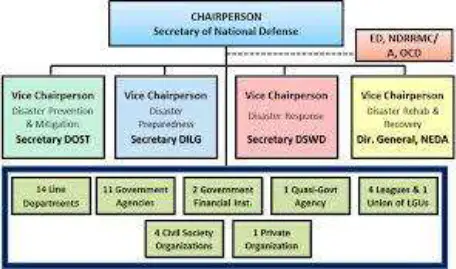
Placeholder for the Organizational Chart of NDRRMC showing the Chairperson, Vice Chairpersons, and various member organizations.
Organizational Chart of NDRRMC with Chairperson, Vice Chairpersons, and member organizations
Organizational Chart of DOH with Secretary and Undersecretaries
Organizational Chart of DepEd with Secretary and Directors
Organizational Chart of DILG with Secretary and Regional Directors
Which of the following is NOT one of the fourteen line departments that compose the NDRRMC?
Department of Agriculture (DA)
Department of Education (DEP ED)
Department of Tourism (DOT)
Department of Transportation (DOTC)
What is the primary mission of the Office of Civil Defense (OCD) according to Section 8 of the law?
To provide food and shelter during disasters
To administer a comprehensive national civil defense and disaster risk reduction and management program
To organize community events
To train police officers
Which government institution is responsible for funding together with Social Security System (SSS) in the NDRRMC?
PHILHEALTH
Department of Health (DOH)
Department of Finance (DOF)
Department of Social Welfare and Development (DSWD)
What authority does the NDRRMC Chairperson have during disasters or calamities?
To call upon government and nongovernment organizations for assistance
To organize sports competitions
To appoint school principals
To manage city traffic
Why is the Operations Center established by the NDRRMC important?
It is a place for storing food supplies
It is a 24/7 facility for monitoring and coordination during disasters
It is used for holding meetings with students
It is a training center for athletes
Imagine you are a member of the NDRRMC. What would be an important responsibility you have during a disaster?
Organizing a parade
Monitoring and evaluating disaster response activities
Painting buildings
Selling tickets for a concert
If the NDRRMC needs help during a calamity, which group can they call upon for assistance?
Only government agencies
Only private companies
Both government and nongovernment organizations
Only schools
Which law provides for the creation of the Regional Disaster Risk Reduction and Management Council (RDRRMC)?
RA 10121
RA 9003
RA 9165
RA 7277
Who coordinates, integrates, supervises, and evaluates the activities of the local Disaster Risk Reduction and Management Councils (LDRRMCs)?
RDRRMC
BDC
DSWD
OCD
What is the main responsibility of the RDRRMC in case of emergencies?
Ensuring disaster sensitive regional development plans
Providing medical aid
Building new schools
Organizing sports events
According to Section 11, which council operates at the barangay level?
Barangay Disaster Risk Reduction and Management Committee (BDRRMC)
Provincial Disaster Risk Reduction and Management Council
City Disaster Risk Reduction and Management Council
National Disaster Risk Reduction and Management Council
Who chairs the Local DRRMCs at the provincial, city, and municipal levels?
The local chief executive
The barangay captain
The school principal
The police chief
Which of the following is a function of the LDRRMCs?
Approve, monitor, and evaluate the implementation of local DRRM Plans
Organize sports competitions
Build shopping malls
Manage local businesses
How often must the local council convene according to the LDRRMC functions?
Every three months or as necessary
Every week
Every year
Every day
Why is it important for LDRRMCs to integrate disaster risk reduction and climate change adaptation into local development plans?
To promote sustainable development and poverty reduction
To increase entertainment options
To improve transportation only
To reduce school hours
What is mandated by Section 12 regarding the Local Disaster Risk Reduction and Management Office (LDRRMO)?
Every province, city, and municipality must establish an LDRRMO
Only cities must have an LDRRMO
Only provinces must have an LDRRMO
Only barangays must have an LDRRMO
If a disaster occurs and residents need to be evacuated, which function of the LDRRMCs is being applied?
Recommend the implementation of forced or preemptive evacuation
Organize a festival
Build new houses
Start a business
What is the main responsibility of Local Disaster Risk Reduction and Management Councils (LDRRMCs) during emergencies?
To take the lead in preparing for, responding to, and recovering from the effects of disasters
To provide medical aid only
To build new schools
To organize sports events
What percentage of the Local Disaster Risk Reduction and Management Fund (LDRRMF) must be set aside from estimated revenue from regular sources?
5%
10%
20%
50%
Which of the following is NOT a use for the Local Disaster Risk Reduction and Management Fund (LDRRMF)?
Organizing post-disaster activities
Purchasing life-saving rescue equipment
Paying premiums on calamity insurance
Building amusement parks
How much of the LDRRMF should be allocated as Quick Response Fund (QRF)?
30%
10%
50%
5%
What happens to unexpended LDRRMF after five years?
It reverts back to the general fund and is available for other social services
It is given to private companies
It is used for building new roads
It is donated to charity
What is the National Disaster Risk Reduction and Management Fund (NDRRM Fund) used for?
Disaster risk reduction or mitigation, prevention, and preparedness activities
Buying sports equipment
Organizing festivals
Building shopping malls
Which fund is used for relief, recovery, reconstruction, and other work or services in connection with calamities?
National Disaster Risk Reduction and Management Fund (NDRRM Fund)
Sports Fund
Education Fund
Tourism Fund
What must departments/agencies and LGUs do after receiving DRRM funds?
Submit monthly statements on the utilization of DRRM funds to the NDRRMC
Spend all the money immediately
Use the funds for personal expenses
Ignore the reporting requirements
If a disaster occurs, which fund is used to quickly help normalize the situation and living conditions of people?
Quick Response Fund (QRF)
Education Fund
Tourism Fund
Sports Fund
Why is it important for the LDRRMC to monitor and evaluate the use of the LDRRMF?
To ensure funds are used for disaster risk management activities
To make sure money is spent on parties
To avoid spending money on disaster relief
To ignore the needs of the community
What is the main goal of mitigation efforts in disaster risk reduction?
To prevent hazards from developing into disasters or reduce the effects of disasters
To create emergency shelters for affected people
To provide food and water during disasters
To train volunteers for emergency response
Which of the following is a common preparedness measure for emergencies?
Stockpiling, inventory, and maintenance of supplies and equipment
Ignoring emergency warnings
Waiting for disasters to happen
Avoiding communication with others
Why is it important for emergency managers to develop communication plans with easily understood terminology and chain of command?
To ensure everyone knows what to do during an emergency
To confuse people during disasters
To make emergencies more difficult to manage
To avoid training emergency services
Which phase focuses on long-term measures for reducing or eliminating risk in disaster management?
Mitigation
Preparedness
Response
Recovery
Imagine you are part of a community preparing for a possible disaster. Which action would best help your community be ready?
Developing and practicing multi-agency coordination and incident command
Ignoring emergency warnings
Waiting for help without any plans
Refusing to stockpile supplies
Which phase includes the mobilization of emergency services and first responders in a disaster area?
A. Recovery
B. Response
C. Prevention
D. Reconstruction
What is the main goal of the recovery phase after a disaster?
A. To prevent future disasters
B. To restore the affected area to its previous state
C. To evacuate people from the area
D. To provide food and water
Which of the following actions is most likely part of the recovery phase after a disaster?
A. Mobilizing fire-fighters and police
B. Rebuilding destroyed property
C. Predicting early warning signs
D. Conducting impact assessment
Why is the Philippines prone to almost all types of natural hazards?
A. Because of its climate
B. Because of its geographical location and geotectonic setting
C. Because of its population size
D. Because of its government policies
Imagine you are part of a disaster management team. After a typhoon, which phase would you focus on to help people rebuild their homes and return to work?
A. Response phase
B. Recovery phase
C. Mitigation phase
D. Preparedness phase
Which area is the Philippines situated along that makes it prone to earthquakes, tsunamis, and volcanic eruptions?
The Atlantic Ocean
The Pacific Ring of Fire
The Sahara Desert
The Arctic Circle
How many volcanoes are there in the Philippines, and how many of them are active?
100 volcanoes, 10 active
300 volcanoes, 22 active
50 volcanoes, 5 active
200 volcanoes, 30 active
According to PHIVOLCS, what is the average number of earthquakes experienced in the Philippines per day?
5
10
20
50
Why is the Philippines prone to occurrences of earthquakes and volcanic eruptions?
Because it is near the equator
Because it is situated along the Pacific Ring of Fire where tectonic plates meet
Because it has a lot of rivers
Because it is a small country
Imagine you are planning a safety drill for your school in the Philippines. Based on the information about the frequency of earthquakes, what would be an important step to include in your plan?
Practice fire drills only
Ignore earthquake safety because they are rare
Include regular earthquake drills and teach students what to do during an earthquake
Only focus on flood safety
Which earthquake had the highest magnitude mentioned in the text?
Surigao del Norte earthquake (6.7)
Sarangani, Davao Occidental earthquake (7.2)
Ormoc City, Leyte earthquake (6.5)
Mabini, Batangas Province earthquake (5.5)
Between 1997 and 2007, how many tropical cyclones entered the Philippine Area of Responsibility (PAR)?
50
84
100
25
What is the main reason PAGASA developed the category for Super Typhoon?
Because of Typhoon Yolanda
Because of El Nino
Because of earthquake swarms
Because of floods
What is the sustained wind speed required for a tropical cyclone to be classified as a Super Typhoon according to PAGASA?
Greater than 150 km/h
Greater than 220 km/h
Greater than 100 km/h
Greater than 180 km/h
Which category of tropical cyclone has sustained winds of 34–63 knots?
Tropical Depression
Tropical Storm
Severe Tropical Storm
Typhoon
Why did PAGASA realize that the strength of typhoons can go beyond the country’s existing threshold?
Because of the number of earthquakes
Because of Typhoon Yolanda
Because of El Nino
Because of floods and landslides
In 2010, tropical cyclones contributed to more than half of the damages caused by natural disasters. How many people were affected in that year alone?
More than 1 million
More than 2 million
More than 3 million
More than 5 million
What is one effect of strong ground shaking caused by earthquakes, as mentioned in the text?
Increased rainfall
Liquefaction
Drought
Volcanic eruption
Which periodic disaster is mentioned as causing high economic costs in just a single occurrence?
Earthquake
El Nino Southern Oscillation
Flood
Landslide
What is the estimated economic loss due to typhoon damages in agriculture, infrastructures, and private properties between 1997 and 2007?
P100.000-B
P158.242-B
P200.000-B
P51.000-B
Which disaster occurred in Sitio Sindulan, Barangay Tinaan, Naga City, Cebu in September 2018?
Typhoon Mangkhut
Volcanic Activity
Naga Landslides
Earthquake
How many families were affected by the Naga landslide in September 2018?
1,972 families
730,596 families
200,000 families
5,917 families
What was the local name for Typhoon Mangkhut when it entered the Philippine Area of Responsibility?
Typhoon Yolanda
Typhoon Ompong
Typhoon Ondoy
Typhoon Rolly
Which region was most affected by flooding and landslides due to Typhoon Mangkhut?
Visayas Region
Cordillera Administrative Region
Bicol Region
Metro Manila
What was the estimated amount of damage to agriculture caused by Typhoon Mangkhut?
P26.8B
P7.2B
P100M
P1B
Which volcano in the Philippines erupted in January 2018?
Taal Volcano
Mount Pinatubo
Mayon Volcano
Mount Apo
How many times has Mayon Volcano erupted in the past 400 years?
10 times
25 times
49 times
100 times
What was the estimated height of the ash plume during the Mayon Volcano eruption in January 2018?
1,000 meters
2,500 meters
5,000 meters
500 meters
Why were pilots advised to avoid flying close to Mayon Volcano’s summit during the eruption?
Because of strong winds
Because of ash from eruptions
Because of heavy rainfall
Because of landslides
On 07 March 2018, how many volcanic earthquakes were recorded by Mayon’s seismic monitoring network?
13
49
76
100
(DoK Level 2) What actions did authorities take to protect the public during the Mayon Volcano eruption in January 2018?
They ignored the eruption
They advised the public to enter the danger zone
They extended the Danger Zone and advised vigilance
They stopped all volcanic activity
(DoK Level 2) How did the rugged terrain of Northern Luzon affect the impact of Typhoon Mangkhut?
It made the typhoon weaker
It caused more flooding and landslides
It prevented any damage
It helped crops grow
(DoK Level 3) Imagine you are a local government official in a barangay affected by a landslide. What would be your first step to ensure the safety of your community?
Ignore the situation
Declare a State of Calamity and organize evacuation
Wait for the landslide to stop
Tell everyone to stay at home
(DoK Level 3) If you were a pilot scheduled to fly near Mayon Volcano during an eruption, what evidence from the situation would help you decide whether to proceed or cancel the flight?
The color of the volcano
The presence of ash plumes and aviation advisories
The number of tourists in the area
The weather in Manila
Which typhoon entered the Philippines on December 4, 2014, with maximum winds of 175kph?
Typhoon Yolanda
Typhoon Hagupit
Typhoon Haiyan
Typhoon Ruby
What was the magnitude of the earthquake that occurred in Central Visayas in October 2013?
6.5
7.2
8.0
5.9
Which region was the epicenter of the 2013 Central Visayas earthquake?
Region V
Region VII
Region IV-A
Region III

