
NEW
Font size
 Worksheets
UNIT I: Water and its Treatment Introduction
Total questions: 15
Worksheet time: 8mins
Which source most commonly imparts natural color to surface water and is associated with humic substances?
Algae and tannins in surface water
Ferric hydroxide from corrosion scale
Calcium carbonate from limestone beds
Sodium chloride from saline intrusion
A municipal plant reports persistent yellowish-red water. Which targeted treatment is most appropriate to address the likely cause of this discoloration?
Oxidation followed by precipitation of iron
Softening with lime-soda ash only
Chlorination without prior aeration
Fluoride removal using alumina beds
Which consequence best explains why high turbidity must be reduced before disinfection in drinking water treatment?
Particles shield microbes from disinfectants
Turbidity lowers water alkalinity strongly
Suspended clays add pleasant mineral taste
Turbidity always reduces salinity levels
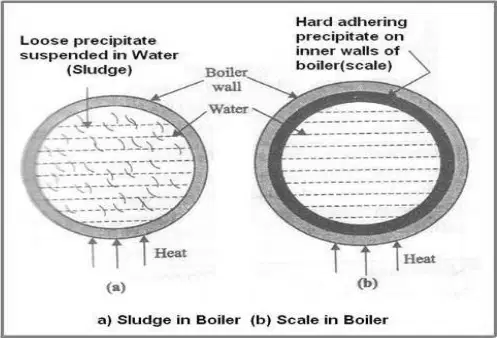
Which statement best distinguishes sludge from scale in boilers?
Sludge is soft, loose deposits; scale is hard, adhering
Sludge forms at hot spots; scale forms only in cool zones
Sludge contains only CaSO4; scale contains only MgCl2
Sludge increases heat transfer; scale improves conductivity
Which equation shows the net result when water passes sequentially through cation and anion exchangers?
H+ + OH− → H2O
2H+ + CO3 2− → H2CO3
Na+ + Cl− → NaCl
Ca2+ + SO4 2− → CaSO4
Zeolites used for softening are best described as:
Hydrated sodium alumino silicates
Anhydrous calcium silicate minerals
Metallic sodium alumina alloys
Organic polystyrene copolymers
Which statement correctly contrasts chemical usage in internal vs external water treatment?
Internal uses chemicals; external uses none
Internal uses none; external uses chemicals
Both use extensive chemicals
Neither uses chemicals in practice
During pre-treatment storage in reservoirs, what is one purpose of adding copper sulphate?
Increase alkalinity of water
Prevent algal growth in basins
Accelerate sand filtration rate
Convert Ca2+ to CaCO3 rapidly
Which step primarily removes debris and large suspended solids using a porous barrier?
Aeration
Screening
Coagulation
Filtration
Which is a key disadvantage of ozonization for municipal water treatment?
High cost and poor large‑scale storage stability
Formation of stable residual disinfectant
Low capital cost with simple maintenance
Suitable for long‑term on‑site storage
What is the primary mechanism by which UV light inactivates microorganisms in water?
Damaging genetic material and cellular capability
Oxidizing organic matter into carbon dioxide
Hydrolyzing cell walls to simple sugars
Precipitating proteins with metal ions
Which statement best contrasts ozonization with chlorination in typical municipal practice?
Ozonization offers colour and odour removal but lacks residual
Chlorination removes colour effectively while leaving no residual
Ozonization is cheaper and easier to store than chlorine
Chlorination cannot kill most bacteria effectively in water
Which balanced reaction represents chlorine removal using sodium sulphite in water?
Na2SO3 + Cl2 + H2O → Na2SO4 + 2HCl
Na2SO3 + Cl2 → NaCl + NaClO2
Na2SO3 + 2Cl2 → Na2SO5 + 2HCl
Na2SO3 + Cl2 → Na2SO3Cl2
Water containing 20,000 ppm of dissolved solids is classified as
Brackish water by dissolved solids range
Fresh water by low dissolved solids
Sea water by very high dissolved solids
Distilled water by negligible solids
In normal osmosis across a semipermeable membrane, the solvent flows from
Lower solute concentration to higher concentration
Higher solute concentration to lower concentration
Higher pressure side to lower pressure side
Hypertonic solution to isotonic solution

