
 Worksheets
Impulse and Momentum Concepts (OnRamps4.1)
Total questions: 25
Worksheet time: 15mins
What is the definition of linear momentum?
Force multiplied by acceleration
Mass multiplied by velocity
Energy divided by time
Work done over distance
Which of the following best describes linear momentum?
A scalar quantity
A vector quantity
A unitless quantity
A measure of energy
What are the SI units for linear momentum?
Newtons (N)
Joules (J)
Kilogram-meters per second (kg·m/s)
Watts (W)
A ball rolling down a hill gathers momentum. What causes this increase in momentum?
Decrease in mass
Increase in velocity due to gravity
Decrease in gravitational force
Increase in friction
An object can have a large momentum due to which of the following factors?
Being less massive and moving at low velocity
Being more massive or moving at high velocity
Being stationary and having high mass
Having zero mass and high velocity
To bring a moving car to rest, what must be applied?
A force over some duration of time
Only a large force
Only a long duration of time
An increase in velocity
What is the term for a force applied multiplied by the duration of time it is applied?
Momentum
Energy
Impulse
Work
What are the SI units for impulse?
Kilogram-meters per second (kg·m/s)
Joules (J)
Newtons (N)
Newton-seconds (N·s)
The impulse-momentum theorem states that impulse is equal to what?
The initial momentum
The final momentum
The change in momentum
The total energy
If a force is applied to push an object for some duration of time, what happens to the object's momentum?
It decreases proportionally.
It remains unchanged.
It gains a proportional amount of momentum.
It converts to energy.
If an object loses momentum, what must it be doing?
Gaining energy.
Imparting force to something else.
Increasing its velocity.
Decreasing its mass.
The impulse-momentum theorem describes the conservation of linear momentum, similar to how the work-energy theorem describes the conservation of what?
Thermal energy
Chemical energy
Mechanical energy
Nuclear energy
When a moving object strikes a surface, how does the time duration of the interaction affect the force imparted?
A longer interaction time results in a larger force.
A shorter interaction time results in a smaller force.
A longer interaction time results in a smaller force.
The time duration has no effect on the force.
Why are baseball players taught to 'swing through the ball' rather than stopping the swing upon impact?
To reduce the force on their hands.
To ensure a shorter contact time with the ball.
To impart the maximum possible momentum to the ball.
To conserve their own momentum.
What happens to the total momentum when objects collide?
It is always lost.
It is always gained.
It is conserved.
It is converted into energy.
An object of mass m has an initial velocity of −7 m/s. If it experiences an impulse of +91 Ns. Which of the following correctly derives for the velocity after, in terms of m?
−7 + (91/m)
−7 + (91m)
91/m
91m
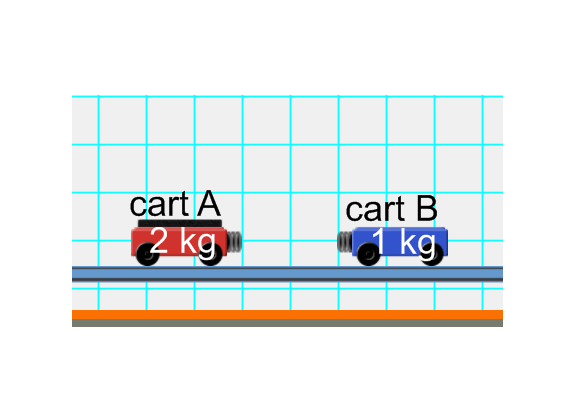



In a futuristic space collision, if the total momentum of two spacecrafts before the collision is 100 kg·m/s, what is the total momentum after the collision assuming no external space forces act on the system?
0 kg·m/s
50 kg·m/s
100 kg·m/s
200 kg·m/s

Which of the following scenarios involves the highest impulse?
A hoverball is hit with a plasma racket for 0.05 seconds with a force of 30 N
A quantum football is kicked with a force of 50 N for 0.02 seconds
A spaceship crashes into an asteroid with a force of 1000 N for 0.01 seconds
A zero-gravity basketball is dribbled with a force of 20 N for 0.1 seconds

If the mass of a hovercar is doubled while its velocity through the neo-city airspace remains constant, what happens to its momentum?
It remains the same
It is halved
It is doubled
It is quadrupled

A ball is traveling through the air as represented by the initial momentum vector shown above on the left. A racket then makes contact with the ball, as shown in the middle figure above. After the racket makes contact with the ball, the ball is traveling through the air as represented by the momentum vector shown above on the right. Which of the following vectors could represent the impulse the racket exerts on the ball?
A vector that points in the rightward direction
A vector that points up and to the right
A vector that points straight up
A vector that points straight down
A vector that points straight to the left

What is the impulse of a 60 kg sprinter that goes from rest to 10 m/s?
+600 kg m/s
-600 kg m/s
+300 kg m/s
-300 kg m/s

