
 Worksheets
Classical Civilizations assessment
Total questions: 20
Worksheet time: 10mins
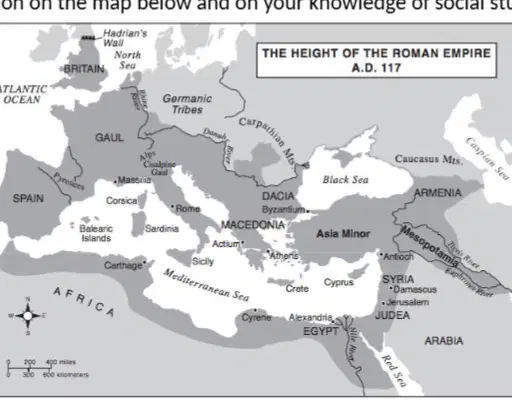
Base your answer to the question on the map below and on your knowledge of social studies. Which statement is best supported by the information on this map?
The Roman Empire extended over three continents.
Rivers kept invaders out of the Roman Empire.
Alexandria served as the eastern capital of the Roman Empire.
Carthage was eventually destroyed by the Romans.
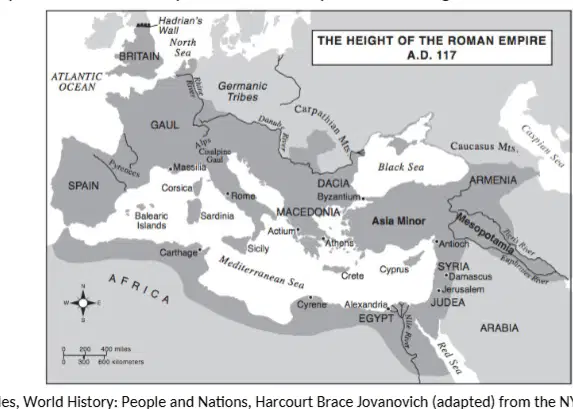
Based on the information provided by this map, which body of water was most likely the center of Roman trade?
Red Sea
Black Sea
Atlantic Ocean
Mediterranean Sea
Where would you find evidence of Roman Roads ?
South Asia
Western Europe
Sub-Saharan Africa
Mongolia
Why did the Romans build roads? The Romans considered a well-organized and efficient transportation system a basic element of proper administration; i.e. an indispensable element in creating and maintaining the Roman state. The earliest highways or main roads were constructed for the use of the military, and their economic benefit for civilians was a later byproduct and not the main reason for their creation. The military nature of the roads continued to be essential as Romans expanded into territory outside Italy. In the province of Arabia Petraea (which included what is now Jordan), the movement of troops and ease of communication for the army and Roman administration were the primary reasons for construction of the Via Nova, one of the many viae militares or military roads built in conquered provinces. However, smaller, shorter, and less well-constructed local roads (actus) or tracks (callis) also increased in territory after it was brought under Roman control. Nevertheless, the main public highways (viae publicae) normally began as military roads and only gradually evolved into civilian conduits [passageways].
what conclusion can you make based on this passage ?
The Romans were the best road builders during the Classical period.
Neglect of the Roman road system led to the collapse of the empire.
The Roman economy would not have prospered if it were not for the roads in the empire.
Roman roads were built primarily to keep order in the empire
The purpose of the development of the Roman road system was:
to improve transportation and communication across the empire
to decorate cities with impressive structures
to provide a place for public gatherings and festivals
to serve as boundaries between different regions

(Also, the largest city-state by a wide margin)

Athens and Sparta were
City states
Capitals of Greece
Independent countries
part of song China
The Peloponnesian War was
A war between Macedonia and Athens
A war between Sparta and Persia
A war between Athens and Persia
A war between Athens and Sparta
What caused the Peloponnesian War?
it was caused because Sparta was afraid of Athen's growth
Athens was afraid of Sparta's growth
they hated each other
Sparta thought Athens was too friendly with Persia
Athens and Sparta developed different political systems because
the Byzantines controlled them
foreign merchants and missionaries brought new ideas
civil wars raged in these city-states
mountainous topography resulted in isolation of city-states
In ancient Greece, a "polis" referred to ______.
A theater performance
A city-state
A religious ritual
A musical instrument
Who conquered ancient Greece?
Augustus Caesar
Alexander the Great
General Washington
Julius Caesar
How would you describe the geography of ancient Greece?
Plains
Desert
Peninsula
Arctic
What were the Punic Wars?
Wars between Rome and Gaul
Wars between Rome and Greece
Wars between Rome and Carthage
Wars between Rome and Spain
How were the Punic Wars a turning point for Rome?
Rome fell to Carthage
Rome gained land and power
Rome was forced to share power with Carthage
Rome lost to Athens
Who was Alexander the Great ?
Greekmathematician – “Father of Geometry”
King of Macedonia. Empire stretched fromGreece to Indus River.
King of the Franks - crowned Holy Roman Emperor by the Pope
Founded Persian Empire by conqueringMesopotamia,Syria,&Judea
After penetrating into the city [Carthage], Scipio [the Roman commander] turned his attention to the citadel, its strongest point, where many people had taken refuge. Three streets leading from the marketplace to the citadel were lined on both sides with six story houses, from which the Romans were pelted. They seized the first houses and used them as a base for attacking the next. From their roofs they made bridges of planks and beams to cross over to the next. While one battle was in progress on the roofs another was fought, against all comers, in the narrow street below.
Everywhere there was groaning and wailing and shouting and agony of every description. Some Carthaginians were killed out of hand, some flung down alive from the roofs to the pavement, and of these some were caught on upright spears or ambers or swords….
Others were seen still living, especially old men, women, and young children who had hidden in the inmost corners of the houses, some of them wounded, some more or less burned, and uttering pitiful cries. Still others thrust out and falling from such a height with the stones, timbers, and fire, were torn asunder in all shapes of horror, crushed and mangled.
Nor was this the end of their miseries, for the street cleaners, who were removing the rubbish with axes, mattocks, and forks, and making the roads passable, tossed with the dead and the living together into holes in the ground….
What is the historical circumstances that led to the destruction of Carthage?
Alexander defeated Persia
Carthage invaded Rome through Italy
China invaded India
Aliens

