
NEW
Font size
 Worksheets
Unit 3 Progress Check: Manifest Destiny and Westward Expansion
Total questions: 18
Worksheet time: 24mins
"Up to our own day American history is the history of the colonization of the Great West. The existence of an area of free land, . . . and the advance of American settlement westward explain American development."
should be preserved for free use by all the people
has mirrored European values and social patterns
has caused problems for indigenous Native American communities
has had a positive effect on the growth of the United States
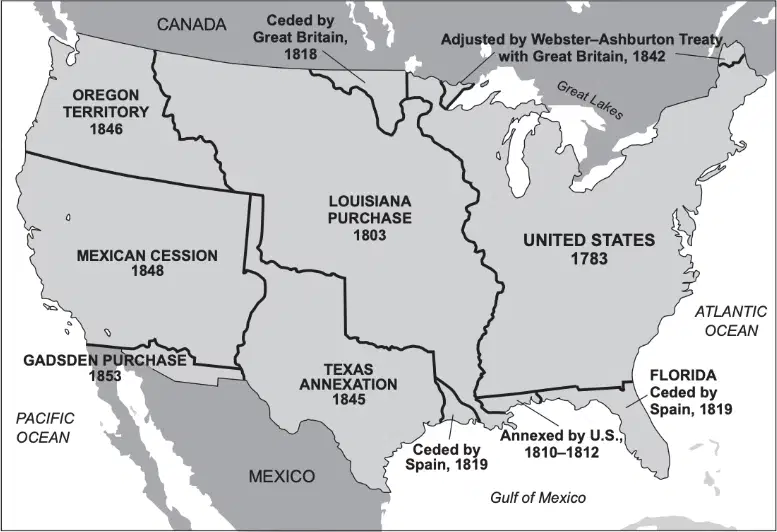
A historian could best use this map to study
the Monroe Doctrine
American nativism
Manifest Destiny
Dutch imperialism in North America
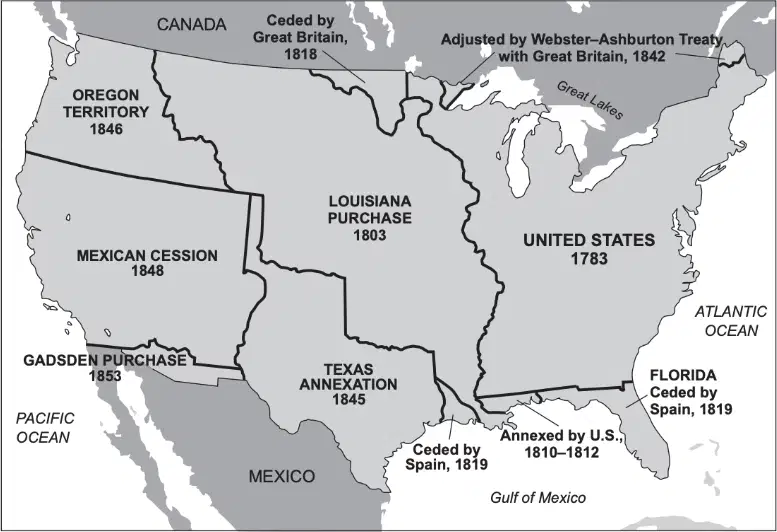
Which statement can best be supported by the information found on this map?
Territorial expansion during the 1800s was achieved through a variety of methods.
Colonial goals had been realized once the Louisiana Purchase was complete.
The annexation of Texas was an effort to avoid war with Mexico.
The Great Plains was the last area settled.
[Buffalo hunters] have done more in the last two years, and will do more in the next year, to settle the . . . Indian question than the entire regular army has done in the last thirty years. . . . For the sake of peace let them kill, skin, and sell until the buffalo are destroyed.” —General Philip Sheridan
Native American Indians were granted farmland under the Homestead Act.
The disappearance of their food source helped drive Native American Indians onto reservations.
Many Native American Indians moved to Eastern cities to work in factories.
Most Native American Indians migrated to Canada to find new ways to earn a living
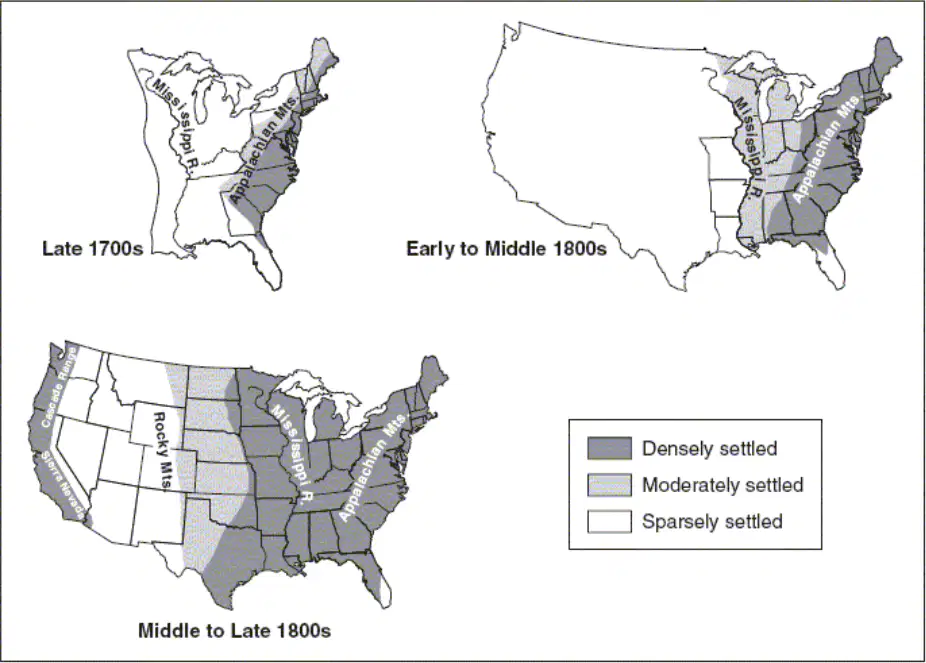
Which of the following would be the most appropriate title for this map?
Expanding Frontier of the United States
Industrialization of the United States
Sectional Conflict in the United States
American Transportation Revolution
Read and analyze the following documents, applying your social studies knowledge and skills to answer: Which of the following best describes the historical context surrounding the Indian Removal Act of 1830 and the Treaty of New Echota, and explains how Major Ridge’s speech reflects the point of view and reliability of Document 2? Document 1: An Act to provide for an exchange of lands with the Indians residing in any of the states or territories, and for their removal west of the river Mississippi. Source: Excerpt from the Indian Removal Act of 1830, passed by Congress and signed into law by Andrew Jackson on May 28, 1830. Document 2: This excerpt is from a speech by Major Ridge to his fellow Cherokees in support of the 1835 Treaty of New Echota. Major Ridge and his son John were Cherokee leaders who negotiated the Treaty of New Echota with the U.S. Government to leave traditional Cherokee lands in the Southeast without the support of most Cherokee people. I am one of the native sons of these wild woods. I have hunted the deer and turkey here, more than fifty years. I have fought your battles, have defended your truth and honesty, and fair trading. The Georgians have shown a grasping spirit lately; they have extended their laws, to which we are unaccustomed, which harass our braves and make the children suffer and cry. I know the Indians have an older title than theirs. We obtained the land from the living God above. They got their title from the British. Yet they are strong and we are weak. We are few, they are many. We cannot remain here in safety and comfort. I know we love the graves of our fathers. We can never forget these homes, but an unbending, iron necessity tells us we must leave them. I would willingly die to preserve them, but any forcible effort to keep them will cost us our lands, our lives and the lives of our children. There is but one path of safety, one road to future existence as a Nation. That path is open before you. Make a treaty of cession. Give up these lands and go over beyond the great Father of Waters.
The Indian Removal Act of 1830 forced Native Americans to leave their lands, and Major Ridge’s speech shows a perspective favoring removal for survival, but his support for the treaty may reflect bias and limits reliability as evidence.
The Indian Removal Act of 1830 was designed to protect Native American rights, and Major Ridge’s speech is a completely unbiased and reliable source of Cherokee opinion.
The Treaty of New Echota was supported by all Cherokee people, and Major Ridge’s speech is a reliable source because it represents the majority view.
The Indian Removal Act of 1830 had little impact on Native Americans, and Major Ridge’s speech is unreliable because it was written by a U.S. government official.
Which of the following best describes the historical context of Documents 1 and 2, including the events and key vocabulary that led to what is shown in the documents (5Ws)?
The documents reflect significant events, people, and places that shaped the historical period, including causes and effects leading to the depicted situation.
The documents only show random events without any historical significance.
The documents focus solely on economic factors, ignoring social and political influences.
The documents are fictional and do not represent any real historical context.
Analyze Document 2 and explain how audience, OR purpose, OR bias, OR point of view affects this document’s use as a reliable source of evidence. (Can you trust this source? Why or why not?)
The audience, purpose, bias, or point of view can affect the reliability of Document 2 as a source of evidence because these factors may influence how information is presented.
The audience, purpose, bias, or point of view do not affect the reliability of Document 2 as a source of evidence.
Document 2 is always a reliable source regardless of its audience, purpose, bias, or point of view.
Bias and point of view only affect primary sources, not Document 2.
Name one American Indian tribe in the United States.
Cherokee
Slavs
Zawi Chemi
Celts
Which of the following represented an important aspect of Plains Indian culture?
Land was a commodity to be bought, sold, and traded
Buffalo were the primary resource for food, clothing, and shelter
Alliances between tribes were strong, facilitating general peace between various Native groups that lived on the Plains
They were relocated to the Plains from east of the Mississippi River by the federal government in the 1830s
What is a central idea of the excerpt?
A. The common images of Indians are unfair and far from the reality of Indian life.
B. Most American children have no idea that Indians live in reservations.
C. Indians won more battles against white men than they lost.
D. Most of the wars fought between white men and Indians were conflicts over Indian artistic creations.
Which of the following were important aspects of Native American culture before the arrival of Europeans?
Religion and Nature
Ownership of Land
Constant warfare
Nature and Religion were not important
Cactus Hill is located in what part of Virginia?
North
South
West
Southeastern
Pismo State Beach is named after the Chumash word 'Pismu', which means what in English?
Sun
Tar
Ocean
Beautiful


