
Font size
 Worksheets
Musical Elements, Instrument Families, and Aural Skills
Total questions: 102
Worksheet time: 51mins
Which term indicates soft dynamics in music?
piano
forte
allegro
largo
Which term best describes a fast tempo?
largo
andante
allegro
mezzo forte
What does andante usually mean for tempo?
walking pace
very fast
extremely loud
very slow
Identify the texture: one melody without accompaniment.
brass
homophonic
polyphonic
monophonic
Identify the texture: melody with chordal accompaniment.
homophonic
monophonic
polyphonic
woodwind
Identify the texture: multiple independent melodies at once.
monophonic
homophonic
percussion
polyphonic
Match each Italian term to its meaning.
piano
soft
forte
loud
allegro
fast
largo
slow
Which instruments are part of the strings family?
trombone
cello
clarinet
violin
Which instruments belong to the woodwind family?
flute
recorder
tuba
oboe
Which statement describes how brass instruments produce sound?
Lips vibrate air into a mouthpiece
Surfaces resonate when struck or shaken
Air vibrates across a reed or hole
Strings vibrate when bowed or plucked
Which instruments are in the brass family?
tuba
trombone
xylophone
trumpet
Which description fits percussion instruments?
Sound by lips vibrating a mouthpiece
Sound by air through reed or mouthpiece
Sound when struck, shaken, or scraped
Sound by bowing or plucking strings
Match instrument families to an example.
Strings
violin
Woodwind
clarinet
Brass
trumpet
Percussion
drums
You hear a single singer with no accompaniment. What texture is this?
monophonic
homophonic
polyphonic
andante
A piece feels calm and slow with broad notes. Which tempo term fits best?
forte
largo
allegro
andante
Which set lists only dynamics terms?
mezzo forte
forte
allegro
piano
During an aural test, what can help you comment on mood?
tempo changes
dynamic levels
instrumentation
math formulas
In an aural activity, which action finds the steady beat?
Name the family
Clap the pulse
Change the key
Sing the melody
How many lines are on a standard music stave?
Five lines total
Four lines total
Six lines total
Seven lines total
Where are notes placed to show pitch on the stave?
Only under the stave
Only between two staves
On lines and spaces
Only above the stave
Which clef is also called the G clef?
Alto clef sign
Treble clef sign
Bass clef sign
Tenor clef sign
Which clef is mainly used for lower‑pitched instruments like cello?
Alto clef symbol
Bass clef symbol
Soprano clef symbol
Treble clef symbol
Match each clef to the typical instrument family it serves.
Treble clef
Higher‑pitched instruments
Bass clef
Lower‑pitched instruments
Both clefs
Piano uses both
In 4/4 time, how many beats are in each bar?
Four beats total
Three beats total
Two beats total
Five beats total
In 4/4 time, which note value receives one beat?
Quaver note
Crotchet note
Minim note
Semibreve note
How many beats does a semibreve last?
One beat long
Four beats long
Three beats long
Two beats long
How many beats does a minim last?
Half a beat long
One beat long
Two beats long
Four beats long
How many beats does a quaver last?
One beat long
Half a beat long
Two beats long
Four beats long
A crotchet rest indicates what?
Half a silent beat
Two silent beats
Four silent beats
One silent beat
Which combination correctly fills one bar in 4/4 time?
Two minims total
One minim total
Two crotchets total
Four quavers total
Which set equals four beats in 4/4 time?
Eight quavers total
One semibreve only
Four crotchets total
Two crotchets and four quavers
Which set does NOT add to four beats in 4/4 time?
Eight quavers total
One semibreve only
Two minims total
Three crotchets total
Match note values to their beat counts.
Semibreve
Four beats
Minim
Two beats
Crotchet
One beat
Quaver
Half beat
If a bar shows two crotchets and four quavers, how many beats are there?
Three beats total
Four beats total
Five beats total
Six beats total
Always check what when reading a bar in 4/4 time?
Instrument names shown
Key signature symbols
Total beats match time
Tempo marking words
Which statement about treble and bass clefs is accurate?
Both mark lower pitches
Treble marks higher pitches
Neither indicates pitch range
Bass marks violin notes
Which set lists only white key note names on a piano?
C D E F G A B
C D E F G A Bb
C# D# F# G# A# B
Do Re Mi Fa Sol La
Which 3-note pattern moves in steps?
A–C–B
E–E–E
C–E–G
C–D–E
Which example shows repeated notes instead of steps?
G–G–A
F–G–A
A–B–C
B–C–D
Match each term to its description.
Step
Move to the next adjacent note
Repeat
Play the same key twice in a row
White keys
Notes named C D E F G A B
Pattern
A short sequence like C–D–E
Which sets are valid 3-note patterns using white keys? Select all that apply.
C–D–E
G–A–B
C–E–F
A–B–C
E–F–G
If you start on A and take two steps up on white keys, which note do you reach?
D
B
G
C
You play C, then the same key again, then move up one. Which notes did you play?
C–D–E
D–D–E
C–C–D
B–C–D
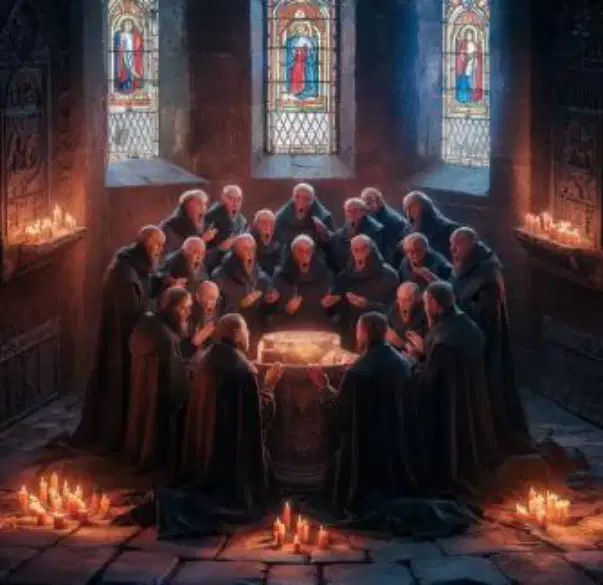
Which texture best describes Medieval plainchant heard in monasteries?
Homophonic tune with chords
Monophonic single melody line
Heterophonic varied versions
Polyphonic overlapping melodies
Early Medieval notation used neumes. What was a key limitation of this system?
Only for secular court dances
Too many instruments required
Pitch and rhythm not fully precise
Could not be sung by choirs

Where was most Medieval music performed and used?
Royal outdoor festivals
Private salons of nobles
Churches and monastic settings
Public theaters and markets
Which statement compares Medieval and Renaissance vocal music textures?
Renaissance heterophonic; Medieval homophonic
Medieval polyphonic; Renaissance monophonic
Both periods strictly monophonic
Medieval monophonic; Renaissance polyphonic
Renaissance polyphony involves what musical feature?
Multiple independent melody lines
One solo melody without chords
Instrumental improvisation mainly
Only percussion-based rhythms

Complex choral works in the Renaissance were often performed where?
Universities during lectures
Military camps on marches
Town squares at markets
Churches and European courts

Josquin des Prez is best known for which contribution?
Expressive, highly structured vocal music
Developing electronic sound effects
Inventing the modern piano keyboard
Writing only instrumental symphonies
Which pair correctly matches period to a characteristic?
Medieval
Plainchant monophonic
Renaissance
Polyphonic textures
Baroque
Dynamics and ornamentation

In the Baroque period, what did composers use to create dramatic contrast?
Sudden changes in dynamics
Strictly even volume levels
Only slow, quiet passages
Random tempo fluctuations

What is musical ornamentation in the Baroque style?
Decorative trills and embellishments
Eliminating all melodic variation
Only using simple block chords
Replacing singers with drums

Which keyboard instrument is closely associated with the Baroque era?
Harpsichord with plucked strings
Modern synthesizer keyboard
Grand piano with hammered strings
Pipe organ with air-driven reeds
J.S. Bach is described as:
Inventor of Renaissance notation
Leader of Medieval plainchant
Composer known for intricate polyphony
Baroque-era court dance choreographer

Select all features typical of Medieval music.
Precise modern rhythmic notation
Secular dance focus and strong beat
Plainchant monophonic texture
Mostly vocal, minimal instruments

Which statements fit the Renaissance period?
Exclusive use of solo chant
Elaborate sacred choral music
Decline of church performances
Polyphonic textures common
Match each composer or instrument to its era.
Josquin des Prez
Renaissance
Harpsichord
Baroque
J.S. Bach
Baroque

Which combination describes a Baroque musical performance?
Strictly even volume and simple tunes
Multiple choirs singing only unison
Single-line chant without instruments
Ornamented melodies with dynamic contrasts

How does a harpsichord make sound?
Membranes are hit by sticks
Metal bars are struck with hammers
Air is blown through pipes
Strings are plucked by mechanism
Place these in chronological order from earliest to latest: Medieval, Renaissance, Baroque.
Baroque → Medieval → Renaissance
Medieval → Renaissance → Baroque
Renaissance → Baroque → Medieval
Renaissance → Medieval → Baroque
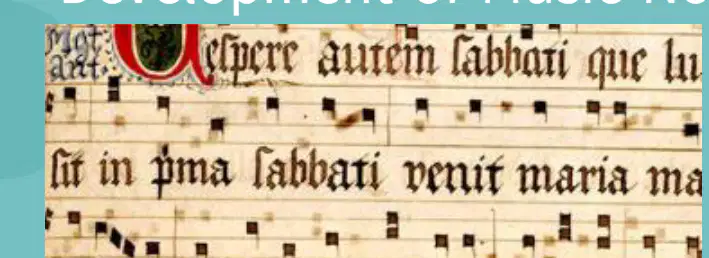
Which statement best describes medieval neumes?
Letters naming notes on a five-line staff
Symbols showing exact pitch and dynamics
Marks indicating general melody shape only
Detailed notes for precise rhythm and tempo
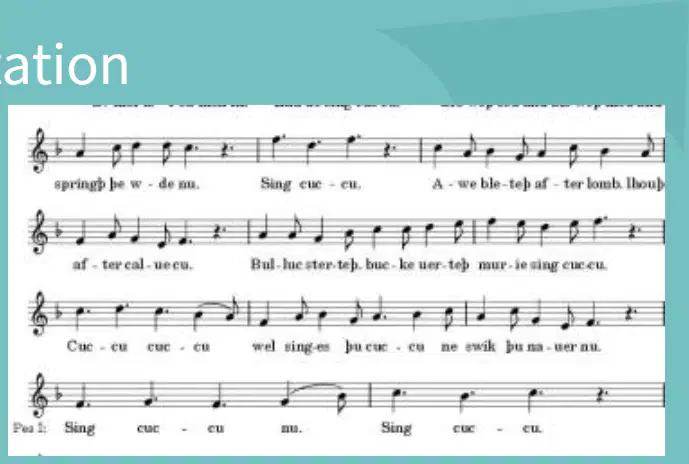
What feature of modern music notation allows musicians to read precise pitch?
Neumes written above lyrics
Stave combined with clefs
Rests placed between notes
Stems attached to note heads
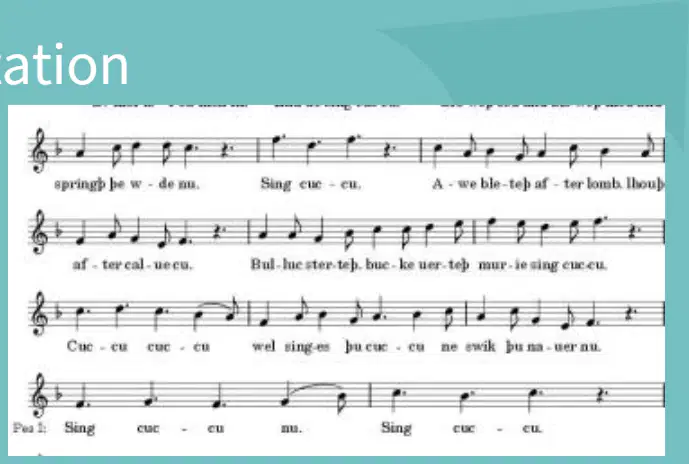
Select ALL elements commonly used in modern notation to show rhythm and duration.
Clefs and stave
Rests and barlines
Neumes and chant lines
Note heads and stems

Match each term to its role in modern notation.
Stave
Five lines where notes are placed
Clef
Symbol that sets pitch reference
Rest
Sign indicating silence for a time
Note head
Shape that shows a note’s position
How did the purpose of notation change from medieval to modern times?
From exact rhythm to free improvisation
From instrumental focus to vocal-only use
From detailed pitch to general melody hints
From memory aids to precise performance
Which composer wrote the Hallelujah Chorus from the oratorio Messiah?
Wolfgang Amadeus Mozart
Antonio Vivaldi
George Frideric Handel
Johann Sebastian Bach
What best describes the texture of the Hallelujah Chorus?
Homophonic chordal harmony
Monophonic single melody
Polyphonic weaving lines
Heterophonic varied melody
The Four Seasons is a set of violin concertos that musically represents which idea?
Spring, summer, autumn, winter
Ancient myths and heroes
The four times of day
Famous cities of Europe
Which option explains why 'Spring' from The Four Seasons is called program music?
It follows strict counterpoint rules
It uses only solo piano parts
It tells a story through sounds
It copies a popular folk tune
Match each work to its key feature.
Hallelujah Chorus
Strong homophonic texture
The Four Seasons: Spring
Bright melodies imitate birdsong
The Four Seasons (set)
Concerto group for four seasons
Which statements are true about Vivaldi's The Four Seasons?
Its 'Spring' imitates birdsong
It represents daily weather reports
It consists of violin concertos
It is by Antonio Vivaldi
In 4/4 time, which combination correctly fills one bar?
Two minims
One semibreve
Four crotchets
Eight quavers
Which note value equals half a beat in 4/4 time?
Semibreve
Minim
Quaver
Crotchet
When planning a rhythm in 4/4, what should you avoid to keep the pulse steady?
Using a crotchet rest
Spacing long and short notes
Clumping many quavers together
Counting 1 and 2 and 3 and 4
Which statement best describes a crotchet rest?
One beat of sound
One beat of silence
Half beat of silence
Two beats of silence
You wrote three crotchets and two quavers in a bar. How many beats is that?
Five beats total
Four beats total
Six beats total
Three beats total
To check even 4-beat bars, how should you count?
1-and 2-and evenly
1 2 3 4 quickly
1 2 3 loudly
1-and-2-and-3 fast
Choose the set of notes that fits a simple melody in C major.
E F# G# A B
G A B C D
A B C# D# E
C D E F G
What is stepwise motion in melody writing?
Repeating the same note
Moving to adjacent notes
Jumping by fifths
Skipping a scale degree
Which melodic move shows stepwise motion in C major?
G to C
D to E
E to C
C to G
Why build a melody into a 4-bar structure?
To change key often
To make it louder
To create clear phrasing
To add random notes
Best way to test if your four-bar melody flows well?
Add more rests
Only write faster notes
Remove all quavers
Clap and sing it
Match each dynamic marking or term to its meaning.
Crescendo
Getting louder
Diminuendo
Getting softer
Piano (p)
Soft volume
Forte (f)
Loud volume
Which description fits allegro?
Soft dynamic level
Fast lively tempo
Moderate walking speed
Very slow tempo
Andante is best described as which tempo?
Extremely fast
Moderate walking
Very loud speed
Slow and calm
Largo typically feels how?
Moderate and steady
Soft and quiet
Very slow and broad
Fast and bright
Which change would add excitement through dynamics?
Diminuendo to piano
Crescendo toward forte
Stay at mezzo-piano
Drop to pianissimo
Which choices are valid ways to complete a 4/4 bar? Select all that apply.
A crotchet, four quavers, one crotchet
A minim and two crotchets
Two minims
Eight semiquavers only
Select all techniques that keep a beginner melody smooth in C major.
Limit notes to C D E F G
Use stepwise motion often
Build into four bars
Insert many large leaps

Which statement best describes timbre?
The speed of the steady beat in music
The loudness level of a performed sound
The exact pitch frequency measured in hertz
The tone colour that helps identify instruments
Two instruments play the same pitch. How can you still tell them apart?
By the alphabetical name of the note
By counting how many strings they have
By their different tone colour, or timbre
By the length of the written bar
Match each instrument to a typical timbre description.
Violin
Bright and rich
Flute
Light and airy
Drum
Deep and resonant
Which pair shows instruments likely reading mostly treble clef?
Trombone and tuba
Violin and flute
Bass voice and baritone
Cello and double bass
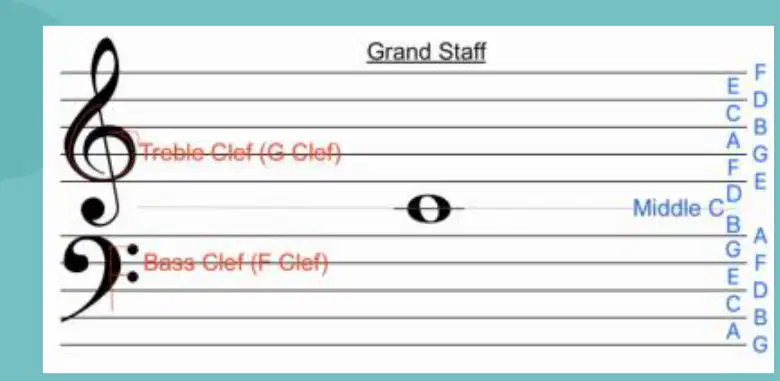
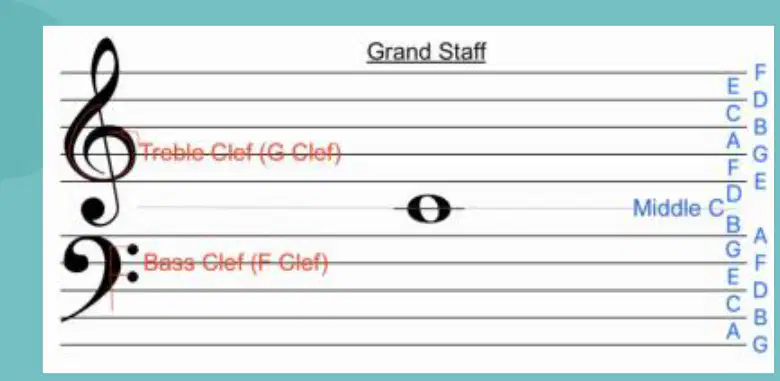
What does the treble clef symbol curl around on the staff?
The first line, note E
The third line, note B
The fourth line, note D
The second line, note G
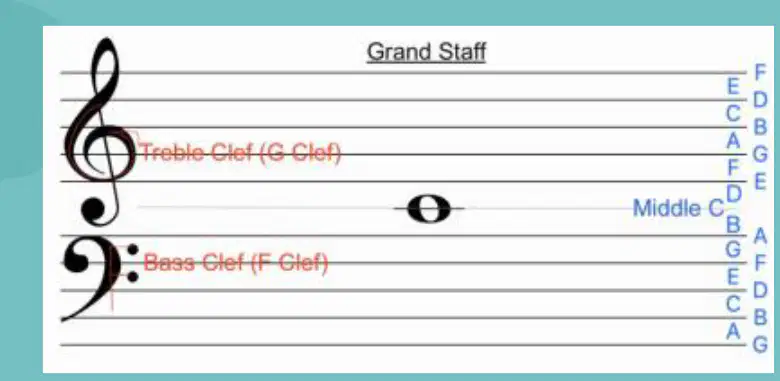
Where is the bass clef centered on the staff?
On the bottom space, note A
On the second-to-last line, note F
On the first line, note G
On the top space, note E
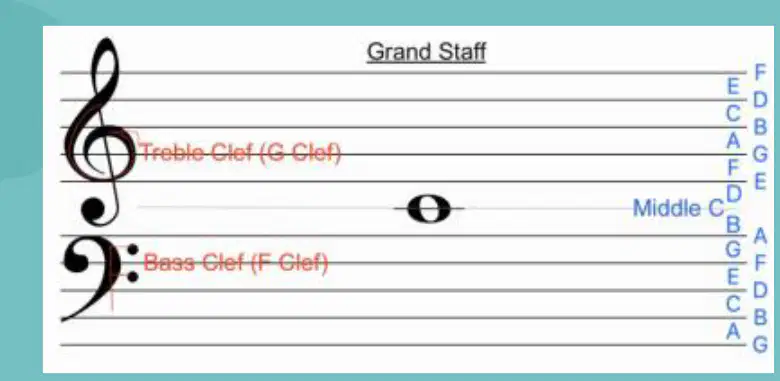
What is Middle C’s role on the grand staff?
Marks the highest treble line pitch
Indicates tempo such as allegro
Shows the beat at the start of bars
Bridges high and low notes between staves
Which statement about the grand staff is correct?
It uses only the treble clef for low notes
It is used only for percussion notation
It replaces ledger lines with rests entirely
It combines treble and bass to cover range
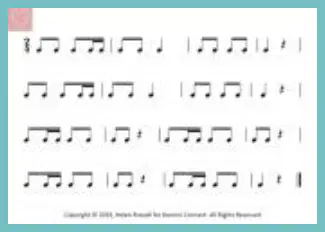
You are asked to clap the pulse. What should you focus on?
Changing dynamics of each phrase
The steady beat that repeats evenly
Only the offbeat syncopation patterns
The melody notes and their names
Which terms describe tempo, the speed of the music?
Andante
Quaver
Crotchet
Allegro

In 4/4 time, how many beats must each bar contain?
Two beats total per bar
Four beats total per bar
Three beats total per bar
Eight beats total per bar
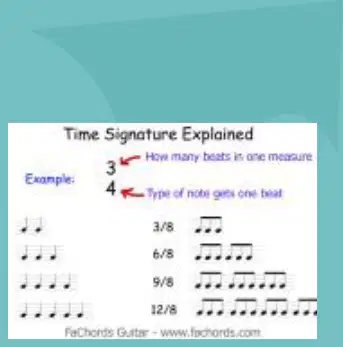
Which set correctly completes a 4/4 bar?
Three crotchets and a quaver
One semibreve note
Two quavers and a minim rest
Four quaver rests and a quaver

