
Font size
 Worksheets
H Admin Theory 1.4 Impact of IT Quiz
Total questions: 97
Worksheet time: 49mins
Which of the following is a direct impact of I.T. on an organisation?
Retrieval of information
Decrease in global temperature
Increase in agricultural output
Reduction in physical exercise
Which term refers to the ability of employees to work from different locations due to I.T. advancements?
Remote
Password
Processing
Meetings
How does I.T. contribute to organisational workflow?
By improving the efficiency of processes
By increasing manual paperwork
By reducing the need for communication
By eliminating the need for management
Which concept is most closely related to the protection of organisational data in the context of I.T.?
Integrity
Layout
Morale
Meetings
Strategically, how can collaboration through I.T. impact an organisation's performance?
It can enhance teamwork and productivity.
It can reduce the need for hardware.
It can eliminate the need for data storage.
It can decrease employee motivation.
What is the main focus of ergonomics in the workplace?
Fitting the task and equipment to the user
Fitting the user to the equipment and task
Increasing the number of employees in an office
Reducing the size of office spaces
Which of the following is an advantage of a cellular office layout?
Work can be conducted in privacy and relative quiet
It is easy to share equipment between offices
Communication is always easier
Supervision is more straightforward
Which of the following is a disadvantage of cellular office layouts?
It is more difficult to work in teams
Workstations can be set up to suit individual requirements
Light and temperature can be adjusted
Information can be stored securely
What is an alternative to the cellular office layout mentioned in the text?
Open plan or flexible office layout
Cubicle office layout
Remote office layout
Virtual office layout
Explain how the birth of ergonomics impacted employee morale and motivation in the workplace.
It led to the creation of effective and suitable environments, which improved morale and motivation.
It made employees work longer hours.
It reduced the need for equipment in offices.
It eliminated the need for supervision.
Why might supervision be more challenging in a cellular office layout?
Employees are based in different locations around the workplace.
Supervisors have more authority.
Employees work in open spaces.
There are fewer employees in the office.
A company is considering switching from a cellular office layout to an open plan layout. What strategic factors should they consider regarding communication and teamwork?
Open plan layouts may improve communication and teamwork by reducing physical barriers.
Open plan layouts always reduce privacy for employees.
Cellular layouts are better for teamwork.
Open plan layouts make supervision impossible.
If an organisation needs to frequently adapt its office space to changing requirements, which office layout would be more suitable and why?
Open plan or flexible layout, because it allows for non-permanent and moveable walls.
Cellular layout, because it is more private.
Cellular layout, because it is more secure.
Open plan layout, because it is more difficult to change.
Which of the following is an advantage of an open plan or flexible office layout?
The space is flexible and can be adapted according to the organisation’s requirements.
Employees have more privacy for confidential meetings.
Secure storage is easier for personal belongings.
It is easier to adjust temperature and lighting for each employee.
What is a common disadvantage of an open plan or flexible office layout?
Employees can communicate more easily with each other.
It is easier to supervise employees in one large area.
There may be a lack of privacy to conduct confidential meetings.
The most economical use of space can be achieved.
Which of the following work areas is described as a bookable space for confidential meetings or discussions?
Hot rooms
Break out areas
Touchdown areas
Open plan desks
How has technology helped minimise some issues associated with workflow and workspace in offices?
By making it easier to share equipment through local area networks
By increasing the need for dedicated offices
By making it harder to access information in electronic format
By reducing the use of informal work areas
Which of the following is a strategy to minimise disadvantages of open plan offices?
Using flexible work areas like break out areas and touchdown areas
Increasing the number of small, isolated offices
Reducing the use of technology in the workplace
Assigning each employee a dedicated office
An employee feels their workspace lacks status because all employees are accommodated in one area. This is most likely a disadvantage of which office layout?
Open plan or flexible office layout
Cellular office layout
Home office layout
Virtual office layout
Why might employees become more easily distracted in an open plan office?
It may be difficult to concentrate in a large open plan area.
There are more private offices available.
There is less communication between employees.
Lighting and temperature are always perfect for everyone.
Which area provides employees with an informal space to chat or exchange information?
Break out areas
Hot rooms
Private offices
Reception areas
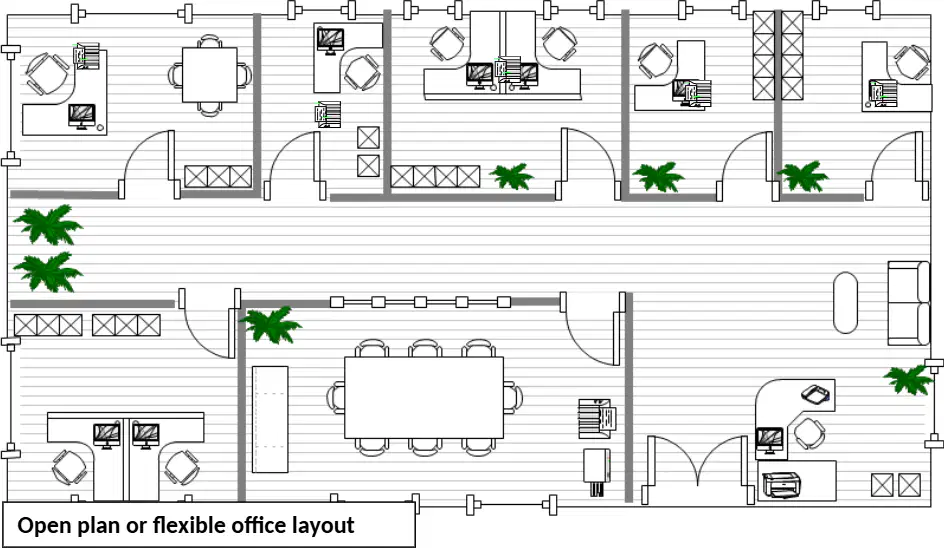
Which type of office layout allows for easier accommodation of more employees and flexible rearrangement of space?
Cellular or traditional office layout
Open plan or flexible office layout
Home office layout
Cubicle-only office layout
In the flexible office layout, how is equipment such as photocopiers and printers typically managed?
Each employee has their own printer
Equipment is shared among employees
Only the manager has access to printers
Printers are not used in flexible layouts
What is a key advantage of the flexible office layout compared to the cellular office layout when organisational needs change?
Flexible layout is more expensive to change
Cellular layout is easier to rearrange
Flexible layout can be adapted by moving filing cabinets
Cellular layout allows for more employees
A company wants to supervise employees while still providing the manager with a personal office space. Which office layout best supports this need?
Only the cellular layout
Only the flexible layout
Both cellular and flexible layouts
Neither layout supports this need
Which of the following is a direct effect of poorly designed work spaces on employees?
Increased job satisfaction
Decreased employee absence rates
Decreased motivation and productivity
Improved communication
What is workflow in the context of an organisation?
The process of hiring new employees
A series of steps or tasks that join together to create a process or system of work
The design of office furniture
The method of calculating employee salaries
How can a well-designed workspace impact the productivity of an organisation?
By increasing employee turnover
By slowing down communication
By improving workflow and employee morale
By reducing the amount of information shared
Why might employees become frustrated in a poorly designed workplace where Sales and Marketing departments are on separate floors?
They have too much information
They are required to travel between locations to discuss issues
They have more free time
They receive higher salaries
How does the use of IT contribute to employee morale and motivation?
By making employees work longer hours
By enabling communication and distribution of information at low cost
By reducing the number of employees
By increasing physical barriers between departments
Which of the following best describes the role of intranets or local area networks in an organisation?
They prevent employees from accessing information
They allow large volumes of information to be available to employees regardless of location
They increase the cost of communication
They slow down decision making
Increased information sharing can positively impact employee morale and wellbeing. Why?
It makes employees feel less confident in their roles.
It ensures employees have the information required to do their jobs well, leading to greater happiness and motivation.
It reduces the amount of information available to employees.
It increases employee absence rates.
A well-designed, well laid-out ergonomic work environment can help improve productivity. Which of the following best explains why this is true?
It reduces physical strain and discomfort, allowing employees to work more efficiently.
It increases the amount of paperwork required for each task.
It encourages employees to take more frequent breaks, reducing overall work time.
It makes the workplace more visually appealing, but does not affect productivity.
Which of the following best summarizes the advantages and disadvantages of open-plan and cubicle office layouts?
Open-plan offices promote collaboration but can be noisy; cubicle offices offer privacy but may reduce teamwork.
Open-plan offices offer maximum privacy; cubicle offices are best for group discussions.
Open-plan offices are always preferred for quiet work; cubicle offices are best for socializing.
Open-plan offices and cubicle offices have no impact on productivity.
Which of the following are principles of a good office design?
Efficient use of space and good lighting
Lack of ventilation and overcrowding
Poor accessibility and limited storage
Dark colors and minimal furniture
The impact upon both the organisation and the employees if the above mentioned principles are not adhered to is:
Decreased trust, lower morale, and potential legal or ethical issues.
Increased productivity and employee satisfaction.
Improved communication and stronger teamwork.
Enhanced reputation and employee loyalty.
Which of the following is NOT a type of flexible working hour pattern mentioned in the text?
Part-time
Full-time
Overtime
Flexi-time
Which of the following is a potential disadvantage of home-working or tele-working?
Employees can keep in touch with colleagues via web-cam
Employees may feel isolated from colleagues
Employees save time by not travelling
Employees can fit working hours around their lifestyle
What is one way information technology supports flexible working practices?
By providing free office supplies
By allowing access to centrally-held electronic information from anywhere
By increasing the number of office meetings
By reducing the need for internet connections
Which of the following best explains why home-working can reduce stress levels for employees?
Employees have more time to socialize with colleagues
Employees spend less time travelling, leading to more relaxation and focus
Employees receive higher salaries
Employees do not need to use computers
Suppose an employee needs to drop off and collect children from school. Which flexible work benefit would most help them?
Ability to fit working hours around their lifestyle
Increased office meetings
Permanent contracts only
Fixed office-based work
An employee working from home finds that their internet connection is unreliable, making it difficult to communicate with colleagues. According to the text, what is the likely impact of this situation?
Increased productivity
Decreased productivity
No effect on work
Improved morale
Which of the following is a benefit for an organisation when employees work from home or tele-work?
More workspace is required in the office.
Employees are less motivated and productive.
The organisation can retain workers with family commitments.
It is easier for managers to supervise employees.
What is a potential disadvantage for managers when employees work from home or tele-work?
Employees are always more productive.
It is more difficult to supervise and monitor employees.
Less equipment is needed for employees.
Employees never miss meetings.
Which of the following is a reason why home or tele-workers may become unproductive?
They have access to all office equipment.
They are always motivated.
They may have too many distractions at home.
They attend all meetings regularly.
Why might an organisation need to provide equipment to home or tele-workers?
Because they can share office equipment easily.
Because they are unable to share office equipment in the workplace.
Because they do not need any equipment.
Because equipment is not important for productivity.
Which of the following is a low cost and effective way of communicating in business, as mentioned in the text?
Telephone calls
Face-to-face meetings
Postal mail
A company is considering allowing more employees to work from home. Based on the information provided, which of the following should the company consider to ensure productivity does not decrease?
Allow employees to work without any supervision.
Provide health and safety checks and training for home-workers.
Remove all meetings from the schedule.
Require employees to use only their own equipment.
Audio-conferencing and video-conferencing are two methods for conducting meetings with colleagues. Which of the following best describes a key difference between them?
Audio-conferencing allows participants to hear each other, while video-conferencing allows both seeing and hearing each other.
Audio-conferencing requires a camera, while video-conferencing does not.
Video-conferencing is only used for large meetings, while audio-conferencing is for small groups.
Audio-conferencing is more expensive than video-conferencing.
Justify the cost of investing in up-to-date technology for communications.
It improves efficiency and enables better collaboration.
It increases unnecessary spending without benefits.
It makes communication slower and less reliable.
It reduces the ability to connect with clients.
Which of the following best describes a LAN (Local Area Network)?
A network set up within one geographical location connecting all of an organisation's computers together.
A network that covers multiple countries and continents.
A software used for online collaborative white-boarding.
A type of file management system for backing up data.
What is the main advantage of using workgroup productivity software in an organisation?
It allows staff to access an online area to upload documents and collaborate on projects.
It provides physical storage for paper-based files.
It restricts all users from accessing any files.
It only allows one person to work on a document at a time.
Which feature is provided by online collaborative white-boarding software?
Multiple users can edit and adapt a file in real time while others see changes on their screens.
It only allows one user to access the file at a time.
It is used solely for backing up files.
It is a type of hardware for connecting computers.
Which of the following is NOT a benefit of electronic file management?
Files can only be accessed by one person at a time.
Files and information can be backed up regularly.
Files stored electronically occupy less space than paper-based files.
Access to information can be restricted and controlled.
How does the use of 'read only' attributes help protect file data?
It allows employees to view information but restricts editing, adding, or deleting, preserving data integrity.
It enables all users to edit and delete files freely.
It automatically backs up files to a remote server.
It encrypts files so no one can access them.
Why is data integrity important in an organisation?
It ensures the accuracy and consistency of data for as long as it is required.
It allows unlimited access to all files for all employees.
It reduces the need for any data storage.
It eliminates the need for file backups.
A company wants to allow employees in different countries to access and share company information securely. Which type of network should they use?
WAN (Wide Area Network)
LAN (Local Area Network)
Workgroup Productivity Software
Read Only Attribute
Which of the following best explains the purpose of access rights and privileges in file management?
To restrict and control access so only certain users can access specific files.
To allow all employees to access and edit all files.
To automatically delete files after a set period.
To convert electronic files into paper-based files.
Which type of data in a business organisation is covered by Data Protection legislation and requires secure storage and accuracy?
Customer records
Stock figures
Supplier information
Sales figures
Why is the accuracy of stock figures important in a business organisation?
It impacts daily or weekly operations
It protects personal data
It ensures payment terms are met
It prevents unauthorised access
Which of the following is a basic security measure to protect computer equipment in an organisation?
Marking equipment with security markers
Leaving equipment unlocked
Sharing passwords with all employees
Disabling backup systems
What is a recommended way to protect information held on electronic storage devices such as CDs, DVDs, or portable memory drives?
Store them securely
Leave them on desks
Share them with all staff
Discard them after use
Which type of organisational data is likely to include details of absences, contractual agreements, and disciplinary records?
Personnel records
Financial data
Supplier information
Sales figures
How can confidential information be protected within an organisation?
By storing it in secure areas with keypad entry or swipe cards
By emailing it to all employees
By posting it on public notice boards
By leaving it unlocked in common areas
Why should data be backed-up regularly in an organisation?
To prevent loss or damage to data
To increase the number of files
To reduce storage costs
To allow public access
Which type of data in a business organisation typically includes credit limits, payment terms, and history of orders and deliveries?
Supplier information
Customer records
Personnel records
Stock figures
A company wants to ensure that only authorised personnel can access confidential information. Which security measure would best achieve this?
Using keypad entry or swipe cards for secure areas
Allowing open access to all employees
Storing information on unsecured devices
Posting passwords on notice boards

An organisation is planning to improve its data management system. What strategic steps should it take to ensure both security and integrity of its data?
Implement security markers, regular backups, and secure storage for confidential information
Only mark equipment with security markers
Store all data in one location without backups
Allow unrestricted access to all data
Which of the following is a primary reason for installing anti-virus software on a network?
To protect the network from viruses
To increase internet speed
To reduce electricity consumption
To improve printer performance
What is one way organisations can prevent unauthorised access to sensitive or confidential data?
By setting access rights and secure login procedures
By allowing open access to all files
By disabling all passwords
By sharing login credentials with everyone
Why is it important for organisations to have systems and procedures for file management?
To ensure data is stored in an organised manner and can be accessed easily
To make files larger in size
To increase the number of outdated files
To prevent any user from accessing data
Which of the following best describes a centralised data management system?
All data is stored in one location, usually electronically
Data is stored on paper in multiple offices
Each employee keeps their own data on personal devices
Data is only stored on external hard drives
What is a key advantage of storing data centrally within an organisation?
Data will not be duplicated elsewhere, ensuring consistency
It increases the risk of data loss
It makes it harder for users to access information
It requires more manual data entry
How can validation features improve data input accuracy in a central data management system?
By checking that the data entered meets certain criteria
By allowing any type of data to be entered
By ignoring errors in data entry
By deleting all incorrect data automatically
A company wants to ensure that only authorised users can access certain files. Which measure should they implement?
Set up access rights and secure login procedures
Allow all users to share passwords
Disable all security features
Store files on public websites
Why might technical support monitor user activity on a network?
To detect attempts to access unauthorised information or potential security threats
To increase the number of emails sent
To reduce the size of files
To improve the colour quality of monitors
Which of the following is NOT an advantage of a centralised data management system?
Data is duplicated in multiple locations
Multiple users can access data at the same time
Security measures can be applied across the board
Validation features can improve data accuracy
Why is training staff on IT systems important for an organisation?
To ensure employees use the systems safely and responsibly
To make employees work longer hours
To reduce the number of computers needed
To increase the cost of IT support
Which of the following is a benefit of a good system of file management in an organisation?
It increases the number of complaints from customers.
It slows down decision making.
It helps improve response times and aids faster decision making.
It reduces competitive edge.
What is one way effective data management systems can impact staff motivation?
By increasing the time spent searching for information.
By increasing employee complaints.
By increasing employee’s sense of job satisfaction and morale.
By reducing productivity.
Which of the following is a factor to consider when establishing a good data management system?
The colour of the office walls.
The type of hardware and software suitable for the organisation.
The number of employees in the organisation.
The location of the organisation.
Why might larger organisations choose custom-designed hardware for their data management systems?
To fit their own data management and technical requirements.
To reduce the cost of equipment.
To avoid using any software.
To increase the number of staff.
Which type of software can be used to organise specific events for an organisation?
Accounting software
Event management software
CAD-CAM software
Performance management software
Project management software is mainly used to:
Monitor the performance of computer systems.
Organise specific events.
Support the planning and undertaking of projects.
Process accounts and finance data.
Which software helps managers set targets and monitor staff development?
Employee performance management software
CAD-CAM software
Accounting software
Event management software
What is the primary function of accounting software in an organisation?
Organising events
Monitoring computer performance
Processing and storing accounts and finance data
Designing products
How does CAD-CAM software benefit manufacturing organisations?
By organising staff meetings
By providing storage of information, costings, and stock reports
By monitoring employee performance
By producing financial reports
If an organisation wants to improve both staff motivation and customer service, which aspect of data management should they focus on and why?
Only purchasing expensive hardware, because it looks impressive.
Implementing effective data management systems, because it reduces time spent searching for information and increases job satisfaction.
Ignoring software updates, because it saves money.
Reducing the number of staff, because it lowers costs.
Why might an organisation choose to use 'off-the-shelf' components for their data management system?
To increase the cost of their system.
To avoid modifying their system to suit their needs.
To minimise costs by using widely available equipment.
To ensure their system is custom-designed.
An organisation is deciding between purchasing specialised software and using general business software for data management. What factors should they consider in making this decision?
The colour of the software interface.
The specific needs and requirements of their industry, cost, and potential benefits of investment.
The number of windows the software can open.
The location of their office.
A manufacturing organisation is considering investing in CAD-CAM software. What strategic advantages might this bring to their operations?
It will help organise staff parties.
It will provide storage of information, costings, stock reports, and support design and production processes.
It will reduce the need for any hardware.
It will eliminate the need for financial reports.

Which of the following is a basic function provided by office administration software?
Word-processing
Video editing
3D modeling
Game development
What is one possible consequence of poor data management in an organisation?
Improved customer satisfaction
Loss of customers and sales turnover
Increased market share
Enhanced brand reputation
Which of the following best describes a risk associated with inconsistent or missing data in an organisation?
Faster decision-making
Loss of productivity and missed deadlines
Reduced resource costs
Improved data accuracy
Why might poor data management result in legal action against an organisation?
Because it increases profits
Because it leads to better customer service
Because the organisation may fail to adhere to legislative guidelines
Because it improves data security
An organisation spends significant resources on both hardware and software for data management. Which of the following best justifies this investment?
To increase the number of employees
To ensure effective data management and avoid higher costs from poor data management
To reduce the need for customer service
To eliminate all business risks
A company is experiencing time wasted searching for data and correcting errors. What is the most likely cause?
Effective data management
Poor data management leading to duplicated or inconsistent data
High employee motivation
Centralised database management

