
 Worksheets
QUIZ III - PHY 504 - AY 2025-26
Total questions: 20
Worksheet time: 10mins

In the context of a transverse pulse traveling on a stretched rope, what is the relationship between the direction of motion of element P and the direction of propagation?
The direction of motion of element P is parallel to the direction of propagation.
The direction of motion of element P is perpendicular to the direction of propagation.
The direction of motion of element P is opposite to the direction of propagation.
The direction of motion of element P is diagonal to the direction of propagation.
Which of the following best describes the motion of a longitudinal wave?
The wave causes the medium to move in the same direction as the wave's propagation.
The wave causes the medium to move perpendicular to the wave's propagation.
The wave causes the medium to move in a circular motion.
The wave causes the medium to remain stationary while the wave propagates.
What is the mathematical expression for the resultant wave when two waves interfere to form a standing wave?
y = y₁ + y₂ = (2A sin kx) cos ωt
y = y₁ + y₂ = (A sin kx) cos ωt
y = y₁ + y₂ = (A cos kx) sin ωt
y = y₁ + y₂ = (2A cos kx) sin ωt
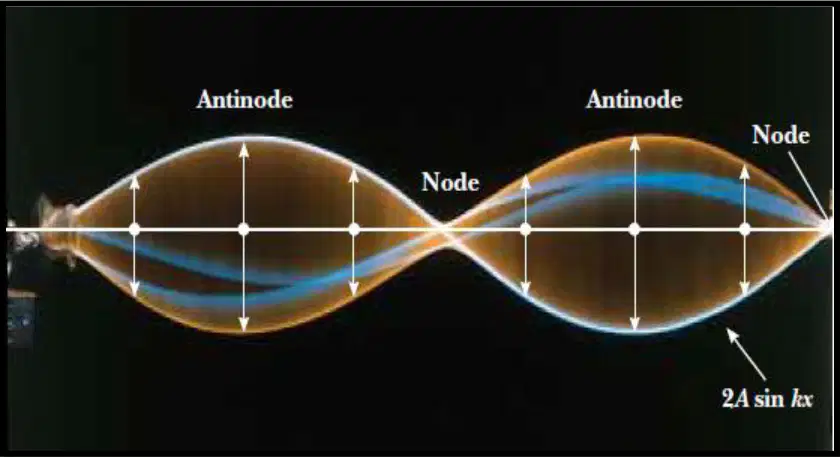
What is the distance between adjacent nodes in a standing wave?
λ/2
λ/4
λ
2λ
What is the frequency of a traveling wave if the number of oscillations in one second is three and a half?
2.5 Hz
1.5 Hz
3.5 Hz
2 Hz
What is the equation for the curl of the magnetic field in free space?
∇×B=μ0J+μ0ϵ0∂t∂E
∇×B=μ0ϵ0∂t∂E
∇×B=∇⋅B−∇2B
∇×B=μ0ϵ0∂t2∂2B
What is the general form of the second-order differential wave equation?
∇²ψ = 1/v² ∂²ψ/∂t²
∇ψ = v² ∂ψ/∂t
∇²ψ = v ∂ψ/∂t²
∇ψ = 1/v² ∂ψ/∂t²
What is the numerical value of the speed of electromagnetic wave in free space?
3.0 × 10⁸ m/s
2.5 × 10⁸ m/s
3.5 × 10⁸ m/s
4.5 × 10⁸ m/s
Which range of electromagnetic spectra has highest wave length?
X-Ray
Micro-wave
Visible Range
Radio Wave
What is the relationship between the electric field & magnetic field in an electromagnetic wave?
The electric field and magnetic field are parallel to each other.
The electric field and magnetic field are perpendicular to each other and the direction of propagation.
The electric field and magnetic field are perpendicular to each other but parallel to the direction of propagation.
The electric field and magnetic field are parallel to the direction of propagation.
Which frequency range corresponds to visible light in the electromagnetic spectrum?
104 Hz to 108 Hz
100 - 420 GHz
430–770 THz
1120 - 1320 PHz
Which of the following material parameters primarily control electromagnetic (EM) wave propagation in a medium?
Conductivity, Permeability, and Permittivity
Density, Temperature, and Pressure
Frequency, Wavelength, and Amplitude
Resistance, Capacitance, and Inductance
In a loss-less dielectric medium, what is the approximate value of conductivity (σ)?
σ = 0
σ ≈ 0
σ ≠ 0
σ ≈ ∞
What is the characteristic of conductivity (σ) in a good conductor?
σ = 0
σ ≈ 0
σ ≠ 0
σ ≈ ∞
In a lossy dielectric medium, how is permittivity (ε) expressed?
ε = ε₀
ε = ε₀εᵣ
ε = ε₀μᵣ
ε = μ₀εᵣ
What does the Poynting's Vector represent?
Instantaneous power density vector associated with gravitational field at a given point.
Instantaneous power density vector associated with electro-magnetic field at a given point.
Instantaneous power density vector associated with magnetic field at a given point.
Instantaneous power density vector associated with electrical field at a given point.
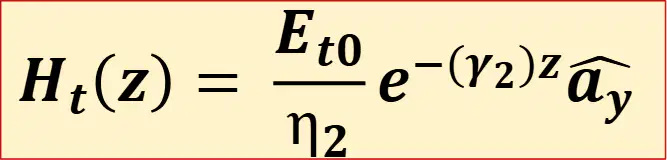
In the diagram, what does η2 represent in the equation
The intrinsic impedance of Medium 2
The intrinsic impedance of Medium 1
The reflection coefficient of the wave
The propagation constant of the wave
Define the corresponding Magnetic Field associated with the electric field E=E0Sin(ωt−βx)j
H=H0Sin(ωt−βx±ϕ)j
H=H0Sin(ωt−βz±ϕ)j
H=H0Sin(ωt−βy±ϕ)j
H=H0Sin(ωt−βx±ϕ)k
An electromagnetic wave propagating in z-direction, with E field oscillating in X-axis and H field oscillating in Y-axis, reflecting from Z=0 interface, what would be reflected EM Field?
Propagation along Z-direction, E field along X-axis, H field along Y-axis
Propagation along (-Z)-direction, E field along -X-axis, H field along (-Y)-axis
Propagation along (-Z)-direction, E field along X-axis, H field along (-Y)-axis
Propagation along Z-direction, (-E) field along X-axis, H field along (-Y)-axis
What is an electrostatic dipole?
Two positive charges separated by a small distance
Two negative charges separated by a small distance
One positive and One negative charges separated by a small distance
One positive and One negative charges separated by a large distance

