
 Worksheets
T.3,L.1 Properties of waves
Total questions: 35
Worksheet time: 27mins
What is a wave?
A type of solid object
A kind of heavy liquid
A way to store energy
A way to transfer energy
Which best describes amplitude in a wave diagram?
Distance from trough to trough line
Distance from start to end of water
Distance along the whole wave shape
Distance from crest to the rest line
The crest of a wave is the
bottom point of a wave
side point of a wave
middle line of a wave
top point of a wave
The trough of a wave is the
side bend of a wave
flat part of a wave
highest part of a wave
bottom point of a wave
What is a medium?
Energy without any matter
Only empty outer space
Only a liquid substance
Material made of particles
Which list shows three possible forms of a medium?
Metal, energy, color
Air, vacuum, light
Heat, light, sound
Solid, liquid, gas
Wavelength is the distance
between two crests or two troughs
from crest straight down to rest
from start of wave to the end
from water to the beach sand
Which picture label would show the highest amplitude?
A tall crest above the rest line
A short crest near the rest line
A flat line with no crests
A trough just touching the rest
If the crests move farther apart, what happens to wavelength?
Medium disappears
Amplitude increases
Wavelength decreases
Wavelength increases
Where would you mark the trough on a simple wave drawing?
At the lowest point
At the highest point
Along the rest line
At the far right edge
Two students draw a wave. Student A draws higher crests than Student B. Which is larger for Student A’s wave?
Wavelength
Medium
Amplitude
Troughs
Choose the pair that matches correctly.
Crest — top point
Trough — top point
Amplitude — distance along
Wavelength — height up
Which change would make the wavelength smaller?
Crests getting closer together
Crests getting taller only
Rest line moving upward
Medium changing from gas
Which type of wave is shown when sound moves through the air as squished and stretched parts?
Light wave bending around corners
Transverse wave with crests and troughs
Longitudinal wave with compressions and rarefactions
Ocean wave breaking on a beach
Which example is a transverse wave?
Sound from a whistle
Light from a lamp
Air pressure in a room
Vibrations in a slinky pushed forward
Which example is a longitudinal wave?
A jump rope moved up and down
Sound from a guitar string
Ripples on a pond surface
Light from the Sun
What best describes how particles move in a transverse wave?
Side to side along the path
Up and down across the path
Forward only without moving back
Randomly in all directions
Which picture would most likely show a longitudinal wave?
Wavy line with tall peaks and deep dips
Zigzag line changing directions sharply
Flat line with no rises or dips
Row of loops close together then farther apart
If you move a slinky by pushing and pulling along its length, what wave is made?
Transverse wave moving up and down
Longitudinal wave moving back and forth
Standing wave with no motion
Circular wave spinning around
If you move a rope up and down, what kind of wave travels along the rope?
Sound wave through the rope
No wave because ropes cannot wave
Longitudinal wave with compressions
Transverse wave with crests and troughs
Which pair correctly matches the motion to the wave type?
Back-and-forth motion: transverse
Circular motion: transverse
Back-and-forth motion: longitudinal
Up-and-down motion: longitudinal
Which set lists only transverse wave examples?
Ocean waves and air pressure
Light waves and ocean waves
Sound waves and light waves
Sound waves and ocean waves

Andy drew a diagram of a transverse wave. Which part of the wave is labeled X?
rarefaction
crest
trough
compression
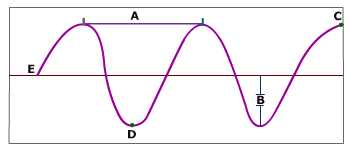


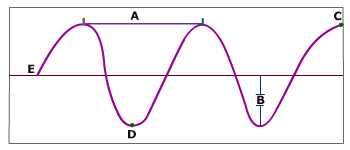

Which image represents a longitudinal wave?
A
B
Which image represents a transverse wave?
A
B

What type of wave is pictured?
Transverse wave
Longitudinal wave
Waving goodbye
Stadium wave

What type of wave is pictured?
Transverse wave
Longitudinal wave
Wave, what wave?
Slinky wave

This is an example of ______________________.
Transverse waves
Longitudinal waves


