
 Worksheets
Deciduous Maxillary First Molar Views
Total questions: 89
Worksheet time: 45mins
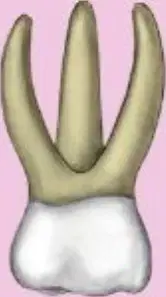
In the buccal view of a deciduous maxillary first molar, which feature is most emphasized by the outward flare of the roots?
Single straight conical root form
Short fused palatal root trunk
Flattened distal root surface
Prominent furcation near the cervical area
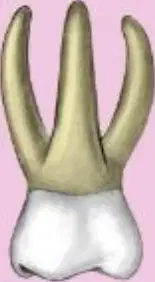
From the palatal (lingual) view, which root is typically the largest and most prominent in a deciduous maxillary first molar?
All three roots equal in size
Distobuccal root appearing stout
Mesiobuccal root appearing slender
Palatal root showing bulk and length
Which pair correctly matches the view with the surface primarily observed: buccal view shows buccal surface; palatal view shows palatal surface; mesial view shows mesial surface; distal view shows distal surface.
Distal view → mesial surface
Buccal view → buccal surface
Palatal view → palatal surface
Mesial view → distal surface
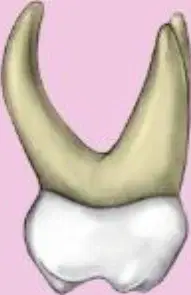
On the mesial view of a deciduous maxillary first molar, the cervical convexity of the crown is usually more pronounced than on the distal. Which statement best explains its clinical implication?
It indicates a longer distobuccal cusp ridge
Greater prominence affects matrix band adaptation
It reduces contact point height consistently
It necessitates a wider occlusal isthmus routinely
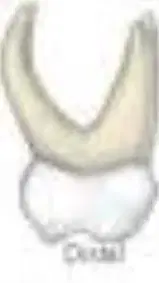
In the distal view, how does the convergence of the crown toward the occlusal surface typically compare with the mesial view in a primary maxillary first molar?
Less taper distally toward occlusal
No taper visible in primary molars
Greater taper distally toward occlusal
Equal taper on both proximal sides
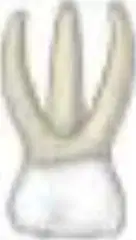
Which view most reliably reveals three separate roots of a deciduous maxillary first molar without overlap?
Buccal view with clear root divergence
Mesial view showing palatal root only
Distal view with fused appearance
Occlusal view showing cuspal outline
Identify the view that best displays the occlusal table morphology, including marginal ridges and fossae, in a primary maxillary first molar.
Mesial view of proximal contour
Palatal view of root dominance
Buccal view of the facial surface
Occlusal view of the crown surface
When orienting the occlusal view, which edges correspond to the buccal and lingual sides for a maxillary molar diagram labeled with B (buccal) and L (lingual)?
B marks the tongue side; L marks labial side
B marks distal side; L marks mesial side
B marks the cheek side; L marks palatal side
B and L both mark proximal contacts
Place the developmental events of the deciduous maxillary first molar in chronological order from earliest to latest.
Calcification initiation, crown completion, eruption, root completion
Crown completion, calcification initiation, eruption, exfoliation
Eruption, calcification initiation, root completion, exfoliation
Root completion, tooth eruption, exfoliation, crown completion
At approximately what age does the deciduous maxillary first molar typically erupt?
16 months
6 months
2.5 years
10 years
Root completion for the deciduous maxillary first molar is typically achieved by (a) .
Which event occurs in utero for the deciduous maxillary first molar?
Initiation of calcification
Tooth exfoliation
Tooth eruption
Crown completion
Select all milestones that occur after eruption of the deciduous maxillary first molar.
Calcification initiation in utero
Crown completion at 6 months
Exfoliation at 10 years
Root completion at 2.5 years
From the buccal view of a deciduous maxillary first molar, which statement about root visibility is correct?
Only mesial and palatal roots are observable
Only the palatal root is hidden buccally
Only two roots are observable buccally
All three roots are observable buccally
Which root is the longest in the deciduous maxillary first molar?
Mesial root is the longest
Distal root is the longest
Palatal root is the longest
All roots are equal length
Identify the root that is shorter compared with the mesial root in the deciduous maxillary first molar.
Distal root is shorter
Palatal root is shorter
Mesiolingual root is shorter
All roots are shorter
Where does the division of roots typically begin in the deciduous maxillary first molar?
Just below the cementoenamel junction
Near the apices of the three roots
At the mid-root level of mesial root
Well above the cementoenamel junction
From the lingual view, which cusp is most prominent and sharp on the deciduous maxillary first molar?
Mesiobuccal cusp is most prominent
Distolingual cusp is most prominent
Distobuccal cusp is most prominent
Mesiolingual cusp is most prominent
Which lingual cusp tends to be smooth and rounded on the deciduous maxillary first molar?
Distolingual cusp is rounded
Mesiobuccal cusp is rounded
Mesiolingual cusp is rounded
Distobuccal cusp is rounded
Why is the distobuccal cusp visible from the lingual aspect in this tooth?
It is short and underdeveloped
It is long and well developed
The crown tilts buccally
The palatal root obscures it
In a three-cusp type deciduous maxillary first molar, which cusp arrangement is present?
Three buccal cusps and no lingual cusp
One buccal cusp and two lingual cusps
Two buccal cusps and one large lingual cusp
Two lingual cusps and one small buccal cusp
From the lingual aspect, which roots are visible and which is the largest in the deciduous maxillary first molar?
The palatal root is the largest
Mesial, distal, and palatal are visible
Only mesial and distal are visible
Only palatal is visible
Which cusp is longer and sharper on the deciduous maxillary first molar when viewed from the mesial aspect?
Mesiobuccal cusp
Mesiolingual cusp
Distobuccal cusp
Distolingual cusp
From the mesial aspect, which structure connects the mesiolingual cusp with the mesiobuccal cusp?
Mesial marginal ridge
Distal marginal ridge
Oblique ridge
Transverse ridge
Fill in the blank: From the mesial aspect, the tooth shows a pronounced convexity on the (a) surface at the cervical third of the crown.
Which way does the cervical line curve when the deciduous maxillary first molar is observed from the mesial aspect?
Toward occlusal surface
Toward cervical root
Toward buccal surface
Toward lingual surface
Regarding the lingual root from the mesial aspect, which description is accurate?
Curves distally from midpoint
Remains straight without curvature
Extends buccally then curves lingually
Extends lingually then curves buccally
From the distal aspect, how does crown width compare with the mesial aspect?
Narrower distally
Wider distally
Equal widths
Variable widths
Which cusp description from the distal aspect is correct?
Distolingual long and sharp
Mesiobuccal long and sharp
Mesiolingual shortest and blunt
Distobuccal long and sharp
Why are parts of the mesiobuccal and mesiolingual cusps visible from the distal aspect?
Small distal cusps
Buccal root prominence
Large distal cusps
Overhanging marginal ridge
From the distal aspect, the cervical line runs in what manner from buccal to lingual?
Deep cervical curve
Pronounced distal dip
Deep occlusal curve
Nearly straight line
Which root portion is visible from the distal aspect?
Part of mesiobuccal root
Entire lingual root
No root visible
Entire distobuccal root
From the occlusal view, the crown converges in which two directions?
Toward buccal aspect
Toward mesial aspect
Toward distal aspect
Toward lingual aspect
Which fossae set is present on the occlusal surface?
Central and four marginal pits
Two central fossae only
Two distal triangular fossae
Central and two triangular fossae
Which groove extends between the mesial triangular fossa and the distal triangular fossa?
Central developmental groove
Transverse groove of oblique ridge
Buccal developmental groove
Lingual developmental groove
Compared between marginal ridges, which statement is correct for the occlusal aspect?
Both ridges underdeveloped
Distal marginal ridge thin
Mesial marginal ridge thinner
Both ridges very thick
In the buccal view of the deciduous maxillary second molar shown in the diagram, which feature is best appreciated from this aspect?
Relative prominence of buccal cusps
Depth of palatal root groove
Contour of palatal cusps
Distal marginal ridge height
Which diagram view would most clearly display the palatal roots of the deciduous maxillary second molar?
Buccal aspect illustration
Palatal aspect illustration
Mesial aspect illustration
Distal aspect illustration
Select ALL views that primarily help assess proximal surface morphology of the deciduous maxillary second molar.
Distal view image
Palatal view image
Buccal view image
Mesial view image
From the mesial view diagram of the deciduous maxillary second molar, which orientation is correct for identifying the proximal surface?
Surface toward palatal vault
Surface toward buccal vestibule
Surface facing away from midline
Surface facing the midline
At approximately what age does the deciduous maxillary second molar typically erupt?
23 months of age
18 months of age
29 months of age
34 months of age
The first evidence of calcification for the deciduous maxillary second molar occurs at what time point?
28 weeks in utero
19 weeks in utero
12 weeks in utero
6 weeks postnatal
Fill in the blank: Completion of enamel for the deciduous maxillary second molar occurs at (a) .
Which of the following events is expected around 3 years for the deciduous maxillary second molar?
Initial calcification
Physiologic exfoliation
Root completion
Tooth eruption
Select ALL statements that are accurate for the deciduous maxillary second molar timeline.
Calcification begins at 19 weeks in utero
Enamel completes by 11 months of age
Typical eruption occurs at 29 months
Exfoliation occurs at 5–6 years
The deciduous maxillary second molar is ultimately replaced by which permanent tooth?
Maxillary second premolar
Maxillary first premolar
Maxillary canine
Maxillary first molar
In a routine exam, an 11-year-old presents with mobility of the maxillary second primary molar. Which stage best explains this finding?
Early root development stage
Physiologic exfoliation window
Post-eruptive maturation stage
Active enamel formation stage
Which pair forms the two well-developed buccal cusps of the deciduous maxillary second molar?
Mesiopalatal and distopalatal cusps
Mesiolingual and distolingual cusps
Mesial and distal marginal ridges
Mesiobuccal and distobuccal cusps
Between the two buccal cusps of a deciduous maxillary second molar, a shallow (a) is typically present.
How many roots are present in the deciduous maxillary second molar when viewed from the buccal aspect?
One fused root
Three distinct roots
Two separate roots
Four slender roots
Select all names that correctly identify the roots of the deciduous maxillary second molar.
Buccal root
Distal root
Palatal root
Mesial root
Where is the point of division (furcation) relative to the cemento-enamel junction in the deciduous maxillary second molar?
Close to the CEJ
Midway to the apex
At the apical third
Exactly at the apex

Compared with the deciduous maxillary first molar, the roots of the deciduous maxillary second molar appear:
Wider, shorter, lighter
Thicker, shorter, heavier
Slender, longer, heavier
Shorter, broader, lighter
Identify the mislabeled statement about the buccal aspect of the deciduous maxillary second molar.
A shallow groove separates buccal cusps
Furcation is far from the CEJ
Buccal cusps are equal in development
Crown is larger than the first molar crown
Which cusps are visible from the lingual aspect of a deciduous maxillary second molar?
Mesiobuccal, distobuccal, and palatal
Distolingual, distobuccal, and palatal
Mesiolingual, distolingual, and supplementary
Mesiolingual, mesiobuccal, and palatal
The supplementary cusp seen lingually on the deciduous maxillary second molar is also called the (a) .
From the mesial aspect, how many cusps are typically visible on the deciduous maxillary second molar?
Two cusps are visible mesially
Three cusps are visible mesially
Five cusps are visible mesially
Four cusps are visible mesially
Which structures are connected by the mesial marginal ridge when viewed from the mesial aspect?
Mesiobuccal cusp and mesiolingual cusp
Distobuccal cusp and distolingual cusp
Mesiolingual cusp and distolingual cusp
Mesiobuccal cusp and distobuccal cusp
What feature contributes to the molar-like appearance of the deciduous maxillary second molar crown when viewed mesially?
Greater buccolingual dimensions with long roots
Greater mesiodistal width with short roots
Narrow palatal surface with fused roots
Flattened buccal surface with thin roots
From the distal aspect, which cusps are described as small and equal in size on the deciduous maxillary second molar?
Mesiobuccal and distobuccal cusps
Distobuccal and distolingual cusps
Mesiolingual and distolingual cusps
Mesiobuccal and mesiolingual cusps
Which statement about the cervical line from the distal aspect is accurate?
It is markedly convex occlusally
It is nearly straight distally
It dips apically at the center
It shows strong mesial curvature
Why are all three roots visible from the distal aspect of the deciduous maxillary second molar?
The mesial root curves distally
The palatal root is the shortest
The distal root has smaller dimensions
The distal root is very divergent
How many major cusps are seen on the occlusal surface of the deciduous maxillary second molar?
Two major cusps only
Five major cusps present
Three major cusps total
Four major cusps present
Name the four major cusps on the occlusal surface of the deciduous maxillary second molar.
Mesiobuccal cusp
Cusp of Carabelli
Mesiolingual cusp
Distolingual cusp
Distobuccal cusp
Which fossa is the largest on the occlusal surface and contains the central pit?
Mesial fossae are the largest
Distal fossae are the largest
Central fossa is the largest
Triangular fossae are largest
Where are the mesial and distal triangular fossae located relative to the marginal ridges?
Centered within the central fossa
Crossing the oblique ridge midway
Far from the respective marginal ridges
Adjacent to the respective marginal ridges
Which groove crosses the occlusal surface as a prominent developmental feature?
Central developmental groove
Cervical developmental groove
Transverse marginal groove
Palatal supplemental groove
The buccal and lingual developmental grooves serve primarily as what?
Boundaries of the marginal ridge
Origins of the oblique ridge
Entrances to root canals
Demarcations between cusp pairs
Supplementary grooves on the occlusal surface most often originate from which structure?
Oblique ridge crest
Main developmental groove
Triangular fossae margins
Central pit opening
Which cusps are connected by the prominent oblique ridge on the deciduous maxillary second molar?
Mesiolingual cusp with distobuccal
Mesiolingual cusp with mesiobuccal
Mesiobuccal cusp with distolingual
Mesiobuccal cusp with distobuccal
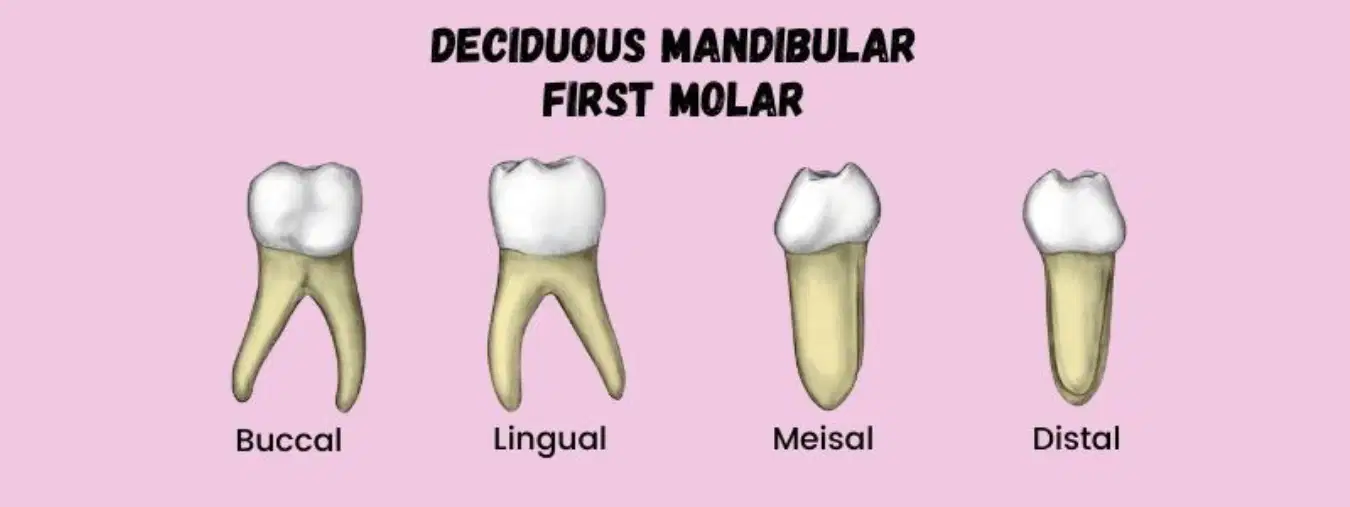
Identify the view that best shows two separate roots diverging toward the buccal and lingual aspects in a deciduous mandibular first molar.
Lingual view of the tooth
Buccal view of the tooth
Mesial view of the tooth
Distal view of the tooth
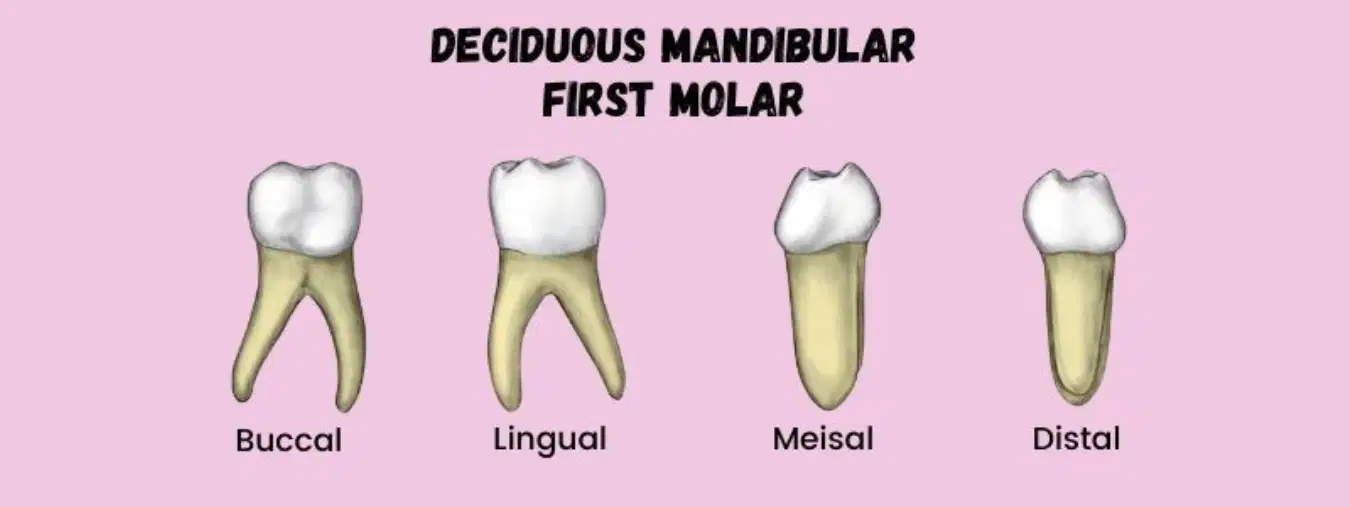
Which view would most directly display the height of contour on the lingual surface of a deciduous mandibular first molar crown?
Mesial aspect visualization
Distal aspect visualization
Lingual aspect visualization
Buccal aspect visualization
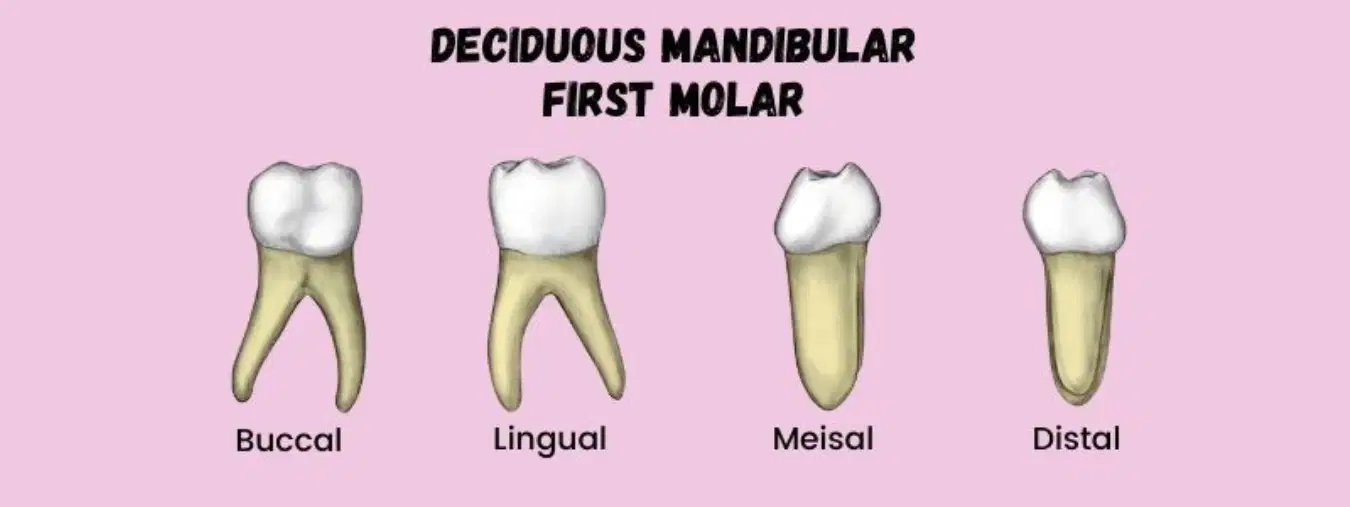
Select ALL views that primarily show a single broad root trunk tapering cervically rather than clearly separated roots in the deciduous mandibular first molar diagrams.
Buccal surface perspective
Lingual surface perspective
Distal surface perspective
Mesial surface perspective
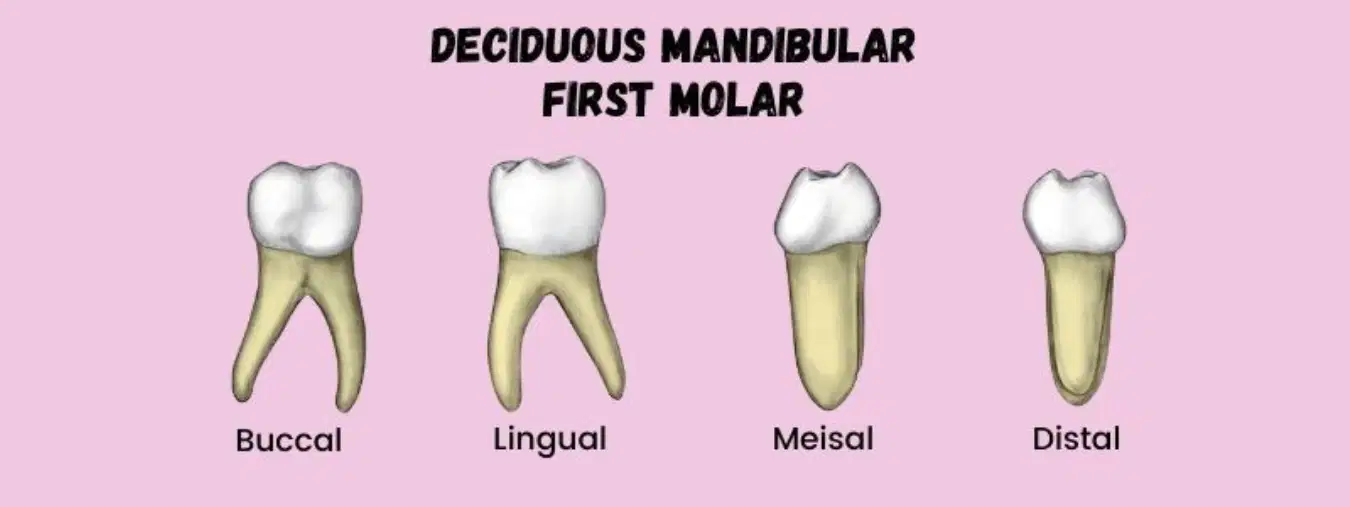
From the diagrams, which view is most suitable to compare relative cusp prominence on the occlusal outline silhouette of a deciduous mandibular first molar?
Lingual view profile
Distal view profile
Buccal view profile
Mesial view profile
At what age does the deciduous mandibular first molar typically erupt?
24 months of age
36 months of age
16 months of age
12 months of age
Beginning of calcification for the deciduous mandibular first molar occurs at (a) .
Which developmental event is expected around 5.5 months after birth for the deciduous mandibular first molar?
Tooth eruption completes
Crown formation completes
Root formation begins
Exfoliation commences
Select all correct statements about the deciduous mandibular first molar timeline.
Calcification begins postnatally at 15.5 weeks
Exfoliation typically at 6–7 years
Eruption occurs at about 16 months
Root completion occurs by about 2.5 years
The deciduous mandibular first molar is replaced by which tooth, and at approximately what age?
Mandibular first premolar at 10–11 years
Mandibular second premolar at 8–9 years
Mandibular canine at 11–12 years
Mandibular first molar at 6–7 years
Place the following events for the deciduous mandibular first molar in correct chronological order: calcification begins, crown completion, eruption, root completion.
Crown completion, calcification, eruption, root completion
Eruption, crown completion, calcification, root completion
Calcification, eruption, crown completion, root completion
Calcification, crown completion, eruption, root completion
Which statement best characterizes the mesial outline of the crown from the buccal aspect of a deciduous mandibular first molar?
Strongly convex along the mesial outline
Almost straight along the mesial outline
Irregular with pronounced notches
Concave from contact to cervical
From the buccal aspect, how does the distal part of the crown height compare with the mesial part?
Distal height varies widely
Both parts are equal
Distal part height is less
Distal part height is greater
Identify the two cusps present on the buccal aspect of a deciduous mandibular first molar.
Distolingual cusp
Mesiolingual cusp
Distobuccal cusp
Mesiobuccal cusp
Which comparison between the buccal cusps is accurate?
Mesiobuccal is lower and narrower
Mesiobuccal is wider and higher
Distobuccal is wider and higher
Both are equal in dimensions
Name the shallow groove located between the two buccal cusps of the deciduous mandibular first molar.
(a)
How many roots are typically present, and what are they called, in the deciduous mandibular first molar?
Four roots, widely divergent
Single root, conical and stout
Three roots, two buccal one lingual
Two roots, mesial and distal
Which statement regarding root morphology in deciduous molars is correct?
Root trunk large, roots widely flared
Root trunk absent, roots fused together
Root trunk is large, roots short and thick
Root trunk is small, roots long and slender
From the lingual aspect, what is the general convergence pattern of the crown and roots?
They converge toward the lingual
They diverge toward the lingual
They flare toward the buccal
They remain parallel lingually
Select the correct descriptions of the lingual cusps of the deciduous mandibular first molar.
Mesiolingual cusp long and sharp
Distolingual cusp short and round
Both lingual cusps equal in size
Only one lingual cusp present