
 Worksheets
Water Cycle 4th grade
Total questions: 22
Worksheet time: 12mins
Anh spilled some water on a hot metal picnic table. When she came back to the table, she noticed the water was no longer there. If the water was left untouched, how did it most likely disappear?
The water precipitated into the atmosphere.
The water was absorbed by the table.
The water evaporated into the atmosphere.
The water dissolved into the table.
When cooking pasta, steam is given off. If a lid is put on the pot, the steam will stay inside. When the lid is taken off, the steam will travel wherever it can. What can steam be called?
plasma
liquid
solid
gas
Sandra wakes up and finds the grass is covered with drops of water. It did not rain overnight, and her parents did not turn on the sprinkler. How did the water most likely get ther?
Ice from a nearby pond evaporated and formed water drops.
Water drops were blown from a nearby pond onto the grass.
Water vapor from the air condensed when air was cooled, forming liquid water.
Ice from the air melted into liquid water as it touched the grass, forming drops.
Which of the following sentences is true?
Water can be cooled to create ice, and ice can be cooled to create water vapor.
Water vapor can be heated to create water, and water can be cooled to create ice.
Ice can be heated to create water, and water can be heated to create water vapor.
Ice can be heated to create water vapor, and water vapor cannot change state.
Which of the following best describes solid or liquid water that falls from the atmosphere?
evaporation
condensation
collection
precipitation
Which of these is a model of condensation?
A bottle of water left in the freezer bursts.
A rain gauge overflows after large thunderstorms.
A bowl of water decreases in volume after being left in the Sun.
A person's glasses fog up when stepping into an air-conditioned room.
Which stages of the water cycle have to happen before it rains?
water condenses and forms dew
water evaporates and condenses into clouds
water runs off and evaporates
water condenses into vapor and freezes
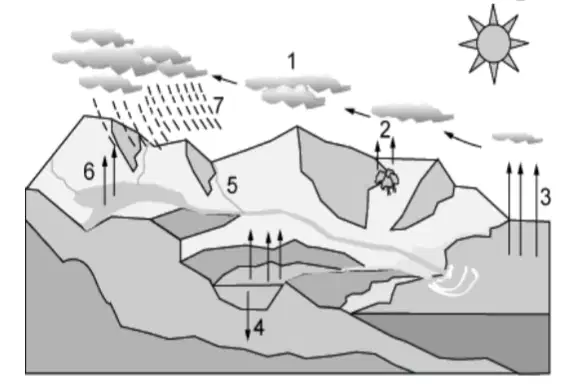
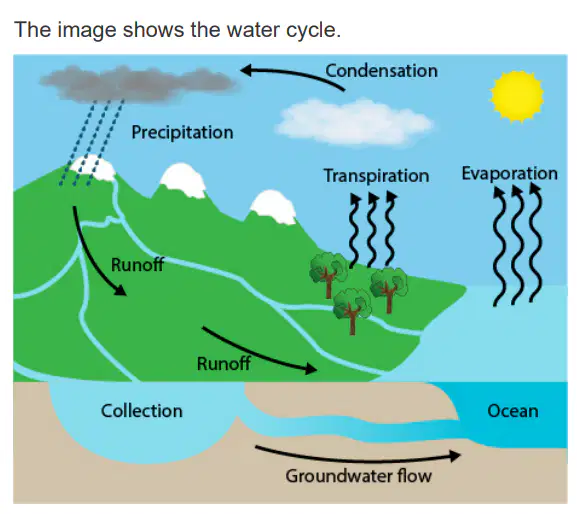
The picture shows pathways of water in the water cycle. Which part of the water cycle is taking place at point 3?
transpiration
condensation
precipitation
evaporation
Which of the following is the phase change that occurs when a liquid becomes a solid?
condensation
freezing
melting
evaporating
In a three-day experiment, a bowl of liquid water is put into a room with a temperature of 75°F on the first day. On the second day, the temperature of the room is lowered to 0°F. On the third day, the room is heated to 105°F. What changes will most likely occur to the water in the bowl on the third day?
Liquid water will turn into ice, then some ice will turn into vapor.
Ice will turn into vapor, then some vapor will turn into liquid water.
Ice will turn into liquid water, then some liquid water will turn into vapor.
Vapor will turn into liquid water, then some liquid water will turn into ice.
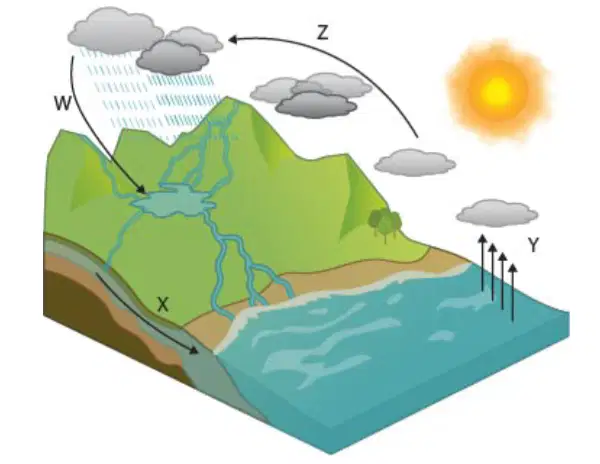
The picture shows the water cycle. Which two letters show the processes most important in forming clouds?
W and Z
X and Z
W and X
Y and Z
Evan left his frozen popsicle outside in the sun. What two changes will happen to the popsicle?
It will become liquid.
It will become solid.
It will melt.
It will freeze.

The pictures show the experiment Dawn created with two cups and ice. Both cups are covered with metal screens. Select three parts of the water cycle that Dawn will see in her experiment.
evaporation
condensation
transportation
precipitation
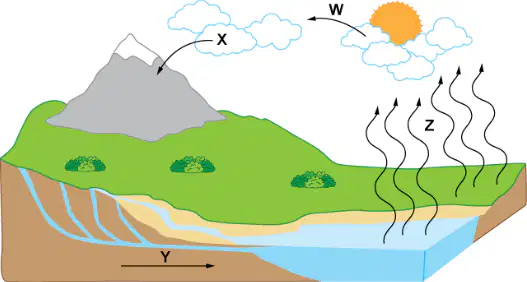
The picture shows parts of the water cycle labeled W, X, Y, and Z. Which letter best represents where precipitation happens?
W near clouds and sun
X falling from clouds
Z rising as water vapor
Y moving underground

Three cups of water are shown: Sample P (plain water), Sample Q (water with ice cubes), and Sample R (water with steam rising). Which order is most likely from hottest to coldest?
P, Q, R
Q, P, R
R, P, Q
R, Q, P
The energy that drives the water cycle comes from
Earth's rotation
Earth's core
Earth's core
the Sun
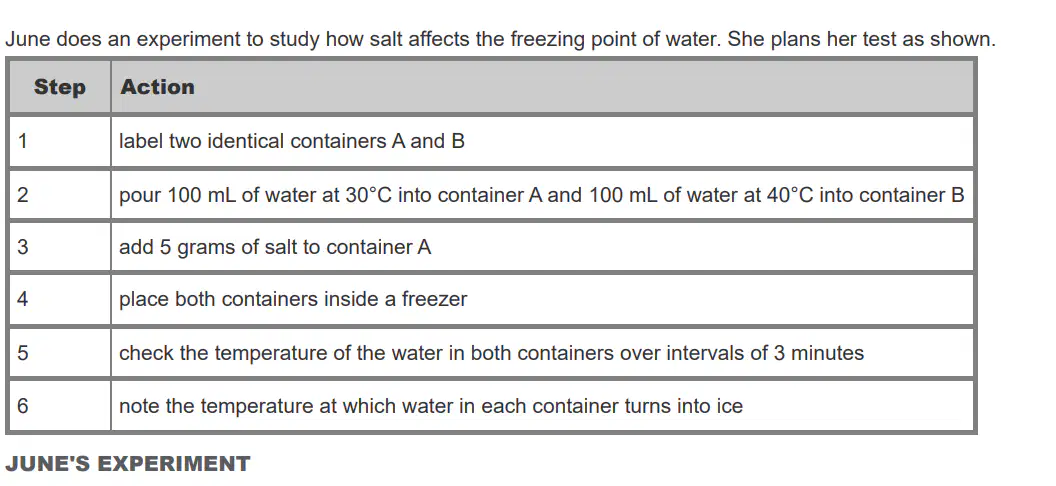
June does an experiment to study how salt affects the freezing point of water. She plans her test as shown. Will her test produce accurate results?
No, because equal amounts of water were poured in both of the containers.
Yes, because the temperature of water was noted at regular intervals.
No, because the starting temperature of the water was not the same.
Yes, because salt was added to the water in only one of the containers.
Select the two processes in which water vapor cab be transferred into liquid water.
precipitation
transpiration
condensation
evaporation
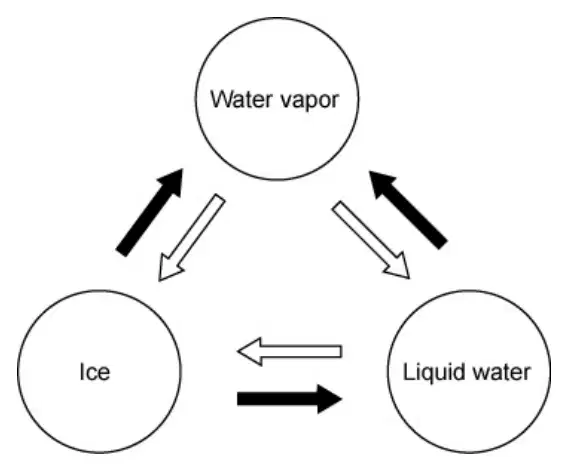
Look closely at the illustration below if the three states of water. Which of the following labels should be added to all of the black arrows in the above illustration?
heat added
heat removed
endothermic reaction
exothermic reaction

What is happening at point 4?
Water is being condensed into solid water.
Water is being evaporated into water vapor.
Water is draining through the surface into the ocean.
Water is seeping through the surface into the groundwater.
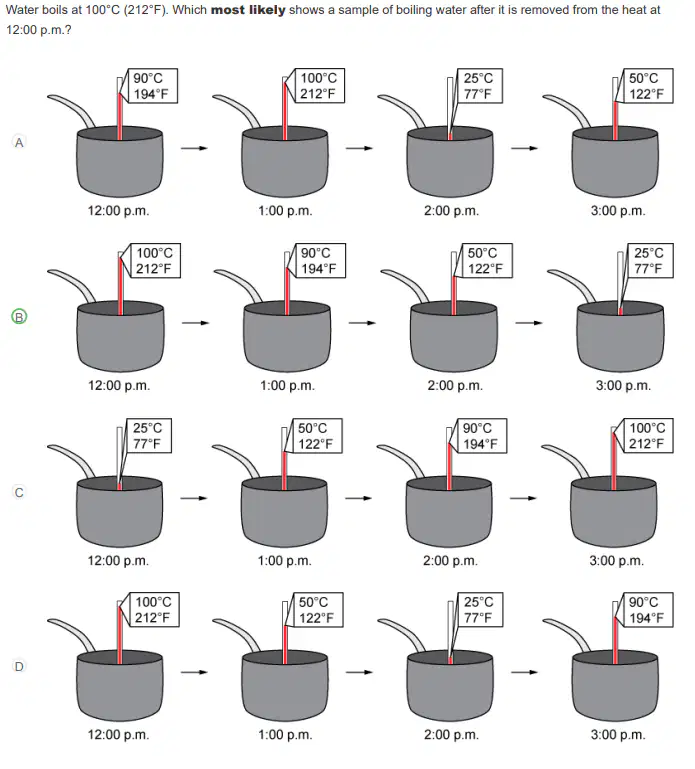
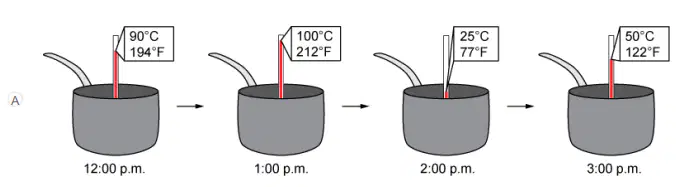
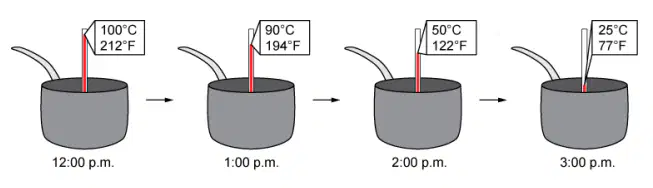
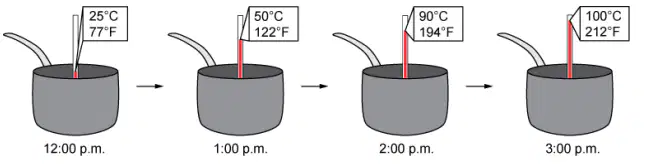
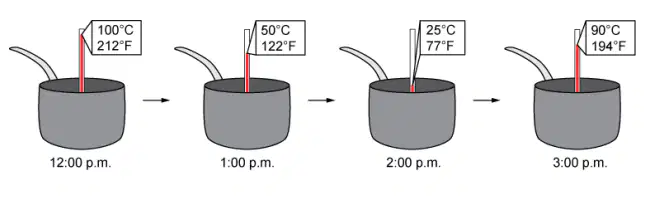
Water boils at 100*C (212*F). Which most likely shows a sample of boiling water after it is removed from the heat at 12:00p.m?
___ is the process where water vapor cools and turns into liquid water. It is the opposite of ___, where liquid water becomes water vapor.
Choice 1: Evaporation
Choice 1: Condensation
Choice 2: Evaporation
Choice 2: collection

