
 Worksheets
Mrs. Watters' Sound Practice HW
Total questions: 18
Worksheet time: 54mins
This is a form of energy that causes vibrations.
Light
Sound
Wavelength
Amplitude
A wave carries energy from one place to another.
Sarah is playing LOUD music.
Nearby, Chelsie is playing soft music.
Describe the difference between loud sounds and soft sounds:
Loud sounds have a greater pitch than soft sounds.
Loud sounds have a greater amplitude than soft sounds.
Loud sounds have more waves.
Loud sounds vibrate, soft sounds do not.
Match the following terms:
Pitch
How low or high a sound is.
Frequency
How many waves pass in a set time.
Vibration
Fast shaking, back and forth.
Amplitude
Height of a sound wave, affects volume.
Volume
How loud or soft a sound is.
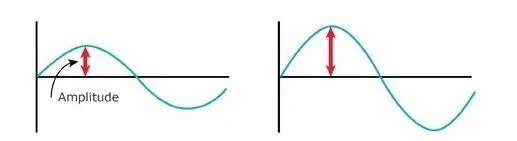
Review the diagram. On the left, the wave's amplitude is small. On the right, the wave's amplitude is greater. Which statement below is TRUE?
The sound on the left is louder.
The sound on the right is louder.
Sound waves require a ______________ to travel through.
Medium
Liquid
Light
Human
Sound can only travel through material, a.k.a. matter. For example, sound can travel through solid, liquid, or gas.
True
Falso
Sound travels fastest through _______, such as steel or diamond, because the particles in this matter are packed most tightly together.
A vacumn
Solids
Liquids
Gases
Sound travels slowest through ______, like oxygen. This is because the particles in this matter are far apart, making it hard for sound waves to transfer energy.
a vacumn
solid
liquid
gas
Sound travels fastest through
Solid
Liquid
Gas
Sound travels most slowly through:
Solid
Liquid
Gas
A vacuum is a space with very little to no matter, like air. There is no air in space. Why can't sound travel in space?
Because sound requires a medium to travel.
Because sound requires light to travel.
Because sound can only echo on Earth.
Because sound must only be emitted into oxygen.
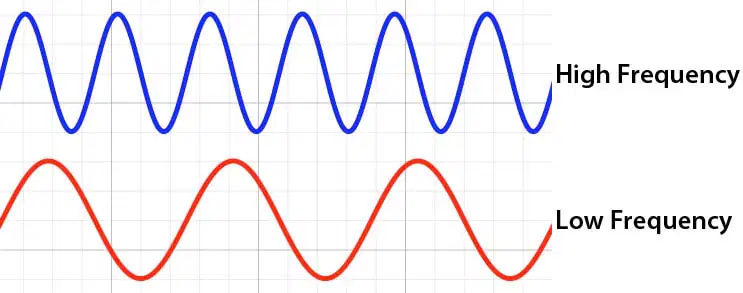
Tommy's voice is represented in the blue sound waves.
William's voice is represented with the red sound waves.
Which man's voice is the LOWEST pitch?
Tommy (blue) has a lower pitched voice.
William (red) has a lower pitched voice.
More information is needed.
Both Tommy and William have the lowest pitched voices possible.

Which sound wave has the highest pitch, like the squeak of a mouse?
1
2
3
4
Which sound wave has the lowest pitch, like the tune of a tuba?
1
2
3
4
Which wave has the highest frequency?
1
2
3
4
Which is an example of a teaching using SOUND to communicate?
Mrs. Pelinsky turns the lights off and then on, to let her students know she needs their attention.
Ms. Cramer blows the whistle to let kids know recess is over.
Mr. Monterola taps Dr. Davis on the shoulder to let her know it's time to leave.
Mr. Ray sprays disinfectant in the air to freshen the boys' restroom.
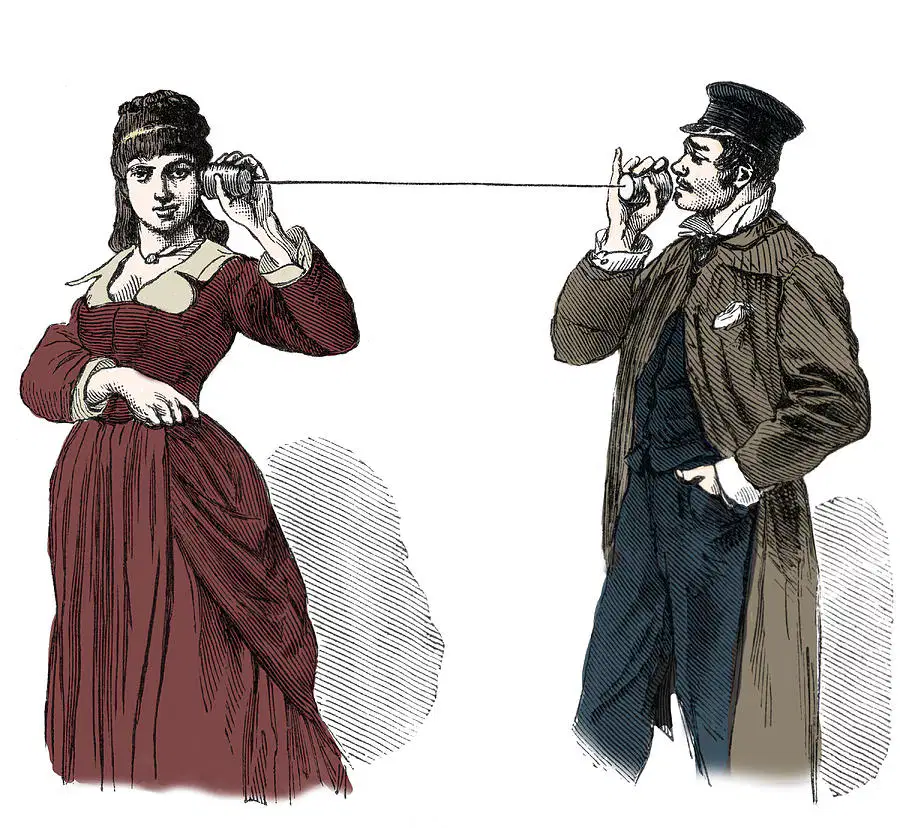
Bennett and Alice take two tin cans and a piece of string and create the device shown in the picture. Bennett speaks into the can and Alice can hear his voice in the other can. What's the best explanation for this?
The sound waves travel along the tight string, because sound waves travel through matter.
The sound waves float into the gas outside the can, because sound waves need gas.
The sound waves are absorbed by the moisture in the air, because sound travels through liquid.
The sound waves bounce inside the can and create many echoes. Alice's ear hears the echoes from the other can.

