
 Worksheets
Azetidene: Structure, Properties, and Preparation
Total questions: 15
Worksheet time: 5mins
Azetidine is used as a building block due to its stability. Which property most directly supports this use in drug design?
Aromatic N‑heterocycle with exceptional resonance
Smallest unsaturated N‑heterocycle with poor stability
Largest saturated N‑heterocycle with high aromaticity
Smallest saturated N‑heterocycle with reasonable stability
Which preparation route pairs correctly with a key reagent or condition to form azetidine derivatives?
Pyrolysis of cyclopropyl azides under heat releasing N2
Hydrogenation of benzene using Pd to insert nitrogen
Aldol condensation of ketones under base to cyclize
Grignard addition to nitriles followed by oxidation
In azetidinium ring-opening by a nucleophile, which site is most often attacked?
The carbon bearing the positive nitrogen
The least substituted ring carbon
The nitrogen center of the azetidinium
A remote benzylic substituent
Why does acid catalysis commonly facilitate ring-opening in four-membered heterocycles?
Acid removes steric hindrance around ring
Acid decreases nucleophile basicity
Protonation increases electrophilicity of the ring
Protonation strengthens C–C bonds in ring
Thietane reacts with chlorine at −70 °C. What key intermediate is formed before ring opening?
Carbocation adjacent to sulfur after hydride loss
Thietane epoxide via oxidative addition
Sulfur-centered radical stabilized by chlorine
Chlorosulfonium intermediate from electrophilic chlorination
When comparing azetidinium to larger ring systems, why is ring-opening more favorable?
Lower torsional strain discourages reaction
Higher aromatic stabilization resists opening
Greater conjugation stabilizes the ring
Greater angle strain lowers activation energy
During acid-catalyzed opening of azetidinium, which step enhances electrophilicity?
Single-electron transfer to the ring
Protonation at nitrogen forming azetidinium
Coordination of base to nitrogen lone pair
Hydrogen abstraction from a ring carbon
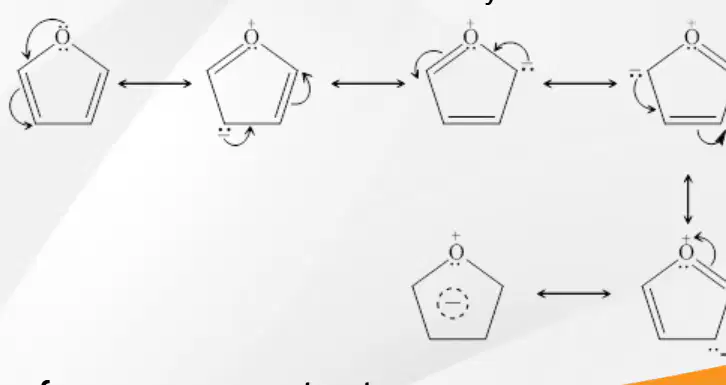
A five-membered heterocycle is shown with an oxygen atom and delocalized π electrons. Using Huckel’s rule, which statement best explains why this ring is aromatic?
It has four π electrons from oxygen lone pairs only
It has six π electrons meeting the 4n+2 criterion
It has eight π electrons satisfying a 4n requirement
It has five π electrons from carbon–carbon double bonds
Which route converts furoic acid to furan, and what key transformation occurs?
Halogenation produces a chloro derivative
Oxidation forms a dicarbonyl intermediate
Hydrogenation adds H2 across the ring
Decarboxylation releases CO2 to yield furan
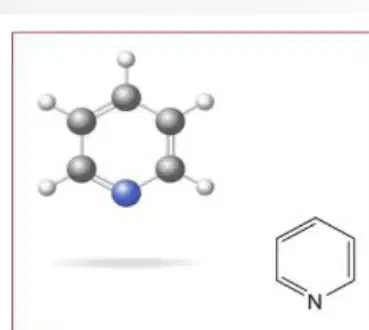
Five carbons and one sp2-hybridized nitrogen form an aromatic sextet in pyridine. Which change would most reduce its aromatic stabilization?
Replacing nitrogen with a methine CH group
Shortening C–C bonds to typical double bonds
Rehybridizing nitrogen to sp3, disrupting sextet
Increasing bond angle from 120° to 125°
A researcher plans electrophilic bromination of pyridine. Which strategy most increases yield while respecting its deactivated ring?
Use harsh conditions with strong Lewis acid
Exploit ring activation by protonation
Avoid halogenation under any conditions
Perform Friedel–Crafts alkylation first
In the diagram comparing pyrrole and furan synthesis, which condition converts furan to pyrrole in commercial practice?
Ammonia over silica at ambient pressure
Hydrogen over palladium at room temperature
Nitrogen over alumina at 25 degrees Celsius
Ammonia over alumina at 400 degrees Celsius
Which explanation best accounts for why pyrrole undergoes electrophilic substitution rather than addition?
Its ring is aromatic with six pi electrons
Its carbons are sp3-hybridized and isolated
Its ring is antiaromatic with four pi electrons
Its nitrogen is strongly basic and nucleophilic
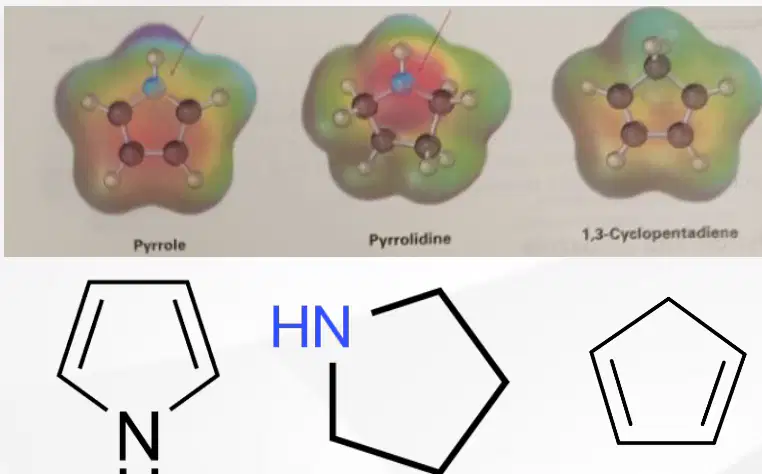
Which statement best explains the lower basicity of pyrrole compared with an aliphatic amine, as suggested by the electrostatic potential maps?
Nitrogen lone pair participates in aromatic sextet
Nitrogen lone pair is in an sp3 orbital
Nitrogen carries a formal negative charge
Nitrogen donates electron density through sigma bonds
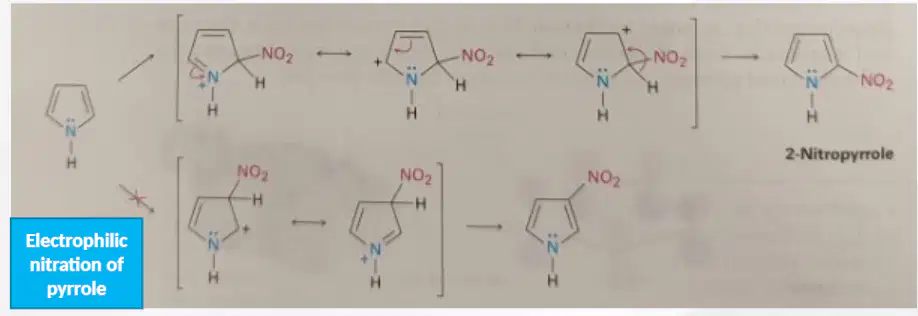
A diagram shows pyrrole undergoing halogenation and nitration. Which statement best explains why electrophilic substitution on pyrrole predominantly occurs at C2 rather than at C3?
C2 attack forms a cation with three resonance forms
C2 attack avoids disruption of the aromatic sextet entirely
C3 attack forms a cation stabilized by hyperconjugation
C3 attack is favored because nitrogen donates less electron density
C2 attack proceeds only under strong Lewis acid conditions

