
Font size
 Worksheets
Keplers Laws
Total questions: 105
Worksheet time: 53mins
Which beliefs were still held by most astronomers after Copernicus introduced heliocentrism?
The planets are moved by crystalline spheres in which they are embedded
Mars was the center of the universe
The planets must move in perfectly circular paths
The Earth is flat
Tycho Brahe's most important contribution to astronomy:
discovering that planets orbit the Sun in elliptical paths
producing the best observational data for planets and stars ever seen before
developing the geoheliocentric model
the invention of the telescope
Which event allowed Kepler to access data that led him to develop his laws?
Copernicus died
the telescope was invented
Tycho died
the spectroscope was invented
Kepler discovered the elliptical shape of planetary orbits by studying the data for which planet?
Earth
Mars
Venus
Jupiter
Which statements are true according to Kepler’s 1st Law?
the Sun is not at the center of a planet's orbit, but rather sits at one of two foci of the planet's elliptical orbit
the distance of a planet to the Sun and its distance to the orbit's empty focus will always add up to equal a constant
the major planets have orbits that are elliptical, but still look a lot like circles (more round than flat)
planets move in elliptical orbits, not circular orbits
planets move in perfectly circular orbits
The following are true of ellipses:
they have two foci
they are perfectly circular
they have a center
they are the conic section produced by slicing a cone at an angle
all points are equally distant from the center
What is the distance from one focus to the other through the center?
semimajor axis (a)
eccentricity (e)
linear eccentricity (c)
semiminor axis (b)
What is the distance from one focus to the other through the center?
semimajor axis (a)
eccentricity (e)
linear eccentricity (c)
semiminor axis (b)
What is the distance from one focus to the other through the center?
semimajor axis (a)
eccentricity (e)
linear eccentricity (c)
semiminor axis (b)
What is the distance from one focus to the other through the center?
semimajor axis (a)
eccentricity (e)
linear eccentricity (c)
semiminor axis (b)
Which equation best describes the semiminor axis?
e → e = c/a
b → b=a2−c2
c2=a2−b2 or c=ae
a=b2+c2 or a=c/e
Which equation best describes the semimajor axis?
e → e = c/a
b → b=a2−c2
c2=a2−b2 or c=ae
a=b2+c2 or a=c/e
Which equation best describes linear eccentricity?
e → e = c/a
b → b=a2−c2
c2=a2−b2 or c=ae
a=b2+c2 or a=c/e
Which equation best describes eccentricity?
e → e=c/a
b → b=a2−c2
c2=a2−b2 or c=ae
a=b2+c2 or a=c/e
Linear eccentricity of Mars's orbit (semi-major = 1.524 AU, semi-minor = 1.517 AU)
2.322 AU
2.3018 AU
0.0202 AU
0.1423 AU
Eccentricity of Mars's orbit
10.71 AU
10.71
0.093
0.093 AU
Mars's orbit is closer to a flat line or a circle?
equally similar to both
flat line
perfect circle
The major planet with the most circular orbit:
Jupiter
Venus
Uranus
Saturn
The major planet with the most elliptical orbit:
Neptune
Mars
Jupiter
Mercury
Uranus
Which non-major planet has a very elliptical orbit?
Earth’s Moon
Venus
Pluto
What was the Copernican Revolution?
Pluto being reclassified as a dwarf planet instead of a major planet
the change from a geocentric model of the universe to a heliocentric model
the shift from believing the Earth was flat to it being a sphere
During which historical period did the Copernican Revolution occur?
the 20th century
the Middle Ages
the Enlightenment
the European Renaissance
What was Brahe able to accomplish?
Discover a new planet
Discover the moons of Jupiter
Propose that the Sun was at the center of the Solar System
Collect the best astronomical data at that point in history
Copernicus (and pretty much everyone else) thought that the orbits of the planets…
were perfect circles
were ellipses
were double circles — epicycles attached to circular main orbits
Kepler used Brahe’s data to determine that the orbits of the planets…
were perfect circles
were double circles — epicycles attached to circular main orbits
were ellipses
Circles have one _______ and ellipses have two ________.
focus; centers
center; foci
center; conic sections
In the diagram of an elliptical orbit of the Earth (in the video), the sum of r1 and r2 is:
always equal to the orbital velocity of the Earth
always equal to the square of the ellipse’s area
impossible to determine
The closer the two foci of an ellipse are, the more that ellipse…
resembles a sphere
resembles a circle
becomes flatter in appearance
In Kepler’s model of planetary orbits, one focus of each elliptical orbit is occupied by:
a planet other than Earth
the Earth
the Sun
Perihelion is when a planet is:
closest to the Sun
closest to the Moon
farthest from the Moon
The fact that the orbits of the planets are ellipses with the Sun acting as one focus is also known as:
Kepler’s 3rd Law
Newton’s Universal Law of Gravitation
Kepler’s 2nd Law
According to Kepler’s 2nd Law, ________
the orbital speed of a planet will remain constant, but planets closer to the Sun have a higher constant speed
the orbital speed of a planet will remain constant, but planets farther from the Sun have a higher constant speed
the orbital speed of a planet will vary depending on its distance from the Sun
When would Earth experience its fastest orbital velocity?
aphelion
perigee
apogee
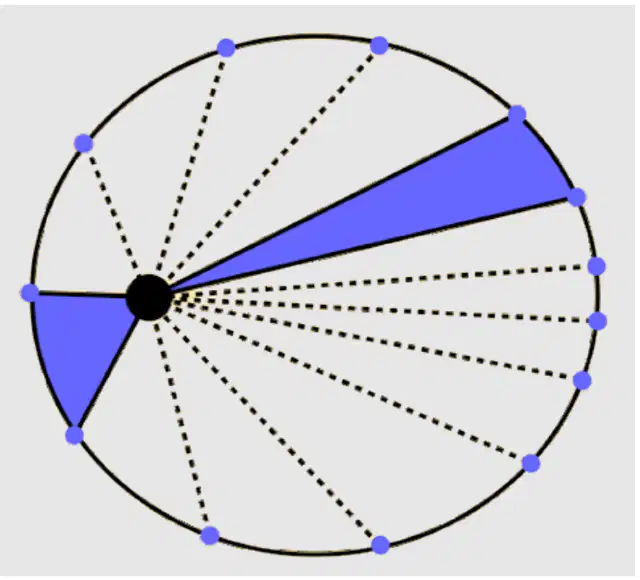
Another consequence of Kepler’s 2nd Law is that, as a planet moves across both blue-shaded areas shown in the image,
there will be no way to predict how long it will take for the planet to move across either shaded area
it will take the same amount of time to move across both
it will move across the left shaded area faster than the right shaded area
In Kepler’s 3rd Law, he relates the orbital period of a planet to the length of:
the distance between both foci
the semimajor axis
the semiminor axis
The cube of a planet’s semimajor axis is proportional to the ______ of the planet’s orbital period.
square
cube
cube root
What was one major early use of Kepler’s Laws?
calculate the masses of the planets
discover the first “new” planet: Uranus
determine the size of the Sun
Kepler’s Laws proved that:
the orbits of the planets are complicated and hard to predict
the Earth is a cube!
things in space obey simple mathematical laws
How did Kepler gain access to astronomical observational data that helped him formulate his laws?
Kepler was Tycho’s assistant, so Tycho simply shared his findings.
Tycho died and his family allowed Kepler access.
Kepler had to do all of his own observations.
The best naked-eye observational data of stars & planets was recorded:
by Copernicus in the early 1500s
in the earliest days of human prehistory
in the decades leading up to the telescope’s invention (late 1500s–early 1600s)
When reviewing Tycho’s data, Kepler focused on Tycho’s observations of:
the Sun
Jupiter
Venus
Kepler studied observations of Mars because:
Tycho recommended it based on the observations of Mars being very difficult to match with a circular orbit
Tycho told him that Mars’s observations should mean that it would have the most circular of all planetary orbits
the orbit of Mars had never been accurately observed before
Was Kepler able to match Tycho’s Martian observations with a circular orbit?
no
yes
Which best describe Kepler’s discovery of elliptical orbits for planets? (select all that apply)
Kepler was actively looking for proof for circular orbits
The idea of elliptical orbits clashed with his ideas about God, faith and creation
Kepler was actively looking for proof for elliptical orbits
In Kepler’s elliptical model of planetary orbits, the Sun is located at:
one of two foci of the elliptical orbit
the very center of a circular orbit
Which description correctly matches the fastest orbital velocity?
planet is closest to the Sun
planet is farthest from the Sun
Which description correctly matches the slowest orbital velocity?
planet is farthest from the Sun
planet is closest to the Sun
Which are true of Kepler’s 1st Law of Planetary Motion? (select all that apply)
a planet moves around the Sun in a circle
a planet moves around the Sun in an ellipse
the Sun is located at one of two foci of a planet’s orbit
Kepler was the first person to ________ use ________ to explain how the planets move and predict their motion.
diagrams
correctly
inaccurately
mathematical equations
Problems After Copernicus — What problem remained in the Copernican model even after it replaced geocentrism?
It used telescopes
It excluded the Moon
It still used perfect circles for planetary orbits
It denied gravity
Problems After Copernicus — What ancient idea did Copernicus and Galileo still believe in?
Elliptical orbits
Crystalline spheres and circular motion
Flat Earth
Parallax
Problems After Copernicus — Why was it difficult to study Copernicus’s heliocentric model?
Lack of printing
The Christian Church considered it heretical
It was written in Latin
It had no support
Tycho Brahe — Where was Tycho Brahe from?
Germany
Denmark
Austria
Sweden
Tycho Brahe — What was Tycho Brahe’s greatest contribution to astronomy?
Telescope invention
Extremely accurate data on stars and planets
Discovery of Neptune
Proof of gravity
Tycho Brahe — What made Brahe’s research possible?
He built telescopes
He was wealthy and had royal support
He used satellites
He worked in a university
Tycho Brahe — Where did Brahe go after leaving Denmark?
Berlin
Prague
Rome
Vienna
Tycho Brahe — What position did Brahe hold in Prague?
Royal Astronomer of Austria
Imperial Mathematician for the Holy Roman Emperor
Pope’s Astronomer
Dean of Prague Observatory
Johannes Kepler — What was Kepler’s profession?
Priest
Mathematician and astronomer
Navigator
Explorer
Johannes Kepler — How did Kepler become interested in heliocentrism?
He read Aristotle
Through his college professor Michael Maestlin
From Galileo’s books
By inventing a telescope
Johannes Kepler — What religion did Kepler follow?
Catholic
Lutheran (Protestant)
Muslim
Orthodox
Johannes Kepler — Why did Kepler leave Graz in 1600?
He was exiled for science
Protestants were forced to convert or flee
He wanted to study with Galileo
He was invited by Copernicus
Johannes Kepler — How did Kepler gain access to Brahe’s data?
He bought it
He became Brahe’s assistant
He hacked his notes
He found it in a library
Johannes Kepler — What role did Kepler assume after Brahe’s death?
Royal cartographer
Imperial Mathematician
Astronomer General
Professor of Astrology
Kepler’s First Law — What planet’s data did Kepler focus on to discover his first law?
Venus
Mars
Jupiter
Mercury
Kepler’s First Law — What did Kepler realize about Mars’s orbit?
It was circular
It was elliptical
It was flat
It was unpredictable
Kepler’s First Law — What shape defines Kepler’s First Law of Planetary Motion?
Circle
Ellipse
Spiral
Triangle
Kepler’s First Law — In an ellipse, where is the Sun located according to Kepler’s First Law?
At the center
At one of the two foci
Outside the orbit
At both foci
Kepler’s First Law — What does the sum of distances from a planet to each focus of the ellipse equal?
The eccentricity
A constant
The orbit time
The planet’s speed
Circles vs. Ellipses — What is true about all points on a circle?
They are random
They are the same distance from the center
They move at different speeds
They point to the Moon
Circles vs. Ellipses — How is an ellipse different from a circle?
It has one focus
It has two foci
It is a spiral
It is square-shaped
Circles vs. Ellipses — What shape results from slicing a cone at an angle not parallel to the base?
Circle
Ellipse
Square
Sphere
Circles vs. Ellipses — What other conic sections exist besides ellipses and circles?
Squares and triangles
Parabolas and hyperbolas
Cylinders and cubes
Rectangles and ovals
Ellipse Measurements — What is the major axis of an ellipse?
The short diameter
The long diameter through both foci
The distance to the Sun
The orbit speed
Ellipse Measurements — What does the semimajor axis represent?
Half of the major axis
The shortest distance to the Sun
A random line
The orbit time
Ellipse Measurements — What is the linear eccentricity (c)?
The orbit speed
Distance from the center to a focus
The radius of a circle
The age of the planet
Ellipse Measurements — What does 1 AU equal?
93 million meters
~150,000,000 km or ~93,000,000 miles
The Sun’s radius
One light-year
Eccentricity (e) — What does eccentricity (e) describe?
The color of a planet
How stretched or flat an ellipse is
Planet temperature
Number of moons
Eccentricity (e) — What is the eccentricity of a perfect circle?
1
0
0.5
2
Eccentricity (e) — Which major planet has the most eccentric orbit?
Earth
Venus
Mercury
Mars
Eccentricity (e) — Which major planet has the least eccentric orbit?
Mercury
Venus
Mars
Jupiter
Eccentricity (e) — What is the formula for finding eccentricity?
e = a/c
e = c/a
e = a × b
e = b − a
If Mercury’s semimajor axis a=0.387 AU and semiminor axis b=0.3788 AU , what is c2 for its elliptical orbit using c2=a2−b2 ?
0.1435 AU^2
0.0063 AU^2
0.205 AU^2
0.387 AU^2
Using a = 0.387 AU and b = 0.3788 AU for Mercury’s orbit, what is the linear eccentricity c (in AU) computed from c=a2−b2 ?
0.205 AU
0.0794 AU
0.387 AU
0.3788 AU
Given Mercury’s semimajor axis a = 0.387 AU and linear eccentricity c = 0.0794 AU, what is the orbital eccentricity e using e = c / a?
0.0794
0.205
0.387
0.0063
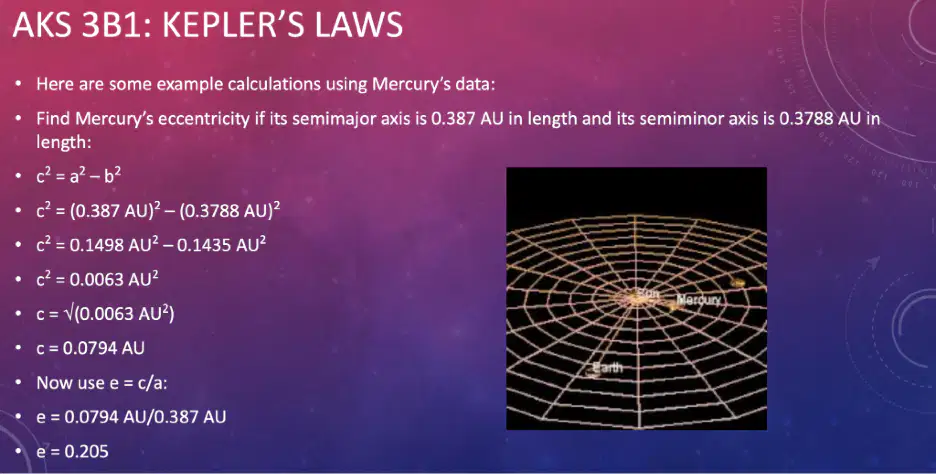
Find Mercury’s orbital eccentricity if its semimajor axis is 0.387AU and its semiminor axis is 0.3788AU . Use c2=a2−b2 to determine c , then e=ac .
0.0794
0.205
0.387
0.0063
Section: Kepler’s 2nd Law – Equal Areas in Equal Time — What does Kepler’s 2nd Law state?
Planets orbit in perfect circles
A planet sweeps equal areas in equal time as it orbits the Sun
Gravity keeps planets in motion
All planets move at constant speed
Section: Kepler’s 2nd Law – Equal Areas in Equal Time — What happens to a planet’s speed when it is closest to the Sun?
It slows down
It speeds up
It stops
It moves in a straight line
Section: Kepler’s 2nd Law – Equal Areas in Equal Time — What is the name of the point where a planet is closest to the Sun?
Apogee
Perihelion
Focus
Zenith
Section: Kepler’s 2nd Law – Equal Areas in Equal Time — What is the name of the point where a planet is farthest from the Sun?
Perigee
Zenith
Aphelion
Solstice
Section: Kepler’s 2nd Law – Equal Areas in Equal Time — Why do planets move faster near the Sun?
Solar wind pushes them
Gravitational force is stronger
The Sun heats them up
Light pressure accelerates them
Section: Kepler’s 2nd Law – Equal Areas in Equal Time — What traditional belief did Kepler’s 2nd Law challenge?
Circular orbits
Invisibility of stars
Perfect and unchanging heavenly motion
Flat Earth theory
Section: Kepler’s 2nd Law – Equal Areas in Equal Time — Did Kepler know why the speed changed during orbit?
Yes, he cited gravity
No, he only observed the pattern
Yes, he used calculus
No, but Galileo explained it
Section: Kepler’s 2nd Law – Equal Areas in Equal Time — In what book did Kepler publish both his 1st and 2nd laws?
The Harmony of the World
The New Astronomy
The Starry Messenger
The Almagest
Section: Kepler’s 2nd Law – Equal Areas in Equal Time — When were Kepler’s 1st and 2nd laws published?
1595
1619
1609
1630
Section: Kepler’s 3rd Law – The Harmonic Law — What does Kepler’s 3rd Law compare?
Planet size and gravity
A planet’s orbital period squared to its semimajor axis cubed
Orbit speed and temperature
Planet mass and distance
Section: Kepler’s 3rd Law – The Harmonic Law — What is the formula for Kepler’s 3rd Law?
P2=a3
a2=p3
P = a
a = √p
Section: Kepler’s 3rd Law – The Harmonic Law — What does P stand for in the formula P2=a3 ?
Planetary mass
Perihelion distance
Orbital period (in Earth years)
Planetary temperature
Section: Kepler’s 3rd Law – The Harmonic Law — What does a stand for in the formula P2=a3 ?
Average orbital speed
Semimajor axis (distance from Sun in AUs)
Aphelion distance
Axis of rotation
Section: Kepler’s 3rd Law – The Harmonic Law — What is the simplified meaning of Kepler’s 3rd Law?
All orbits are slow
Planets closer to the Sun orbit faster
Bigger planets take longer
Planets orbit in a spiral
Section: Kepler’s 3rd Law – The Harmonic Law — What pattern did Kepler notice from data on all planets?
Every planet orbited in 1 year
P2/a3≈1 for all planets
All orbits were circles
Planet distances were equal
Section: Kepler’s 3rd Law – The Harmonic Law — What did Kepler call this consistent ratio between planets?
Gravity
Harmony (resonance)
Revolution
Ellipse constant
Section: Kepler’s 3rd Law – The Harmonic Law — In which book did Kepler publish his 3rd Law?
The New Astronomy
The Harmony of the World
Principia Mathematica
Dialogues on Motion
Section: Kepler’s 3rd Law – The Harmonic Law — In what year was Kepler’s 3rd Law published?
1609
1619
1630
1596
Section: From Kepler to Newton — What did Kepler not fully understand about his own laws?
The shape of orbits
Why planets sped up near the Sun or why closer planets orbited faster
The structure of the universe
How to use telescopes
Section: From Kepler to Newton — Who eventually explained the causes behind Kepler’s laws?
Galileo Galilei
Isaac Newton
Tycho Brahe
Albert Einstein

