
 Worksheets
Math Exam Review
Total questions: 76
Worksheet time: 2hrs 51mins
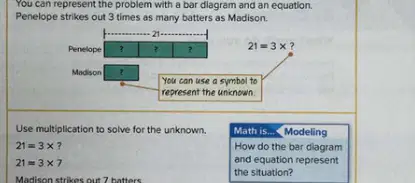
Penelope strikes out 21 batters at the softball tournament. She strikes out 3 times as many batters as Madison. How many batters does Madison strike out? Use the bar diagram showing Penelope’s bar divided into three equal parts and Madison’s single part, and the comparison equation 21 = 3 × ?.
5
7
9
63
How do the bar diagram and the equation represent the situation where Penelope strikes out 3 times as many batters as Madison, with a total of 21 batters? Explain the roles of each part and symbol in showing the comparison.
Ty has 32 coins in his collection. Den has 8 coins in his collection. How many times as many coins does Ty have than Den? Use the idea of a bar diagram with Ty’s bar made of equal parts matching Den’s bar, and represent the comparison with a multiplication equation.
3
4
5
8
Write a multiplication equation to represent the comparison, then find the unknown number: 56 is 7 times as much as (a) .
Write a multiplication equation to represent the comparison, then find the unknown number: 36 is (a) times as many as 9.
Write a multiplication equation to represent the comparison, then find the unknown number: 25 is (a) times as many as 5.
Write a multiplication equation to represent the comparison, then find the unknown number: 45 is (a) times as much as 5.
How can you represent the problem? Draw a bar diagram and write a multiplication equation to solve: Mary read 20 pages of a book last week. She read 2 times as many pages this week as she did last week. How many pages did Mary read this week?
(a)
How can you represent the problem? Draw a bar diagram and write a multiplication equation to solve: A tomato plant is 48 inches tall. How many times as tall is the tomato plant as a pepper plant that is 8 inches tall?
(a)
Dana saved $63. Dana saved 7 times as much as Julie. How much did Julie save? Write a multiplication equation to represent and solve.
(a)
A winter coat costs $50. A winter coat costs 5 times as much as a pair of gloves. Use a bar diagram to represent the problem, write a division equation to represent and solve the problem, and find the cost of a pair of gloves.
$5
$8
$10
$15
What is the unknown number? Write a division equation to represent the comparison. Then solve the equation: 24 is 8 times as much as (a)
What is the unknown number? Write a division equation to represent the comparison. Then solve the equation: 20 is (a) times as much as 5
What is the unknown number? Write a division equation to represent the comparison. Then solve the equation: 18 is (a) times as much as 6
What is the unknown number? Write a division equation to represent the comparison. Then solve the equation: 16 is 4 times as much as (a)
How can you represent the problem? Draw a bar diagram and write a division equation to solve: A piece of green string is 48 inches long. How many times as long is the green string than a piece of red string that is 8 inches long?
Ella has 50 blue blocks. She has 5 times as many blue blocks as white blocks. How many white blocks does she have?
(a)
Charlie read 4 times as many pages as his sister. Charlie read 36 pages of his book. How many pages did Charlie's sister read? What equations represent the problem? Choose all that apply.
36÷4=n
36÷6=n
n×4=36
36×6=n
n+4=36

Image shows a heading Understanding Factors of a Number with three labeled sections. According to the section labeled 1, factors are numbers that you can multiply together to get another number. Which statement matches this definition?
Factors are numbers you add to get another number.
Factors are numbers you can multiply together to get another number.
Factors are numbers you subtract to get another number.
Factors are numbers you divide to get zero remainder.

The section labeled 2 gives examples to get 12 by multiplying 1 × 12, 2 × 6, and 3 × 4. Which multiplication pair from these examples equals 12?
2 × 6
5 × 2
3 × 5
2 × 5

The section labeled 3 states the factors of 12 are 1, 2, 3, 4, 6, 12. Which option shows exactly these factors?
1, 2, 3, 4, 6, 12
1, 2, 3, 4, 6, 8, 12
1, 2, 4, 6, 12
1, 3, 4, 6, 12, 13
What are all the factor pairs for 14? List every pair of whole numbers that multiplies to 14.
What are all the factor pairs for 55? List every pair of whole numbers that multiplies to 55.
What are all the factor pairs for 23? List every pair of whole numbers that multiplies to 23.
What are all the factor pairs for 64? List every pair of whole numbers that multiplies to 64.
What are all the factor pairs for 32? List every pair of whole numbers that multiplies to 32.
What are all the factor pairs for 20? List every pair of whole numbers that multiplies to 20.
What are all the factor pairs for 10? List every pair of whole numbers that multiplies to 10.
What are all the factor pairs for 100? List every pair of whole numbers that multiplies to 100.
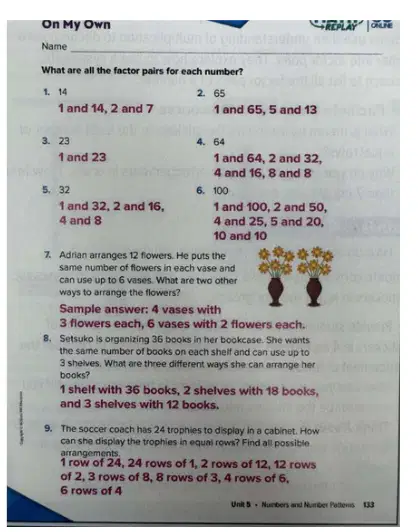
Adrian arranges 8 flowers. He puts the same number of flowers in each vase. Using the vases shown, list the different ways he can arrange the flowers so each vase has an equal number of flowers.
Felicia is organizing books in her bookcase. She wants equal rows of books on each shelf. What are different ways she can arrange 36 books into equal rows on shelves?
The soccer coach has 24 trophies to display in a cabinet. How can the coach display the trophies in equal rows? List all possible equal-row arrangements.
Fran used 84 nails to build 7 shelves. Can Fran use 88 nails to build 8 shelves? Explain your reasoning.
Kate arranges her collection of toy cars in equal rows. She could place 30 cars as 1 row of 30, 2 rows of 15, 3 rows of 10, 5 rows of 6, and 6 rows of 5. Using reverse factors, what other arrangements could she show? Explain.
Aareni is planting twelve tulips in his garden. He can arrange tulips in equal rows. Explain how he can arrange the tulips in equal rows.
Extend Your Thinking. What number less than 20 has exactly three factor pairs? Explain your choice.
Reflect. What strategy can you use to find all factor pairs of a number?
Is 3 prime or composite?
Prime
Composite
Is 24 prime or composite?
Prime
Composite
Is 9 prime or composite?
Prime
Composite
Is 31 prime or composite?
Prime
Composite
Is 87 prime or composite?
Prime
Composite
Is 2 prime or composite?
Prime
Composite
Is the statement true or false? All even numbers greater than 2 are composite.
True
False
Is the statement true or false? 1 is a prime number.
True
False
Is the statement true or false? All odd numbers are prime.
True
False
Is the statement true or false? All prime numbers are odd.
True
False
Find a prime number greater than 50 . Explain how you know it is prime.
According to the lesson, what is a multiple of a number?
The result when you add the number to itself once
The result when you multiply the number by 1, 2, 3, 4, and so on
A number you get by dividing by 2
Any number greater than the original number
Which statement best describes multiples?
They are the skip-counting numbers of a given number
They are random numbers with no pattern
They are only even numbers
They are numbers found by subtracting
Which list shows multiples of 5 as in the example?
5, 9, 13, 17, 21
5, 10, 15, 20, 25, 30
6, 12, 18, 24, 30
4, 8, 12, 16, 20
To find multiples of a number, which method is used in the lesson?
Round the number to the nearest ten
Skip-count by the number
Subtract 1 repeatedly
Divide the number by larger and larger numbers
Based on the example for 4, which equation shows the third multiple of 4?
4×1=4
4×2=8
4×3=12
4×4=16
Choose all that apply. Which numbers are multiples of 4? A 16 B 34 C 36 D 64
16
34
36
64
Choose all that apply. Which numbers are multiples of 9? A 81 B 89 C 45 D 18
81
89
45
18
What do you know about the patterns in the products of 5? How can this help you determine if a number is a multiple of 5?
There are 3 olives on each slice of pizza. Danny will eat 2 of 3 slices. How many olives will Danny eat? Explain your thinking.
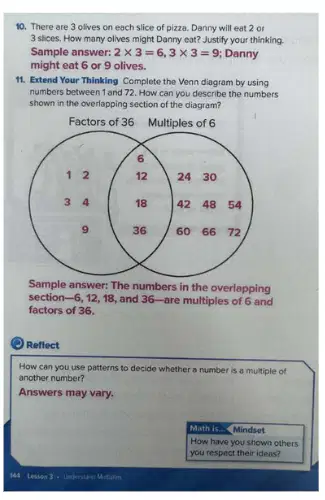
Number Tool Training. Use the Venn diagram titled Factors of 36 • Multiples of 6. Describe the numbers shown in each region of the diagram.
Reflect. How can you use patterns to decide whether a number is a multiple of another number?
Pattern: 4, 7, 10, 13, 16. Choose the rule that describes how this number pattern is made.
Add 2 each time
Add 3 each time
Subtract 3 each time
Multiply by 3 each time
Pattern: 20, 15, 10, 5. Choose the rule that describes how this number pattern is made.
Subtract 3 each time
Subtract 5 each time
Divide by 2 each time
Add 5 each time
Pattern: 5, 8, 5, 8, 5, 8. Choose the next number in the pattern.
5
8
10
3
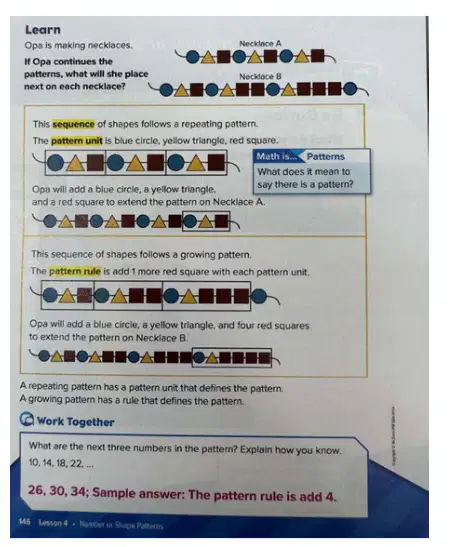
Learn: Ogo is making necklaces. If Ogo continues the pattern on Necklace A, what will he place next? Necklace A shows a repeating pattern with the pattern unit blue circle, yellow triangle, red square. State the next three shapes to be added.
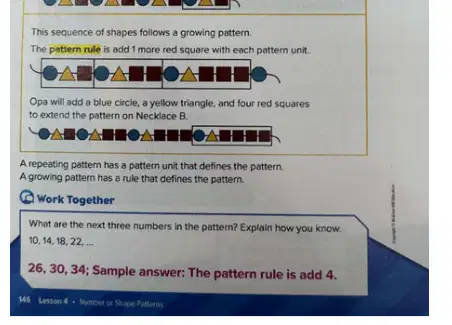
Learn: Ogo is making necklaces. If Ogo continues the pattern on Necklace B, what will he place next? Necklace B shows a growing pattern where the pattern rule is add 1 more red square with each pattern unit. State the shapes to be added for the next pattern unit.
Work Together: What are the next three numbers in the pattern? Explain how you know. 10, 14, 18, 22, …
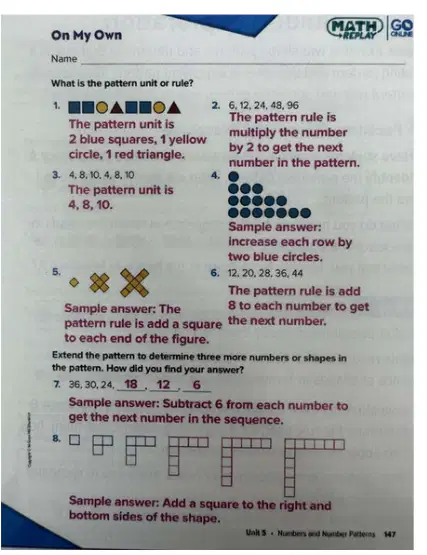
On My Own: What is the pattern unit? The shape sequence shows a repeating unit of two blue squares, one yellow circle, and one red triangle.
On My Own: What is the pattern rule for the number sequence 6, 12, 24, 48, 96? Choose the rule that correctly generates the next number.
Multiply the previous number by 2.
Add 6 to the previous number.
Subtract 3 from the previous number.
Multiply the previous number by 4.
On My Own: What is the pattern rule for the number sequence 12, 20, 28, 36, 44? Choose the rule that correctly generates the next number.
Add 8 to the previous number.
Add 6 to the previous number.
Multiply the previous number by 2.
Subtract 4 from the previous number.
On My Own: Extend the pattern to determine three more numbers in the sequence. Explain how you found your answer. 36, 30, 24, 18, 12, 6, …
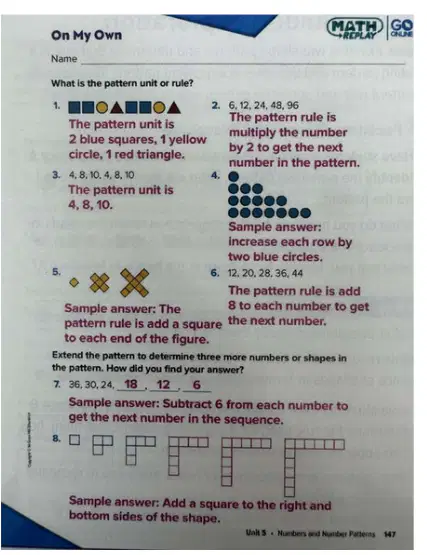
On My Own: Extend the pattern to determine three more shapes in the sequence. The figure grows by adding squares. Explain how you found your answer.
According to the page titled Generating a Pattern, what does it mean to generate a pattern?
Choose a rule and follow it to create your own pattern
Copy a pattern exactly as someone else made it
Pick random items until they look interesting
Change the rule every time to keep it surprising
What is a pattern, as described on the page?
Something that repeats or changes in a predictable way
A list of unrelated things with no order
A design that is always the same and never changes
An arrangement that must be random to be creative
When generating a pattern, what do you do first?
Make the rule, then follow it
Draw the shapes before deciding any rule
Choose colors and ignore rules
Start with a random sequence and adjust later
Which items can a sequence be made of when you follow a pattern rule? Select all that apply.
numbers
shapes
colors
objects
letters

Thomas is on page 12 in his book. He plans to read 5 pages of his book each day this week. What page will he be on after 5 days? Use the table: Day 1: 1×5+12=17 , Day 2: 2×5+12=22 , Day 3: 3×5+12=27 , Day 4: 4×5+12=32 , Day 5: 5×5+12=37 .
(a)
Jasmine makes a row of 2 counters. She makes another row using 1 more counter than the previous row. If she continues this pattern, how many counters will there be in the 5th row?
(a)

