
 Worksheets
Digital Transformation in Banking
Total questions: 30
Worksheet time: 30mins
Which trend best describes how consumers prefer to handle banking today?
Visiting branches for every transaction
Using mobile and online channels
Relying on cash for daily payments
Mailing paper forms for services
Calling support for routine tasks
Which role of Artificial Intelligence in banking is emphasized?
Replacing all human advisors entirely
Boosting marketing without data use
Increasing branch visits for support
Revolutionizing operations and services
Eliminating cybersecurity risks fully
A bank plans to meet increased cyber fraud amid rapid digital adoption. Which combined approach is most effective?
Delay new features and freeze accounts
Adopt AI fraud analytics and educate users
Rely on passwords without monitoring
Expand branches and reduce online access
Ignore trends and maintain legacy tools
Considering the timeline, which sequence correctly orders these milestones from earliest to latest?
Turing Test → Expert Systems → Dartmouth → AlexNet → Deep Blue → GPT-3
Turing Test → Dartmouth → Expert Systems → Deep Blue → AlexNet → GPT-3
Dartmouth → Turing Test → Expert Systems → Deep Blue → GPT-3 → AlexNet
Expert Systems → Turing Test → Dartmouth → Deep Blue → AlexNet → GPT-3
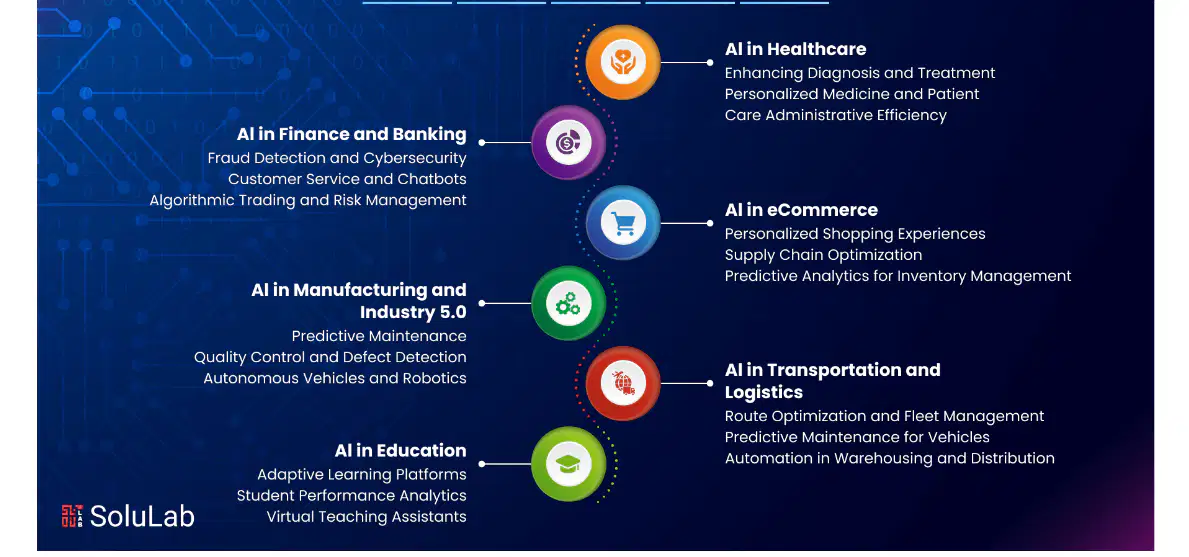
In the diagram, which AI use case is explicitly associated with healthcare applications?
Fraud detection and cybersecurity initiatives
Adaptive learning platforms and student analytics
Personalized medicine and patient care personalization
Route optimization and fleet management systems
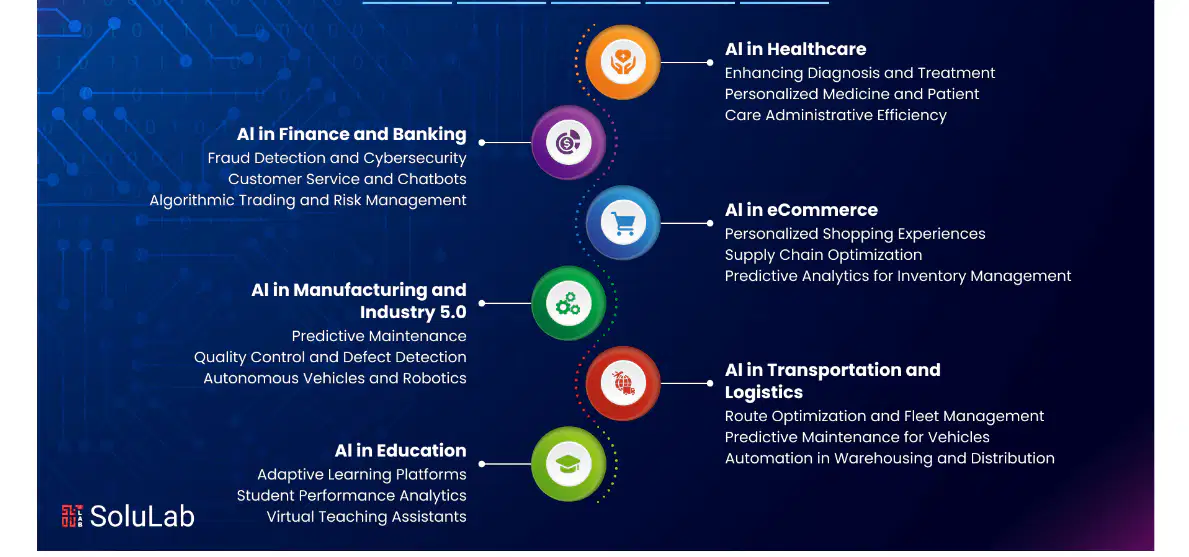
A logistics company wants to reduce vehicle downtime and improve delivery reliability. Based on the diagram, which AI strategy should they prioritize first?
Personalized shopping experiences to boost customer sales
Predictive maintenance for vehicles to anticipate failures
Virtual teaching assistants to train new drivers
Algorithmic trading systems to hedge fuel costs
In the diagram, which banking function is described as using Robotic Process Automation and Natural Language Processing to streamline back‑office tasks and reduce human error?
Customer service with 24/7 chatbots and assistants
Fraud detection using real‑time transaction monitoring
Operations automation with RPA and NLP
Credit decisioning for faster loan approvals
A regulator mandates real‑time transaction monitoring to reduce systemic risk. Which outcome is most plausible for banks?
Slower adoption of AI across departments
Reduced data analysis for decision processes
Targeted AI deployments for compliance needs
Elimination of customer‑facing digital channels
A bank plans an AI chatbot but its core systems are decades old and siloed. What is the primary barrier to successful deployment?
External vendor licensing negotiations
Insufficient training budget for staff
Integration with legacy systems and interfaces
End-user lack of access to smartphones
Which AI use case commonly enhances customer support in banks?
Predictive maintenance for ATMs
Quantum cryptography modules
Blockchain for settlement
NLP chatbots for inquiries
What action helps mitigate ethical risks in AI deployment?
Ignoring edge cases
Conducting impact assessments
Removing governance teams
Maximizing model complexity
Which scenario exemplifies model drift risk in banking AI?
Database indexes optimized overnight
New product changes customer behavior
Office chairs replaced recently
Printer firmware updated quietly
Which control best addresses privacy risks in AI customer analytics?
Differential privacy techniques
Open public data publication
Unlimited data sharing agreements
Unencrypted data lakes
What is a reasonable risk scenario for chatbots in banking?
Perfect sentiment understanding
Hallucinating policy instructions
Zero downtime forever
Infinite personalization accuracy
Which risk arises when a bank outsources AI models?
Vendor lock-in and opacity
Higher in-house talent growth
Automatic fairness guarantees
Reduced legal obligations entirely
Which AI capability enables proactive customer retention?
Randomized A/B assignments
Manual ticket logging
Static rule-based systems
Churn prediction modeling
Which ethical tension arises in fraud detection systems?
Privacy versus detection sensitivity
ATM location versus queue length
UI color versus typography choices
Printer speed versus paper weight
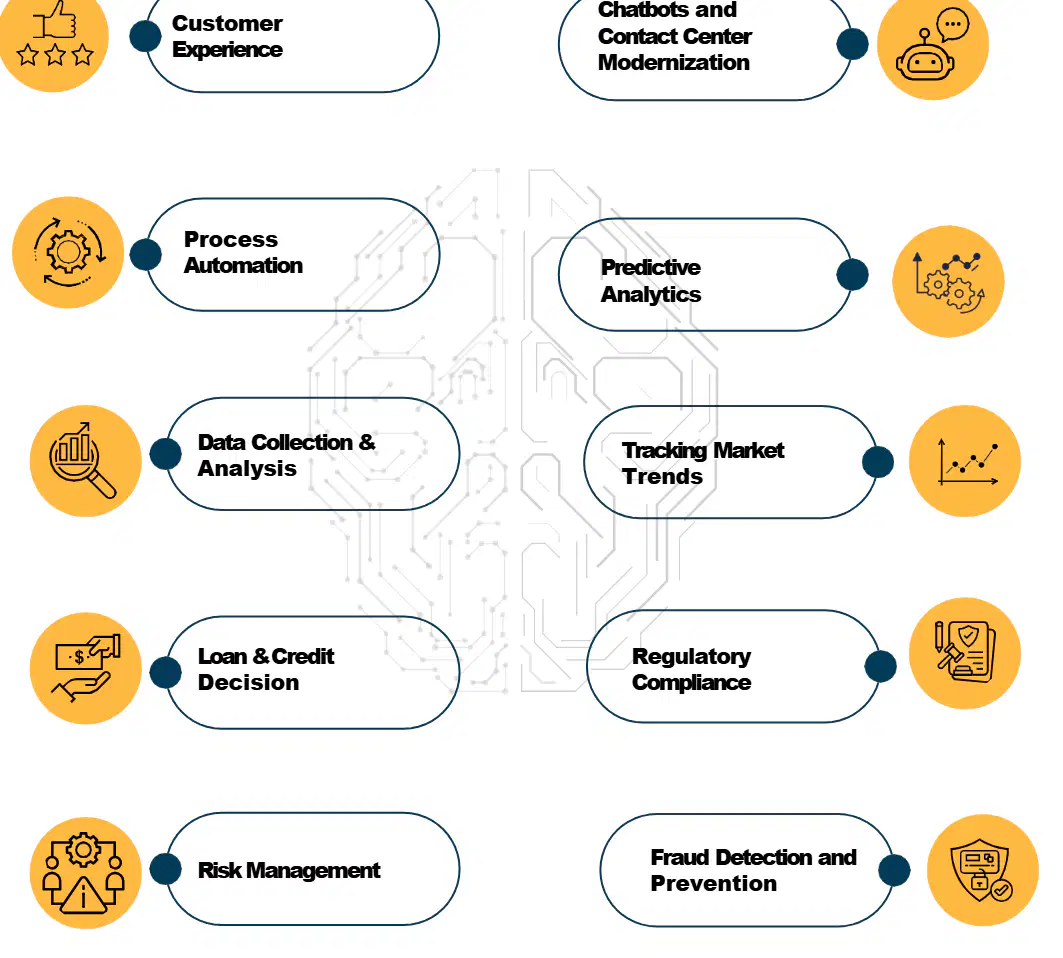
In the diagram, which banking workflow most directly leverages machine learning to personalize interactions and improve satisfaction metrics?
Regulatory compliance monitoring with rule engines
Predictive analytics for portfolio risk forecasting
AI in customer experience for personalized engagement
Process automation with AI to reduce manual steps
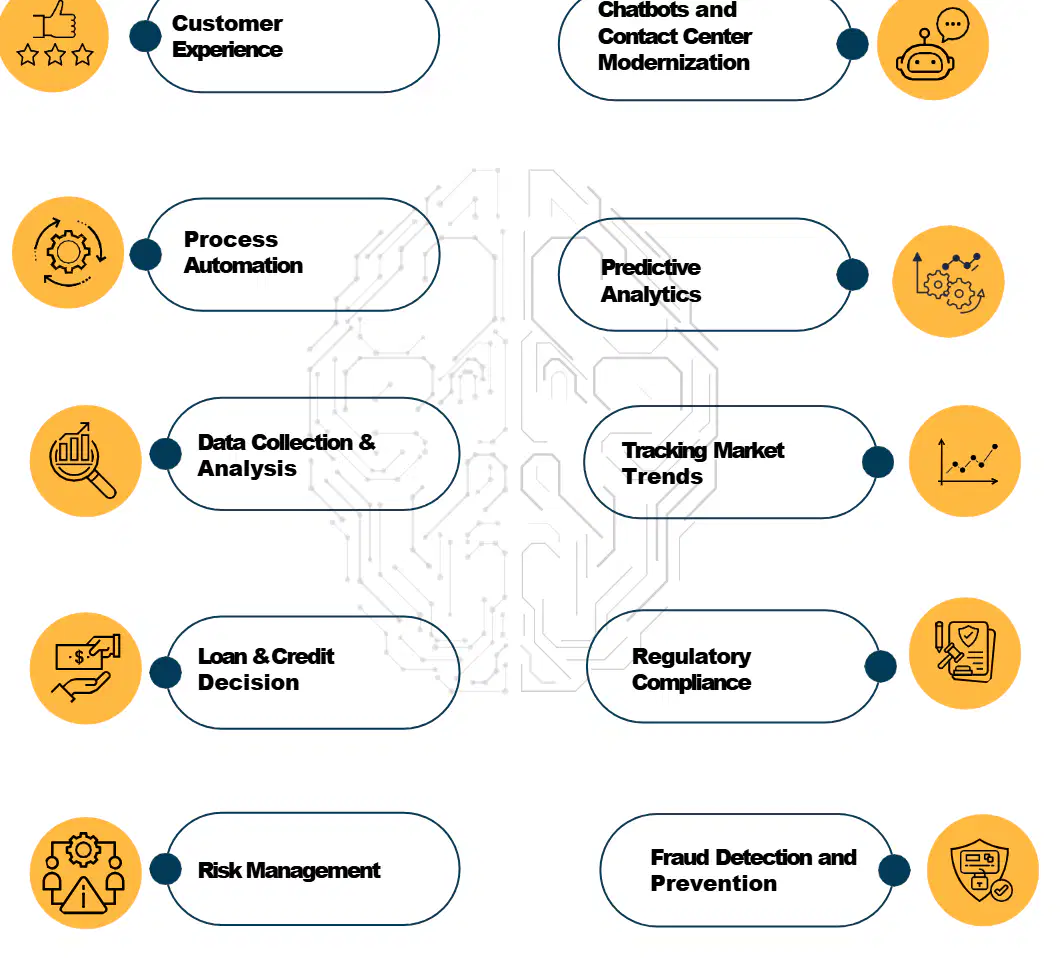
A bank must decide whether to approve a credit application while minimizing fraud risk and operational delays. Using the diagram’s elements, which integrated approach best meets this goal?
Run predictive analytics alone for default probability
Automate processes only to speed document checks
Combine loan decisioning with fraud detection analytics
Rely on customer experience tools for faster responses
Which layer focuses on creating personalized and frictionless user experiences across channels like mobile apps, websites, and chatbots?
Engagement Layer
Core Technology and Data Layer
Operating Model
AI-Powered Decision-Making Layer

A bank uses an ML model to predict default probabilities. To perform a what-if analysis on a severe unemployment shock, which approach is most appropriate?
Exclude unemployment features to avoid overfitting risk
Adjust macroeconomic inputs and recompute predictions
Replace ML with rule-based scoring for simplicity
Freeze current predictions and compare to last quarter
Which issue is addressed by drift analysis after deployment?
Missing data in a single column
Incorrect label encoding values
Duplicate rows in training set
Changing data distribution over time
What is the primary purpose of SHAP local explanations?
Measure server inference latency
Tune regularization hyperparameters
Estimate overall feature variance
Explain one prediction’s feature impacts
A borrower’s SHAP plot shows Income has negative contribution. What does that mean?
Increases predicted default risk
Indicates Income missing values
Removes Income from dataset
Reduces predicted default risk
Why might LIME produce different explanations for a single prediction?
Small input changes can alter local approximations
Fairness metrics penalize unstable feature effects
Regularization hyperparameters drive feature sparsity
Global model weights vary across training epochs
Which requirement ensures objectivity by mandating that validation be performed by a team outside the model developers?
Comprehensive documentation of validation steps
Data quality assessment of training and testing
Outcome analysis of accuracy and compliance
Independent review conducted by a separate team
An observed rise in default rates occurs even though applicant feature distributions remain stable. Which monitoring insight is most likely indicated?
Concept drift affecting input–outcome relationships
Sampling bias introduced by data augmentation
Data drift caused by shifting applicant population
Overfitting due to increased model complexity
What does SHAP primarily provide for underwriting decisions?
Synthetic sample generation methods
Raw probability calibration scores
Batch data ingestion schedules
Feature-level contribution explanations
Drift analysis is used to detect what in model monitoring?
Changes in data or prediction distributions
Improvements in UI component layouts
Upgrades in server hardware drivers
Increases in team communication frequency
Which evaluation metric best measures PD model discrimination?
Area under the ROC curve (AUC)
Total number of concurrent users
Average time to resolve tickets
Mean web page scroll depth

