
Font size
 Worksheets
7th Grade Civic SOL Review Section 1 FundamentalsS
Total questions: 99
Worksheet time: 50mins
The government cannot tell you what religion to follow.
Limited Government
Popular Sovereignty
Rule of Law
Separation of Powers
The government can only do what the people allow.
Limited Government
Popular Sovereignty
Judicial Review
Federalism
Senator Jones wants to give fireworks to his constituents, but fireworks are illegal in Virginia.
Rule of Law
Freedom of Speech
Separation of Powers
Due Process
Students want to wear hats at school. They elect a student council president to speak for them.
Representative Government
Direct Democracy
Monarchy
Dictatorship
The people are the source of all government power.
Consent of the Governed
Rule of Law
Separation of Powers
Judicial Review
People choose leaders to make laws for them.
Representative Government
Direct Democracy
Monarchy
Dictatorship
Match the statement to the fundamental principle:
7. "We the people" ___________________________
Consent of the Governed
Rule of Law
Separation of Powers
Limited Government
The people rule.
Democracy
Monarchy
Dictatorship
Oligarchy
Judge Johnson was arrested for stealing. Why can't he have the charges dropped just because he is a judge?
Rule of Law
Judges are above the law
Judges can pardon themselves
Judges are immune to arrest
The federal system of government has checks and balances.
Limited Government
Direct Democracy
Absolute Monarchy
Unitary System
"I'm glad our government doesn't make us wear purple shoes."
Limited Government
Popular Sovereignty
Checks and Balances
Judicial Review
Virginians voted for a new governor.
Representative Government
Direct Democracy
Monarchy
Dictatorship
Which principle means that people give power to the government in exchange for protection of their rights?
Consent of the Governed
Rule of Law
Separation of Powers
Checks and Balances
Which principle means the government can only do what the people allow?
Limited Government
Popular Sovereignty
Judicial Review
Federalism
Which principle means everyone, including the government, must follow the law?
Rule of Law
Separation of Powers
Popular Sovereignty
Judicial Review
Which principle means 'the people rule' in a democratic government?
Democracy
Monarchy
Oligarchy
Theocracy
Which principle means the people elect officials to make laws and run the government for them?
Representative Government
Rule of Law
Consent of the Governed
Limited Government
Which statement best shows the idea of "consent of the governed"?
Congress must meet at least once every year
Bills for raising money start in the House of Representatives
We the People of the United States ... establish this Constitution
Only a natural born citizen can be President
Which is an example of the "rule of law"?
A. A city council member is found guilty of speeding.
B. A state senator is re-elected.
C. A suspect is told his rights.
D. A citizen learns how to register to vote.
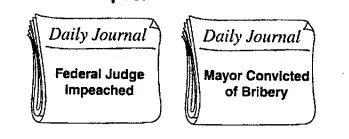
These headlines best illustrate —
democracy
consent of the governed
rule of law
popular sovereignty
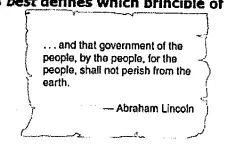
This quote from the Gettysburg Address best defines which principle of American government?
Separation of powers
Limited government
Rule of law
Democratic government
In the United States, voters elect officials to make laws and run the government for them. What political principle is this? "Consent of the governed" means —
Representative government
people are the source of power
Consent of the governed
Limited government
Rule of law
Which document was the first form of national government?
Articles of Confederation
Declaration of Independence
Charters of the Virginia Company of London
Virginia Statute for Religious Freedom
Virginia Declaration of Rights
Which document stated grievances against the King of Great Britain?
Declaration of Independence
Virginia Declaration of Rights
Charters of the Virginia Company of London
Articles of Confederation
Virginia Statute for Religious Freedom
Which document served as a model for the Bill of Rights (amendments 1-10)?
D) Declaration of Independence
E) Articles of Confederation
A) Charters of the Virginia Company of London
B) Virginia Statute for Religious Freedom
C) Virginia Declaration of Rights
Which document established the structure of the US government?
F) United States Constitution
C) Virginia Declaration of Rights
D) Declaration of Independence
A) Charters of the Virginia Company of London
B) Virginia Statute for Religious Freedom
Which document guaranteed rights of Englishmen to the colonists?
Charters of the Virginia Company of London
Virginia Statute for Religious Freedom
Declaration of Independence
Articles of Confederation
Virginia Declaration of Rights
Which reason matches the 'Virginia Statute for Religious Freedom'?
It stated grievances against the king of Great Britain.
It states that all people should have freedom of religion and opinions.
It extended rights of Englishmen to colonists.
Declared the colonies' independence from Great Britain.
It served as a model for the Bill of Rights of the U.S. Constitution.
Match the document to its reason for importance. What is the reason for the 'Declaration of Independence'?
Declared the colonies' independence from Great Britain.
Extended rights of Englishmen to colonists.
Stated that all people should have freedom of religion and opinions.
Listed grievances against the king of Great Britain.
Served as a model for the Bill of Rights.
Which reason matches the 'Virginia Declaration of Rights'?
It states that all people should have freedom of religion and opinions.
It stated grievances against the king of Great Britain.
Declared the colonies' independence from Great Britain.
It extended rights of Englishmen to colonists.
It served as a model for the Bill of Rights of the U.S. Constitution.
Which reason matches the 'Charters of Virginia Company of London'?
It stated grievances against the king of Great Britain.
It extended rights of Englishmen to colonists.
It states that all people should have freedom of religion and opinions.
Declared the colonies' independence from Great Britain.
It served as a model for the Bill of Rights of the U.S. Constitution.
Match the document to its reason for importance. Which reason matches the 'Articles of Confederation'?
D. Stated grievances against the king of Great Britain.
M. Created a weak central government with no power to tax or enforce. Led to the U.S. Constitution.
A. Extended rights of Englishmen to colonists.
C. Served as a model for the Bill of Rights.
B. Declared independence from Great Britain.
Which reason matches the 'U.S. Constitution including the Bill of Rights'?
D. It stated grievances against the king of Great Britain.
C. It served as a model for the Bill of Rights of the U.S. Constitution.
B. Declared the colonies' independence from Great Britain.
A. It extended rights of Englishmen to colonists.
J. Establishes the structure of U.S. government
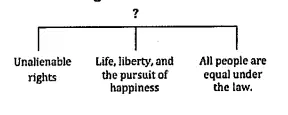
Which early American document is the best title for this diagram?
Charters of the Virginia Company of London
Virginia Declaration of Rights
Articles of Confederation
Declaration of Independence
Which document was written for this purpose?
..... IN ORDER TO FORM A MORE PERFECT UNION
Constitution of the United States
Declaration of Independence
Articles of Confederation
Virginia Declaration of Rights
Why were the Virginia Company of London charters important?
They created a federal court system.
They established a national banking system.
They guaranteed colonists' rights as Englishmen.
They listed colonists' complaints against the king.
The first national government of the United States was created by --
Declaration of Independence
Articles of Confederation
Constitution of the United States
Inaugural Address
"We, the People of the United States, in order to form a more perfect union..." — U.S. Constitution, 1787. This phrase best refers to the —
failed policies by foreign officials
grievances in the Declaration of Independence
national problems from outdated laws
weaknesses in the Articles of Confederation
Which document did Thomas Jefferson write to support religious freedom?
Virginia Statute for Religious Freedoms
Virginia Declaration of Rights
Constitution of the United States of America
Articles of Confederation
Preamble- the __________ to the US Constitution; tells us why the Constitution was written.
introduction
amendment
conclusion
article
Fill in the blanks: We the __________ of the United States, in order to form a more perfect __________, establish __________, insure domestic __________, provide for the __________ defense, __________ the general welfare, and secure the __________ of liberty to ourselves and our posterity, do ordain and __________ this Constitution for the United __________ of America.
people, union, justice, tranquility, common, promote, blessings, establish, States
citizens, country, law, peace, national, support, rights, create, Nations
leaders, nation, order, harmony, federal, encourage, freedoms, write, Republic
members, state, rules, safety, shared, advance, privileges, approve, Country
When the U.S. armed forces defend our country, they fulfill a purpose of government listed in the -
Virginia Declaration of Rights.
Charters of the Virginia Company of London.
Preamble of the United States Constitution.
Bill of Rights.
What best summarizes the Preamble to the U.S. Constitution?
Lists the powers of the Supreme Court, General Court and District Court
Describes the role of the branches of government
Explains how a bill becomes a law
States the goals and purposes of the government
Proposal by ________ (to amend the U.S. Constitution)
Congress or convention
President
Supreme Court
State legislatures
Ratification by ________ (for amending the U.S. Constitution)
the states
the President
the Supreme Court
the Senate
How many amendments are in the US Constitution?
27
10
33
45
Who can propose an amendment to the Virginia Constitution?
General Assembly or convention
Governor
Supreme Court
President
Ratification by ________ (for amending the Virginia Constitution)
the voters
the governor
the Supreme Court
the General Assembly
Why have there been only 27 amendments to the U.S. Constitution in over 200 years?
Adding amendments is very complex.
The courts reject many amendments.
National laws limit amendments.
Society changes too little for amendments.
What is required to amend the U.S. Constitution?
Majority vote by the Electoral College
Unanimous vote by both houses of Congress
Ratification by legislatures or conventions in the states
Recommendation by the executive and judicial branches in the states
Proposal → Action by General Assembly or Convention → Ratification by Voters of Virginia
What is the best title for the process shown?
How the Electoral College Elects a President
How the U.S. Constitution is Amended
How the Virginia Constitution is Amended
How A Bill Becomes A Law
Proposal → Action by Congress or Convention → Ratification by the States
What is the best title for the process shown?
How the Electoral College Elects a President
How the U.S. Constitution is Amended
How the Virginia Constitution is Amended
How A Bill Becomes A Law
To date, how many amendments have been added to the United States Constitution?
25
26
27
28
___th Amendment: Defines what a ________________ is.
14th Amendment; citizen
15th Amendment; voter
13th Amendment; slave
19th Amendment; woman
The Amendment says, "All persons ________________ or ________________ in the United States, and subject to the jurisdiction thereof, are ________________ of the United States and the ________________ wherein they reside."
born; naturalized; citizens; state
born; immigrated; residents; country
naturalized; registered; nationals; city
born; adopted; members; nation
What are the two ways you can become a U.S. citizen?
birth; naturalization
marriage; adoption
visa; sponsorship
employment; investment
To become a citizen through naturalization, a person must: 1. Be at least ______ years old.
18
16
21
25
To become a citizen through naturalization, a person must: 2. Be a legal resident of the United States for _____ to _____ years (or longer).
5; 14
3; 7
2; 10
6; 12
To become a citizen through naturalization, a person must: 3. Be of good ____________ character and be ________________ to the United States.
moral; loyal
ethical; devoted
legal; patriotic
honest; committed
To become a citizen through naturalization, a person must: 4. Be able to ____________, ________________, and ________________ basic English.
speak; read; write
listen; draw; sing
run; jump; swim
paint; dance; cook
To become a citizen through naturalization, a person must: 5. ________________ a naturalization test.
pass
write
skip
fail
To become a citizen through naturalization, a person must: 6. Take the ________________ of Allegiance at a naturalization ceremony.
Oath
Promise
Pledge
Declaration
Increased immigration and naturalization in the 20th century has led to a very ________________ country.
diverse
isolated
uniform
hostile
"All persons born or naturalized in the United States, and subject to the jurisdiction thereof, are citizens of the United States and the state wherein they reside." The above excerpt is from Amendment —
12
13
14
15
Demonstrate knowledge of American history and principles.
Demonstrate the ability to read, speak, and write words in the English language.
These are required for which process?
Voter Registration Process
Naturalization Process
Congressional Nomination Process
Presidential Nomination Process
A person must do which of the following to become a citizen through naturalization?
Pass a citizenship test and meet residency requirements
Be born in the country
Hold a government job
Marry a citizen
What are the two ways to obtain U.S. citizenship?
Birth
Live in the country
Naturalization
Immigration
What Amendment defines citizenship in the United States?
16th
12th
15th
14th
Carlos was naturalized in 2009. This means that he —
was asked to leave the United States
was granted the rights of United States citizenship
was born in the United States
was denied the right to vote
Which of the following is NOT a result of immigration and naturalization?
A. Society becomes more diverse
B. New holidays are introduced
C. New foods are available
D. Children attend school
Birth and naturalization are examples of—
Methods that identify judicial perspectives on ethical issues
Methods that identify qualifications for political party alignment
Methods in which individuals can obtain citizenship in the United States
Methods in which people may earn the right to vote in the United States
R ________ - The government may not establish an ________ religion, ________ an official religion, or unduly interfere with the free ________ of religion.
Religion, official, endorse, exercise
Religion, national, support, practice
Religion, public, promote, belief
Religion, state, favor, worship
A ________ - Individuals may peacefully ________.
Assembly, gather
Meeting, disperse
Group, protest
Crowd, argue
P ________ - The press has the right to gather and publish ________ including that which ________ the government.
Press, information, criticize
People, news, support
Public, stories, praise
Paper, facts, help
P ________ - Individuals have the right to make their ________ known to public ________.
Petition, views, officials
Protest, opinions, servants
Publish, ideas, authorities
Participate, beliefs, representatives
S ________ - Individuals are ________ to express their ________ and ________.
Speech, free, opinions, beliefs
Society, allowed, thoughts, actions
Security, required, feelings, ideas
Service, encouraged, emotions, values
Which of the following is a 1st Amendment Freedom?
Religion
Education
Voting
Travel
Few rights, if any, are considered _____________. For example, you may not yell, "FIRE!" in a crowded movie theater.
absolute
conditional
universal
unlimited
The idea that newspapers have a right to criticize the government is known as freedom of
The press
Speech
The economy
Assembly
Which of the following statements does the First Amendment guarantee?
You may meet with other people.
You may have a speedy trial.
You may vote in elections.
You may own firearms.
You can express your opinions or beliefs
freedom of Religion
freedom of Petition
freedom of the Press
freedom of Speech

Which freedom is shown in this picture?
Freedom of Petition
Freedom of Expression
Freedom of Religion
Freedom of Speech
All of the following freedoms are protected under the First Amendment EXCEPT —
privacy
speech
press
religion
An important goal of the First Amendment regarding religion is —
collecting taxes for charity work.
outlawing certain violent religions.
establishing a national religion.
allowing the free exercise of religion.
The idea that individuals have the right to make their views known to public officials is —
freedom of petition.
freedom of the press.
freedom of speech.
freedom of the economy.
Circle the THREE statements that are protected by the 1st Amendment.
Gathering and publishing information
Yelling "bomb" on an airplane
Wearing a cross necklace to school
Sending signatures you have gathered to your Senator
Using illegal drugs
A duty is something that you _______ do. Obey _______. Pay _______. Served in the armed _______, if called. Serve on a _______ or as a witness in _______ when summoned.
must, laws, taxes, forces, jury, court
may, rules, bills, teams, panel, office
should, orders, fees, clubs, group, hall
can, commands, fines, squads, board, room
Citizens who choose NOT to fulfill their civic duties face _______ consequences.
legal
financial
social
educational
A responsibility is done by _______; it is _______. Register and _______. Hold _______ office. Communicate with _______ officials to influence government actions. Serve in voluntary, appointed government _______. Participate in _______ campaigns. Keep informed regarding current _______. Respect others' _______ to an equal voice in _______.
choice, voluntary, vote, elective, government, positions, political, issues, right, government
choice, mandatory, vote, elective, government, positions, political, issues, right, government
choice, voluntary, vote, elective, government, positions, political, issues, right, society
choice, voluntary, vote, elective, government, positions, political, issues, right, community
duty of citizenship :: pay taxes
responsibility of citizenship :: _______
vote
travel
shop
sing
DUTY: Serve as a witness in court, when summoned
RESPONSIBILITY:__________
Vote
Pay Taxes
Obey laws
While all citizens have both duties and responsibilities to their country, civic responsibilities- Choose the correct answer.
Are voluntary actions
Carry consequences if they are not fulfilled.
Are required by law
Are listed in the U.S. Constitution.
Communicate with government officials to influence government actions is a _______.
responsibility
privilege
right
duty
Hold elective office is a _______.
responsibility
privilege
punishment
hobby
Serve as a witness in court, when summoned is a _______.
duty
right
privilege
opinion
Serve in the armed forces, if called is a _______.
duty
right
privilege
opinion
Obeying the law, paying taxes, and serving in court are examples of a citizen's —
responsibilities
liberties
individual rights
duties
What happens to citizens who do not fulfill a civic duty?
They must pay higher taxes.
They are no longer guaranteed due process.
They face legal consequences.
They lose their citizenship.
Which American civic action is a duty rather than a responsibility?
Jury service
Supporting a political party
Volunteering
Voting in elections

