
Font size
 Worksheets
REVIEW FOR FUCKING POI
Total questions: 129
Worksheet time: 1hrs 5mins
Which statement best defines voluntary motion in radiography?
Motion due to tremors only
Movement the patient can control
Movement caused by heartbeats
Motion from peristalsis alone
Which is an example of involuntary motion during imaging?
Talking during exposure
Heartbeat during exposure
Following clear instructions
Holding breath tightly
What is the primary goal of limiting motion unsharpness?
Reduce focal spot size
Increase exposure time
Lower patient dose only
Make the image sharper
Which method directly helps reduce motion blur by patient cooperation?
Clear instructions and breath-hold
Using poor film-screen contact
Larger focal spot selection
Increasing OFD slightly
Suspended respiration is most useful to reduce blur in which scenario?
Skull imaging with immobilizers
Dental panoramic exposures
Extremity imaging with casts
Chest radiography with rib clarity
Which item is an immobilization aid effect on image quality?
Enlarges focal spot
Increases OFD markedly
Speeds screen conversion
Reduces patient motion
Which factor describes the space between the patient or object and the image receptor?
Object–film distance
Source–image distance
Film–screen contact
Intensifying screen speed
What does focal spot size primarily influence?
Geometric unsharpness
OFD measurement errors
Patient cooperation
Screen light emission
Which distance is measured from the x‑ray tube focal spot to the image receptor?
Film–cassette gap distance
Patient–tube distance
Object–film distance
Source–image distance
Good film–screen contact produces what outcome for a mesh test image?
Clear sharp wire mesh
Blurry uneven wire mesh
Overexposed grid pattern
Magnified mesh spacing
Poor film–screen contact most likely causes which artifact?
Uniformly sharper detail
Localized fuzzy mesh area
Increased SID blur
Reduced magnification only
Which combination best limits motion unsharpness during routine studies?
Fast exposure times
Large OFD values
Loose screen contact
Big focal spot usage
Why can slight breathing during a chest x‑ray sometimes be advantageous?
Increases SID to reduce blur
Sharpens ribs for bone detail
Blurs ribs to show lung tissue
Prevents heart motion entirely
Intentional blur in tomography is achieved by which action?
Moving the x‑ray tube during exposure
Using a stationary large focal spot
Reducing SID to increase magnification
Increasing OFD for organ separation
Functional studies like fluoroscopy rely on motion for what purpose?
Reduce film–screen noise artifacts
Measure OFD accurately each time
Eliminate patient movement entirely
Study organ dynamics in real time
Which factor primarily controls the quantity of x‑ray photons produced during an exposure?
SID chosen by technologist
Grid ratio used
mAs setting selected
kVp of the generator
Increasing mAs without changing other factors will most directly cause what effect on the image receptor exposure?
Higher contrast only
Higher overall exposure
Lower overall exposure
No change in exposure
What does exposure to the image receptor determine for a digital image?
Pixel matrix size
Focal spot blur amount
Displayed brightness level
Detector quantum efficiency
Raising kVp generally results in which combined effect?
Same penetration, lower exposure
More penetrating beam, higher exposure
More scatter, lower exposure
Less penetrating beam, lower exposure
Which statement best describes the role of SID in exposure?
Exposure decreases as distance increases
Exposure peaks at midrange distance
Exposure is independent of distance
Exposure increases with greater distance
A thicker body part typically leads to what outcome if technique is unchanged?
More absorption, less receptor exposure
Less absorption, more receptor exposure
Same absorption, same exposure
More scatter, more receptor exposure
What is the main factor used to adjust image brightness/density when exposure is incorrect?
Change SID only
Change kVp slightly
Change grid ratio
Change mAs primarily
Which grid effect on exposure is most accurate?
Grids decrease contrast but increase exposure
Grids add exposure by emitting radiation
Grids remove scatter and require more mAs
Grids reduce absorption in thick parts
If SID is increased from 40 inches to 50 inches and mAs is not changed, what happens to receptor exposure?
Exposure increases noticeably
Exposure doubles exactly
Exposure decreases noticeably
Exposure remains identical
Which formula represents the inverse square law for intensity change with distance?
I2 = I1 × d2
I2 / I1 = d1 × d2
I1 / I2 = d2² / d1²
I1 × I2 = d1 / d2
A radiograph appears lighter after moving the tube farther from the detector without technique change. What adjustment best restores proper exposure?
Decrease mAs appropriately
Reduce kVp minimally
Increase SID further
Lower grid ratio slightly
Which pair correctly matches factor and its primary influence?
mAs—beam energy
Grid—source distance
kVp—quantity only
SID—intensity at receptor
Two exams differ only by patient thickness: Exam A is thicker. If technique is unchanged, which image outcome is expected for Exam A?
Darker image due to more exposure
Lighter image due to less exposure
Same brightness due to AEC
Higher spatial resolution automatically
Which scenario most likely increases film darkness if no adjustments are made?
Closer SID with same mAs
Higher grid ratio installed
Lower kVp with same mAs
Thicker part with same mAs
Given: original distance d1 = 40 inches, new distance d2 = 45 inches, original intensity I1 = 5 R. Using the inverse square law, what is the new intensity I2?
4.94 R approximately
2.22 R approximately
3.95 R approximately
5.62 R approximately
A radiograph is taken at 10 mAs without a grid. To add an 8:1 grid (GCF ≈ 4), what mAs is required to maintain receptor exposure?
40 mAs
30 mAs
20 mAs
10 mAs
An exposure used 40 mAs with an 8:1 grid (GCF ≈ 4). If the grid is changed to 12:1 (GCF ≈ 5), what is the new mAs to keep the same exposure?
32 mAs
45 mAs
50 mAs
60 mAs
Using the inverse square law, an exposure at distance d1 = 36 in gives intensity I1 = 8.0 R. If the distance is doubled to d2 = 72 in, what is the new intensity I2?
8.0 R
6.0 R
2.0 R
4.0 R
Using the inverse square law, at d1 = 40 in the intensity is I1 = 5.0 R. If the distance is reduced to d2 = 30 in, what is the new intensity I2?
3.8 R
8.9 R
6.7 R
10.5 R
Using the inverse square law, at d1 = 50 in the intensity is I1 = 10.0 R. What distance d2 is needed to reach I2 = 15.0 R?
48 in
44 in
41 in
52 in
Which statement best defines film speed in radiography?
How sharp edges appear
How fast the x-ray tube spins
How much scatter is produced
How sensitive the film is
If film sensitivity increases, what change occurs to achieve the same image density?
Grid ratio must be lower
Less radiation is needed
Exposure time must be longer
More radiation is needed
Greater film sensitivity generally affects patient dose in what way?
Increases patient dose
Does not change dose
Decreases patient dose
Depends only on kVp
When changing from one grid to another, which relation correctly calculates new mAs?
mAs2 = mAs1 × (GCF1/GCF2)
mAs2 = mAs1 ÷ (GCF2/GCF1)
mAs2 = mAs1 × (GCF2/GCF1)
mAs2 = mAs1 + (GCF2−GCF1)
What is the approximate Grid Conversion Factor (GCF) for a 12:1 grid?
6
3
2
5
Spectral matching requires the film’s sensitivity to match what property of the intensifying screen?
Screen thickness
Color of emitted light
Grid ratio used
Focal spot size
Which statement best describes the Reciprocity Law in radiographic imaging?
Density depends on kVp only and not time
Density depends on distance only from the source
Density depends on intensity multiplied by exposure time
Density depends on patient thickness primarily
You keep total exposure (intensity × time) constant but use a shorter exposure time. According to the Reciprocity Law, what happens to optical density (OD)?
OD increases significantly with shorter time
OD remains the same if intensity is adjusted
OD decreases regardless of intensity
OD fluctuates unpredictably with time
The 15% Rule states that increasing kVp by 15% will do what to optical density when mAs is unchanged?
Reduce OD by half making image lighter
Increase OD slightly by about 5%
Double OD making image twice as dark
Leave OD unchanged across all distances
To maintain the same OD after increasing kVp by 15%, what adjustment to mAs is required?
Increase mAs by thirty percent
Decrease mAs by thirty percent
Decrease mAs by a factor of two
Increase mAs by a factor of two
If kVp is decreased by 15% and you want the same OD, how should mAs be changed?
Double the mAs to compensate for lower kVp
Halve the mAs to reduce patient dose
Increase mAs by about five percent
Keep mAs unchanged because OD is constant
A 5% change in kVp typically causes what approximate change in optical density when mAs is constant?
Exactly fifty percent change in OD
No noticeable change in OD
About thirty percent change in OD
About ten percent change in OD
Which factor does not directly affect optical density aside from distance?
Exposure time used for the film
Intensifying screen (IS) speed
Ambient room lighting during exposure
kVp setting of the x-ray tube
As source-to-image distance (SID) increases, what happens to x-ray intensity at the film?
Intensity decreases following the inverse square law
Intensity fluctuates randomly with SID
Intensity remains constant regardless of SID
Intensity increases proportionally with SID
To keep the same OD when increasing SID from 40 inches to 80 inches, how should mAs change?
Increase mAs to four times original
Increase mAs to twice the original
Decrease mAs to one quarter of original
Keep mAs the same for constant OD
Use the mAs-distance formula mAs1=mAs2×(d12/d22) . Original setup: mAs1=3mAsatd1=72inches . New distance d2=54inches . What mAs2 is needed to keep the same OD?
mAs2 equals 2.25 mAs at 54 inches
mAs2 equals 4.00 mAs at 54 inches
mAs2 equals 1.50 mAs at 54 inches
mAs2 equals 3.00 mAs at 54 inches
A patient’s tissue thickness increases by 2 cm compared to your baseline setup. To maintain image density without changing SID, what kVp adjustment should you make?
Double the baseline kVp value
Subtract 4 kVp from baseline
Add 4 kVp to the baseline
Add 2 kVp to the baseline
You angle the central ray 10 degrees caudad while keeping the detector stationary. According to the rule of thumb, what change to SID compensates for the angle?
Decrease SID by 1 inch total
Decrease SID by 2 inches total
Increase SID by 1 inch total
No SID change is required
A radiograph appears underexposed. What minimum mAs change is typically needed to produce a visible change in density?
Double the mAs value
Exactly 50% increase
At least 20–30% change
About 10% mAs increase
Tissue thickness increases by 5 cm. To hold density constant without altering kVp or SID, which mAs adjustment is recommended?
Increase mAs by 10%
Increase mAs by 25%
Either double or half the mAs
Double the mAs value
You must increase SID by 8 inches from 40 inches. Using the maintaining density rule, how should mAs be adjusted?
Increase mAs by 10% total
Increase mAs by 5% per inch
Increase mAs by 20% per inch
Increase mAs by 8% total
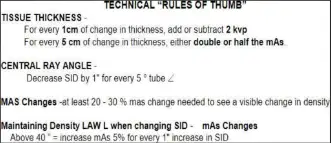
A lateral knee protocol calls for a 5-degree tube tilt. What is the practical SID adjustment to preserve exposure geometry?
Decrease SID by 0.5 inch
Decrease SID by 1 inch
Maintain original SID
Increase SID by 1 inch
Which change in kVp most increases subject contrast in a radiographic image?
Increase kVp to produce longer grayscale
Decrease kVp to produce shorter grayscale
Increase kVp with added filtration only
Maintain kVp and decrease mAs slightly
Raising mAs primarily affects which image quality factor?
Subject contrast increase
Optical density increase
Geometric magnification
Spatial resolution increase
What is the expected effect on magnification when SID is increased while OID remains constant?
Magnification decreases
Magnification increases
Magnification unchanged
Edge blur increases
Which combination best reduces motion blur during exposure?
Shorter exposure time with larger focal spot
Longer exposure time with larger focal spot
Shorter exposure time with small focal spot
Longer exposure time with small focal spot
Increasing OID while keeping SID constant will most likely produce which outcome?
Higher contrast with less magnification
Smaller image and sharper edges
Unchanged size and reduced blur
Larger image and increased blur
Compared to a large focal spot, a small focal spot primarily yields which result?
Greater edge blur and lower detail
Sharper image and better detail
Higher patient dose and lower noise
Lower spatial resolution and more magnification
Fast screens in the image receptor system generally cause which change?
Lower noise and higher spatial resolution
Higher detail and more noise
Lower mAs and less detail
Higher mAs and more detail
Which statement correctly describes the grid ratio?
Height of lead strips divided by interspace width
Width of lead strips divided by strip height
Interspace width divided by strip height
Product of strip height and interspace width
Which kVp setting most likely produces a long-scale contrast image?
Lower kVp with shorter grayscale
Lower kVp with longer grayscale
Higher kVp with shorter grayscale
Higher kVp with longer grayscale
During exposure, which factor most directly increases motion blur when the patient moves?
Small focal spot
Long exposure time
Short exposure time
Large SID
Which change in SID tends to improve image sharpness if other factors are held constant?
Shorter SID reduces magnification
Longer SID reduces beam divergence
Longer SID increases magnification
Shorter SID increases beam divergence
Which region of the H&D curve corresponds to underexposure with faint densities?
Shoulder region
Toe region
Straight-line region
Heel region
What does the shoulder region of the H&D characteristic curve indicate?
Linear response with constant gradient
Overexposure with poor contrast
Underexposure with high contrast
Optimal exposures with best detail
The H&H contrast curve re-plots which relationship to visualize contrast changes?
Density versus time
Gradient versus exposure
Exposure versus SID
mAs versus screen speed
Best sharpness is achieved with which combination of geometry and focal spot?
Small OID, long SID, small focal spot
Large OID, short SID, small focal spot
Large OID, long SID, small focal spot
Small OID, short SID, large focal spot
Increasing mAs while keeping kVp constant will most likely produce which visual result on film?
Shorter grayscale with high contrast
More dark or black areas
Longer grayscale with low contrast
Less dark or black areas
Switching from a slow screen to a fast screen typically requires which adjustment to maintain density?
Increase mAs moderately
Decrease mAs moderately
Increase kVp slightly
Decrease SID slightly
Which property is most compromised when a radiograph appears sharp but vessel outlines are obscured by excessive optical density?
Recorded detail
Spatial resolution
Visibility of detail
Geometric sharpness
Which factor would most likely increase base plus fog density, thereby reducing film contrast?
Fresh, properly stored film
Decreased processing temperature
Low developer activity
Excessive safelight exposure
A technologist increases SID from 100 cm to 180 cm while keeping mAs constant. Which effect is expected?
Increased magnification and unsharpness
Decreased magnification and improved sharpness
No effect on geometric detail
Higher density and contrast
A radiograph shows uneven density and localized blurring due to poor physical contact inside the cassette. Which imaging factor was compromised?
Focal spot size
Grid ratio selection
Film–screen contact
Safelight exposure
Using a large focal spot during an extremity x‑ray causes mild image blur. What is the most accurate explanation?
Reduced beam divergence
Decreased subject contrast
Enhanced image magnification
Increased geometric unsharpness
A radiograph made with a fast intensifying screen appears slightly blurred compared to a slow screen. What is the primary cause of this difference?
Fast screens have thicker phosphor layers, increasing light spread
Slow screens convert x‑rays to UV light
Slow screens produce less quantum mottle
Fast screens emit less light per photon
True or False: Increasing kVp always increases radiographic contrast.
Only with grid use
True
False
Only with high mAs
True or False: If kVp increases by 15%, you typically must double the mAs to maintain the same receptor exposure.
Only with slow screens
Only for non‑grid exams
False
True
True or False: Grid ratio is calculated by dividing the height of the lead strips by the width of the interspace material.
Only for focused grids
False
Only for parallel grids
True
True or False: A larger focal spot reduces image detail more than a smaller focal spot.
Only with slow screens
Only at short SID
False
True
If exposure falls in the shoulder region, the image has too much density and low contrast.
Depends on SID
Only with high grid ratio
False
True
Fast screens inherently reduce patient dose because they require more exposure.
True
False
Only with low mAs
Only at high kVp
Increasing the SID results in increased magnification.
True
False
Only with OID zero
Only with focused grid
A 15% increase in kVp results in the receptor exposure being halved.
True
False
Only with mAs raised
Only with filtration
Using a focused grid upside-down causes greater density in the center than the periphery.
Only with high kVp
Only at long SID
False
True
Poor film-screen contact degrades detail even if density and exposure are otherwise correct.
Only with slow screens
Only with high mAs
True
False
Switching from a slower screen to a faster screen always requires reducing mAs.
Only at low kVp
Only for grid exams
False
True
Subject contrast increases when tissues have greater variation in atomic number.
Only with lower SID
Only with added filtration
False
True
If the part is angled relative to the IR while the CR remains perpendicular, shape distortion results.
Only with magnification
False
Only with stationary grid
True
Rare-earth phosphor screens typically emit light that matches film sensitivity better than calcium-tungstate.
Only with fast films
True
False
Only at low temperature
Higher kVp increases the number of low-energy photons in the beam.
True
False
Only with added grid
Only with long exposure
Grid frequency is unrelated to how thin the lead strips are.
Only with moving grids
Only with high-ratio grids
False
True
Increasing OID reduces unsharpness because the beam diverges less.
True
False
Only with small focal spot
Only with long SID
The mirror in a collimator adds no filtration to the beam.
False
Only at high kVp
True
Only with old units
A steeper slope in the straight-line portion means lower contrast.
Only with long processing
False
Only with low speed
True
For diagnostic consistency, applying the 15% rule always keeps contrast constant.
Only with grid in use
True
Only with small focal spot
False
Patient motion reduces recorded detail even with an optimal focal spot and exposure.
Only with long SID
Only with high mAs
True
False
Using a grid always doubles contrast improvement, regardless of grid ratio.
Only with slow screens
Only for chest exams
False
True
There is an inverse relationship between screen speed and recorded detail.
Only above 80 kVp
Only with daylight loading
False
True
Rectangular collimation always eliminates the need for a grid because scatter is fully prevented.
Only for extremities
Only at low kVp
False
True
To artificially design an image where soft-tissue attenuation resembles the diffuse opacity of ARDS, which factor would contribute least toward elevating image density?
Raising kVp
Lowering filtration
Increasing mAs
Decreasing SID
Which manipulation would produce the least degradation of recorded detail when attempting to mimic the irregular architecture of Paget’s disease?
Slightly increased OID
Large focal spot
Fast screen speed
Use of high grid ratio
Which factor would be least effective in engineering a high-density radiograph meant to obscure signs of small pneumothorax?
Increasing kVp
Increasing mAs
Reducing SID
Increasing collimation
To intentionally simulate motion patterns similar to myoclonic jerks, which factor is least likely to increase motion blur?
Increased SID
Respiratory drift
Involuntary motion
Longer exposure time
When designing an exposure meant to minimize contrast for a fluid-filled abdomen, which strategy is the least appropriate?
Using large field size
Removing the grid
Raising kVp
Lowering kVp
To construct an image with apparent cortical thinning resembling severe osteopenia, which variable contributes least?
Large focal spot
Lower kVp
Increased OID
Fast IR system
Which factor would be least effective in engineering a high-density radiograph meant to obscure signs of small pneumothorax?
Increasing mAs
Increasing kVp
Reducing SID
Increasing collimation
Which factor would be least effective in engineering a high-density radiograph meant to obscure signs of small pneumothorax?
Increasing kVp
Increasing collimation
Increasing mAs
Reducing SID
Which option contributes least to magnification effects used to exaggerate apparent size changes like splenomegaly?
Elevating OID
Reducing SID
Tilting object relative to IR
Increasing air gap
To simulate physiologic blur resembling ventricular tachycardia, which factor plays the least role?
Short exposure time
Patient respiration
Cardiac motion
Voluntary oscillation
Which manipulation is least consistent with lowering subject contrast to mimic the uniform radiopacity of generalized edema?
Decreasing field size
Removing the grid
Increasing kVp
Increasing scatter
Which selection contributes least toward reducing resolution to imitate blurry trabeculae seen in osteomyelitis?
Large focal spot
Increased SID
Fast screen
Increased OID
Regarding the effect of mAs on density, which is LEAST correct?
mAs strongly alters subject contrast
mAs doubles density when doubled
mAs controls photon quantity
mAs influences IR exposure
With respect to shape distortion, which is LEAST correct?
Tube angulation causes shape distortion
IR-object misalignment causes shape distortion
Object tilt causes shape distortion
Focal spot size causes shape distortion
Concerning involuntary motion, which statement is LEAST correct?
It persists despite instructions
It can be eliminated by immobilization
It includes cardiac motion
It cannot be voluntarily controlled
On scatter radiation, which is LEAST correct?
Grids increase scatter production
Higher kVp increases scatter
Scatter decreases image contrast
Larger field size increases scatter
Regarding recorded detail, which is LEAST correct?
Recorded detail is influenced by kVp
Focal spot size is a key component
It depends on geometric factors
SID influences recorded detail
Which adjustment best increases density while minimizing contrast reduction?
Increase kVp but compensate mAs
Lower filtration
Reduce SID
Increase mAs
Which factor most directly enhances fine detail of calcifications in sarcoidosis?
Minimal OID
Slow screen
High SID
Small focal spot
Which method best minimizes blur from respiratory motion during a chest radiograph?
Short exposure time
Breath-hold instruction
Patient immobilization
Increasing mA to shorten time
Which action can increase radiographic image contrast without changing anatomy or positioning?
Tight collimation
Decreasing kVp
Using a grid
Employing a slower IR system
Why does adding a grid without altering other technical factors often cause the image to become lighter?
Grid absorbs scatter and some primary
Grid removes scatter only
Grid increases SID inadvertently
Higher grid ratio converts scatter
When SID increases, which explanation most accurately describes why the IR receives less radiation if mAs is unchanged?
Photons lose energy leaving tube
Beam spreads over larger area
Automatic exposure reduces mAs
Grid absorbs more useful radiation
Which explanation best describes why a 15% increase in kVp can drastically affect receptor exposure?
More photons, shorter wavelength
kVp increases beam penetration
kVp mainly affects scatter only
Exposure doubles only when mAs changes
Which strategy most directly reduces motion blur from breathing during abdominal imaging?
Use the shortest exposure
Apply compression straps firmly
Coach slow shallow breathing
Raise mA to limit time modestly