
 Worksheets
Dev L2
Total questions: 15
Worksheet time: 8mins
Which of the following is NOT typically a basis for forming criminal youth gangs?
Territory
Loyalty
Academic achievement
Hierarchy
According to Willmott (1966), why did adolescents in East London commit deviant acts?
To look for excitement
To avoid trouble
To gain social status
To earn money
Which of the following is NOT mentioned as a way gang culture in the UK can be seen?
Masculine identity
Educational failure
Style and resistance
Political activism
Explain how resistance theory is connected to gang culture in the UK.
It suggests gangs form to resist mainstream society
It claims gangs are only about economic gain
It argues gangs are formed for entertainment
It states gangs are a result of political movements
According to the text, what is one way some young men may resolve the 'crisis of masculinity'?
By joining anti-school subcultures and engaging in violence and crime
By focusing on academic achievement
By participating in sports teams
By seeking mentorship from older males
Why are youth cultures often seen as deviant?
Because they differ from mainstream culture
Because they follow all societal norms
Because they are always violent
Because they avoid any form of expression
According to the statement, what distinguishes the activities of young people mentioned from merely deviant behavior?
Their activities are considered creative rather than harmful.
Their activities are against the law, not just deviant.
Their activities are always accepted by society.
Their activities are only deviant, not illegal.
Consider a scenario where a group of young people is involved in an activity that is both deviant and illegal. What might be the implications for how society responds to their actions?
Society may ignore their actions because they are young.
Society may respond more severely because the activity breaks both social norms and legal rules.
Society will always reward them for their creativity.
Society will only focus on the deviant aspect and not the legal consequences.
According to the text, which group has always been over-represented in crime statistics?
Young people
Elderly people
Middle-aged people
Children under 10
Based on the information provided, why might it be important to study crime statistics over time?
To understand changes in youth involvement in crime
To predict weather patterns
To improve sports performance
To increase school attendance
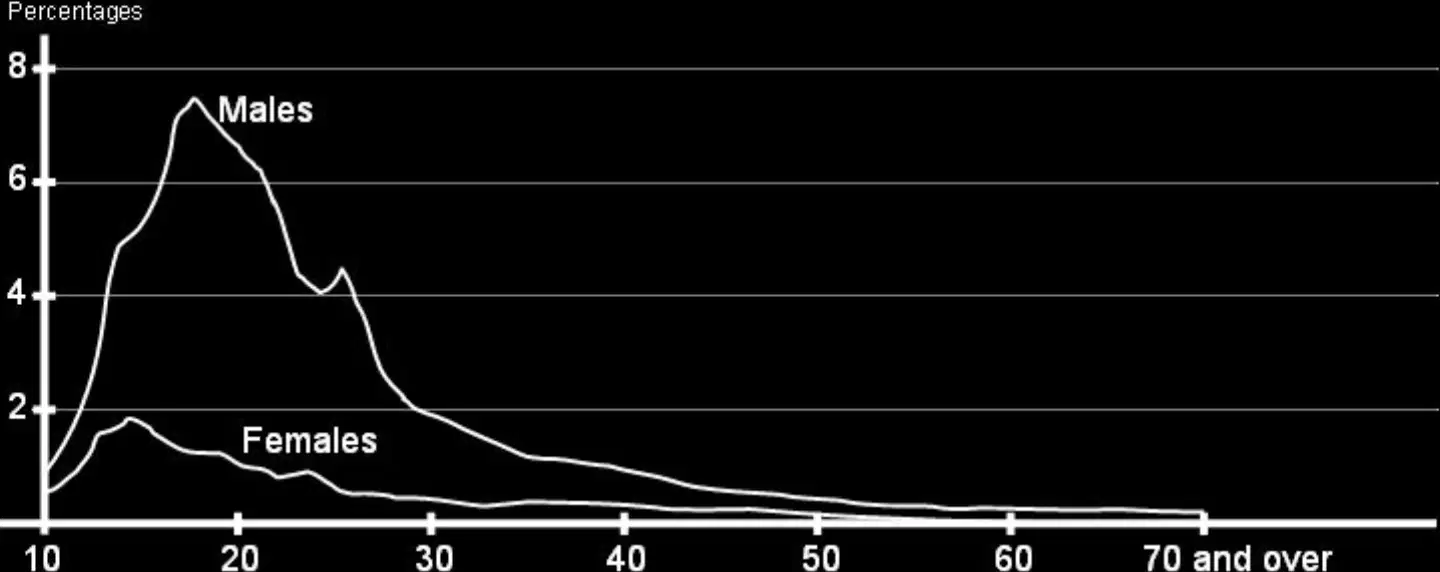
What trend is observed in the percentage of offenders for both males and females as age increases beyond 20 years?
The percentage increases steadily
The percentage remains constant
The percentage decreases
The percentage fluctuates randomly
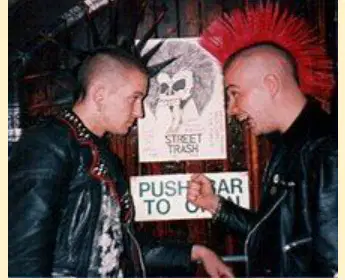
Which of the following behaviors was commonly associated with punks in the 1980s?
Outlandish clothing, drug use, and anti-social rowdy behavior
Formal attire and polite manners
Academic excellence and community service
Traditional family values and conservative behavior

Which youth culture quickly followed club culture in the 1990s?
Punk culture
Rave culture
Hip-hop culture
Grunge culture
Explain how the association between dance music and ecstasy led to a moral panic in the 1990s. Use evidence from youth culture trends of the time.
The popularity of dance music led to increased academic achievement.
The use of ecstasy at dance events resulted in teenage deaths, causing public concern.
Dance music events were strictly regulated, preventing any drug use.
Ecstasy was used only by adults, so there was no panic.
Explain how the theme of "knife culture" might influence the perception of youth crime in society. Use evidence or reasoning to support your answer.
It may lead to increased fear and stricter laws targeting young people.
It encourages more youth to participate in sports.
It reduces the rate of illegal drug use among youths.
It has no impact on society's perception of youth crime.

