
 Worksheets
Industrial Revolution Unit Exam review
Total questions: 20
Worksheet time: 10mins
Which 19th-century economic condition was the basis for the ideas of Karl Marx?
Capitalism contributed to a widening gap between the rich and the poor.
The availability of material goods increased.
Access to certain resources changed how goods were produced.
People left farms and moved to the cities in search of work.
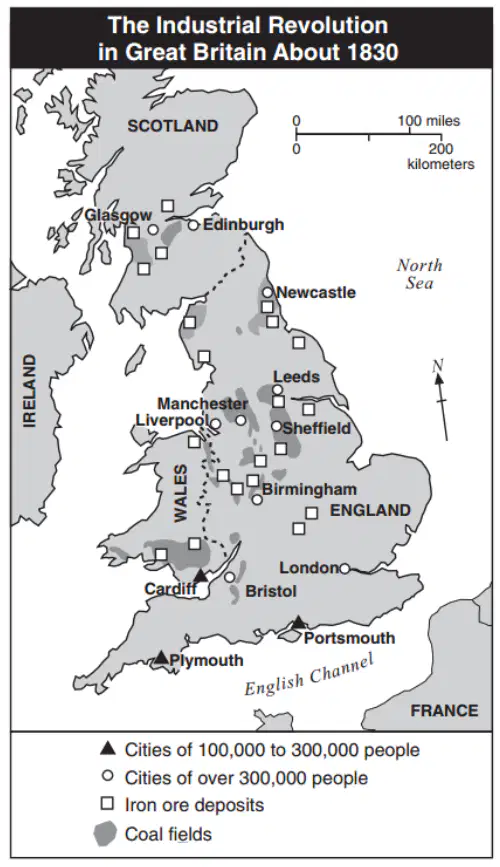
Base your answer to this question on the map and on your knowledge of social studies. Identify one cause of the historical development depicted in the map.
Socialist organizations promised land and a good wage to those who moved to industrial cities.
The British government paid people to move to cities.
Agricultural innovations made it easier for farmers to hire more people.
Coal powered steam engines powered factories that employed many people in England.
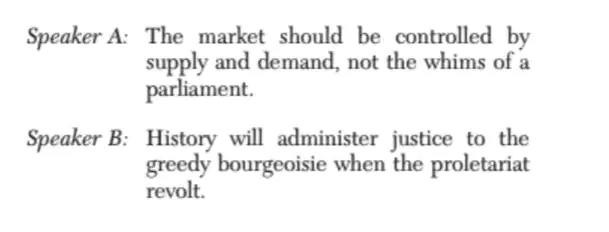
Speaker statements: Speaker A says, "The market should be controlled by supply and demand, not the whims of a parliament." Which type of economy is Speaker A most likely to support?
Laissez-faire
self-sufficient
barter
mixed
Which economic system is best characterized by these statements? Prices are determined by supply and demand. Governments have little involvement in economic decision making. Private ownership is the norm.
Capitalism
command
socialism
traditional

Identify the best use of this document for a historian. "I don't know how old I am. . . . I began to work when I was about 9. I first worked for a man who used to hit me with a belt. . . . I used to sleep in the pits that had no more coal in them; I used to eat whatever I could get; I ate for a long time the candles that I found in the pits. . . ." Source: E. Royston Pike, 1896, adapted from Hard Times, Human Documents of the Industrial Revolution from the NYS Global History and Geography Regents Exam, June 2005.
To determine why mine owners employed children.
To study the long term effects of working in mines on child labors
To find out how much money mine owners saved by hiring children rather than adults
To understand the conditions child laborers experienced
Which invention most contributed to the expansion of railroads during the Industrial Revolution?
Printing press
Spinning Jenny
Telegraph
Steam engine
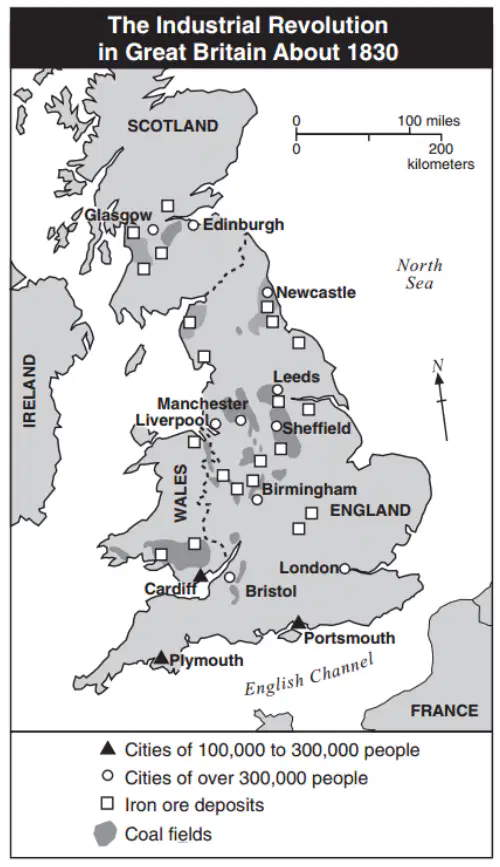
Base your answer to this question on the map and on your knowledge of social studies. Which conclusion is best supported by the information on the map?
England's natural resources led to the growth of industrial cities.
In 1830, England had an unfavorable balance of trade.
Great Britain's prosperity unified the people.
People emigrated from Great Britain because of pollution.
Which factor most contributed to the rapid growth of industrial cities in 19th-century England?
Abundant coal and iron resources
Strict government regulations
Widespread subsistence farming
Limited transportation networks
During the 1800s, reform legislation passed in Great Britain, France, and Germany led to
formation of zaibatsu, greater equality for men, and establishment of a banking system
legalizing trade unions, setting minimum wages, and limiting child labor
government-owned factories, establishment of five-year plans, and limits placed on immigration
bans on overseas trade, mandatory military service, and universal suffrage for women
Which was an effect of the Industrial Revolution?
Agricultural Revolution
Increased demand for goods
Natural resources
Rise of big businesses
What was a direct result of the Industrial Revolution in Europe?
a massive growth of cities
the rise of the manorial system
an increase in the use of the divine right theory of government
religions preaching the importance of the afterlife
What was one major reason factories were often built near rivers during the early Industrial Revolution?
Rivers prevented the spread of disease
Rivers marked the boundaries of cities
Rivers were used for religious ceremonies
Rivers provided a source of water power for machinery
What is one of the primary differences between a market economy and a command economy?
A command economy has less government control.
A command economy offers more consumer choices.
A market economy has less private ownership.
A market economy has more business competition.
Which social class expanded most as a result of industrialization in 19th-century Europe?
Nobility
Middle class
Clergy
Peasantry
Which statement best describes a feature of capitalism as practiced during the Industrial Revolution?
Equal distribution of wealth
Prices set by supply and demand
Central planning of the economy
Government ownership of all factories
What was one significant impact of child labor during the Industrial Revolution?
Improved educational opportunities for children
Decrease in factory production
Widespread health problems among young workers
Shorter working hours for adults
Which of the following was a major reason for the growth of urban populations during the Industrial Revolution?
Increased job opportunities in factories
Decline in international trade
Strict government control over city growth
Expansion of rural farming communities
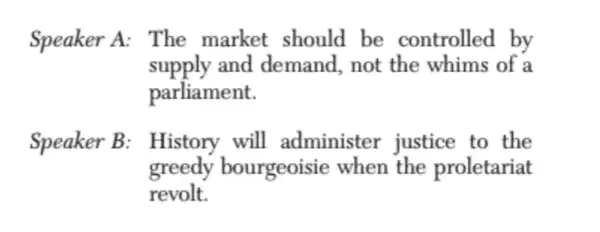
Speaker statements: Speaker B says, "History will administer justice to the greedy bourgeoisie when the proletariat revolt." Speaker B best represents the ideas of
Thomas Malthus
Robert Owen
Cecil Rhodes
Karl Marx
What was one major reason for the use of child labor in 19th-century factories?
Children could operate complex machinery
Children were paid higher wages than adults
Children had more education than adults
Children were seen as a cheap source of labor
Which of the following partly describes the problems of the industrial workers?
Their political control over parliament
Long working hours at low pay
Their control over the means of production and distribution of goods
They had too much break time

