
 Worksheets
Unit 4 and 5 Review (2025-26)
Total questions: 46
Worksheet time: 21mins
In what ways do the economies of Mexico and Brazil share similarities?
Both have mixed economies
Both are pure market economies
Both are pure command economies
Both are traditional economies
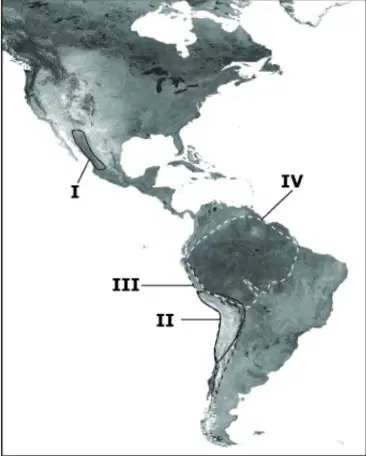
Sean is traveling throughout Latin America in order to see major geographic features of the region. He first plans to visit the Atacama Desert, before traveling to see the Amazon Rainforest, and finally ending his journey visiting the Sierra Madre Mountains.
Which answer choice represents the path Sean will be taking on his trip?
I
II
III
II
IV
I
III
II
IV
IV
III
II
Mexico charges a 35% tax on steel imported into the country. What is this an example of?
Import fee
Tariff
Embargo
Quota
Why do most people in Brazil live along the eastern coast?
To be close to the Amazon Rainforest
The long borders with other countries
The Tourism industry offers many economic opportunities
To avoid the cold climate in the north
Why might Brazil embargo trade with Cuba?
To improve political relations with Cuba
To force businesses in Brazil to increase their efficiency
To encourage Cuba to change its policies
To provide consumers in Brazil with access to more goods
Which of these causes the least air pollution in Mexico City?
Vehicle Emissions
Industrial activity
Desertification
Overcrowding
In what way does entrepreneurship help economic development the most?
Contributes to the public sector
Contributes to the private sector
Improves national literacy rates
Improves access to resources
Why does Mexico City have higher air pollution levels than other cities with similar population density?
Mexico City is surrounded by mountains that trap the air
Mexico City receives large amounts of precipitation every year
Mexico City has more cars and buses than other large cities
Mexico City engages in more industrial activity than other large cities
Did US citizens with investments in Cuba support the new Cuban government after the Cuban Revolution? Why or why not?
They were opposed to the new government. Cuba had nuclear missiles, which people in the United States feared the new government would use.
They supported the new government. The previous dictator was very unpopular and US citizens wanted Cuban citizens to enjoy a free democracy.
They supported the new government. The previous government taxed US sugar at a high rate and they hoped the new government would reduce taxes.
They were opposed to the new government. The new Cuban government took over private property in Cuba, including property owned by US citizens

Where would Mexico fall on the Economic Continuum?
X
Y
Z
Where would Cuba fall on the Economic Continuum?
X
Y
Z
Where would Brazil fall on the Economic Continuum?
X
Y
Z
How do command economies answer the three basic economic questions?
Private businesses control all economic resources and activities.
The government plans and controls all economic activities.
Consumers freely choose what to produce and sell.
The market determines all production and distribution decisions.
In Country X, the factors of production are all publicly owned and controlled by the government. The basic economic questions of what to produce, how to do so, and how to distribute goods are determined by Country X's government and not by market forces. Because they are set by central planners, prices do not signal to producers whether to increase or decrease production.
What kind of economy does Country X have?
The government's encouragement of entrepreneurship shows that Country X has a command economy.
The government's role in setting the prices of goods shows that Country X has a market economy.
The government's control of the factors of
production shows that Country X has a command economy.
The government's ownership of the factors of production shows that Country X has a market economy.
What type of government policy would make Cuba's economy more like Mexico's?
Imposing strict regulations on Cuban companies
Increasing barriers to trade with foreign countries
Easing restrictions on starting private businesses in Cuba
Placing major industries under the control of the government
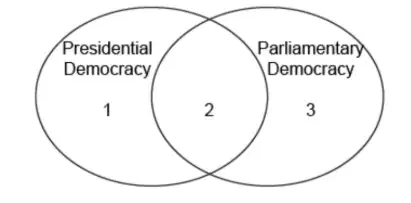
What belongs in section 3?
Citizens elect the head of government
Citizens elect members of the legislature
The legislature selects the head of government
The excutive and legislative branches are seperate
In which way are voting rights limited in Cuba?
Only the president is directly elected by citizens
Citizens must be over 18 years old to vote
Voters are only allowed to vote in national elections
All candidates come from one political party
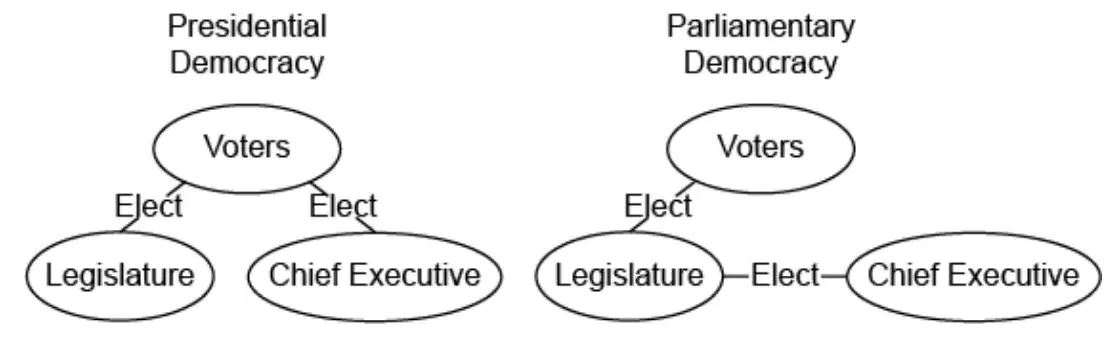
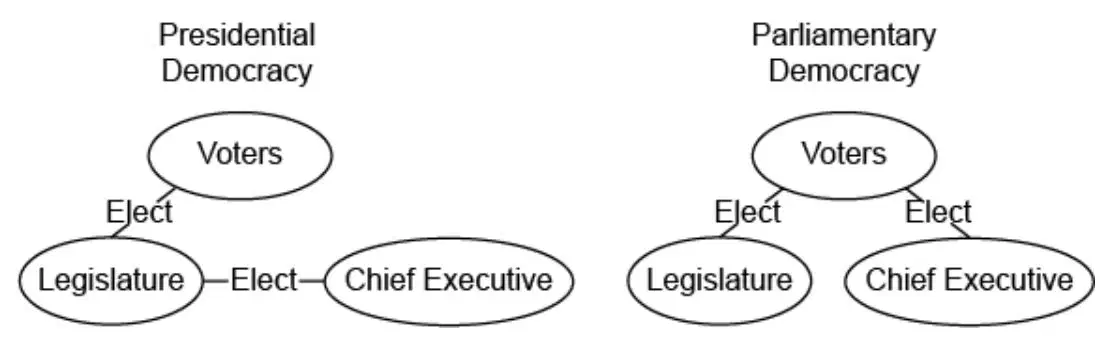
Which diagram represents the role of voters in parliamentary and presidential democracies?


In which type of government do citizens directly elect the leader of the national government?
Parliamentary autocracy
Parliamentary democracy
Presidential democracy
Presidential autocracy
What type of government has its Members of Parliament choose the leader?
Parliamentary autocracy
Parliamentary democracy
Presidential democracy
Presidential autocracy
Cuba does not allow freedom of choice in elections and only the Communist Party is permitted to exist. Cuba has a dictatorship in which power is held by one central authority.
What type of government would Cuba be classified as?
Federal
Democracy
Autocracy
In which type of government do citizens directly elect the leader of the national government?
Presidential democracy
Parliamentary democracy
Which diagram correctly represents the role of voters in parliamentary and presidential democracies?
Demand for which resource has greatly contributed to the destruction of the Amazon Rainforest?
Coal
Diamonds
Lumber
Oil
True or False: Cuba has the MOST influence in selecting their national leader
True
False
Why does the destruction of the Amazon Rainforest threaten the whole world?
The rainforest produces approximately a fifth of the world's oxygen
The deforestation contributes to drought in many countries
The rainforest prevents the spread of polluted air and water to other regions
The crops grown in the rainforest account for much of the world's food supply
How did the relationship between the United States and Cuba change during President Obama's time in office?
The countries become military allies
Cuba requested the US help to reform its government
US businesses were allowed to trade more with Cuba
The countries fought in battle for the first time in decades
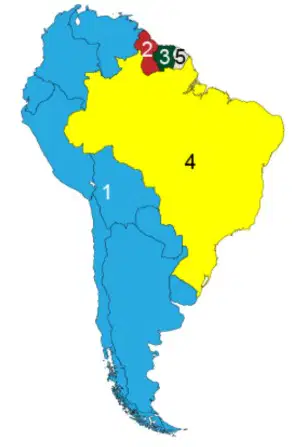
Based on your knowledge of Latin American languages, which region was colonized by the Portuguese?
1
2
3
4
5
What effect did the Columbian Exchange have on the indigenous people in Latin America?
It increased significantly due to the agricultural techniques introduced by European explorers.
It increased significantly due to the advanced medicines brought to the Americas from Europe.
It declined significantly due to the virulent
diseases introduced by European explorers.
It declined significantly due to the rapid
migration of people from the Americas to
Europe.
Which reason best explains why so many of Brazil’s biggest cities are on the coastline?
The Brazilian economy depends on overseas shipping and cities grew around the country's ports.
The majority of Brazil's territory is covered by desert and the only habitable areas are along the coast.
The majority of Brazil's territory is covered by rainforest and the only habitable areas are along the coast.
The Brazilian economy is dependent on coffee production and coffee plants grow best in a coastal climate.

Which country is located at numeral III ?
Cuba
Panama
Mexico
Colombia
The Panama Canal connects which two bodies of water?
the Caribbean Sea and the Atlantic Ocean
the Gulf of Mexico and the Atlantic Ocean
the Atlantic Ocean and the Pacific Ocean
the Arctic Ocean and the Pacific Ocean
What was a big effect of European colonization on South America in the sixteenth and seventeenth centuries?
Explorers returned to Europe with deadly
diseases.
The transatlantic slave trade rapidly grew in
volume.
Many world empires went bankrupt and
collapsed.
New World plants destroyed European
ecosystems.
How did the spread of disease in the Americas affect the transatlantic slave trade?
European diseases killed many of the people forced into slavery before they reached the Americas, leading to a decrease in the transatlantic slave trade.
Indigenous diseases killed many Europeans and caused them to abandon plantations in the tropics, leading to a decrease in the transatlantic slave trade.
Indigenous diseases killed many of the people that Europeans brought to the Americas as slaves, leading to an increase in the transatlantic slave trade.
European diseases killed much of the indigenous population that Europeans forced into slavery, leading to an increase in the transatlantic slave trade.

Based on the image and your knowledge of geography, which statements about Panama are false? Select all that apply
It is a gulf that seperates Costa Rica from South America
It is a cape that extends from Colombia into the Pacific Ocean
It is a narrow strip of land that connects North and South America
It is a peninsula that extends into the Pacific and Atlantic Oceans
It is an isthmus that lies between the Caribbean Sea and the Pacific Ocean
What did the fall of the Berlin Wall in 1989 symbolize?
The rise of the Fascist Party in German politics
The Soviet Union's loss of control in Eastern
Europe
The strength of command economies in
Eastern Europe
the influence of the Treaty of Versailles in
German politics
What factor helped the Bolshevik Communists gain power in Russia?
The United States supported the goals of the Bolsheviks and provided them with money and weapons.
The Russian Republic surrendered in World War I but the people of Russia wanted to continue the fight.
The Russian people were suffering because of World War I and wanted to end the war.
The tsar supported the Bolsheviks and the Russian people followed the will of the tsar.
In Ali's country, a king or queen is the head of state. Any head of state must be a member of the royal family, but they have little real power. Ali votes for the political party that he favors in each year's election, and these elections determine who will serve in the legislature. The legislature then appoints the head of government.
Based on this information, what is MOST LIKELY true about Ali's country?
It is an absolute monarchy and a democracy
It is a constitutional monarchy and a democracy
It is an absolute monarchy and an autocracy
It is a constitutional monarchy and an autocracy
Which three language groups do the primary languages spoken in modern Europe fall into?
Celtic, Basque, Turkic
Hellenic, Afro-Asiatic, Dravidian
Semitic, Indo-Iranian, Uralic
Germanic, Romance, Slavic
How has the European Union promoted trade?
By creating a common currency
By nationalizing major European industries
By eliminating quotas on all foreign imports
By eliminating tariffs on trade between members
Based on its geography, what does international trade with the United Kingdom (UK) rely on the MOST?
Airports
Railways
Seaports
Highways
What contributes the MOST to heavy smog in London, England?
Agricultural runoff
clear-cutting forests
Automobile emissions
Slash and burn farming

Which numeral represents the Alps?
I
II
III
IV
Label the physical features in the correct place
Danube
Mediterranean Sea
Pyrenees
The Alps
Rhine
Ural Mountains
English Channel
Iberian Peninsula
European Plain
Country 1 and Country 2 are trading partners.
Which type of good should Country 1 specialize in producing?
goods for which there is a higher supply in
Country 1 than there is in Country 2
goods for which there is a higher demand in
Country 2 than there is in Country 1
goods for which the monetary cost of
production is lower in Country 2 than it is
Country 1
goods for which the opportunity cost of
production is lower in Country 1 than it is
Country 2
How do investments in technology impact a nation's economy?
by contributing to an increase in consumer spending and a rise in gross domestic product
by contributing to greater efficiency in
production and a rise in gross domestic product
by contributing to greater income inequality and a decrease in gross domestic product
by contributing to an increase in scarcity and
a decrease in gross domestic product

