
Font size
 Worksheets
Test Prep ELA 5th
Total questions: 80
Worksheet time: 2hrs 40mins
I cringed when I heard her drag her nails on the chalkboard.
His reaction to the news was not good. He started to cry.
My mother rejected the job in Columbia, because she got a better job in Camdenton.
Food was plentiful on Thanksgiving. There was so much to eat that we lots of food leftover.
Football is a very physical sport. There's running, kicking, throwing and tackling.
Let's barter at lunch. I'll take your cupcake for these two cookies.
I bought this hat from the peddler in the park.
You paid $6,000 for a TV? That's an exorbitant amount of money! You could have bought a quality TV for under $1,000.
This alarm clock is broken. It's worthless.
She needs to write her name on the soccer ball with a permanent marker, so it doesn't rub off.
Let's design a playroom that can store all of our toys. Then Dad can build it.
His parents hired a magician to do magic tricks at the party for everyone's amusement.
Since she didn't show up to the dress rehearsal, she didn't know what to do on the day of the performance.
Plants won't grow unless they get an adequate amount of water. If you give them too much water or too little water, they may die.
You should brainstorm many solutions to your problem. That way, if one doesn't work, you'll have more solutions to try.
He went to the store, so he could exchange the shirt for another size that fit.
She found some real bargains at the shoe store. Everything was so cheap!
She likes to browse the toy aisles at Target to discover any new toys she should add to her wish list.
It looks like he hastily got dressed for school this morning. His socks don't match and he forgot to brush his hair.
Bananas are an important product farmed in Guatemala.
It was a frigid winter night; even the lake was frozen solid.
What is the definition of frigid and the type of context clue used?
cold
synonym
definition
long
What do you think the capitalized word means in the following sentence? He felt so ANXIOUS about the test that he chewed on three pencils and continually tapped his fingers on his desk.
happy
wonderful
nervous
shy
The rambunctious kids ran out of the bus and climbed on board. They jumped and yelled and just couldn’t settle down.
What is the definition and the context clue in this passage?
synonym
antonym
full of energy
shy
The teacher's face, like a brightly glowing summer day, signaled her feelings of contentment.
What does CONTENTMENT mean?
annoyance
happiness
fearlessness
expression
“No, no that didn’t literally happen,” she said. “I was speaking figuratively.”
What is the meaning of "literally"?
exact
to guess
imaginary
true
Cherry pie made Leon ecstatic; on the other hand, blueberry cake made him feel sad.
In this sentence, 'ecstatic' means:
overly lonely
quite tired
especially jumpy
very happy
The annual bazaar is scheduled for the last day of school. It’s always a fun festival.
What type of context clue is used to help define festival?
synonym
definition
antonym
example
This painting of the landscape is picturesque, while one of the old houses is just plain ugly.
What is the meaning of the word picturesque?
ugly
beautiful
neat
attractive
“That charlatan!” he cried “That absolute fake!”
What does "charlatan" mean and what type of context clue is used?
synonym
honest
fake or phony
antonym
The feral cat would not let us pet him, unlike our friendly cat.
What does "feral" mean?
friendly
hostile
hotel
unfriendly
Brady tried to QUELL the rumors about his illness, but they continued.
What is the meaning of the word in all caps?
Stop
Begin
Change
Spread
My friend and I will PART company after dinner. I won't see him until he returns from vacation. What does the word "part" mean in this sentence?
separate
actor's role in a play
piece
a line where hair is combed in different directions
When it came to jumping rope, Jenny excelled; she was very talented at sports.
What does EXCELLED mean?
she did well
she was sloppy
she made progress
she was not talented
We had our doubts about the new member of our team; and yet, she surpassed our expectations at every turn.
In this sentence, 'she surpassed our expectations' means that:
She did better than our expectations
She met our expectations
she made progress in our expectations
she didn't meet out expectations
What do you think the capitalized word means in the following sentence?
Kelly's grandmother was so FEEBLE she couldn't walk well or get out of bed much.
happy, overjoyed
frail, weak
determined
strong
Sue discovered that her favorite dress, which she had hung out to dry on a clothesline, had fallen and become bedraggled in the mud.
What does BEDRAGGLED mean?
small and helpless
smooth and colorful
limp and dirty
fresh and clean
What is a person or animal which takes part in the action of a story called?
Setting
Plot
Character
Narrator
The time and location in which a story takes place:
Plot
Setting
Conflict
Characterization
What is the sequence of events involving characters and a central conflict called?
Setting
Plot
Character
Conflict
All events leading up to the climax?
Exposition
Resolution
Falling action
Rising action
All events after the climax and leading to the resolution?
Exposition
Resolution
Falling action
Rising action
The most exciting part of the story is called the _________. The height of tension or emotion/action.
Setting
Exposition
Climax
Rising action
The underlying meaning or message about life of a story is called the ______________.
Theme
Mood
Plot
Setting


True or False: Theme and Main Idea are the same thing.
True
False
What is a metaphor?
A figure of speech that compares two unlike things without using 'like' or 'as'.
A type of analogy that uses 'like' or 'as' for comparison.
A literary device that exaggerates for emphasis.
A phrase that describes something in a literal sense.
What is a point of view?
The perspective from which a story is told.
A character's opinion about another character.
The setting of a story.
The main conflict in a narrative.
What does 'summarize' mean?
To write in shorter form, focusing on the most important parts of the text.
To elaborate on every detail of the text.
To translate the text into another language.
To critique the text and provide personal opinions.
What is a plot?
The sequence of events that make up a story.
A character's emotional journey throughout the narrative.
The underlying message or moral of the story.
The setting and time period in which the story takes place.
What is a simile?
A figure of speech that compares two unlike things using 'like' or 'as'.
A type of metaphor that uses 'than'.
A phrase that describes something in a literal sense.
A rhetorical question that does not require an answer.
What does 'explains' mean?
To make clear or understandable to others.
To confuse or mislead someone.
To provide a brief summary of a topic.
To ignore or overlook details.
What is a setting in a story?
The main character's journey throughout the plot.
The time and place in which the story occurs.
The conflict that drives the narrative forward.
The moral lesson learned by the characters.
What is an author's purpose?
To inform, entertain, or persuade
To summarize a text
To analyze characters
To critique a literary work
What is the central idea in a passage?
The main theme or subject of the passage.
The most important or central thought of the passage.
A summary of the passage's events.
The author's opinion on the topic.
What is an inference?
A conclusion reached based on evidence and reasoning.
A random guess without any basis.
A statement that cannot be proven.
An assumption made without evidence.
When choosing your test answer, you should...
Play eeny meeny miny moe
Read every possible answer carefully, the best one could be the last
Always go for the first answer choice
Make sure it is not the same letter choice as the answer before
When a question is difficult, what should you do?
Look for key words that will give you clues to finding the right answer
Eliminate answers you know are not correct
Always read words that are in BOLD, italics, and underlined carefully
All of the above
If you don't know a word in a question, what do you do?
Ask the teacher
Become a detective and look for a clue
Skip it, it won't matter
Ask your friend
Author's tone refers to...
an author's background information
an author's perspective or attitude about a topic
an author's writing style
an author's choice of text structure(s)
When you are reading a text you should
Write down important notes
Skim it
Write down everything it says
Stop every paragraph for a break
A list of difficult or unusual terms, with definitions, found at the back of a book.
Title
Glossary
Index
Heading
The main point or meaning the author is trying to explain in the story.
Main idea
Character
Setting
Plot
This contains the title of the book, publisher, and author.
Glossary
Map
Title Page
Index
A relationship between actions or events where something causes something to happen.
Character
Cause and effect
Photograph
Compare and Contrast
This gives facts, evidence, details, and other information that support a topic.
Supporting details
Introduction
Plot
Characters
To look for similiarities
Contrast
Central Message
Cause and effect
Compare
To look for differences
Contrast
Inference
Compare
Main idea
Imaginary stories that are entertaining.
Fiction
Nonfiction
Nonfiction writing that is meant to inform.
opinion writing
informational writing
These help readers understand nonfiction (graphs, photos, timelines, and captions)
opinion writing
informational writing
summary
text features
A person, place, or thing that acts as a subject of a sentence
setting
key detail
character
noun

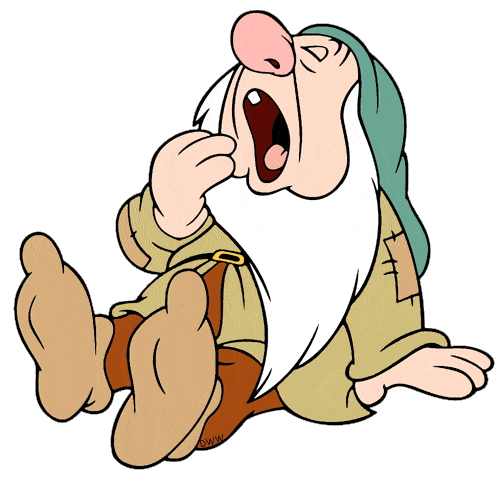
What is a synonym for tired?

