
 Worksheets
Cells and Life Test
Total questions: 20
Worksheet time: 10mins
Name
Class
Date
1.
In plants cells, carry out functions related to storage and support.
a)
Ribosomes
b)
Vacuoles
c)
Mitochonria
d)
Golgi apparatus
2.
All living things are made up of one or more cells.
a)
True
b)
False
3.
It surrounds and protects the cell and controls what enters and leaves the cell. This statement describes:
a)
cell membrane
b)
mitochondira
c)
ribosome
d)
Golgi apparatus
4.
All of the following are principles of the cell theory EXCEPT:
a)
the cell is the smallest unit of life
b)
water is the main ingredient in every cell
c)
all new cells come from preexisting cells
d)
all living things are made of one or more cells
5.
Which organelle packages proteins into vesicles to transport from one area of a cell to another?
a)
Golgi apparatus
b)
chloroplasts
c)
mitochondrion
d)
rough endoplasmic reticulum
6.
Which of these have prokaryotic cells?
a)
snails
b)
frogs
c)
bacteria
d)
mice
7.
Materials enter and leave the cell through its ___.
a)
organelles
b)
DNA
c)
membrane
d)
chromatin
8.
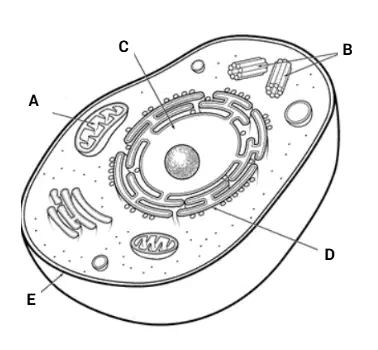
In the animal cell shown, structure A is the site where _______occurs.
a)
power
b)
cellular respiration
c)
nothing
9.
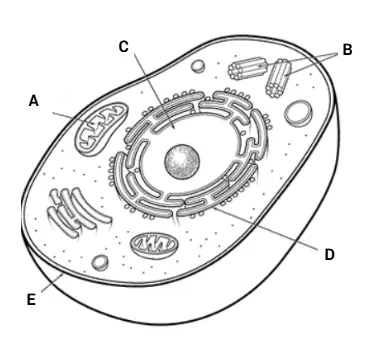
In the animal cell shown, structure C is the , the organelle that directs the cell's activities.
a)
nucleus
b)
endoplasmic reticulum
c)
cell membrane
10.
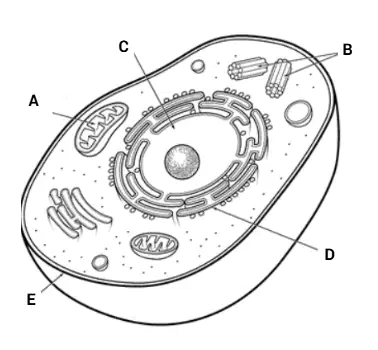
In the animal cell shown, structure E is the , which controls what enters and leaves the cell.
a)
nucleus
b)
endoplasmic reticulum
c)
cell membrane
11.
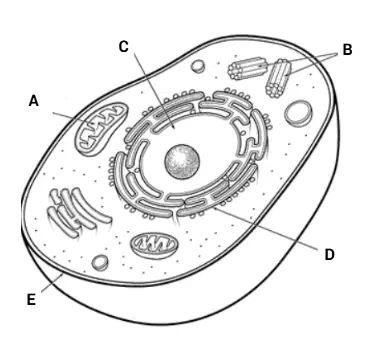
In the animal cell shown, structure D is the , which plays a role in protein production.
a)
nucleus
b)
endoplasmic reticulum
c)
cell membrane
12.
The nucleus directs all the activities of the cell and contains DNA.
a)
True
b)
False
13.
In what organelles do many of the chemical reactions of cellular respiration occur?
a)
mitochondria
b)
chloroplasts
c)
vacuoles
d)
vesicles
14.
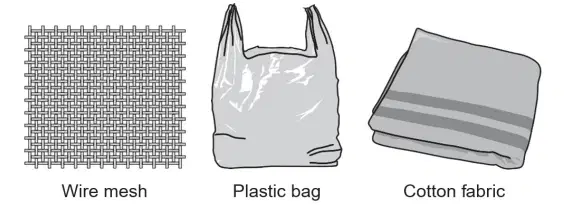
Kate is making a model of a plant cell. The pictures show three materials she can use to make the cell wall: a piece of wire mesh, a plastic bag, and some cotton fabric. Identify the material that is most appropriate for making a model of a cell wall.
a)
wire mesh- firm but allows things in and out of cell
b)
plastic bag- makes a good seal and does not allow things in and out
c)
cotton fabric- will allow liquids in and out, flexible
15.
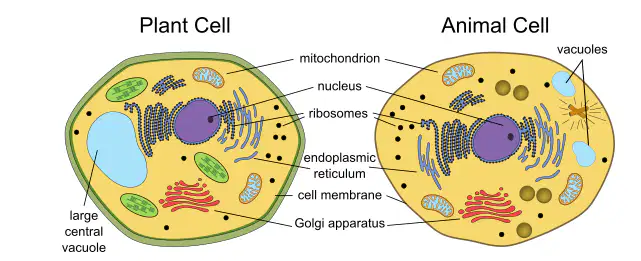
The cell wall is a rigid structure that surrounds plant cells. The materials found in the cell wall protect the plant cells and give plants structural support.
Which conclusion can be made given the above information?
a)
The structure of a cell organelle is directly related to its function.
b)
The functions of most cell organelles are hindered by their structures.
c)
The structures of different types of cell organelles are similar.
d)
The function of a cell organelle can change over time.
16.
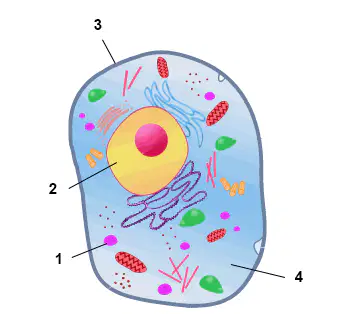
The diagram below shows the structure of an animal cell. What is structure 2, and how does it help sustain life?
a)
Structure 2 is a mitochondrion, which produces energy for the cell.
b)
Structure 2 is a chloroplast, which is the site of photosynthesis.
c)
Structure 2 is the cell membrane, which controls what enters and leaves the cell.
d)
Structure 2 is the nucleus, which serves as the control center of the cell.
17.
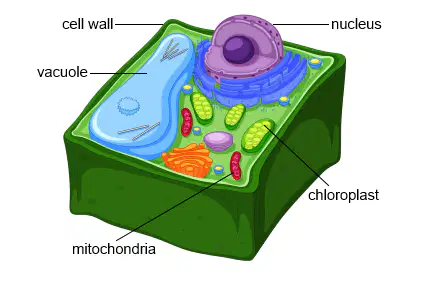
The image below shows a model of a plant cell.
All cells need energy to live. How do the organelles in the plant cell above work together to get and use this energy?
a)
Mitochondria take in food from the environment, and the nucleus breaks down this food to release its energy to the cell.
b)
The nucleus makes energy from materials in the cell, and the vacuole stores this energy until the cell needs to use it.
c)
The vacuole takes in energy from the environment, and chloroplasts change this energy into a form the cell can use.
d)
Chloroplasts make food using energy from the Sun, and mitochondria break down this food to release energy for the cell.
18.
Which of the following is a main difference in cell structure between an onion cell and a human cheek cell?
a)
An onion cell has a cell wall.
b)
A human cheek cell contains chloroplasts.
c)
There is no difference between an onion cell and a human cheek cell.
d)
An onion cell contains one nucleus, whereas a human cheek cell contains two nuclei.
19.
Liz is examining a plant cell under a microscope. She sees many small green structures inside the cell. Her teacher explains that the process of photosynthesis takes place inside these structures. What type of structure is Liz looking at?
a)
mitochondrion
b)
nucleus
c)
chloroplast
d)
cell wall
20.
Muscle cells make up muscle tissues, which are attached to each other and to bones. The main function of muscle cells is to move body parts and organs. They do this by contracting and relaxing, which changes the length and shape of the cells. This process uses several proteins and requires a lot of energy. Which is the best prediction about the cell structures of muscle cells?
a)
Muscle cells have a large volume of cytoplasm so that the cell can easily change shape.
b)
Muscle cells contain a large number of mitochondria in order to provide more energy.
c)
Muscle cells are surrounded by cell walls so that they are strong enough to move bones.
d)
Muscle cells do not have nuclei because they do not need to produce proteins.
100 %

