
NEW
Font size
 Worksheets
Patterns of Natural Selection
Total questions: 22
Worksheet time: 59mins
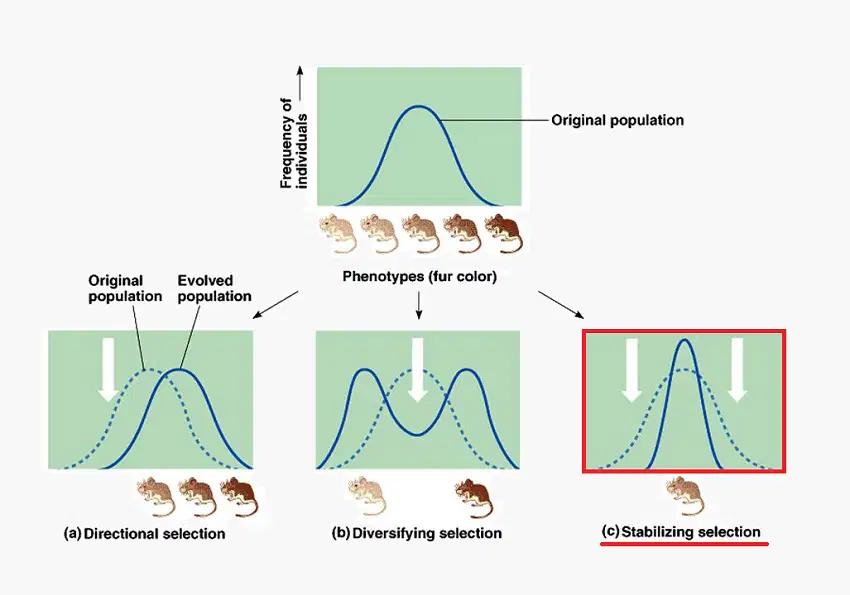
Define stabilizing selection by choosing the most accurate description.
Natural selection that favors intermediate variants and reduces extremes within a population
Natural selection that favors one extreme phenotype and shifts the population mean
Natural selection that simultaneously favors both extreme phenotypes over intermediates
Random changes in allele frequencies due to chance events

Define directional selection by choosing the most accurate description.
Natural selection that favors intermediate phenotypes over extremes
Natural selection that favors one extreme phenotype, causing a consistent shift in the population
Natural selection that favors both extremes equally, producing a bimodal distribution
Change in allele frequency due only to migration between populations
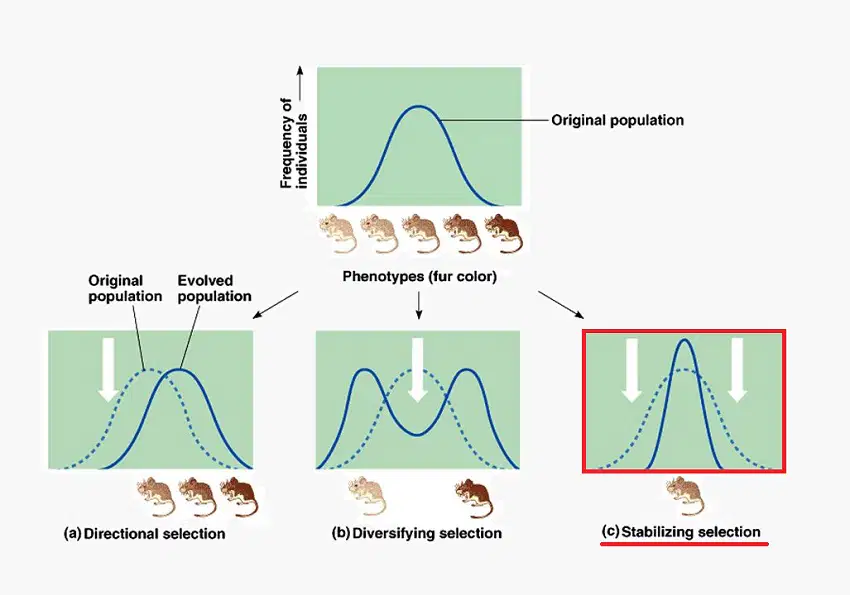
Which of the following is true for Diversifying selection?
Selection that reduces genetic variation by eliminating all extremes and causes extinction of the species.
Selection that favors both extreme phenotypes while selecting against intermediate phenotypes leading to a new species.
Selection that favors a single extreme phenotype and moves the mean and leads to three new species.
Selection that increases heterozygosity through random mating and prompts natural selection of the species.
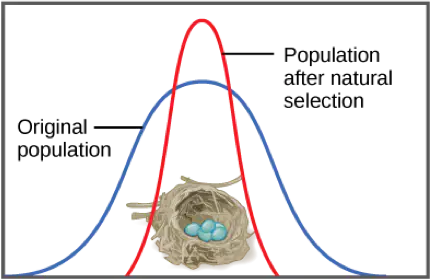
Write the correct type of selection (Diversifying, Directional, or Stabilizing). Starlings produce an average of five eggs in each clutch; clutches with more than five cannot be fed adequately and clutches with fewer than five are more vulnerable to predation, so five becomes the most common clutch size.
Diversifying selection
Directional selection
Stabilizing selection
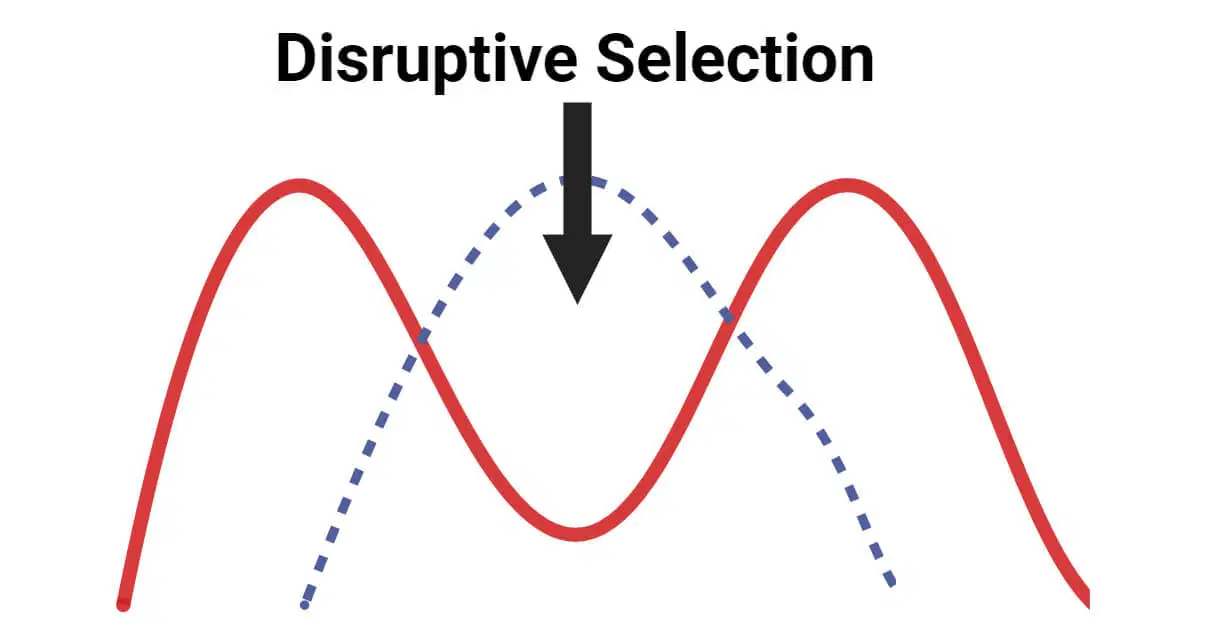
Write the correct type of selection (Diversifying Directional, or Stabilizing). Seed cracker birds have either large beaks or small beaks; medium beaks do not allow adequate cracking of seeds, so mediums are rare.
Diversifying selection
Directional selection
Stabilizing selection
Write the correct type of selection (Diversifying, Directional, or Stabilizing). In an oak population, acorns with a 2 cm circumference are most common and survive; very small (1 cm) and very large (3 cm) acorns are rare and do not persist.
Diversifying selection
Directional selection
Stabilizing selection
Write the correct type of selection (Diversifying, Directional, or Stabilizing). Lizards with small heads cannot eat the largest cockroaches and prey on smaller sizes instead; over time, lizards with larger heads survive better.
Diversifying selection
Directional selection
Stabilizing selection
Write the correct type of selection (Diversifying, Directional, or Stabilizing). Female birds laying close to the optimum number of eggs have the most surviving offspring; laying fewer or more reduces fitness.
Diversifying selection
Directional selection
Stabilizing selection
Write the correct type of selection (Diversifying, Directional, or Stabilizing). During a drought, only large, thick seeds are available; birds with large, thick beaks survive while small-beaked birds do not.
Diversifying selection
Directional selection
Stabilizing selection
Write the correct type of selection (Diversifying, Directional, or Stabilizing). In a rocky environment with white and black rocks, black rabbits (BB) and white rabbits (bb) survive because they are able to camouflage in the environment, while intermediate gray rabbits (Bb) do not survive well.
Diversifying selection
Directional selection
Stabilizing selection
Write the correct type of selection (Diversifying, Directional, or Stabilizing). Small lizards die because they cannot defend territories, and large lizards are eaten by owls; medium-sized lizards survive.
Diversifying selection
Directional selection
Stabilizing selection
Write the correct type of selection (Diversifying, Directional, or Stabilizing). Very large human babies lead to labor complications and very small babies tend to be underdeveloped; medium-sized babies are most likely to survive to adulthood.
Diversifying selection
Directional selection
Stabilizing selection
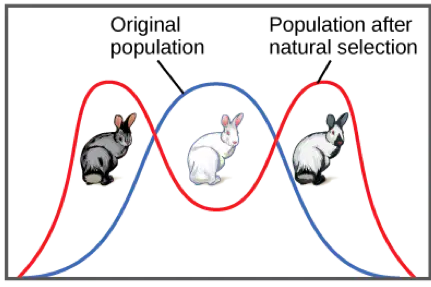
Label the type of selection shown by the graph. The post-selection distribution splits into two peaks at both extremes, leading to creation of two new species, while the intermediate values are reduced.
Stabilizing selection
Directional selection
Disruptive (Diversifying selection)
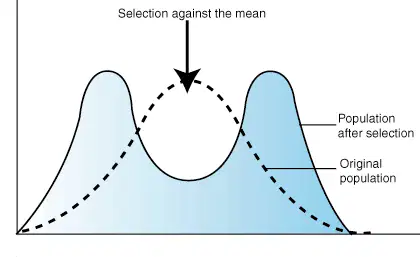
Read the scenario and identify the type of natural selection it illustrates: Seed cracker birds have either large beaks or small beaks; they do not have medium sized beaks because medium sized beaks do not allow for adequate cracking of seeds.
Stabilizing
Directional
Disruptive (Diversifying)
Read the scenario and identify the type of natural selection it illustrates: A scientist measures the circumference of acorns in a population of oak trees and discovers that the most common circumference is 2 cm. There are very few acorns with circumferences of 3 cm or 1 cm because only the 2 cm circumference acorns survive.
Stabilizing
Directional
Disruptive (Diversifying selection)
Read the scenario and identify the type of natural selection it illustrates: A population of Madagascar hissing cockroaches lives in a woodpile and is eaten by lizards. Because the lizards have small heads, they are unable to eat the very largest adult cockroaches and instead prey upon small and medium sized adults. Over time, larger-headed lizards have a survival advantage.
Stabilizing
Directional
Disruptive (Diversifying selection)
Label the type of selection represented by the graph described: The original population is a single peak, while the new distribution splits into two peaks on opposite extremes with low frequency in the middle.
Stabilizing selection
Directional selection
Disruptive (Diversifying) selection

Wild boars prefer to eat cacti with fewer spines and therefore cacti with fewer spines are eaten in greater quantity. Cacti with a more spines are more likely to survive, reproduce, and pass down their genes to the next generation. Which type of selection is occurring?
directional selection
disruptive (diversifying) selection
artificial selection
stabilizing selection
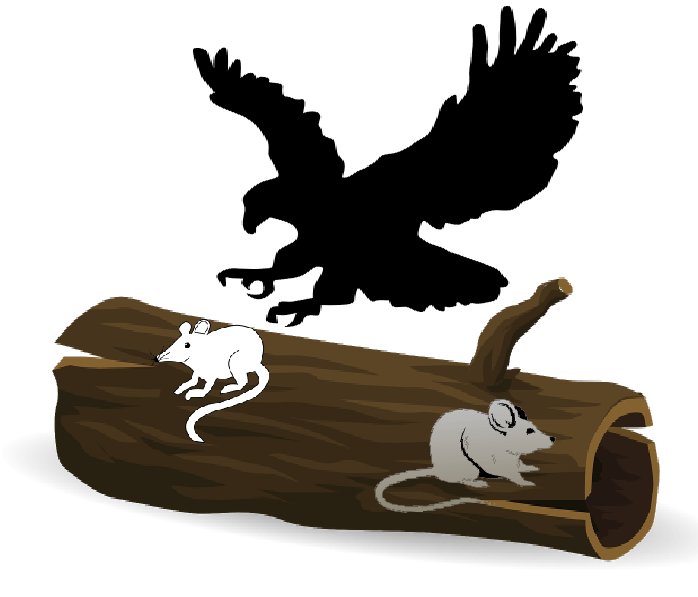
Over the years, white mice became extinct and darker mice survived. This is
stabilizing selection
directional selection
disruptive (diversifying) selection
due to exercise
Which of the following is true for natural selection?
It eliminates all genetic variation from a population.
It only occurs in artificial environments created by humans.
It acts on heritable traits, favoring individuals with higher fitness in a given environment.
It always leads to the creation of new species in a single generation.
What is the main purpose of adaptations in living organisms?
To decrease their lifespan
To increase their size
To help them survive and reproduce in their environment
To make them more colorful
Which adaptation would most likely help a desert plant conserve water?
Thin stems
Bright flowers
Deep root system
Large, broad leaves

