
 Worksheets
Sample Exam 5 answers
Total questions: 29
Worksheet time: 15mins
In an analysis of the nucleotide composition of DNA, which of the following is true?
A = C
A = G and C = T
A + C = G + T
A + T = G + C
Both B and C are true.
catalyzes synthesis of a new strand of DNA
D. DNA polymerase
A. Ligase
B. Helicase
C. Primase
Refer to the following list of enzymes to answer the following two questions. The answers may be used once, more than once, or not at all. A. helicase B. nuclease C. ligase D. DNA polymerase E. primase 3. enhances separation of DNA strands during replication
A. helicase
B. nuclease
C. ligase
D. DNA polymerase
What is the primer that is required to initiate the synthesis of a new DNA strand?
RNA
DNA
protein
ligase
primase
A new DNA strand only elongates in the 5' to 3' direction because
DNA polymerase begins adding nucleotides at the 5' end.
Okazaki fragments prevent elongation in the 3' to 5' direction.
the polarity of the DNA molecule prevents addition of nucleotides at the 3' end.
replication must progress toward the replication fork.
DNA polymerase adds nucleotides only to the free 3' end.
What is the primary transcript of eukaryotic genes?
hnRNA
tRNA
rRNA
mRNA
DNA
A particular triplet of bases in the coding region of DNA is AGT. The corresponding codon for the mRNA transcribed is
AGT.
UCA.
TCA.
AGU.
either UCA or TCA, depending on wobble in the first base.
A portion of the genetic code is UUU = phenylalanine, GCC = alanine, AAA = lysine, and CCC = proline. Assume the correct code places the amino acids phenylalanine, alanine, and lysine in a protein (in that order). Which of the following DNA sequences would substitute proline for alanine?
AAA-CGG-TTA
AAT-CGG-TTT
AAA-CGG-TTT
AAA-GGG-TTT
AAA-CCC-TTT
What are the coding segments of a stretch of eukaryotic DNA called?
introns
exons
codons
replicons
transposons
All of the following are directly involved in translation except
mRNA.
tRNA.
ribosomes.
DNA.
amino acid-activating enzymes.
A particular triplet of bases in the coding sequence of DNA is AAA. The anticodon on the tRNA that binds the mRNA codon is
TTT.
UUA.
UUU.
AAA.
either UAA or TAA, depending on wobble in the first base.
What are ribosomes composed of?
two subunits, each consisting of rRNA only
two subunits, each consisting of several proteins only
both rRNA and protein
mRNA, rRNA, and protein
mRNA, tRNA, rRNA, and protein
As a ribosome translocates along an mRNA molecule by one codon, which of the following occurs?
The tRNA that was in the A site moves into the P site.
The tRNA that was in the P site moves into the A site.
The tRNA that was in the P site moves to the E site and is released.
The tRNA that was in the A site departs from the ribosome.
Both A and C are correct.
Which of the above is analogous to a frameshift mutation?
THERATATETHECAT
THETACATETHERAT
THECATARETHERAT
THECATATTHERAT
CATATETHERAT
Which of the above is analogous to a single substitution mutation?
THERATATETHECAT
THETACATETHERAT
THECATARETHERAT
THECATATTHERAT
CATATETHERAT
A frameshift mutation could result from
a base insertion only.
a base deletion only.
a base substitution only.
deletion of three consecutive bases.
either an insertion or a deletion of a base.
Which of the following is a characteristic of all viruses?
nucleic acid genome
a protein capsid
glycoprotein cell wall
A and B only
A, B, and C
What does the operon model attempt to explain?
the control mechanism of gene expression in bacteria
bacterial resistance to antibiotics
how genes move between homologous regions of DNA
the mechanism of viral attachment to a host cell
horizontal transmission of plant viruses
Transcription of the structural genes in an inducible operon
occurs all the time.
starts when the pathway's substrate is present.
starts when the pathway's product is present.
stops when the pathway's product is present.
does not produce enzymes.
In a nucleosome, what is the DNA wrapped around?
polymerase molecules
ribosomes
mRNA
histones
nucleolus protein
Gene expression can be controlled by
alternative splicing.
mRNA degradation.
translation initiation.
protein processing and degradation.
all of the above.
Plasmids are important in biotechnology because they are
a vehicle for the insertion of recombinant DNA into bacteria.
recognition sites on recombinant DNA strands.
surfaces for protein synthesis in eukaryotic recombinants.
surfaces for respiratory processes in bacteria.
proviruses incorporated into the host DNA.
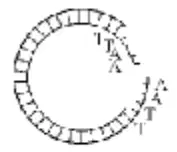
Which enzyme was used to produce the molecule in Figure 20.1?
ligase
transcriptase
a restriction enzyme
RNA polymerase
DNA polymerase
Restriction enzymes are endonucleases that cut DNA at an internal sequence, called the recognition sequence, that is specific for each restriction enzyme. The restriction enzyme often give staggered cuts on the double-stranded DNA, leaving stick ends, overhanging single-stranded regions. Two DNA molecules cut with the same restriction enzyme can come together (hybridize) through base pairing. From the list above, which of the following is the most logical sequence of steps for splicing foreign DNA into a plasmid and inserting the plasmid into a bacterium?
A) I, II, IV, III, V
B) II, III, V, IV, I
C) III, II, IV, V, I
D) III, IV, V, I, II
E) IV, V, I, II, III
After being digested with a restriction enzyme, DNA fragments are separated by gel electrophoresis. Specific fragments are then identified through the use of a
plasmid.
restriction enzyme.
sticky end.
nucleic acid probe.
RFLP.
The polymerase chain reaction is important because it allows us to
insert eukaryotic genes into prokaryotic plasmids.
incorporate genes into viruses.
make DNA from RNA transcripts.
make many copies of a targeted segment of DNA.
insert regulatory sequences into eukaryotic genes.
27) ________ separates molecules by movement due to size and electrical charge
D. gel electrophoresis
A. chromatography
B. centrifugation
C. distillation
28) ________ seals the sticky ends of restriction fragments to make recombinant DNA
C. DNA ligase
A. DNA polymerase
B. RNA ligase
D. Restriction enzyme
In recombinant DNA methods, the term vector can refer to
the enzyme that cuts DNA into restriction fragments.
the sticky end of a DNA fragment.
a RFLP marker.
a plasmid used to transfer DNA into a living cell.
a DNA probe used to identify a particular gene.

