
 Worksheets
Unit 2B Assessment: Food and Agriculture 25-26
Total questions: 20
Worksheet time: 30mins
Agricultural practices, where the members of a farming family produce only enough food for themselves and do not make use of large-scale irrigation, chemical fertilizer, or machinery and technology is called?
traditional agriculture
subsistence agriculture
organic farming
industrial agriculture
The decline of Peregrine falcons in the United States due to the use of DDT is an example of?
biological magnification
bioaccumulation
genetic resistance
biological resistance
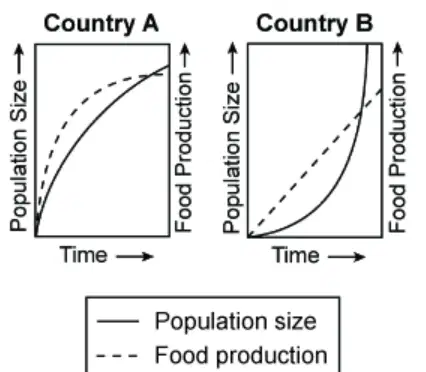
The graphs below show the population size and food production as a function of time for two different countries. Based on the graphs, which prediction will most likely happen?
Country A will always produce more food per person than Country B.
The birth rate in Country A will be higher than that in Country B.
Neither Country A nor Country B will survive without food imports from other countries.
The population of Country A will survive longer than that of Country B without the need for food imports.
If pesticide from a farm runs off into Lake Michigan, which organism in the lake’s food chain would test highest for the pesticide?
macroinvertebrates (shrimp)
zooplankton (microscopic animals)
perch (fish)
fish eaters (birds)
The main cause of undernutrition is
a shift from eating grains to eating processed foods
lack of access to adequate nutritional guides
poverty
unsanitary cooking of food
Which of the following is an example of a genetically modified crop?
tall rice that has been bred with short rice to produce a denser Medium sized rice
the most drought tolerant corn plant is singled out of a crop for cloning propagation
tomatoes contain a soybean’s gene for disease resistance.
potatoes that have developed low tolerance to fertilizer after repeated applications
Which of the following methods are currently being used to increase livestock yields?
administering antibiotics and hormones
establishing outdoor, free roaming farms
increasing domesticated animal varieties
instituting water-quality laws for livestock factories
A potential benefit of genetic engineering is the development of crop plants
resistant to viral diseases, drought, heat, or herbicides.
with genes that can spread to wild relatives of crop plants.
that contain no allergens.
that require sunlight and water to grow.
Industrialized agriculture’s increased use of pesticides over the past years is resulting in
fewer insects and weeds developing resistance to pesticides.
more insects and weeds developing resistance to pesticides.
more beneficial microorganisms in the soil
more biodiversity of fish and other aquatic organisms not affected by the pesticides.
An individual who is overnourished
probably lives in a rural area of a developing country
will have pronounced muscle tone and accelerated skeletal growth.
has an increased likelihood of obesity, diabetes, and heart disease.
has a protein deficiency even though adequate calories are consumed.
Which of the following best describes why many people in the world go hungry?
Food production hasn't increased as fast as the human population
There is plenty of food produced for everyone to have almost enough, but it is not distributed equally.
In recent years, the human population has been growing, while food production has been falling
Global warming has contributed to crop failures
The ____ Revolution was a time in history where we began to transition to more of an industrial agricultural society by introducing the use of fertilizers, pesticides, and heavy machinery to assist with farming.
Green
Farming
Crop
Livestock
A condition that occurs when people do not consume enough calories or nutrients from their food.
Livestock
Undernourishment
Overnourishment
Genetically modified
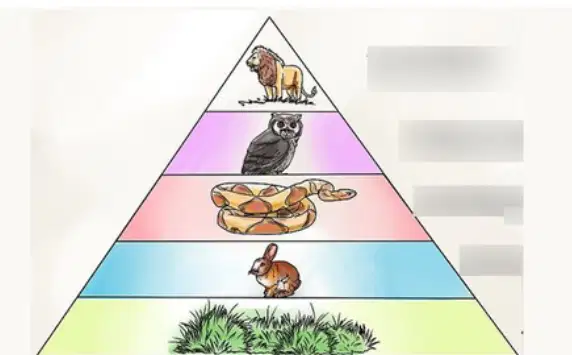
The grass at the base of this food web absorbs 10 units of a heavy metal toxin from the soil. Each Rabbit eats 10 grass plants. Each Snake eats 10 rabbits. Each Owl eats 10 snakes. The Lion eats 10 owls. What is the total number of toxin units accumulated in the Lion's body?
10,000 units
1,000 units
1,000,000 units
100,000 units
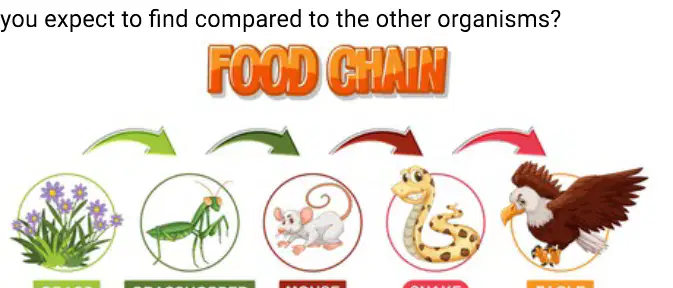
If you measured the pesticide levels in the Grass, what would you expect to find compared to the other organisms?
It would have zero pesticide because plants cannot absorb chemicals.
It would have the lowest concentration because it is at the bottom of the food chain.
It would have the same concentration as the insects.
It would have the highest concentration because it absorbs the spray directly.
Which of the following correctly distinguishes the primary purpose of fertilizers from that of pesticides in industrial agriculture?
Fertilizers are used to kill unwanted weeds, while pesticides are used to kill insects.
Fertilizers are added to the soil to replenish nutrients and boost plant growth, while pesticides are used to destroy organisms that damage crops.
Fertilizers prevent soil erosion, while pesticides increase the nutrient density of the food produced.
Fertilizers are used to genetically modify crops for higher yields, while pesticides are used to irrigate the land.
Food insecurity is best described as:
A lack or shortage of consistent access to sufficient, safe, and nutritious food.
The availability of only processed foods.
A fear of trying new foods.
A condition where food is available but too expensive to export.
Which of the following is NOT a negative impact of pesticide use?
promotion of pesticide resistance in insects
Harmful to wildlife
Pollution
toxic to insects
Which of the following is NOT a problem associated with industrial agriculture?
soil erosion
depletion of fossil fuels
habitat fragmentation
none, these are all problems associated with industrial agriculture
The Green Revolution marked a transition toward industrial agriculture. Which statement correctly contrasts subsistence agriculture with industrial agriculture in terms of who consumes the food and the dependence on external inputs such as fossil fuels, chemicals, or machinery?
Subsistence agriculture primarily feeds the farming family and uses low external inputs, while industrial agriculture produces for mass markets and relies on high external inputs.
Subsistence agriculture mainly produces for export markets and uses high external inputs, while industrial agriculture is mainly for household consumption and uses low external inputs.
Both subsistence and industrial agriculture primarily feed the farmer’s household and both rely on low external inputs.
Subsistence agriculture primarily feeds mass markets and depends on heavy machinery, while industrial agriculture mainly feeds the farmer’s family and uses minimal inputs.

