
 Worksheets
Barther: World History Midterm Exam
Total questions: 69
Worksheet time: 38mins
Name
Class
Date
1.
In the 16th and 17th centuries, the heliocentric theory became the centerpiece of debate between:
a)
capitalism and communism
b)
science and religion
c)
colonialism and nationalism
d)
isolationism and globalism
2.
The new scientific method of the fifteenth and sixteenth centuries relied on:
a)
"natural philosophers."
b)
direct observation and experiment.
c)
Greek thinker Aristotle.
d)
scientific knowledge that already existed
3.
What did Isaac Newton discover about the universe?
a)
the universe was small and chaotic
b)
the universe was held together by an invisible force that made everything run in a particular order
c)
light was the key to man's existence
d)
Newton discovered the ice planet Hoth
4.
Examine the following statements and choose the statement that best embodies Enlightenment ideology.
a)
The purpose and justification of government is that people need to be controlled.
b)
The most efficient form of government is monarchy.
c)
Government planned economies produce economic stability and prosperity.
d)
All people are born with natural rights and are equal before the law.
5.
The origins of the Enlightenment can be traced to the initial questioning of figures of religious authority that began during the following period.
a)
The Reformation
b)
The American Revolution
c)
The Scientific Revolution
d)
The Industrial Revolution
6.
Use the following quotation to answer the next question.
. . . all men are by nature equally free and independent, and have certain inherent rights, of which when they enter into a state of society, they cannot, by any compact, deprive or divest their posterity; namely, the enjoyment of life and liberty, with the means of acquiring and possessing property, and pursuing and obtaining happiness and safety.—Virginia Declaration of Rights, 1776
a)
John Locke
b)
Thomas Hobbes
c)
Beccaria
d)
Jean-Jacques Rousseau
7.
The English philosopher John Locke argued that life, liberty, and property are:
a)
natural rights that should be protected
b)
political rights to be granted as determined by law
c)
economic rights earned in capitalistic system
d)
social rights guaranteed by ruling class
8.
The Enlightenment encouraged people to use ______________________ to solve social, economic, and political problems.
a)
faith and hope
b)
government
c)
reason and science
d)
magic
9.
Enlightenment philosophers such as John Locke and Jean-Jacques Rousseau challenged the idea of the divine right of kings. They wrote about a government’s obligations to uphold people’s rights and how the should be based on the consent of the governed.
These new ideas encouraged people to…
a)
remain firm in the support of absolute monarchs
b)
look for leaders who would exercise dictatorial powers
c)
engage in revolutions to establish democratic governments
d)
call for church leaders to take control
10.
The purpose of separating the power of government into three branches is to
a)
make government more efficient
b)
protect the people from any one branch of government becoming too powerful
c)
strengthen the monarchy
d)
promote freedom
11.
Which philosopher's ideas were the basis for this quotation from the First Amendment of the U.S. Bill of Rights?
"Congress shall make no law respecting an establishment of religion, or prohibiting the free exercise thereof; or abridging the freedom of speech, or of the press; or the right of the people peaceably to assemble, and to petition the government for a redress of grievances." -Amendment I of the US Bill of Rights
a)
Charles-Louis Montesquieu
b)
Jean-Jacques Rousseau
c)
John Locke
d)
Voltaire
12.
How did Diderot's Encyclopedia reflect the age of the Enlightenment?
a)
It collected, examined and spread new ideas urging people to learn and reason.
b)
It argued that Hobbes was correct and that people need to be controlled.
c)
It argued that mankind is generally wicked and needs structure
d)
It argued that the enlightened despots were correct and should be followed without question.
13.
In what ways were the Enlightened Despots less than true reformers?
a)
They didn't allow salons or the reading of Diderot's Encyclopedia in their nation.
b)
They wouldn't give up complete power or complete reforms such as abolishing serfdom.
c)
They refused to allow the Bill or Rights to become a part of their country's documents.
d)
They allowed all of the reforms suggested by the philosophes to become law.
14.
If so much of the U.S. Constitution can be found in European ideas, why were the framers of the U.S. Constitution so important?
a)
The framers of the U.S. Constitution created the ideas found in the Constitution and were not influence by European thinkers who were still governed by monarchs.
b)
The framers of the Constitution took the ideas of different thinkers in different times and combined them into a new and unique way of thinking about government, which the U.S. Constitution represents.
c)
The U.S. Constitution creates specific European inspired articles that govern the United States; however, the underlying philosophy was created by the framers of the Constitution.
d)
The Enlightenment may have influenced the Bill or Rights; however, there was no Enlightenment influence on the Articles of the Constitution.
15.
Use the following information to answer the question below.
Natural Rights Philosophy Emphasizes individual rights to life, liberty and property.
What document best exemplifies the natural rights philosophy described above?
a)
The Communist Manifesto
b)
Plato’s Republic
c)
Luther’s Ninety-five Theses
d)
The Declaration of Independence
16.
Use the quotation and your knowledge of world history to answer the question.
" We the People of the United States, in order to form a more perfect Union, establish Justice, insure domestic Tranquility, provide for the common defense, promote the general Welfare, and secure the Blessings of Liberty to ourselves and our Posterity, do ordain and establish this Constitution of the United States of America."
Preamble, Constitution of the United States of America
All of the following are stated objectives of the Constitution except:
a)
justice
b)
liberty
c)
defense
d)
prosperity
17.
Mary Wollstonecraft, in her essay, "A Vindication of the Rights of Women," argues that women:
a)
should receive an equal education as men and should enter the fields of medicine and politics.
b)
should be grateful to the Enlightenment philosophes for arguing for equality.
c)
should focus on natural rights, home and family.
d)
were recognized as equals by the Enlightenment philosophes and welcomed their new role in politics.
18.
One way in which Robespierre and Louis XVI of France are similar is that both:
a)
were removed from power during the French Revolution;
b)
adopted ideas of the Congress of Vienna;
c)
implemented policies of religious tolerance;
d)
decreased government control of the economy
19.
Maximilien Robespierre and the Jacobins are best known for:
a)
instituting the Reign of Terror;
b)
protecting freedom of religion;
c)
supporting the reign of King Louis XVI;
d)
sending French troops to fight in the American Revolution
20.
Which issue was a cause of the French Revolution?
a)
ineffective rule of Napoleon Bonaparte;
b)
nationalization of the Church;
c)
outrage over the use of the guillotine by the Committee of Public Safety;
d)
demand of the Third Estate for more political power
21.
This event is most closely associated with the French Revolution:
a)
Council of Trent;
b)
Thirty Years’ War;
c)
Reign of Terror;
d)
Paris Peace Conference
22.
This event related to the French Revolution occurred first:
a)
Napoleon became emperor of France;
b)
The Declaration of the Rights of Man was issued;
c)
Louis XVI called the Estates General into sessions;
d)
The Committee of Public Safety led the Reign of Terror.
23.
One way in which Robespierre and Napoleon are similar is that they both:
a)
played an important role at the Congress of Vienna;
b)
increased their power during the French Revolution;
c)
were executed for treason by French monarchs;
d)
led armies against the Haitians
24.
Under the Old Regime in France, the burden of taxation fell mostly on the:
a)
Monarchy;
b)
Nobles;
c)
clergy;
d)
Commoners
25.
One major effect of Napoleon's rule of France was that it led to:
a)
an increase in the power of the Roman Catholic Church;
b)
massive emigration to the Americas;
c)
trade agreements with Great Britain;
d)
a restoration of political stability
26.
A major cause of the French Revolution:
a)
economic success of mercantilism;
b)
failure of the Congress of Vienna;
c)
Continental System of Europe;
d)
inequalities in the tax structure
27.
Which factors protected Russia from control by Napoleon’s army?
a)
religious and cultural similarities;
b)
industrialization and modernization;
c)
geographic size and location;
d)
political and economic instability
28.
Before the French Revolution, the people of France were divided into three estates based mainly on their:
a)
education level;
b)
social class;
c)
geographic region;
d)
religious beliefs
29.
Which list of French leaders is in the correct chronological order?
a)
Louis XVI, Napoleon, Robespierre;
b)
Robespierre, Napoleon, Louis XVI;
c)
Louis XVI, Robespierre, Napoleon;
d)
Napoleon, Louis XVI, Robespierre
30.
The French people supported Napoleon Bonaparte because they hoped he would:
a)
adopt the ideas of the Protestant Reformation;
b)
restore Louis XVI to power;
c)
provide stability for the nation;
d)
end British control of France
31.
In France, which was a major result of the French Revolution?
a)
The King was restored to unlimited power;
b)
The clergy dominated government;
c)
The middle class gained political influence;
d)
The tax burden was carried by the lower classes
32.
The French bourgeoisie supported the French Revolution mainly because they:
a)
believed in the theory of divine right of kings;
b)
were not allowed to own property under the Old Regime;
c)
resented their lack of political power under the Old Regime;
d)
wanted a communist form of government
33.
Which country does Napoleon invade that ultimately destroys a large percentage of his army?
a)
Russia;
b)
Great Britain;
c)
Spain;
d)
Prussia
34.
Why did the Parisian people storm the Bastille on 14th July, 1789?
a)
The Bastille held the leaders of the French revolution and the people wanted to free them.
b)
The people hoped to find hoarded ammunition in the Bastille.
c)
The people wanted to demolish the fortress and sell its stone fragments.
d)
The Bastille was a symbol of the Old Regime, and the King’s authority
35.
An Absolute Monarchy most closely resembles
a)
Dictatorship
b)
democracy
c)
republic
d)
socialist nation
36.
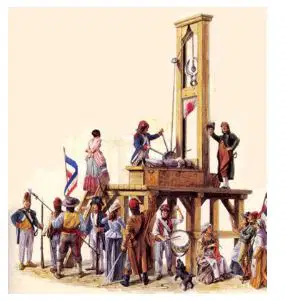
Use the primary source below to answer this question.
What time period in the French Revolution unit is this drawing most likely representing?
a)
Napoleonic Rule
b)
Reign of Robespierre
c)
Reign of Louis XVI
d)
Reign of Marie Antoinette
37.
The need for gunpowder and weapons led to:
a)
The Storming of the Bastille
b)
The Declaration of the Rights of Man
c)
The riots of 1791
d)
War with Austria/Prussia
38.
King Louis XVI left Versailles for Paris when his palace was surrounded by:
a)
Nobles demanding greater privileges
b)
Peasants demanding voting rights
c)
Soldiers demanding higher wages.
d)
Women demanding bread
39.
Which of the following contributed to the French Revolution:
a)
The theory of the divine right of kings.
b)
The theory of the Mandate of Heaven
c)
The ideas of the Enlightenment
d)
d.None of the above
40.
Which was NOT a reason for the French Revolution?
a)
debt from wars including helping in America
b)
the Enlightenment ideas like education, liberty, and equality
c)
Economic inequalities
d)
new, fairer tax laws
41.
This original legislative assembly of the estates, the ____________________ disbanded when the National Assembly was formed
a)
King's Court
b)
Estates-General
c)
National Assembly
d)
Parisian Parliament
42.
The major goal of the French Revolution was
a)
To execute the king
b)
To free the people of Europe
c)
The abolition of slavery
d)
Create a more democratic government
43.
Chronology–Decide which event in each pair happened first and mark it
a)
Louis XVI is executed
b)
Fall of Bastille
44.
Chronology–Decide which event in each pair happened first and mark it
a)
Napoleon invades Russia
b)
Battle of Waterloo
45.
Chronology–Decide which event in each pair happened first and mark it
a)
Napoleon is exiled to Elba
b)
Louis XVI calls the Estates General
46.
Chronology–Decide which event in each pair happened first and mark it
a)
American Revolution begins
b)
French Revolution begins
47.
Chronology–Decide which event in each pair happened first and mark it
a)
Enlightenment begin
b)
French Revolution begins
48.
The first factories developed in what industry?
a)
textiles
b)
coal mining
c)
iron manufacturing
d)
agriculture
49.
During the Industrial Revolution, life changed in what basic way?
a)
People migrated from villages to work on large farms
b)
People migrated from rural areas to cities for jobs
c)
People migrated from cities to small towns
d)
People moved from Europe to the US
50.
One effect of this invention was that textile factories no longer needed to be located near rivers. Another effect was that factories could operate even when a nearby river was frozen over.
Which invention is described in the information?
a)
cotton gin
b)
steam engine
c)
flying shuttle
d)
spinning jenny
51.
This nation’s transition to an industrial economy beginning in the 1700s caused it to be nicknamed “The Workshop of the World.” This nation developed inventions that greatly helped produce goods.
Which nation does the information describe?
a)
France
b)
Germany
c)
Great Britain
d)
United States
52.
Use the information in the list to answer the question.
Technological Innovations in Farming
• Seed drill
• Rotherham plow
• Dr. Patrick Bell’s reaping machine
What effect did these innovations have on England during the Agricultural Revolution?
a)
Farm sizes decreased as less land was needed to grow crops.
b)
People left cities to become farmers as the work became easier.
c)
Pollution increased as more machines were used to harvest fields.
d)
City populations increased as fewer people were needed to work farms.
53.
Which factor BEST explains why the Industrial Revolution started in Great Britain?
a)
fertile land
b)
a large population
c)
an abundance of coal
d)
location by the ocean
54.
Use the list below to answer the question.
• 1764—Spinning jenny
• 1785—Power loom
These inventions contributed to which economic development?
a)
increased agricultural efficiency
b)
mass production of goods
c)
higher demand for skilled workers
d)
faster transportation of products
55.
Which change is MOST closely associated with the Industrial Revolution?
a)
the use of currency to conduct trade
b)
the rise of artisan guilds to produce goods
c)
the transition from an urban population to rural population
d)
the transition from household production to mass production
56.
What was one result of the Industrial Revolution?
a)
Cottage industries were established to meet consumer needs.
b)
Subsistence farming increased to meet the needs of workers.
c)
Manufacturing industries created a demand for urban laborers.
d)
Regulations for a safe working environment slowed production.
57.
Which three nations belonged to the Triple Entente?
a)
Italy, Serbia, Russia
b)
Russia, France, Great Britain
c)
Germany, A-H, Greece
d)
Germany, A-H, Italy
58.
Which three nations belonged to the Triple Alliance?
a)
Italy, Serbia and Russia
b)
Russia, France and Great Britain
c)
Germany, Austria-Hungary and Greece
d)
Germany, Austria-Hungary and Italy
59.
What event sparked the start of WWI?
a)
The declaration of war by Germany on Austria
b)
The assassination of Franz Ferdinand
c)
The death of Kaiser Wilhelm
d)
The overthrow of Nicholas II
60.
This describes the land between the opposing trenches.
a)
nowhere land
b)
nothing land
c)
death trap land
d)
no mans land
61.
Which is a true statement about life in the trenches?
a)
It was not as bad as reported
b)
Exposed to the weather, dirty, lice filled, rat infested and very deadly
c)
They were exposed to the weather but there were few casualties
d)
Casualties were high but only when attempting to carry out the Schlieffen Plan
e)
62.
The scramble for land outside of Europe was one of the causes of tension between the powers of Europe. This was called __________________________.
a)
Imperialism
b)
Militarism
c)
Nationalism
d)
Alliances
63.
How could Germany be considered the aggressor at the onset of WWI?
a)
Germany declared war on France attempting to us their Schlieffen Plan
b)
Germany only declared war when they were challenged first
c)
Germany was only following Austria's lead
d)
Germany issued an ultimatum to Serbia
64.
Franz Ferdinand was the heir to the throne of what nation?
a)
France
b)
Germany
c)
Austria-Hungary
d)
Russia
65.
Which was NOT a cause of WWI?
a)
Alliances
b)
Imperialism
c)
Militarism
d)
Nuclear Weaponry Build Up
66.
The United States was heavily involved in the fighting in WWI during its first two years?
a)
True
b)
False
67.
Match the person to the invention
a)
Jethro Tull
1.
seed drill
b)
James Hargreaves
2.
Spinning Jenny
c)
Richard Arkwright
3.
Water Frame
d)
Samuel Crompton
4.
Spinning Mule
e)
Edmund Cartwright
5.
Power Loom
68.
Match theEnlightened thinker with the correct idea
a)
Hobbes
1.
Social Country Theory
b)
Locke
2.
Natural Rights
c)
Rosusseau
3.
all men ar created equal
d)
Beccaria
4.
No tortur
e)
Montesquieu
5.
Separation of Powers
69.
Match the words to the definitions
a)
Land, Labor, Capital
1.
Factors of Production
b)
process that stemmed from wealthy landowners buying farms
2.
Enclosures
c)
Large buildings with machines
3.
Factory
d)
Process that maintained soil nutrients
4.
Crop Rotation
e)
Person who organizes, manages, and takes on the risk of a business
5.
Entrepreneur
100 %

