
 Worksheets
Prioritizing Traffic, Bandwidth, Congestion, Delay, and Jitter
Total questions: 87
Worksheet time: 44mins
Which statement best explains why devices queue packets during high traffic volumes?
To store packets until bandwidth becomes available
To prevent headers from being encapsulated correctly
To increase jitter for real‑time applications
To ensure low priority traffic always transmits first
What immediate effect does packet queuing have on new incoming packets?
It causes additional delay before transmission
It increases available bandwidth on the link
It reduces serialization time on the wire
It eliminates propagation delay across the path
When a device's memory fills due to excessive queued packets, what occurs?
Packets are dropped by the device
Packets are re‑prioritized to high queue
Bandwidth is automatically increased
Jitter is removed from the stream
Which QoS technique helps manage congestion by separating traffic types?
Classification into multiple queues
Random header compression
Automatic speed matching
Propagation path rerouting
Network bandwidth is measured in what unit?
Frames per minute on a port
Bytes per day across networks
Bits per second on a link
Packets per hour through routers
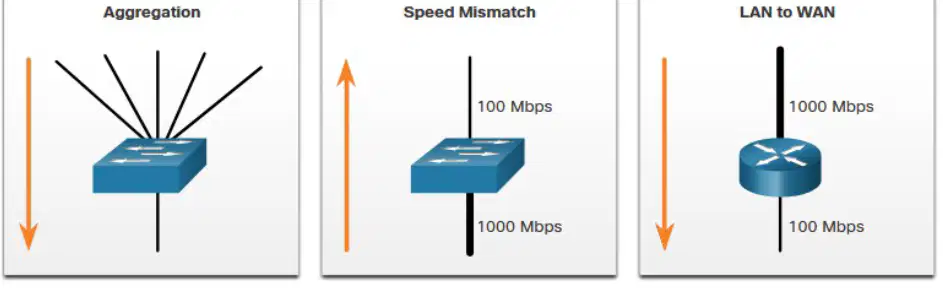
Which situation typically creates a congestion point requiring QoS?
Absence of delay across the path
Idle memory with no queued packets
Use of identical speed on both ends
Aggregation of many flows into one interface
In a speed mismatch, which description fits the cause of delay?
No traffic on either interface
Equal speeds on both interfaces
Slower interface sending to faster interface
Faster interface sending to slower interface
Which statement correctly defines jitter in networking?
Fixed time to encapsulate headers
Total time a bit stays on media
Amount of data sent per second
Variation in packet delay over time
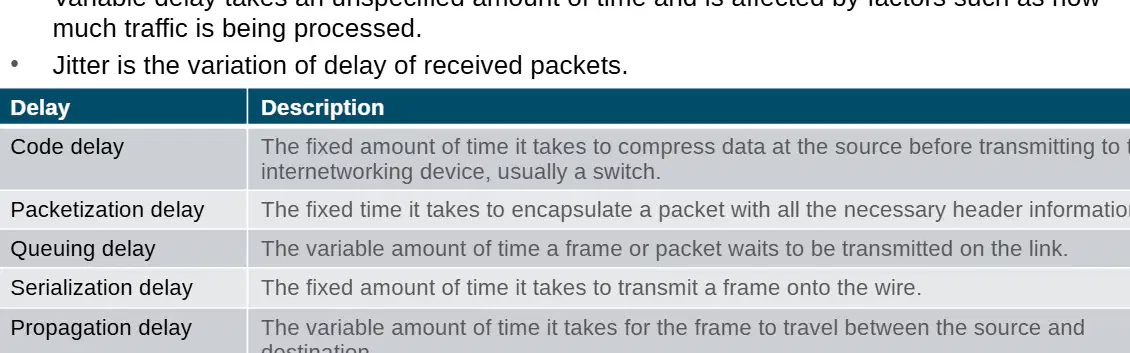
Which delay type is fixed and occurs when placing a frame onto the wire?
De‑jitter delay at the buffer
Queuing delay within a device
Serialization delay on the interface
Propagation delay across the path
Which delay type varies because packets wait before transmission on a link?
De‑jitter delay at evenly spaced send
Packetization delay at encapsulation
Code delay at compression
Queuing delay during congestion
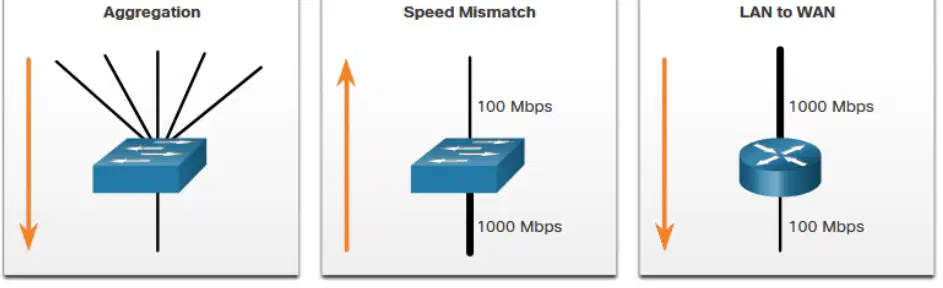
A LAN to WAN connection often causes congestion because:
WAN rate is always higher than LAN rate
No aggregation occurs on the WAN
Both sides operate at identical speeds
Higher LAN rate feeds lower WAN rate

Which process adds headers to create a transmittable packet and has fixed delay?
Packetization at the source device
Propagation across the medium
Queuing within memory buffers
Aggregation across multiple links
Which statement best describes packet loss impact on time-sensitive traffic like VoIP?
It improves throughput by reducing congestion
It has minimal effect on perceived audio quality
It causes dropouts and degraded real-time streams
It only affects non–time-sensitive bulk data
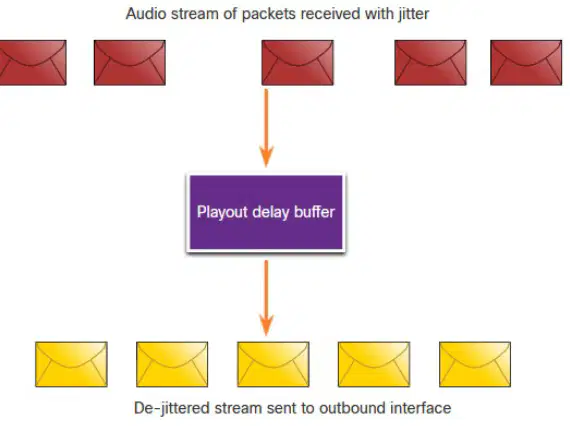
In VoIP using RTP, what role does a playout delay buffer primarily serve?
Encrypts audio frames for secure transport
Compensates for jitter by smoothing playback
Reorders packets to prioritize data traffic
Amplifies audio to counteract low volume
Which component can interpolate missing audio when a small number of packets are lost?
Simple Network Management Protocol
Routing table processor
Digital Signal Processor (DSP)
Network Interface Controller
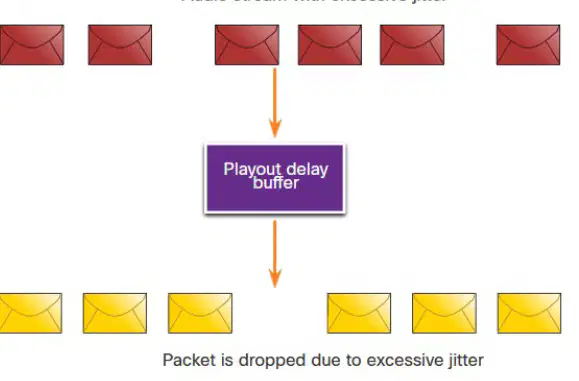
A VoIP call experiences excessive jitter beyond buffer range. What outcome is most likely?
DSP fully reconstructs perfect audio
Out-of-range packets are discarded causing dropouts
Packets are delayed but all still audible
RTP retransmits all lost voice packets
Which protocol carries the digital audio stream in typical VoIP implementations?
Internet Control Message Protocol
Simple Mail Transfer Protocol
Real-Time Protocol (RTP)
Transmission Control Protocol
Why should a properly designed network aim for near-zero packet loss for real-time traffic?
Loss increases compression efficiency
Loss undermines intelligibility and continuity
Loss reduces jitter within buffers
Loss improves DSP interpolation accuracy
You are tuning a playout delay buffer for a VoIP gateway. Which change is most appropriate to mitigate moderate jitter without increasing latency excessively?
Disable buffering entirely for immediate playback
Set a small, fixed buffer to smooth timing
Increase packet retransmission attempts
Use very large buffer to hold many seconds
A user reports brief audio glitches during calls. Network metrics show occasional single-packet losses with normal jitter. What is the most plausible reason audio remains mostly clear?
RTP automatically fills missing data
DSP interpolation masks tiny losses
TCP retransmits voice frames instantly
QoS drops voice in favor of data
Which statement best describes early 2000s IP traffic behavior for data versus voice?
Voice had predictable bandwidth and arrival times
Voice was non–real-time and bursty downloads
Data had predictable bandwidth and arrival times
Data always consumed constant link bandwidth
Which protocol range is commonly used to carry prioritized voice streams?
RTP UDP ports 16384 to 32767
TCP ports 80 to 443 for RTP
RTP UDP ports 1024 to 2048
SIP TCP ports 5060 to 5070
What is the maximum one-way latency generally tolerable for voice without noticeable effects?
150 milliseconds maximum latency
300 milliseconds maximum latency
50 milliseconds maximum latency
200 milliseconds maximum latency
Voice jitter tolerance is typically set to which threshold?
No more than 10 milliseconds jitter
No more than 90 milliseconds jitter
No more than 30 milliseconds jitter
No more than 60 milliseconds jitter
What packet loss rate is generally acceptable for voice traffic?
Up to 10 percent loss
Exactly 0 percent loss
No more than 5 percent loss
No more than 1 percent loss
Which statement about data traffic is accurate for QoS planning?
It is not real-time and bandwidth is unpredictable
It always has known packet arrival times
It never bursts during large file transfers
It is real-time with fixed bandwidth needs
A network link is congested when a large video file download bursts. Which QoS implication is most relevant?
RTP port range automatically limits throughput
Bursty data can consume entire link bandwidth
Voice calls will increase predictable bandwidth
Packet loss tolerance for voice increases
What minimum bandwidth should be provisioned per voice call under typical codecs?
At least 256 Kbps one way
At least 5 Kbps one way
At least 10 Kbps one way
At least 30 Kbps one way
Which protocol and port are commonly used for real-time video streaming and should be prioritized?
FTP over TCP port 21
RTP over TCP port 23
HTTP over TCP port 80
RTSP over UDP port 554
What is an acceptable one-way latency range for video traffic?
200 to 400 ms
10 to 20 ms
600 to 800 ms
1 to 2 seconds
Which statement best describes video traffic behavior?
Predictable and smooth
Stable and lossless
Unpredictable and bursty
Constant and uniform
What is the recommended maximum jitter for video traffic?
5 ms
150 ms
250 ms
50 ms
What is the recommended maximum packet loss for video traffic?
Up to 1 percent
Zero percent exactly
Up to 10 percent
Around 5 percent
What minimum bandwidth might video traffic require?
At least 384 Kbps
At least 10 Kbps
At least 64 Kbps
At least 1 Mbps
Which transport protocol helps data applications recover from packet loss by retransmitting?
ICMP echo replies
SCTP heartbeat
UDP with multicast
TCP with retransmits
Which description fits typical network control data traffic?
Greedy and lossy
Random and jittery
Highly bursty always
Smooth and predictable
Why can FTP downloads impact QoS for other traffic?
They consume as much bandwidth as available
They disable TCP congestion control
They convert UDP to TCP midstream
They reduce packet sizes significantly
For mission-critical interactive data applications, which QoS goal is most appropriate?
Prioritize lowest delay, 1–2 second response
Restrict retransmits, disable TCP ACKs
Prioritize highest bandwidth, 10–20 Mbps
Allow variable delay, 5–10 seconds
How should non-mission-critical, non-interactive data be treated when allocating bandwidth?
Requires fixed latency under 50 ms
Demands jitter below 5 ms
Gets leftover bandwidth after other needs
Receives strict priority over voice and video
Compared to voice and video, how is data traffic generally affected by drops and delays?
Sensitive only to jitter
Unable to tolerate any delay
Extremely sensitive to both
Relatively insensitive to both
When does a QoS queuing policy typically become active on a network link?
During normal low utilization periods
After routing table convergence completes
When congestion is detected on the link
Only when packets are encrypted
Which action is part of congestion management in QoS queuing?
Disabling interface counters
Increasing cable bandwidth
Packet buffering and prioritization
Random packet generation
Which statement best describes the FIFO queuing algorithm?
Packets leave based on assigned weights
Packets are reordered by application type
Packets depart in strict arrival order
Packets are grouped by traffic classes
In FIFO, how many queues are used for packet handling on an interface?
Separate queues per protocol
A single shared queue
Multiple class-based queues
Two priority queues
A link using FIFO receives voice, video, and data packets simultaneously. Which outcome should you expect?
All packets are treated exactly the same
Traffic is split into per-class queues
Voice bypasses others due to priority
Video is weighted higher than data
A network administrator wants delay-sensitive packets to be transmitted ahead of bulk data during congestion. Which approach aligns with this goal?
Disable packet buffering entirely
Rely on link-state routing updates
Use a queuing method with priorities
Enable FIFO queuing on the interface
A burst of packets arrives at an ingress interface configured for FIFO, exceeding egress capacity. What will the device do next?
Buffer packets in one queue then forward in order
Reorder packets by application importance
Drop all packets until congestion clears
Allocate multiple priority queues for classes
Which statement best describes Weighted Fair Queuing (WFQ) in routers?
Automated scheduling providing fair bandwidth to flows
Load-balancing across multiple physical interfaces
Static priority queuing favoring highest priority only
Simple FIFO forwarding without traffic classification
WFQ classifies traffic into flows primarily using which set of identifiers?
User login, application window, GUI theme
Link speed, interface duplex, cable length, CRC
Hostname, VLAN name, DNS record, NTP time
IP addresses, MAC addresses, ports, protocol, ToS
Which limitation prevents WFQ from operating when certain features are enabled?
Fragmentation disables scheduler algorithms entirely
NAT always removes port information completely
QoS marking increases header size excessively
Tunneling and encryption obscure packet fields
In WFQ, what is the role of weights applied to identified traffic?
Determine relative bandwidth each flow receives
Select shortest-path routing metrics for packets
Choose which packets are dropped during congestion
Encrypt headers to protect classification data
Class-Based Weighted Fair Queuing (CBWFQ) extends WFQ to support what capability?
Automatic VLAN creation for different applications
Hardware offload of all queuing operations
User-defined traffic classes with reserved queues
Real-time routing changes based on congestion
In CBWFQ, which configuration element defines traffic membership in a class?
Match criteria such as protocols and ACLs
Interface clock rate and duplex settings
User passwords and authentication tokens
Routing protocol administrative distances
What guarantee does the bandwidth assigned to a CBWFQ class provide during congestion?
Highest priority over all other traffic
Zero packet loss regardless of queue size
Minimum assured bandwidth for that class
Instant delivery bypassing the scheduler
Which statement about queues in CBWFQ is accurate?
Each class has a reserved FIFO queue
All classes share one global priority queue
Queues only exist on ingress interfaces
Queue limits are ignored during congestion
In Class-Based Weighted Fair Queuing, what happens when a class queue reaches its configured limit?
Traffic is rate-limited across all classes
Oldest packets are moved to a priority queue
New packets at the tail are dropped from that queue
Packets at the head are requeued to other classes
Which statement best describes tail drop in queuing systems?
Drops packets after a time-to-live expires
Drops packets arriving at the full queue tail
Drops only low-priority class packets
Drops random packets across all queues
What is the default queuing response to congestion in CBWFQ without additional features?
Random Early Detection behavior
Tail drop treating all traffic equally
Weighted round robin with shaping
Strict priority scheduling for voice
Low Latency Queuing introduces which capability to CBWFQ?
Automatic voice codec optimization
Strict priority queuing for delay-sensitive traffic
Per-class bandwidth guarantees only
Packet reordering to minimize jitter
Under LLQ, how are delay-sensitive packets like voice handled relative to other queues?
Sent first before packets in other queues
Sent only when the network is idle
Sent with lower weight to reduce latency
Sent after best-effort traffic by default
Why does Cisco recommend directing only voice traffic to the priority queue in LLQ?
To avoid exceeding interface MTU
To prevent starvation of CBWFQ classes
To increase packetization interval for data
To maintain equal treatment of all traffic
A link uses CBWFQ with LLQ for voice and three data classes. During congestion, which outcome is most accurate?
Voice packets depart ahead of data packets
WFQ merges priority and data into one queue
Tail drop never occurs on full queues
Data class 1 always starves other classes
You observe rising drops on a specific CBWFQ class during peak hours. Which action aligns with queuing principles before enabling LLQ?
Decrease interface MTU to shrink packet size
Increase the class queue limit to reduce tail drop
Enable strict PQ for all application classes
Disable WFQ to prioritize that class
Which statement best distinguishes IntServ from DiffServ in QoS design?
IntServ offers highest guarantees but poor scalability
IntServ uses traffic classes for flexible scalability
DiffServ guarantees delivery with strict resource reservations
DiffServ requires per-flow signaling and bandwidth reservation
In the best-effort model, how are different packet types treated?
Video packets are reordered to arrive sequentially
Voice packets receive strict priority over email
All packets are treated the same without preference
Critical data is guaranteed fastest delivery path
Which situation most appropriately uses the best-effort model?
When QoS is not required for general internet traffic
When per-flow reservations are needed for SLA compliance
When guaranteed delivery is essential for telemedicine
When network devices must enforce multiple traffic classes
What is a key drawback of the best-effort model?
Limits scalability due to reservations
Requires complex QoS mechanisms
Creates preferential queues for critical traffic
No guarantees of delivery or order
Which benefit is associated with the best-effort model?
Ensures preferential treatment for voice
Offers per-flow bandwidth reservation
Provides guaranteed packet delivery
Most scalable and quick to deploy
Why can IntServ severely limit network scalability?
It defines per-flow signaling and bandwidth reservations
It treats all traffic equally without QoS mechanisms
It relies on traffic classes with flexible policies
It removes delivery guarantees during congestion
A company wants different QoS levels for voice, video, and data without per-flow reservations. Which model fits?
Circuit switching with fixed paths
DiffServ using traffic classes
IntServ with strict guarantees
Best-effort without configuration
When bandwidth is constrained under best-effort, what happens to traffic flows?
All traffic is equally affected without preference
Priority flows are protected by reserved bandwidth
Critical traffic is queued ahead of casual emails
Packets are dropped only from non-real-time flows
Which statement best describes the goal of the Integrated Services (IntServ) model?
Prioritize traffic using simple queuing
Provide per-flow end-to-end QoS guarantees
Aggregate flows for class-based treatment
Offer best-effort service for all traffic
What protocol IntServ relies on to signal QoS requirements along the path?
Internet Control Message Protocol (ICMP)
Border Gateway Protocol (BGP)
Resource Reservation Protocol (RSVP)
Open Shortest Path First (OSPF)
In IntServ, what is the role of admission control at the edge router?
Balance load across multiple links
Encrypt data for secure transmission
Translate private addresses to public
Verify resources before allowing a flow
Which feature reflects IntServ’s connection-oriented approach?
Classes share bandwidth dynamically
Applications send without prior signaling
Routers forward packets statelessly
Each flow specifies a traffic descriptor
An application using IntServ shares its traffic profile before sending data. What is the immediate purpose of this step?
Discover DNS server addresses
Negotiate encryption algorithms
Select a shortest routing path
Request a specific kind of service
Which is a documented benefit of IntServ?
Minimal overhead in core routers
Scales easily to the global internet
No need for continuous signaling
Per-request policy admission control
Which is a known drawback of the IntServ model?
Uses class-based treatment without microflows
Lacks mechanisms for traffic reservation
Resource intensive due to stateful signaling
Requires only edge devices to be QoS-aware
If any device along the path cannot reserve necessary bandwidth for IntServ, what should the originating application do?
Switch to best-effort routing
Send at reduced priority
Do not send any data
Retry with larger packet sizes
Which statement best characterizes the DiffServ QoS model?
Implements scalable hop-by-hop traffic treatment
Uses per-flow signaling like RSVP for each session
Provides strict end-to-end guarantees across paths
Relies on hosts to enforce packet scheduling policies
In DiffServ, how is traffic typically handled by network devices?
Individually processed per unique flow identifier
Aggregated into classes with class-based policies
Queued randomly to avoid congestion globally
Encrypted at each hop to maintain service quality
Which is a primary benefit of DiffServ in large networks?
Automatic end-host enforcement of QoS rules
Absolute guarantees for packet delivery times
Highly scalable class-based QoS mechanisms
Elimination of all congestion under peak load
Which drawback is inherent to DiffServ?
Prohibits multiple service levels across classes
Demands encryption for every traffic class
No absolute guarantee of service quality end-to-end
Requires centralized controller for all routers
A company groups voice, video, and bulk data into traffic aggregates. Under DiffServ, what happens as packets traverse the network?
Packets are tunneled to preserve original priorities
Flows are split to ensure per-flow reservation
Hosts reclassify packets at every hop for precision
Each device identifies the class and services accordingly
Which scenario best applies hop-by-hop QoS in DiffServ?
An edge router sets DS fields, core routers apply PHB
A controller assigns per-flow queues for every host
Endpoints negotiate bandwidth with RSVP end-to-end
Switches ignore classes and forward best-effort only
To meet business requirements, DiffServ divides traffic into classes. What is the implication for service levels?
Classes are temporary and change every packet hop
Each class can be assigned a distinct level of service
All classes receive identical treatment network-wide
Service levels depend solely on end-host configuration
You must choose a QoS model for a multi-domain network without tight coordination. Why might DiffServ be appropriate?
It scales by applying class-based policies per hop
It enforces strict end-to-end SLAs across domains
It requires per-flow signaling between all routers
It guarantees zero packet loss under congestion