
 Worksheets
U.S. Foreign Policy After World War I Quiz
Total questions: 130
Worksheet time: 1hrs 14mins
According to President Roosevelt, what was his fervent desire after World War I?
To expand American territory
To seek peace and prevent future wars
To increase military spending
To form new alliances in Europe
What was the main reason most Americans were determined not to send troops abroad again after World War I?
They wanted to support Germany
They feared the spread of communism
They were worried about the Great Depression
They wanted to colonize Asia
What term best describes the U.S. foreign policy in the 1930s, according to Herbert Hoover?
Expansionism
Isolationism
Interventionism
Militarism
Which event marked Japanese aggression in Manchuria in the early 1930s?
Japan signed the Treaty of Versailles
Japanese troops marched into Manchuria and established a puppet government
Japan joined the League of Nations
Japan declared war on the United States
How did the U.S. foreign policy change from the period after World War I to the period leading up to World War II?
It shifted from total involvement to neutrality
It remained consistently isolationist
It changed from disengagement to neutrality, and then to total involvement
It focused only on economic policies
Analyze why the fragile peace established by the Treaty of Versailles was not expected to last long, according to the text.
The treaty was too harsh on the United States
Few believed it could prevent future aggression from countries like Germany and Japan
The treaty led to immediate economic prosperity
It was supported by all major world powers
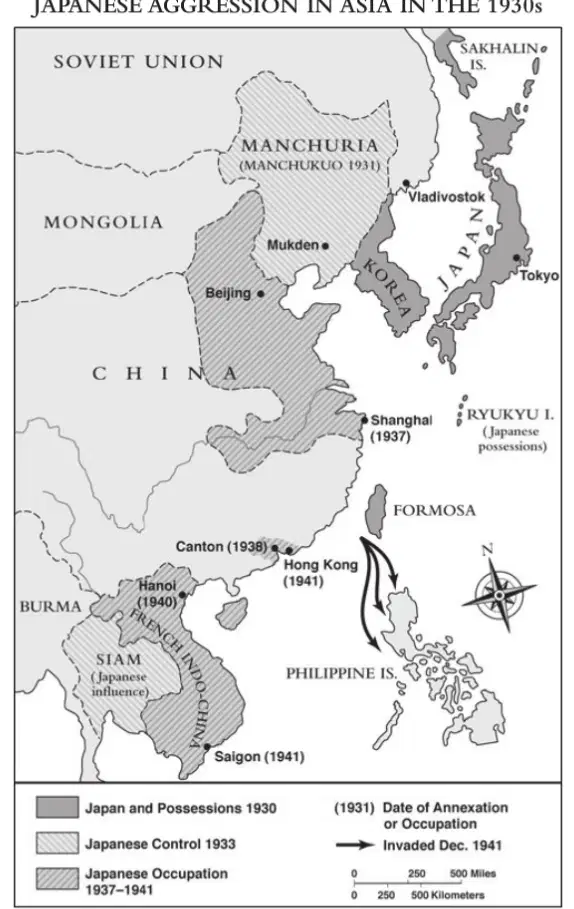
Which region did Japan annex in 1931, marking the beginning of its aggression in Asia during the 1930s?
Manchuria
Korea
Burma
Formosa
What was the League of Nations' response to Japan's actions in Manchuria?
Passed a resolution condemning Japan but took no further action
Declared war on Japan
Sent military forces to Manchuria
Supported Japan's annexation
According to the passage, what did the failure of the League of Nations to act in the Manchuria crisis demonstrate?
Its inability to maintain peace
Its military strength
Its support for Japanese expansion
Its alliance with the United States
What was the main principle of the Stimson Doctrine as stated by Secretary of State Henry Stimson in 1932?
The United States would not recognize any regime established by force in violation of treaties
The United States would support Japanese expansion
The United States would join the League of Nations
The United States would provide military aid to China
How did the U.S. response to Japan's violation of the Open Door policy compare to the League of Nations' response?
It was somewhat stronger but not more effective in deterring aggression
It was much weaker and less effective
It involved direct military intervention
It resulted in immediate Japanese withdrawal
Based on the information provided, why might potential aggressors have felt emboldened by the League of Nations' response to Japan's actions in Manchuria?
The League's failure to take effective action showed that its warnings would not be taken seriously
The League provided military support to Japan
The League encouraged other nations to invade Manchuria
The League formed an alliance with the United States
Which U.S. president actively pursued friendly relations with Latin American countries by arranging for U.S. troops to leave Nicaragua and negotiating a treaty with Haiti?
Herbert Hoover
Franklin D. Roosevelt
Woodrow Wilson
Theodore Roosevelt
What was the main focus of Franklin Roosevelt’s foreign policy toward Latin America during his first term?
Initiating a good-neighbor policy
Expanding military intervention
Promoting isolationism
Supporting colonial expansion
Which policy did Franklin Roosevelt promise in his first inaugural address in 1933?
Policy of the good neighbor
Policy of containment
Policy of open door
Policy of manifest destiny
Why did interventionism in support of dollar diplomacy no longer make economic sense during Roosevelt’s presidency?
U.S. businesses lacked resources to invest in foreign operations during the depression
Foreign countries refused to trade with the U.S.
The U.S. had surplus resources
Dollar diplomacy was outlawed by Congress
At the Seventh Pan-American Conference in Montevideo, Uruguay, in 1933, what did the U.S. delegation pledge?
Never to intervene in the internal affairs of a Latin American country
To increase military presence in Latin America
To support European powers in Latin America
To expand dollar diplomacy
How did Roosevelt respond when Mexico seized oil properties owned by U.S. corporations in 1938?
He encouraged American companies to negotiate a settlement
He sent U.S. troops to Mexico
He imposed economic sanctions on Mexico
He demanded immediate return of the properties
What was the significance of Roosevelt’s attendance at the Pan-American Conference in Buenos Aires, Argentina, in 1936?
He pledged to submit future disputes to arbitration and warned against European aggression
He announced a new military alliance
He signed a trade agreement with Argentina
He declared war on Germany
Why did Cubans resent the Platt Amendment?
It made their country’s foreign policy subject to U.S. approval
It restricted trade with Europe
It required Cuba to pay taxes to the U.S.
It forced Cubans to serve in the U.S. military
In 1934, what action did Roosevelt persuade Congress to take regarding the Platt Amendment?
Nullify the Platt Amendment, retaining only the U.S. right to its naval base at Guantanamo Bay
Expand the Platt Amendment to other countries
Increase military presence in Cuba
Remove all U.S. rights in Cuba
Analyze how Roosevelt’s good-neighbor policy differed from previous U.S. policies toward Latin America.
It emphasized non-intervention and cooperation rather than military and economic intervention
It promoted colonization of Latin America
It increased U.S. military presence in the region
It focused on expanding U.S. territory
What was the chief motivation for Roosevelt’s foreign policy during his first term?
To help the U.S. economy
To expand U.S. territory
To promote world peace
To spread democracy
Which act provided for the independence of the Philippines by 1946 and the gradual removal of U.S. military presence from the islands?
Tydings-McDuffie Act
Dawes Act
Homestead Act
Kellogg-Briand Pact
Why did Roosevelt grant diplomatic recognition to the Soviet Union in 1933?
To increase U.S. trade and boost the economy
To support communism
To form a military alliance
To oppose Germany
What was the main purpose of the Reciprocal Trade Agreements Act enacted by Congress in 1934?
To reduce U.S. tariffs up to 50 percent for nations that reciprocated with comparable reductions
To increase tariffs on all imports
To ban trade with communist countries
To establish a single global currency
Which countries formed the Axis Powers by signing a treaty of alliance in 1940?
Japan, Italy, and Germany
France, Britain, and the U.S.
Russia, China, and Japan
Italy, Spain, and Britain
How did Benito Mussolini consolidate power in Italy in the 1920s?
By leading the Fascist party and using aggressive shows of force
By promoting democracy and free elections
By forming alliances with Britain and France
By abolishing the monarchy peacefully
What strategy did Adolf Hitler use to gain control of the German legislature in early 1933?
Bullying tactics against Jews and exploiting anti-Semitic sentiments
Peaceful negotiations with political opponents
Economic reforms to reduce unemployment
Alliances with France and Britain
How did the worldwide depression after World War I contribute to the rise of military dictatorships in the 1920s and 1930s?
Economic hardships led to political instability, allowing dictators to seize power
It increased global trade, making dictatorships more profitable
It encouraged democratic reforms in Europe
It led to the immediate end of all monarchies
In what way did Roosevelt’s Reciprocal Trade Agreements differ from previous U.S. trade policies?
They promoted mutual tariff reductions with other nations
They increased tariffs to protect U.S. industries
They banned all imports from Europe
They focused only on trade with Latin America
Analyze how the rise of fascist and militarist governments in Italy, Germany, and Japan in the 1920s and 1930s was interconnected with global economic conditions.
Economic depression created instability, which leaders exploited to gain power in all three countries
All three countries were unaffected by the depression and rose independently
The rise was due to technological advancements, not economic conditions
They were influenced only by cultural factors, not economics
What was the main reason, according to the Nye Committee, for U.S. participation in World War I?
To serve the greed of bankers and arms manufacturers
To defend democracy in Europe
To support American allies
To expand U.S. territory
Which region in the United States had the strongest isolationist sentiment during the 1930s?
The Midwest
The Northeast
The South
The West Coast
What did the Neutrality Act of 1935 authorize the president to do?
Prohibit all arms shipments and forbid U.S. citizens to travel on the ships of belligerent nations
Send troops to Europe
Increase military spending
Form alliances with European countries
Which of the following did the Neutrality Act of 1936 forbid?
The extension of loans and credits to belligerents
The shipment of arms to Spain
The travel of U.S. citizens to Europe
The sale of food to neutral countries
How did most Americans and President Roosevelt feel about the Spanish Civil War?
They sympathized with the Loyalists but could not aid them due to the Neutrality Acts
They supported Franco’s Fascists
They remained completely indifferent
They sent military aid to both sides
Why did American isolationists want to avoid involvement in foreign wars after World War I?
They were disillusioned with the results of World War I and wanted to avoid being drawn into another war
They wanted to expand U.S. territory
They sought to support European monarchies
They believed in spreading democracy worldwide
What was the main purpose of the Neutrality Acts passed by Congress in the 1930s?
To keep the United States out of future foreign wars
To increase military alliances
To support the spread of fascism
To encourage American trade with Europe
What was the outcome of the Spanish Civil War in 1939?
Franco’s Fascists prevailed and established a military dictatorship
The Loyalists won and established a democracy
The war ended in a stalemate
Spain became a republic under American influence
Which law forbade the shipment of arms to the opposing sides in the civil war in Spain?
The Neutrality Act of 1937
The Neutrality Act of 1935
The Neutrality Act of 1936
The Lend-Lease Act
How did the America First Committee respond to the outbreak of World War II in Asia and Europe?
They became alarmed by Roosevelt’s pro-intervention policies
They supported immediate U.S. entry into the war
They advocated for increased military spending
They encouraged alliances with European countries
Which policy did Britain and France adopt in the years leading up to World War II to avoid open conflict with Germany?
Appeasement
Isolationism
Militarism
Expansionism
In 1935, which country did Mussolini order Italian troops to invade to prove fascism’s military might?
Ethiopia
Poland
France
Spain
What was the significance of the Munich Conference in 1938?
Britain and France allowed Hitler to take the Sudetenland unopposed
The United States joined the war against Germany
Italy withdrew from the Axis powers
Japan signed a peace treaty with China
Which event demonstrated the policy of appeasement by Britain and France in 1936?
Allowing German troops to march into the Rhineland
Invading Ethiopia
Bombing the Panay
Signing the Treaty of Versailles
What was the public reaction in the United States to Roosevelt’s “Quarantine Speech” in 1937?
Overwhelmingly negative
Strongly supportive
Indifferent
Enthusiastic for war
Why did Congress increase military and naval budgets in 1938, according to the text?
To protect against possible invasion of the Western Hemisphere
To prepare for an invasion of Europe
To support Britain and France directly
To fund the League of Nations
How did the United States respond to the sinking of the U.S. gunboat Panay by Japanese planes in 1937?
Accepted Japan’s apology quickly
Declared war on Japan
Sent troops to China
Imposed economic sanctions on Japan
Which of the following best describes the policy of appeasement?
Allowing aggressive actions to go unchallenged to avoid conflict
Building up military forces for war
Forming alliances to oppose aggression
Imposing strict economic sanctions
What was the main reason Roosevelt’s “Quarantine Speech” was not supported by the public?
Isolationist feelings among Americans
Support for fascist aggression
Desire for immediate war
Economic depression
Strategic Thinking: If Britain and France had not followed a policy of appeasement in the late 1930s, what might have been a possible outcome in Europe?
Earlier military conflict with Germany
Peaceful coexistence with Germany
Expansion of fascism without resistance
Immediate surrender to Germany
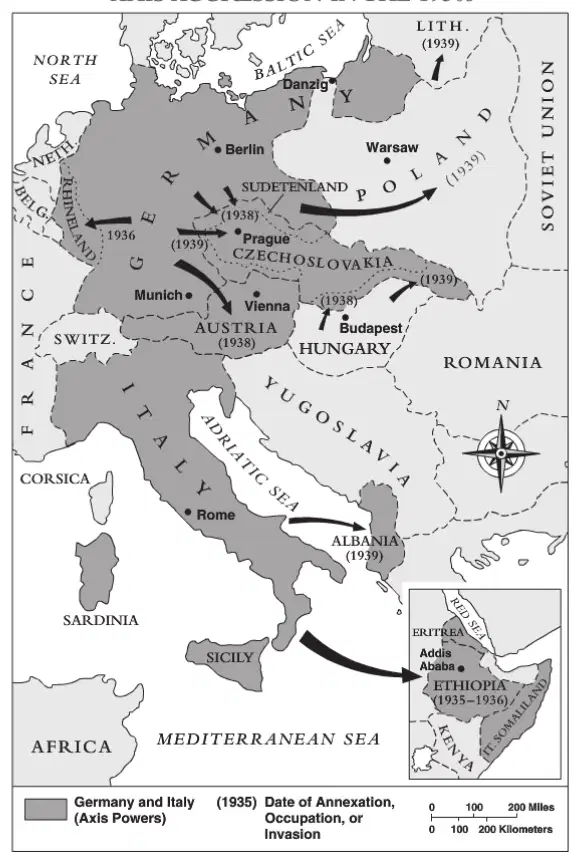
What agreement did Hitler break in March 1939 by sending troops to occupy all of Czechoslovakia?
The Munich agreement
The Treaty of Versailles
The Yalta agreement
The Potsdam agreement
Which two countries pledged to fight if Poland was attacked in 1939?
Britain and France
Germany and Italy
United States and Soviet Union
Poland and Hungary
What was the main reason the democracies were shocked in August 1939?
Stalin and Hitler signed a nonaggression pact
France surrendered to Germany
The United States joined the war
Italy invaded Ethiopia
Why did Britain and France believe they could count on the Soviet Union to oppose Hitler?
Because communism and fascism were ideological enemies
Because the Soviet Union was part of the Axis Powers
Because Stalin had signed the Munich agreement
Because the Soviet Union had already invaded Poland
What did the secret agreement between the Soviet and German dictators involve?
Dividing Poland between them
Invading France together
Attacking Britain
Forming the League of Nations
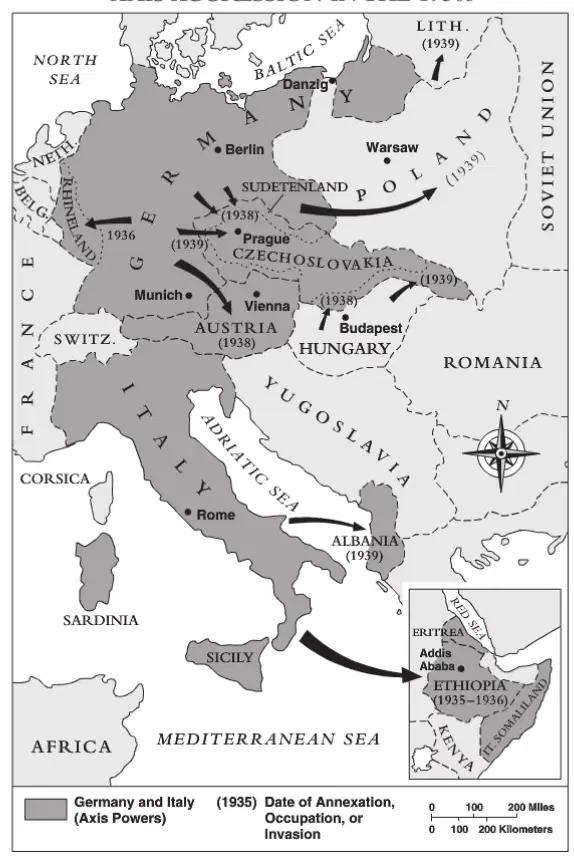
Based on the map, which country was annexed by Germany in 1938?
Austria
France
Italy
Poland
Explain why the failure of appeasement led to the outbreak of war in Europe in 1939.
Appeasement encouraged Hitler to expand further, making war unavoidable.
Appeasement strengthened the League of Nations.
Appeasement led to peace between all European countries.
Appeasement caused Britain and France to ally with Germany.
On what date did Germany begin its full-scale invasion of Poland, marking the start of World War II in Europe?
September 1, 1939
July 4, 1941
November 11, 1918
June 6, 1944
What is the term for the German military tactic that used overwhelming air power and fast-moving tanks, also known as "lightning war"?
Blitzkrieg
Trench warfare
Guerrilla warfare
Attrition warfare
Which country was the only major European power free of German troops by June 1940?
Great Britain
France
Denmark
Norway
How did President Roosevelt begin to counter U.S. isolationism as World War II started in Europe?
By gradually giving aid to the Allies, especially Great Britain
By declaring war on Germany immediately
By increasing trade with Germany
By remaining strictly neutral throughout the war
What was the main purpose of the "Cash and Carry" policy adopted by the United States in 1939?
To allow belligerent countries to buy U.S. arms if they paid cash and transported them
To provide free military aid to all Allied nations
To embargo all trade with Europe
To send American troops to Europe
What did the Selective Service Act of 1940 require?
Registration of all American men between ages 21 and 35 for military service
Immediate deployment of U.S. troops to Europe
The drafting of women into the military
The end of all military drafts in the U.S.
Why was the Destroyers-for-Bases Deal significant for Britain in 1940?
It helped Britain maintain control of the Atlantic against German submarine attacks
It provided Britain with food supplies
It allowed Britain to invade Germany
It ended the war in Europe
Why was the "cash and carry" policy considered technically neutral, but in practice favored Britain?
Because Britain controlled the seas and could transport goods, while Germany could not
Because it allowed Germany to buy more weapons than Britain
Because it required the U.S. to send troops to Britain
Because it banned all trade with both sides
How did the relationship between President Roosevelt and Prime Minister Winston Churchill influence the U.S. role in World War II?
It helped build a strong alliance and facilitated U.S. aid to Britain
It caused the U.S. to remain neutral
It led to a trade war between the two countries
It resulted in the U.S. supporting Germany
Analyze how the fall of France in 1940 influenced American public opinion and U.S. foreign policy.
It made Americans more willing to support aid to Britain and shift away from strict neutrality
It caused Americans to support isolationism even more strongly
It led to immediate U.S. entry into the war
It resulted in the U.S. cutting off all diplomatic ties with Britain
Who was the first president to break the two-term tradition and seek election to a third term?
Franklin Roosevelt
Wendell Willkie
George Washington
Harry Truman
Which of the following was a major factor in Franklin Roosevelt's reelection in 1940?
Strong economic recovery and fear of war
Promise to end the New Deal
Support for isolationism
Opposition to defense spending
What was Wendell Willkie's main criticism of President Roosevelt during the 1940 election campaign?
Roosevelt's decision to break the two-term tradition
Roosevelt's support for isolationism
Roosevelt's opposition to defense spending
Roosevelt's refusal to aid Britain
According to Roosevelt, what were the "Four Freedoms" that the United States should help defend?
Freedom of speech, freedom of religion, freedom from want, and freedom from fear
Freedom of press, freedom of assembly, freedom from taxes, and freedom from war
Freedom of movement, freedom of trade, freedom from poverty, and freedom from oppression
Freedom of education, freedom of health, freedom from discrimination, and freedom from hunger
What was the main purpose of the Lend-Lease Act signed into law in March 1941?
To allow the U.S. to lend or lease arms and supplies to Britain
To end all trade with Europe
To require Britain to pay cash for all U.S. goods
To declare war on Germany
Why did Roosevelt compare the Lend-Lease Act to lending a garden hose to a neighbor?
To illustrate the idea of helping others in an emergency
To show the importance of gardening
To criticize British borrowing habits
To explain the need for neutrality
Which group campaigned vigorously against the Lend-Lease bill?
America First Committee
Democratic Party
Republican Party
British Parliament
Which document, created by Roosevelt and Churchill, affirmed the general principles for a sound peace after World War II, including self-determination, no territorial expansion, and free trade?
Atlantic Charter
Treaty of Versailles
Munich Agreement
Potsdam Declaration
What was the main purpose of the U.S. "shoot-on-sight" policy in July 1941?
To protect U.S. ships from German submarine attacks
To declare war on Germany
To invade France
To support the Soviet Union
Why did U.S. relations with Japan become increasingly strained between 1940 and 1941?
Japan's invasion of China and ambitions to expand into Southeast Asia
Japan's alliance with the United States
Japan's withdrawal from the League of Nations
Japan's support for British colonies
What economic action did President Roosevelt take against Japan after it joined the Axis in 1940?
Prohibited the export of steel and scrap iron to Japan
Increased trade with Japan
Signed a peace treaty with Japan
Supplied Japan with oil
Why did the United States freeze Japanese credits and cut off Japanese access to vital materials in July 1941?
Because Japanese troops occupied French Indochina
Because Japan signed a treaty with Britain
Because Japan withdrew from China
Because Japan supported the Soviet Union
How did the U.S. embargo on oil impact Japan's strategic decisions in 1941?
It forced Japan to consider seizing oil resources in Southeast Asia
It led Japan to withdraw from China
It caused Japan to ally with the Soviet Union
It resulted in Japan increasing trade with the U.S.
What was the main issue that prevented the United States and Japan from reaching an agreement in negotiations before the outbreak of war?
Japan refused to pull its troops out of China
The U.S. wanted to invade Japan
Japan demanded more oil from the U.S.
The U.S. wanted to join the Axis Powers
Analyze why both the United States and Japan believed quick action was necessary in late 1941.
The U.S. wanted to delay confrontation until its military was ready, while Japan needed to act quickly due to limited oil supplies
Both countries wanted to avoid war at all costs
Japan wanted to support Germany in Europe, while the U.S. wanted to invade China
The U.S. wanted to form an alliance with Japan, while Japan wanted to negotiate peace
What was the main purpose of the Atlantic Charter agreed upon by Roosevelt and Churchill in 1941?
To affirm general principles for a sound peace after the war, including self-determination, no territorial expansion, and free trade.
To form a military alliance between the United States and Britain.
To declare war on Germany.
To divide Europe into spheres of influence.
What action did President Roosevelt take in July 1941 to protect British ships from submarine attacks?
He ordered the U.S. Navy to escort British ships carrying lend-lease materials as far as Iceland.
He declared war on Germany.
He sent American troops to Europe.
He imposed an embargo on German goods.
What was the immediate U.S. response after the American destroyer Greer was attacked by a German submarine in September 1941?
Roosevelt ordered the navy to attack all German ships on sight.
The United States declared war on Germany.
The U.S. withdrew its naval forces from the Atlantic.
The U.S. signed a peace treaty with Germany.
Why did U.S. relations with Japan become increasingly strained in 1940 and 1941?
Because of Japan’s invasion of China and ambitions to expand into Southeast Asia.
Because Japan refused to trade with the United States.
Because the U.S. supported Germany in World War II.
Because Japan signed a peace treaty with China.
What economic action did President Roosevelt take after Japan joined the Axis in September 1940?
He prohibited the export of steel and scrap iron to all countries except Britain and Western Hemisphere nations.
He increased trade with Japan.
He sent military aid to Japan.
He reduced tariffs on Japanese goods.
Why did Japan consider quick action necessary in negotiations with the United States in 1941?
Because of its limited oil supplies.
Because it wanted to avoid war with China.
Because it wanted to expand into Europe.
Because it had a surplus of oil.
Which of the following best describes the U.S. Open Door policy in relation to Japan’s actions in China?
It opposed Japan’s invasion of China as a violation of the policy.
It supported Japan’s expansion into China.
It encouraged Japan to trade with China.
It required the U.S. to provide military aid to China.
Analyze the reasons why negotiations between the United States and Japan failed to resolve their differences in 1941.
Both sides refused to change their positions regarding Japan’s withdrawal from China and U.S. oil embargoes.
The United States was unwilling to negotiate with Japan under any circumstances.
Japan was not interested in negotiating with the United States.
The U.S. wanted to join the Axis powers.
What event occurred on December 7, 1941, leading to the United States entering World War II?
The signing of the Treaty of Versailles
The bombing of Pearl Harbor
The invasion of Normandy
The dropping of the atomic bomb on Hiroshima
How long did the surprise attack on Pearl Harbor last?
Less than two hours
All day
Over six hours
Three days
Which of the following statements best describes the American public's reaction to the attack on Pearl Harbor?
They were expecting the attack and were prepared.
They were stunned by the attack.
They ignored the attack.
They celebrated the attack.
What did President Roosevelt call December 7th in his address to Congress?
A day of celebration
A day of peace
A day which will live in infamy
A day of victory
Which countries were the principal Allies fighting Nazi Germany from 1942 to 1945?
United States, Germany, and Italy
Britain, United States, and Soviet Union
France, Japan, and China
Italy, Japan, and Soviet Union
What was the main purpose of the War Production Board (WPB) established in 1942?
To negotiate peace treaties
To manage war industries and set production priorities
To recruit soldiers for the army
To provide medical care to civilians
Why did high government officials know an attack in the Pacific was imminent before Pearl Harbor?
They had spies in Japan
They had broken Japanese codes
They saw Japanese ships approaching
They received a warning from Germany
After the attack on Pearl Harbor, which two countries honored their treaty with Japan by declaring war on the United States?
Germany and Italy
Britain and France
Soviet Union and China
Australia and Canada
What was significant about the atomic bomb?
it was more destructive than any bomb previously used
nothing
it had to be deployed from a submarine
The decision to use the atomic bomb was difficult because _____________ .
many innocent people would be killed
it was expensive
it was untested
Because Japan did not surrender after the bombing of Hiroshima, the United States _______________ .
surrendered to Japan
dropped a second bomb on another Japanese city
invaded Japan with soldiers
As a result of radiation, people in Japan suffered from _______________ for many years.
leukemia
birth defects
death related to burns and bloating
all of the above
On what day did the U.S. declare war on Japan?
July 4th, 1936
December 8th, 1941
December 25th, 1945
We never declared war officially
Douglas Macarthur was commanded to leave the Philippians. T/F?
True
False
What was the bloodiest battle of the pacific theatre?
Iwo Jima
Midway
Tokyo
Okinawa
The U.S. broke the code of the Japanese before the battle of Midway. T/F?
True
False
What is a Kamikaze?
A decorated war hero
A samurai who lost his sword
The Japanese dictator
A pilot who crashed their plane

Blamed Jews for Germany's Economic hard times, Communism, inflation, WWI and killed 6 million Jews
Pearl Harbor Attack
Battle of Midway
The Holocaust
Operation Overlord "D-Day"

Hitler's Final Solution
A Plan to Exterminate ALL Jews living in Third Reich regions
Hitler's plan to annex all of Europe
Removal of all "Undesirables"
Hitler's invasion of Poland

Alliances shift and the Allied Powers are now made up of which countries?
Japan, Italy, Germany
Germany, France, China
Japan, China, U.S.
Great Britain, France, China, Soviet Union, U.S.

The Battle of Midway was a turning point of the war in the Pacific because....
Japan had another successful attack on the U.S.
Japan was now dominating the Pacific
Japan now fighting on the defensive end & the U.S. now on the offense
U.S. lost the battle

This Battle took 2 years to plan, occurred in 3 phases, and caused Germany to fight on 2 war fronts.
Battle of Midway
Operation Overlord "D-Day"
Pearl Harbor
Battle of Britain
Did the U.S. know about the Pearl Harbor attack?
Yes, they knew
No, it was a surprise
Japan and the U.S. were allies; nothing was bombed.
What was the controversial policy carried out by the United States government during World War II?
Forced relocation and imprisonment of Japanese Americans
Forced relocation and imprisonment of British Americans
Forced relocation and imprisonment of German Americans
Forced relocation and imprisonment of Italian Americans
Who signed Executive Order 9066 authorizing the military to designate certain areas as military zones and exclude anyone based on their ancestry?
John F. Kennedy
Franklin D. Roosevelt
Harry S. Truman
Dwight D. Eisenhower
In which landmark Supreme Court case was the internment of Japanese Americans challenged?
Miranda v. Arizona
Brown v. Board of Education
Korematsu v. United States
Roe v. Wade
In which city did a federal court overturn Korematsu's conviction in 1983?
Chicago
Los Angeles
San Francisco
New York
What does the internment of Japanese Americans serve as a historical example of?
The potential consequences of government actions based on justice and equality
The potential consequences of government actions based on fear and prejudice
The potential consequences of government actions based on tolerance and acceptance
The potential consequences of government actions based on diversity and inclusion