
 Worksheets
Honors - Chinese Inventions Review
Total questions: 20
Worksheet time: 10mins
What materials did Cai Lun use to make paper?
Silk and bamboo
Bark and rags
Clay and sand
Wool and cotton
By the 700s AD, paper making had spread to which countries?
India and Persia
Korea and Japan
Egypt and Greece
Rome and Spain
Early Chinese people wrote records on silk or bamboo before the invention of paper.
True
False
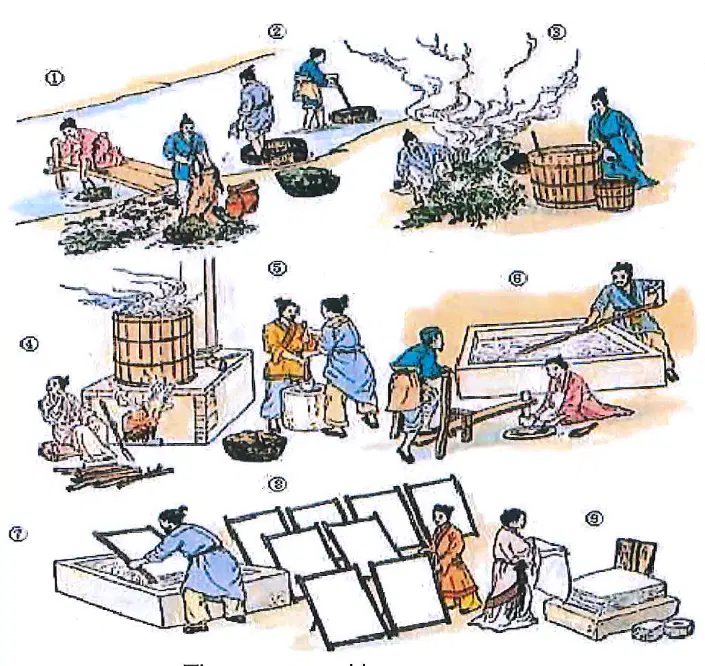
What is shown in the diagram labeled 'The paper making process'? The steps involved in making paper from bark and rags, including soaking, boiling, pressing, drying, and cutting.
The steps involved in making paper from bark and rags, including soaking, boiling, pressing, drying, and cutting.
The process of recycling plastic bottles into new products.
The steps for manufacturing steel from iron ore.
The method of producing glass from sand and soda.
By the 1200s, paper making had reached Europe and was important in spreading knowledge.
True
False
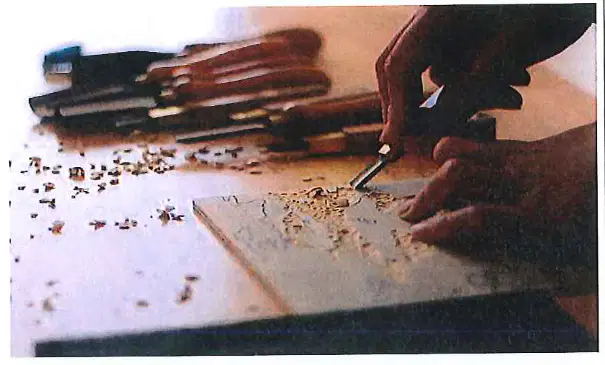
Look at the image labeled 'Carved woodblocks.' What does this image show?
A finished printed book
The process of carving woodblocks for printing
A painting of mountains
A single large woodblock
Read the passage about gunpowder. What did Chinese alchemists originally search for in the 900s?
A substance to make weapons
A substance to grant immortality
A substance to build walls
A substance to make fireworks
By the 1200s, what did the Chinese begin to use gunpowder for?
Building walls
Making armor
Weapons such as guns and bombs
Cooking
Read the passage about gunpowder. Fill in the blank: The earliest use of gunpowder was in ________ which were used to chase evil spirits away.
fireworks
guns
cannons
rockets
Who learned to create gunpowder by 1250 and used it to expand their empire?
Muslims
Romans
Mongols
Vikings
What was the main disadvantage of woodblock printing before the invention of movable type?
It was too expensive
The block could only be used to create a single page
It was not flexible
It was not used in China
Why was movable type less convenient in China compared to other places?
The Chinese language uses thousands of different characters
Movable type was too expensive
Woodblock printing was faster
The Chinese did not print books
Fill in the blank: By the 1450s, printing had spread to _______.
Europe
Asia
Africa
Australia
Which group was the first to adopt Chinese movable type and pass the knowledge to Europe?
Europeans
Muslims
Americans
Indians
Fill in the blank: During the 400s AD, the Chinese discovered ________, a force that attracts or repels objects.
magnetism
gravity
electricity
friction
Using magnetic compasses allowed sailors to:
Sail farther away from land
Cross oceans and settle new lands
Encourage the spread of trade and make cities wealthy
All of the above

What does the page from a Chinese book show?
Directions
Types of ships
Star chart
Compass parts
Su Song developed his clock two hundred years before the mechanical clock was developed in Europe.
True
False
What is the main mineral component of porcelain?
Kaolin
Quartz
Feldspar
Gypsum
Which color was most commonly used in Ming Dynasty porcelain designs?
A) Blue
B) Red
C) Orange
D) Green

