
 Worksheets
Vectors
Total questions: 21
Worksheet time: 11mins
A hiker travels 1.0 kilometer south, turns and travels 3.0 kilometers west, and then turns and travels 3.0 kilometers north. What is the total distance traveled by the hiker?
3.2 Km
3.6 Km
5.0 Km
7.0 Km
A unit used for a vector quantity is
watt
newton
kilogram
second
The speedometer in a car does not measure the car’s velocity because velocity is a
vector quantity and has a direction associated with it
vector quantity and does not have a direction associated with it
scalar quantity and has a direction associated with it
scalar quantity and does not have a direction associated with it

The diagram below represents two forces, F1 and F2, acting concurrently on a block sliding on a horizontal, frictionless surface.
Which statement describes the motion of the block?
The block is accelerating to the right.
The block is accelerating to the left.
The block is moving to the right with constant speed.
The block is moving to the left with decreasing speed.
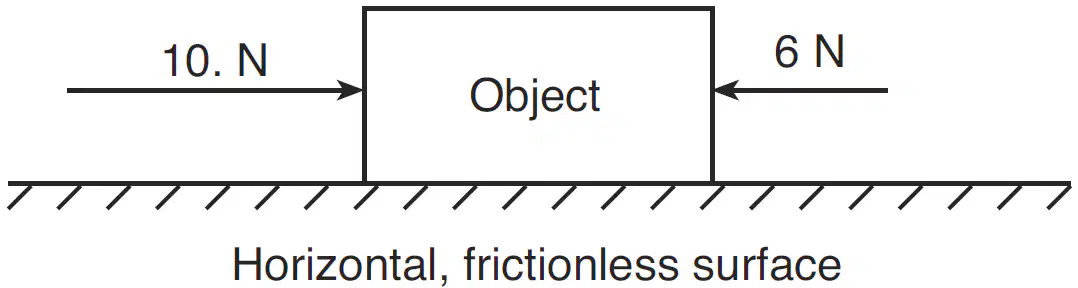
Two forces act concurrently on an object on a horizontal, frictionless surface, as shown in the diagram below.
What additional force, when applied to the object, will establish equilibrium?
16 N toward the right
16 N toward the left
4 N toward the right
4 N toward the left

The diagram below represents two concurrent forces.
Which vector represents the force that will produce equilibrium with these two forces?


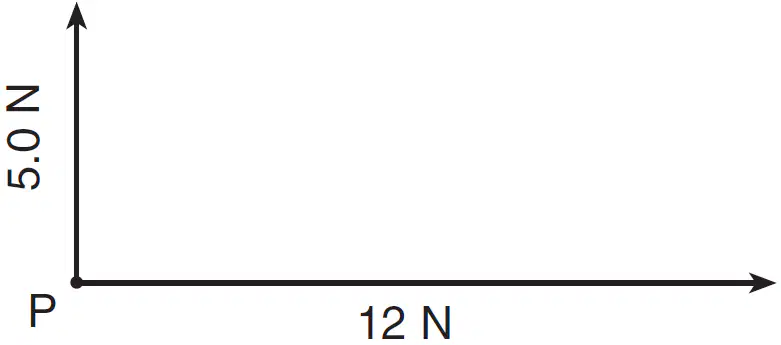
The diagram below represents a 5.0-newton force and a 12-newton force acting on point P.
The resultant of the two forces has a magnitude of
5.0 N
7.0 N
12 N
13 N
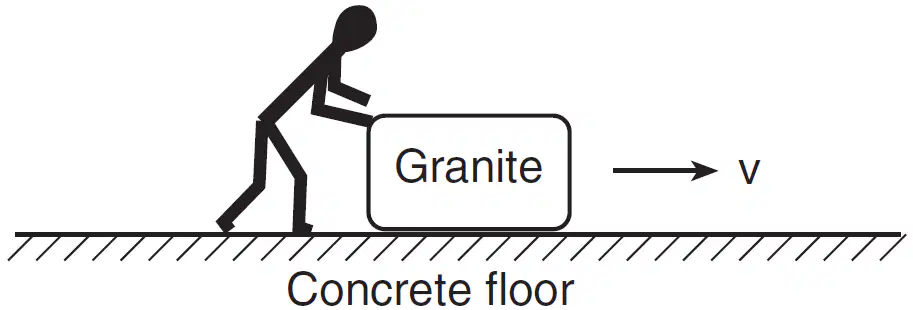
The diagram below shows a granite block being slid at constant speed across a horizontal concrete floor by a force parallel to the floor.
Which pair of quantities could be used to determine the coefficient of friction for the granite on the concrete?
mass and speed of the block
mass and normal force on the block
frictional force and speed of the block
frictional force and normal force on the block

To lift a heavy block off the floor, a student pulls with force F on a rope that passes over a pulley, as shown in the diagram below
Which pair of vectors represents the perpendicular components of the force the student exerts on the rope?


A box weighing 46 newtons rests on an incline that makes an angle of 25° with the horizontal. What is the magnitude of the component of the box's weight perpendicular to the incline?
19 N
21 N
42 N
46 N
If the net force acting on an object is doubled, the acceleration of the object is
halved
doubled
unchanged
quadrupled
An object with a mass of 2 kilograms is accelerated at 5 m/s2. The net force acting on the mass is
5 N
2 N
10 N
20 N

Base your answer on the graph below which represents the velocity-time relationship for a 2.0-kilogram mass moving along a horizontal frictionless surface.
The net force on the mass during interval DE is
1 N
2 N
0 N
4 N
Which pair of quantities are both scalar quantities?
speed and mass
speed and momentum
momentum and displacement
mass and displacement
Which terms identify two scalar quantities?
force and acceleration
impulse and distance
mass and velocity
energy and time
Which is a vector quantity?
distance
speed
power
force

The diagram below shows a resultant vector, R.
Which diagram best represents a pair of component vectors, A and B, that would combine to form resultant vector R?


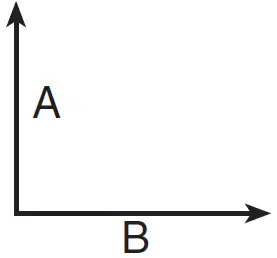


Forces A and B have a resultant R. Force A and resultant R are represented in the diagram below.
Which vector best represents force B?

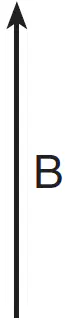
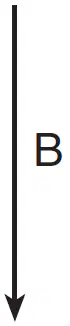
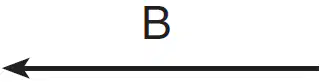
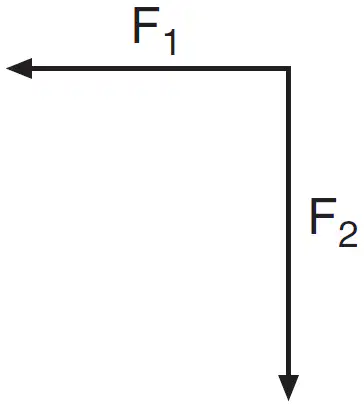
A force vector was resolved into two perpendicular components, F1 and F2, as shown in the diagram below.
Which vector best represents the original force?


A 6-newton force and an 8-newton force act concurrently on a box located on a frictionless horizontal surface. Which top-view diagram shows the forces producing the smallest magnitude of acceleration of the box?


A 150.-newton force, F1, and a 200.-newton force, F2, are applied simultaneously to the same point on a large crate resting on a frictionless, horizontal surface. Which diagram shows the forces positioned to give the crate the greatest acceleration?



