
 Worksheets
M8 Midterm Practice
Total questions: 118
Worksheet time: 1hrs 8mins
Which is the correct product in scientific notation: (3.2×104)×(5×103) ?
1.6×10⁸
16×107
16×106
1.6×10⁷
Compute (9 × 10^6) ÷ (3 × 10^2) and write the answer in scientific notation.
3×10⁴
30×103
0.3×10⁵
3×10⁵
What is (6.4×10⁻²)+(3.6×10⁻² written in scientific notation?
10.0 × 10⁻²
9.0×10⁻²
1.0×10⁻¹
0.1×10⁻¹
Subtract (7.5 × 10^5) – (2.1 × 10^5). Express your answer in scientific notation.
5.4×10⁵
54×104
0.54 × 10⁶
5.4×10⁶
Convert 4.2 × 10^–4 to standard form.
0.0042
0.042
0.00042
0.000042
Convert 5.06 × 10^3 to standard form.
506,000
506
50,600
5,060
Write 0.00079 in scientific notation.
7.9×10⁻⁴
7.9×10⁻⁵
79×10–6
0.79 × 10⁻³
Write 38,400 in scientific notation.
3.84×10⁴
38.4×10³
0.384 × 10⁵
3.84×10³
Which shows (2.5×10–3)×(8×102 simplified?
2.0×10⁻¹
0.2×101
20×10–2
2.0×100
Divide and express in scientific notation: (4.5×10⁷)÷(9×10⁻¹) .
0.5×10⁸
50 × 10^6
5×10⁸
5×10⁷
Add 1.2×10³ + 8.8×10² . What is the result in scientific notation?
0.208×10⁴
2.08×10³
2.8×10³
20.8×10²
Subtract (4.06 × 10^–1) – (9 × 10^–2) and write in scientific notation.
3.16×10⁻¹
31.6×10⁻²
0.316×100
3.16×100
Simplify to a single power: (53)4 equals which expression?
512
57
59
51
Simplify to a single power: 65÷6 equals which expression?
65
64
63
66
Simplify to a single power: 42×4 equals which expression?
42
44
41
43
Which expression is equivalent to 3÷32 ?
1/27
1/9
1/3
3
Which expression is equivalent to 3−4×36 ?
33
321
32
3241
Which value is equivalent to (3−1)2 ?
9
27
1
1/9
Write the number 8.9×10⁵ in standard form.
89,000,000
890000
89000
8,900,000
Write the number 4.3×10⁻⁵ in standard form.
0.0043
0.0000043
0.000043
0.00043
Write the number 4.6×10⁴ in standard form.
46000
4600
460,000
46,000,000
Evaluate and express in scientific notation: 2.49×10³+6.68×10³ .
0.0917 × 10⁵
91.7×10²
0.917 × 10⁴
9.17×10³
Evaluate and express in scientific notation: 5.03×10⁴ − 1.42×10⁴ .
0.0361 × 10⁶
3.61×10⁴
36.1×10³
0.361 × 10⁵
Evaluate and express in scientific notation: 6,100−1.1×10³ .
5×10³
4×10³
5.1×10³
6×10³
Evaluate and express in scientific notation: 5.3×10(−1)+9.1×10(−2) .
0.0621×101
62.1 × 10⁻²
0.621 × 100
6.21×10⁻¹
Evaluate and express in scientific notation: 4.66×10(−4)−3.82×10(−4) .
0.84 × 10⁻⁴
84×10−6
0.0084 × 10⁻³
8.4×10⁻⁵
Evaluate and express in scientific notation: 0.012+3.4×10(−4) .
0.1234 × 10(−1)
12.34×10(−4)
1.234×10(−2)
0.001234 × 10(−1)
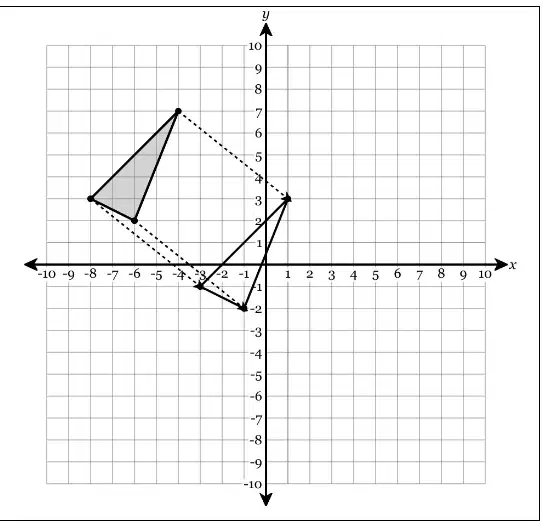
A polygon is translated 5 units right and 4 units down on a coordinate grid. Which rule describes this translation?
(x,y) → (x−4, y+5)
(x,y) → (x+4, y−5)
(x,y) → (x−5, y+4)
(x,y) → (x+5, y−4)
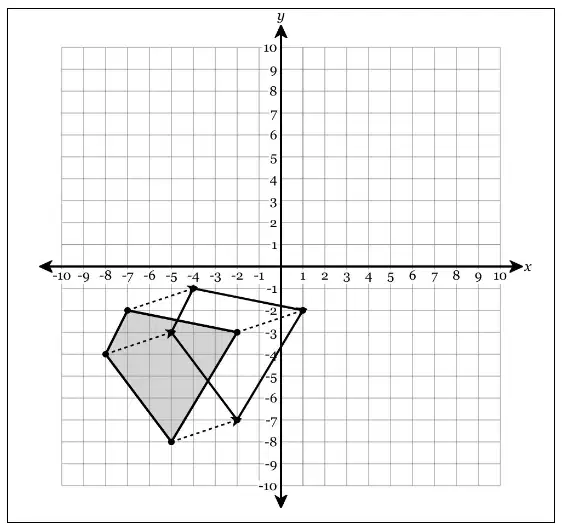
On the coordinate plane, translate the given polygon 3 units right and 1 unit up. Which vector describes this translation?
⟨−3,−1⟩
⟨3,−1⟩
⟨3,1⟩
⟨1,3⟩
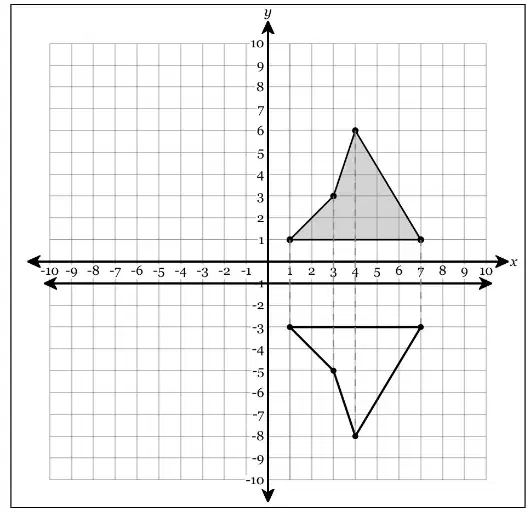
A figure is reflected over the horizontal line y = 1. How do the coordinates (x, 5) change after the reflection?
(x, −3)
(x, −9)
(x, −5)
(x, −1)
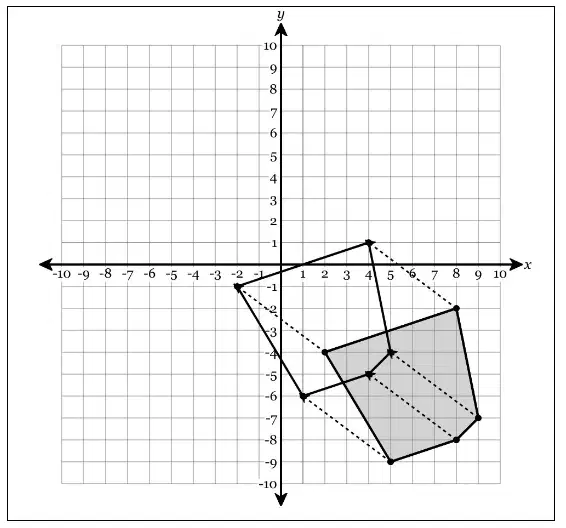
Translate a figure 4 units left and 3 units up. Which coordinate rule applies to any point (x, y)?
(x, y) → (x+3, y−4)
(x, y) → (x−3, y+4)
(x, y) → (x+4, y+3)
(x, y) → (x−4, y+3)
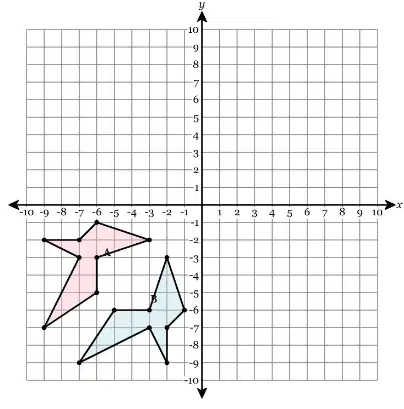
Which transformation takes a shape in quadrant III to a congruent shape in quadrant IV, preserving orientation but changing signs of x only?
Reflection over the x-axis
Reflection over the y-axis
Translation right 5 units
Rotation 270° about the origin
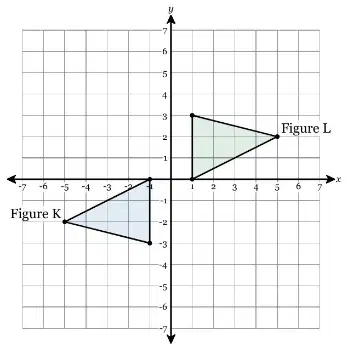
Figure L is the image of Figure K. K is a right triangle in quadrant III with its right angle at (−4, −1). L is the same triangle in quadrant I with right angle at (4, 1). Which transformation maps K to L?
Rotation 180° clockwise about the origin
Translation right 8 and up 2
Rotation 90° counterclockwise about the origin
Reflection over the x-axis
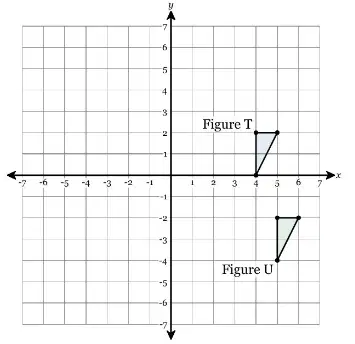
Figure U is obtained from Figure T. T has a vertex at (3, 4) and U has the corresponding vertex at (4, 0). Which translation maps T to U?
Right 1, down 4
Left 1, up 4
Left 4, up 1
Right 4, down 1
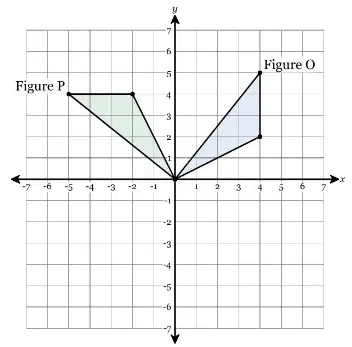
Which rotation about the origin sends the point (2, −5) to (5, 2)?
90° clockwise
90° counterclockwise
180° rotation
270° counterclockwise
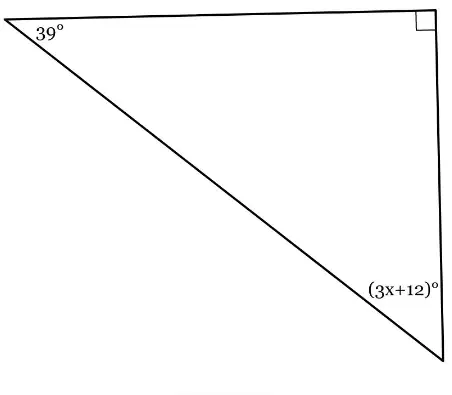
A triangle has two angles measuring 39° and 90°. The third angle is labeled (3x + 12)°. What is x?
13
17
11
15
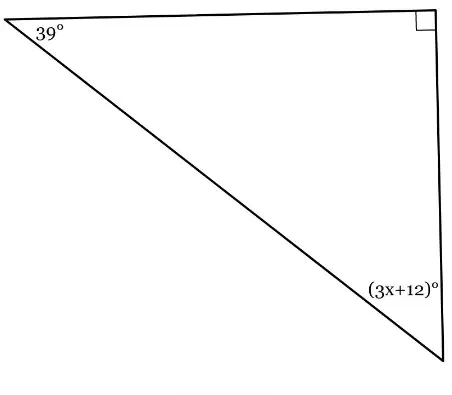
In triangle ABC, the angles measure 39°, (3x + 12)°, and 90°. Find the value of x.
x = 13
x = 10
x = 11
x = 9
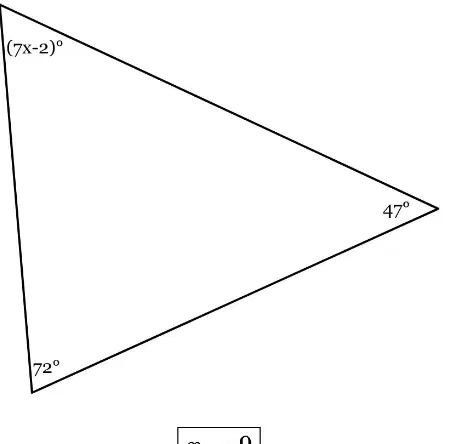
In triangle DEF, the angles measure 72°, 47°, and (7x − 2)°. What is x?
x = 9
x = 8
x = 10
x = 11
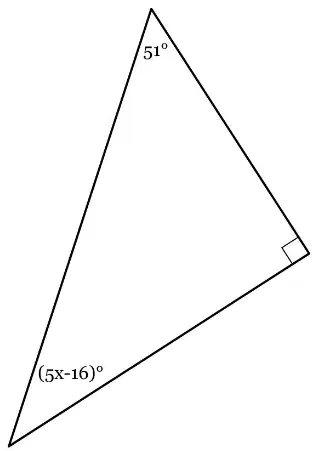
A triangle has angles 51°, (5x − 16)°, and a right angle. Find x.
x = 11
x = 10
x = 12
x = 13
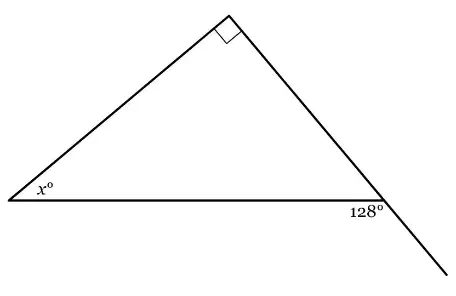
A triangle has an exterior angle measuring 128°. One of the remote interior angles is a right angle. The other remote interior angle measures x°. Find x.
x = 42
x = 38
x = 32
x = 52
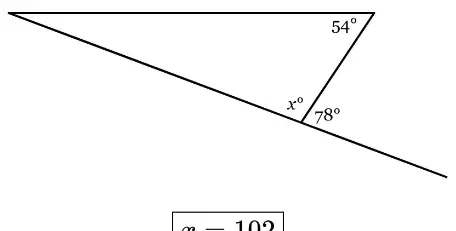
A triangle has an exterior angle measuring 78°. The adjacent interior angle at the same vertex is labeled x°, and the nonadjacent interior angle at another vertex is 54°. Find x.
x = 54
x = 24
x = 48
x = 32
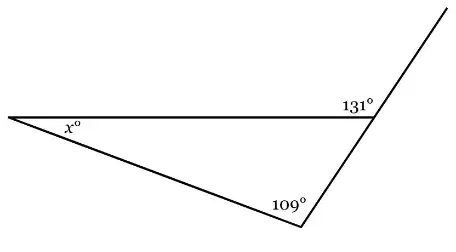
A triangle has exterior angles at two vertices measuring 109° and 131°. The interior angle at the remaining vertex is x°. Find x.
x = 18
x = 40
x = 28
x = 22
In triangle CDE, side CE is extended through E to F. Given m∠CDE = (3x + 18)°, m∠DEF = (8x + 17)°, and m∠ECD = (3x + 13)°. Find m∠CDE.
45°
39°
42°
36°
In triangle AFG, FH is extended through H to I. Given m∠FGH = (3x + 15)°, m∠GHI = (8x − 2)°, and m∠HFG = (3x + 17)°. Find x.
x = 15
x = 17
x = 19
x = 13
In triangle OPQ, m∠O = (3x + 12)°, m∠P = (x + 14)°, and m∠Q = (4x − 6)°. Find m∠Q.
72°
70°
68°
74°
An altitude is drawn from the vertex of an isosceles triangle to the base, splitting the base into two equal segments. The altitude is 30 inches and the full base is 10 inches. Find the triangle’s perimeter. Round to the nearest tenth of an inch.
70.8 in.
68.3 in.
64.2 in.
73.6 in.
You travel 5 miles west, then turn left and drive south for 8 miles. What is your straight-line distance from your starting point? Round to the nearest tenth.
13.0 mi
10.2 mi
8.9 mi
9.4 mi
A TV is advertised as an 85-inch class (diagonal). If the width is 67 inches, what is the height? Round to the nearest tenth of an inch.
52.3 in.
50.1 in.
48.7 in.
54.0 in.
A right triangle has legs 2 cm and 19 cm. Find the hypotenuse. Round to the nearest tenth.
20.0 cm
19.1 cm
19.5 cm
18.8 cm
A right triangle has one leg 8 cm and hypotenuse 16 cm. Find the other leg. Round to the nearest tenth.
13.9 cm
12.0 cm
10.5 cm
14.8 cm
A right triangle has one leg 16 cm and hypotenuse 18 cm. Find the other leg. Round to the nearest tenth.
8.2 cm
9.0 cm
10.4 cm
7.5 cm
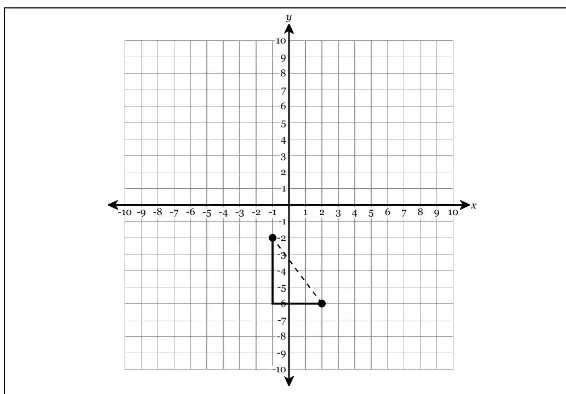
On a coordinate plane, the points A(2, −6) and B(−1, −2) form the endpoints of a right triangle’s hypotenuse with legs parallel to the axes. What is the distance between A and B in simplest radical form?
2√10
5
√13
3√5
Two points are A(5, −4) and B(3, −6). What is the distance AB in simplest radical form?
2√3 units
4√2 units
3√2 units
2√2 units
√8 units
Points C(3, 4) and D(−6, 9) form the hypotenuse of a right triangle with legs parallel to the axes. What is CD in simplest radical form?
√85 units
5√5 units
√106 units
11 units
10√2 units
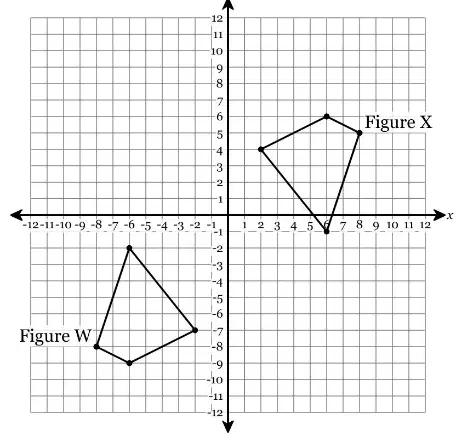
Which sequence maps Figure W to Figure X on a coordinate plane: translate up 3 units then rotate 180° about the origin; rotate 90° clockwise then reflect over x-axis; reflect over y-axis then translate right 3 units; translate left 3 units then rotate 180° about the origin?
Translate left 3 then rotate 180°
Translate up 3 then rotate 180°
Rotate 90° clockwise then reflect x-axis
Translate up 3 then reflect over y-axis
Reflect over y-axis then translate right
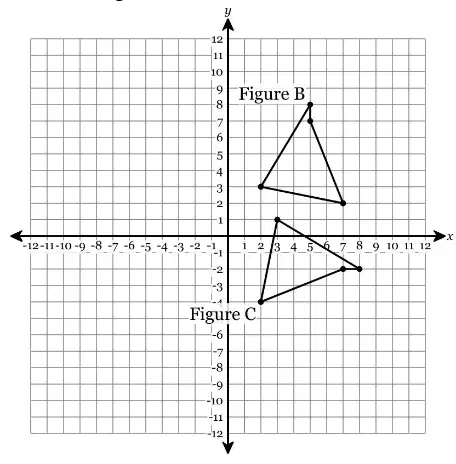
A transformation maps Figure B to Figure C. Which is a valid sequence: rotate 90° clockwise about origin then translate up 3 units; translate up 3 units then rotate 90° counterclockwise; reflect over y-axis then rotate 180°; rotate 180° then translate right 3 units?
Rotate 90° clockwise, then translate up 3
Translate up 3, then rotate 90° counterclockwise
Translate down 3, then rotate 90° clockwise
Reflect over y-axis, then rotate 180°
Rotate 180°, then translate right 3
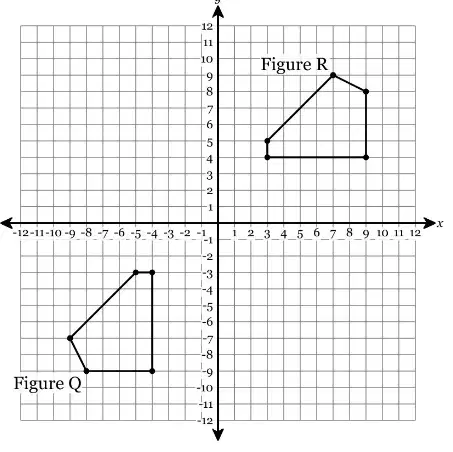
Which sequence maps Figure Q to Figure R: rotate 90° counterclockwise about origin then reflect over x-axis; reflect over y-axis then rotate 90° clockwise; translate right 2 then rotate 180°; rotate 180° then reflect over y-axis?
Rotate 90° CW, then reflect over x-axis
Rotate 180°, then reflect over y-axis
Reflect over y-axis, then rotate 90° CW
Translate right 2, then rotate 180°
Rotate 90° CCW, then reflect over x-axis
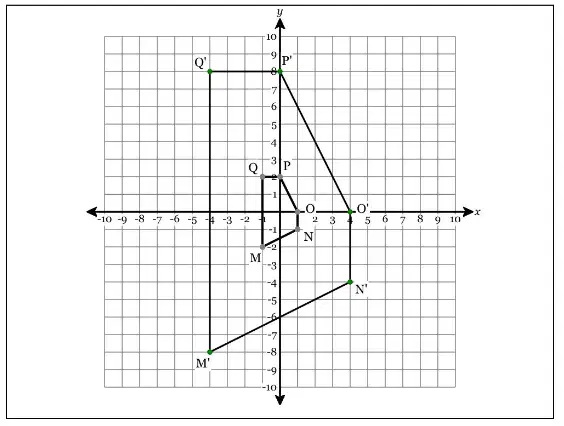
A polygon is dilated by a factor of 4 centered at the origin. Which statement is true about each image point (x, y)?
It maps to (4+y, 4+x)
It maps to (−4x, −4y)
It maps to (x+4, y+4)
It maps to (x/4, y/4)
It maps to (4x, 4y)
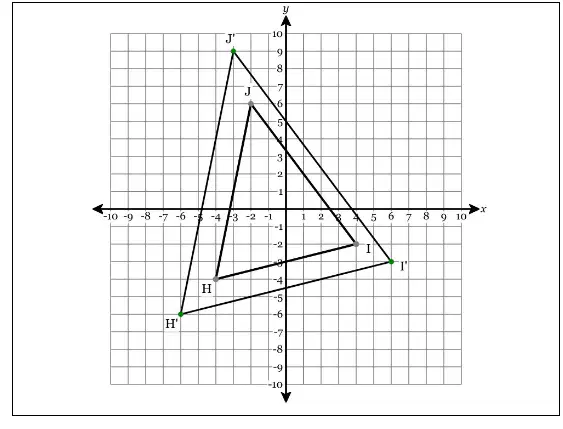
A triangle is dilated by a factor of 3/2 centered at the origin. Which coordinate rule gives the image?
(x, y) → (3x/2, 3y/2)
(x, y) → (2x/3, 2y/3)
(x, y) → (x+3/2, y+3/2)
(x, y) → (−3x/2, −3y/2)
(x, y) → (3x, 2y)
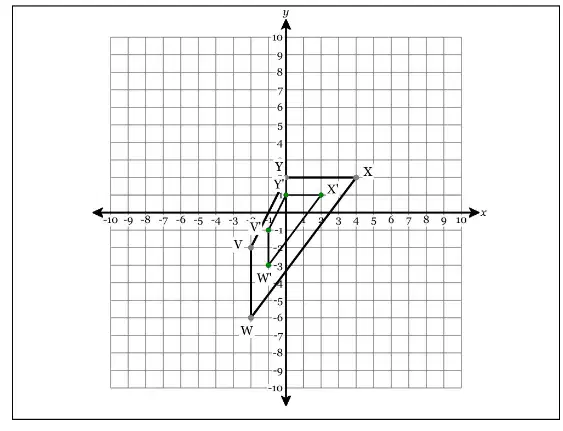
A figure is dilated by a factor of 1/2 centered at the origin. Which effect occurs?
All coordinates are doubled
Only y-coordinates are doubled
All coordinates are halved
Signs of coordinates change
Only x-coordinates are halved
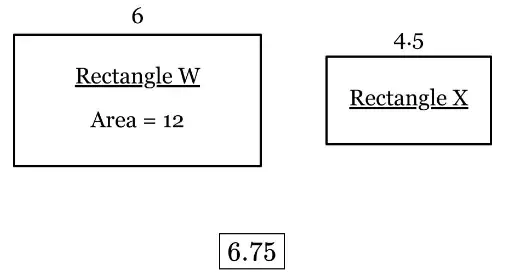
Rectangles W and X are similar. If the scale factor from W to X is 4:5 and area of W is 12, what is the area of X?
75/? wait
6.75
12.5
7.5
15.0
Rectangles J and K are similar. The side lengths scale from J to K by a factor of 3:5. If the area of rectangle J is 42 square units, what is the area of rectangle K?
70.00 square units
116.67 square units
46.67 square units
22.68 square units
Rectangles P and Q are similar. The side lengths scale from P to Q by a factor of 1:4. If the area of rectangle P is 12 square units, what is the area of rectangle Q?
3 square units
12 square units
48 square units
192 square units
A figure is dilated from the origin with scale factor 1/2. A point A at (8, −6) maps to A'. What are the coordinates of A'?
(−4, 3)
(8, −3)
(16, −12)
(4, −3)
A polygon ABCDE is mapped to A'B'C'D'E' by a dilation centered at the origin with scale factor 2, then a translation right 4 units. Which choice describes this sequence best?
Translate right 4 then dilate by 2
Dilate by 2 then translate right 4
Reflect over x-axis then translate right 4
Dilate by 1/2 then translate left 4
A polygon is reflected over the y-axis and then translated down 4 units to form its image. Which statement is true about the orientation and size of the image?
Orientation changes, size doubles
Orientation stays same, size stays same
Orientation stays same, size halves
Orientation changes, size stays same
A figure is dilated with center at the origin and scale factor 1/3. Point T is at (6, 3). What are the coordinates of T' after the dilation?
(1, 3)
(3, 1)
(−2, −1)
(2, 1)
On a coordinate grid, segment AB has endpoints A(−9, 9) and B(−9, 0). After a dilation with scale factor 1/3 centered at the origin, what is the length of A'B'?
27 units
18 units
3 units
9 units
A right triangle has legs 6 cm and 8 cm. After a dilation, the image has legs 9 cm and 12 cm. What is the scale factor from the original to the image?
3/4
4/3
2/3
3/2
A rectangle has length 10 and width 6. It is dilated by a scale factor of k to produce a similar rectangle with area 90. What is the value of k?
√(9/10)
√(3/2)
3/5
5/3
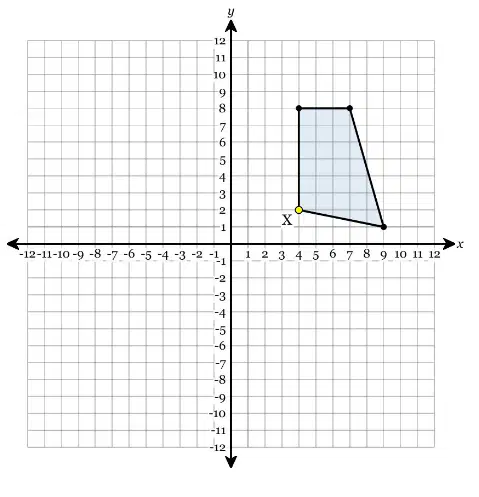
On a coordinate plane, point X is at (4, 2). After a rotation of 180° about the origin, what are the coordinates of the image of X?
(−4, −2)
(4, −2)
(2, 4)
(−4, 2)
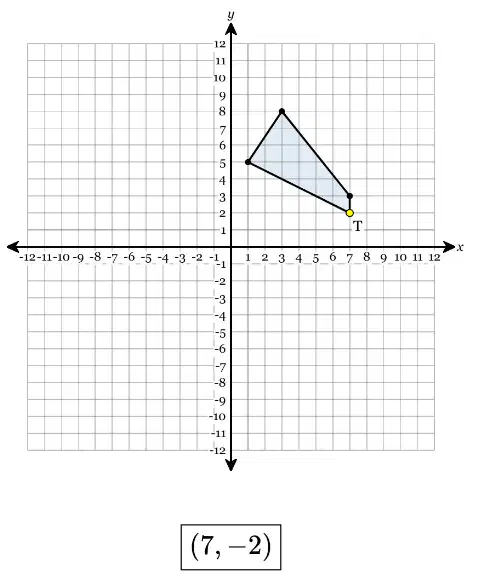
A triangle has a vertex T at (7, 2). If the triangle is reflected over the x-axis, what are the coordinates of the image of T?
(7, −2)
(−7, 2)
(−7, −2)
(2, 7)
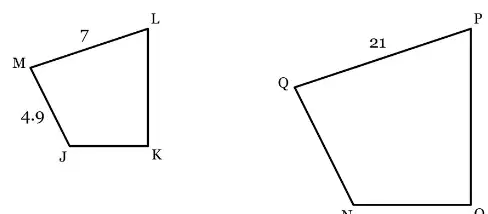
Quadrilateral JKLM is similar to quadrilateral NOPQ. In JKLM, side JL is 7 and side JM is 4.9. In NOPQ, side PQ corresponds to JL and is 21. What is the length of side QN, which corresponds to JM?
10.5
7.0
14.7
12.6
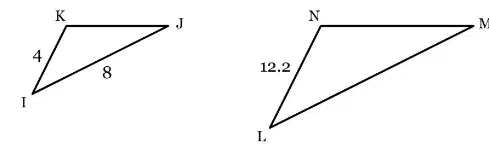
Triangles IJK and LMN are similar. In triangle IJK, IK = 4 and IJ = 8. In triangle LMN, LN corresponds to IK and has length 12.2. What is the length of LM, which corresponds to IJ?
8.0
12.2
16.4
24.4
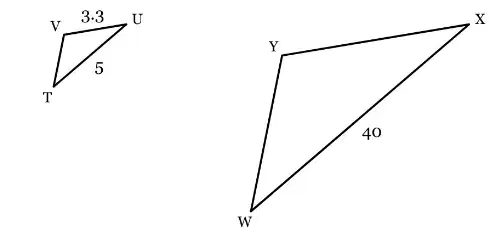
Triangles TUV and WXY are similar. In triangle TUV, TU = 3.3 and TV = 5. In triangle WXY, WX corresponds to TV and has length 40. What is the length of XY, which corresponds to TU?
26.4
24.0
8.3
12.0
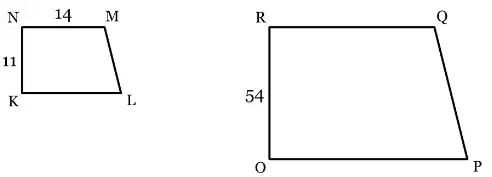
Quadrilateral KLMN is similar to quadrilateral OPQR. In KLMN, side KM = 11 and side MN = 14. In OPQR, side OR corresponds to KM and is 54. What is the length of QR, which corresponds to MN? Round to the nearest tenth.
44.8
34.4
59.3
68.7
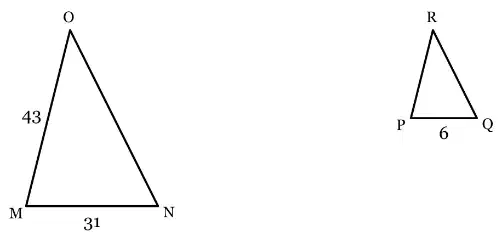
Triangles MNO and PQR are similar. In triangle MNO, MN = 31 and MO = 43. In triangle PQR, PQ corresponds to MN and is 6. What is the length of PR, which corresponds to MO? Round to the nearest tenth.
8.3
5.6
4.3
3.2
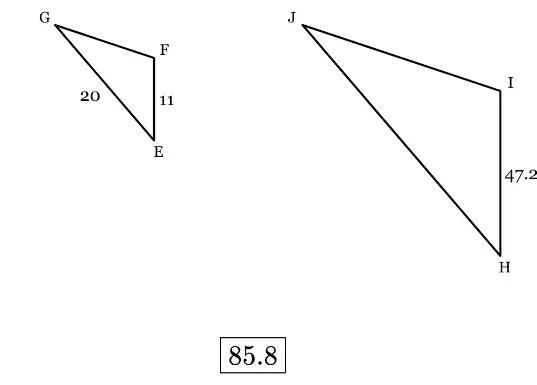
Triangles EFG and HIJ are similar. In triangle EFG, EF = 20 and FG = 11. In triangle HIJ, IJ corresponds to FG and is 47.2. What is the length of JH, which corresponds to EF? Round to the nearest tenth.
26.0
85.8
43.0
35.4
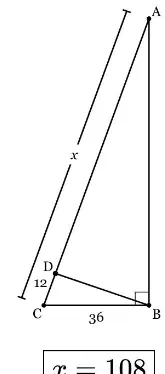
In right triangle ABC, altitude BD is drawn to hypotenuse AC. If BC = 36 and DC = 12, what is the length of AC?
96
84
72
108
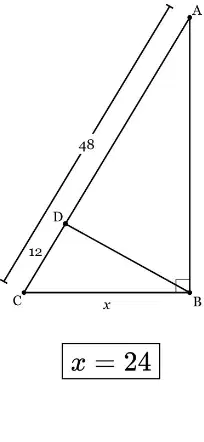
In right triangle ABC, altitude BD is drawn to hypotenuse AC. If AC = 48 and DC = 12, what is the length of BC?
12
32
18
24
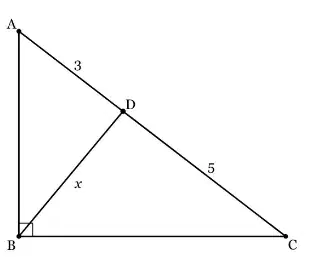
In right triangle ABC, altitude BD is drawn to hypotenuse AC, splitting AC into segments AD = 3 and DC = 5. What is the length of BD in simplest radical form?
sqrt(15)
sqrt(10)
sqrt(12)
sqrt(18)
sqrt(20)
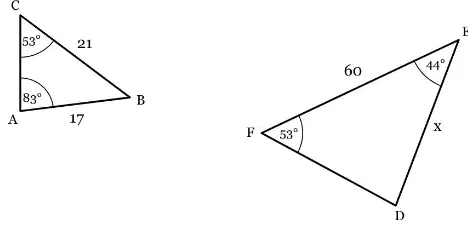
In triangle ABC, angle A is a right angle. Altitude AD is drawn to hypotenuse BC. If BD = 21 and AB = 17, what is the length of AC to the nearest tenth?
48.6
42.0
39.2
36.8
33.0
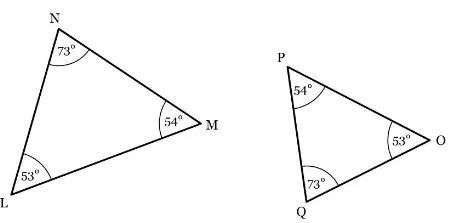
In quadrilateral LMNO, triangles formed are similar as shown. If NL = 63, LM = 74, and OP = 37 in a proportional setup, what is the length of QO to the nearest tenth?
35.0
33.8
37.2
31.5
28.4
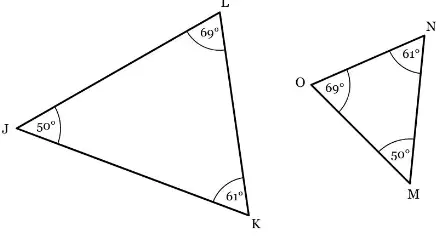
Given triangle MNO where triangles JKL and MNO are similar in a chain of proportions. If JK = 60, KL = 50, JL = 57, NO = 10, and MO = 11.4, what is the perimeter of triangle MNO to the nearest tenth?
35.8
34.6
33.4
32.2
31.0
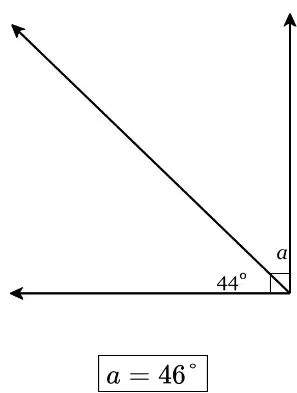
Two rays form a straight line. One acute angle measures 44°. What is the measure of the adjacent angle a?
36°
46°
44°
134°
136°
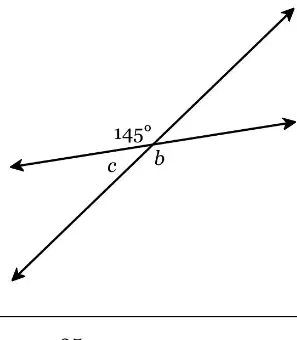
Two lines intersect. One of the vertical angles measures 145°. What is the measure of angle b (adjacent to the 145° angle on a straight line) and angle c (the vertical angle opposite b)?
b = 35°, c = 145°
b = 145°, c = 35°
b = 55°, c = 125°
b = 35°, c = 35°
b = 145°, c = 145°
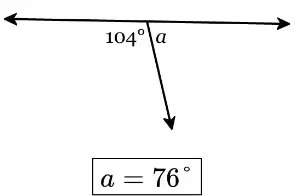
Two rays form a straight line. One angle is 104°. What is the measure of the adjacent angle a on the line?
a = 96°
a = 104°
a = 84°
a = 76°
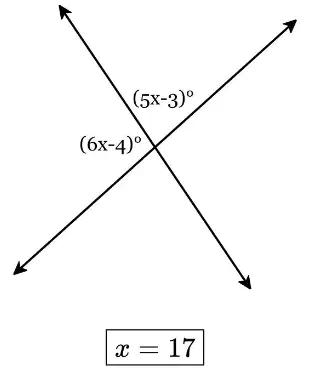
Vertical angles are formed by two intersecting lines. If one angle measures (5x − 3)° and its vertical angle measures (6x − 4)°, what is x?
x = 7
x = 19
x = 9
x = 17
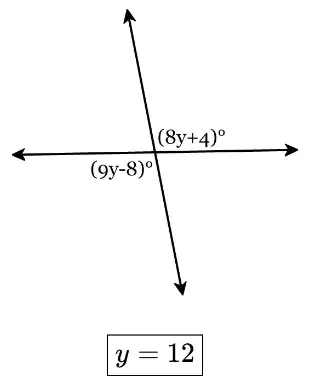
Two angles on a straight line are labeled (9y − 8)° and (8y + 4)°. What is y?
y = 10
y = 8
y = 12
y = 16
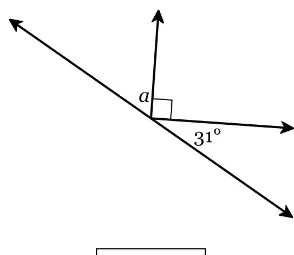
A right angle and a 31° angle sit on a slanted line with a short perpendicular segment creating angle a above the line. Find a.
a = 90°
a = 31°
a = 41°
a = 59°
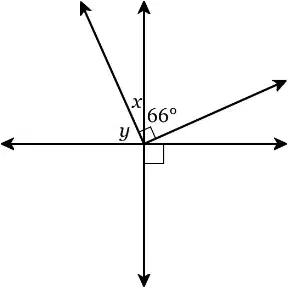
A vertical line meets a horizontal line at a right angle. A slanted ray makes a 66° angle with the horizontal to the right. The acute angle between the slanted ray and the upward vertical is x, and the angle between the downward vertical and the horizontal to the right is a right angle. What are x and y if y is the angle between the slanted ray and the horizontal to the left?
x = 24°, y = 66°
x = 33°, y = 57°
x = 57°, y = 33°
x = 66°, y = 24°
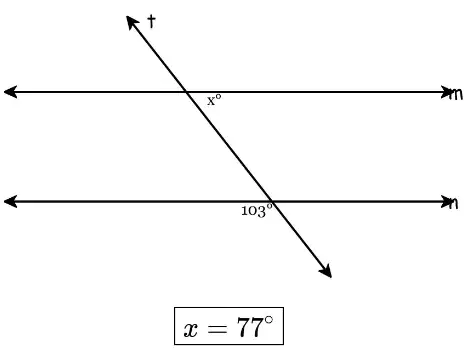
Given parallel lines m and n cut by transversal t, the interior angle on the lower line is 103°. What is the acute angle x on the upper line that is consecutive interior with the 103° angle?
x = 67°
x = 103°
x = 77°
x = 87°
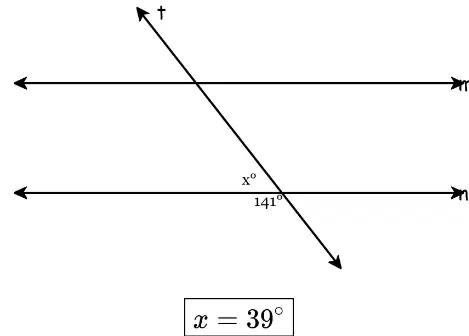
Given parallel lines m ∥ n and transversal t, the angle corresponding to x° is 141°. What is x?
x = 141°
x = 59°
x = 39°
x = 49°
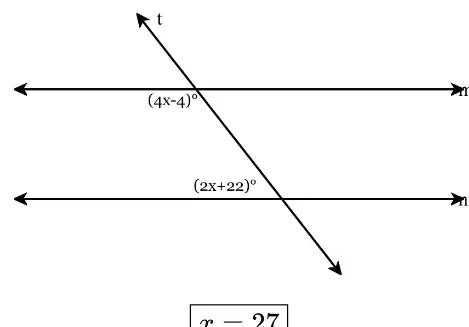
Given m ∥ n and transversal t, the angles (4x − 4)° and (2x + 22)° are alternate interior angles. Find x.
x = 27
x = 13
x = 33
x = 11
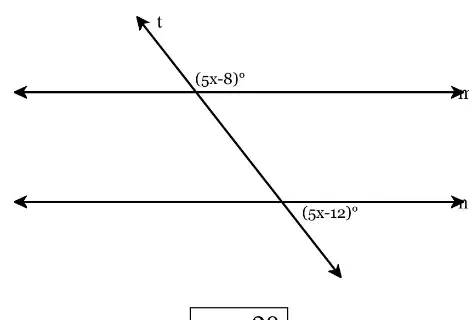
Given m ∥ n and transversal t, the angles (5x − 8)° and (5x − 12)° lie on a straight line along the same side of the transversal. What is x?
x = 20
x = 32
x = 2
x = 10
Given m ∥ n and transversal t, angle x° is corresponding to a 126° angle on the other line. Find x.
x = 126°
x = 54°
x = 64°
x = 76°
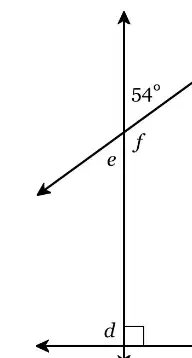
Two parallel lines m and n are cut by transversal t. The angles along the transversal at one intersection are labeled 54°, e, and f around the vertical line, and at the bottom there is a right angle d with the horizontal. Find d, e, and f.
d = 54°, e = 90°, f = 126°
d = 90°, e = 36°, f = 144°
d = 126°, e = 54°, f = 90°
d = 90°, e = 54°, f = 126°
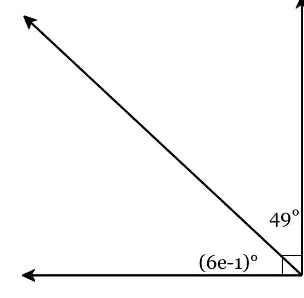
A right angle is split by a ray that forms a 49° acute angle with the vertical. The adjacent exterior angle along the horizontal is labeled (6e − 1)°. Find e.
e = 9
e = 6
e = 8
e = 7
Given m ∥ n and transversal t, the angle on the top line is (8x + 26)°, and the corresponding angle on the bottom line is (9x + 9)°. Find x.
x = 8
x = 26
x = 17
x = 9


Figure F has been transformed to F'.
Select all the statements that are true.
reflected across the y-axis
translated 8 units up
translated 8 units down
reflected across x axis
congruent and similar



If a triangle has angle measures of 40 and 56, what does the third angle measure?
96
16
84
86

37
143
143
37



