
 Worksheets
Law Studies 1-3
Total questions: 134
Worksheet time: 2hrs 2mins
Which grievance contributed to the American colonists’ desire for independence?
British policies had made frontier lands too expensive.
The King had denied the colonists their freedom of religion.
The British government had been too generous to the Indian tribes.
The British government had taxed the colonists without their consent.
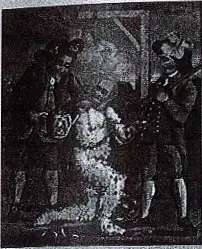
What was the main purpose of the tar-and-feathering shown in this British caricature of the colonists?
to protest their being taxed without their consent
to protest the high cost of British manufactured goods
to protest British involvement in the French and Indian War
to protest the quartering of troops in colonists’ own homes

The diagram below describes causal relationships leading to the Declaration of Independence. Which event completes the diagram?
British give up the attempt to tax the colonists.
British apply armed force against the colonists.
British agree to give the colonists their independence.
British grant the colonists representation in Parliament.
In the 1760s and 1770s, the British Parliament passed the Stamp Act, Townshend Acts, Tea Act, and Intolerable Acts. What was the impact of these British colonial policies?
Indian tribes were able to keep their lands.
Colonists began to think of becoming independent.
The British government was able to pay off its debts.
The French were defeated in the French and Indian War.
Which complaint against King George III was stated in the Declaration of Independence?
He had quartered his troops among the colonists.
He had forced the colonists to accept the practice of slavery.
He had required the colonists to trade with French merchants.
He had failed to defend the colonists in the French and Indian War.
Which source publicized the concept of “natural rights,” later found in the Declaration of Independence?
Magna Carta
the English Bill of Rights
the Mayflower Compact
John Locke on the social contract
According to the Declaration of Independence, what was an “unalienable right” that all governments should protect?
the right to social equality
the right to personal liberty
the right to religious equality
the right to elect government officials
The passage below comes from the Declaration of Independence (1776). Which section of the Declaration contained this passage?
its list of colonial grievances
its justification of the conduct of the colonists
its theory of government based on a social contract
its announcement of American independence from Britain
Which statement best describes the role of government according to the Declaration of Independence?
“The main purpose of government is to expand and glorify the state.”
“The main purpose of government is to protect the unalienable rights of individuals.”
“The main purpose of government is to protect the rights and privileges of His Majesty, the King.”
“The main purpose of government is to promote the general welfare of the community by taking steps toward social equality.”
The passage below comes from the Declaration of Independence. According to this passage, what is the principal role of government?
to promote greater social equality
to protect the natural rights of citizens
to glorify the ruler in the eyes of the Creator
to help individuals cooperate against the forces of nature

The diagram below summarizes ideas from the Declaration of Independence. Which statement completes the diagram?
Because governments derive their just powers from the consent of the governed, they are incapable of acting against the people.
Whenever any form of government becomes destructive of these ends, it is the right of the people to take peaceful measures to alter those policies.
Whenever any form of government becomes destructive of these ends, it is the right of the people to alter or abolish it, and to institute new government.
Because governments derive their powers from the consent of the governed, it is the obligation of the people to obey their government whatever it commands.
Based on the Declaration of Independence, which is a natural right?
the right to vote
the right to bear arms
the right to pursue happiness
the right to equal protection of the laws
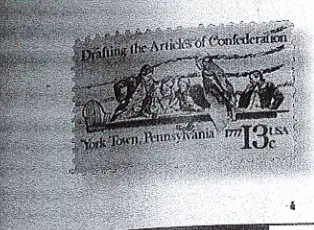
The postage stamp on the left shows a committee of the Second Continental Congress drafting the Articles of Confederation. Why did this committee create a weak central government?
to encourage more trade between states
to preserve the powers of the individual states
to promote national security against foreign invasion
to permit the taxation of citizens to pay the nation’s debts
How did Americans’ experience under British rule influence the form of government they established under the Articles of Confederation?
The new legislature had two houses, just like the British Parliament.
The states were sovereign, just as the colonies had been under British rule.
The new central government was not given any power to direct the military.
The new central government was not able to tax citizens as the British government had tried to do.
Why did the members of the Constitutional Convention decide to create a national government with three separate branches?
This system made it easier for government officials to specialize.
This was as a compromise since some delegates wanted four branches.
Having separate branches gave the government greater flexibility in wartime.
This structure would prevent any one branch of government from becoming too strong.
By 1786, why did many merchants want the Articles of Confederation to be replaced?
Several states were taxing the activities of the Confederation.
States were discouraging trade by taxing one another’s goods.
Congress was forcing the states to contribute to its general fund.
The national government had printed so much money that it lost its value.
How did the U.S. Constitution solve a problem created by a weakness of the Articles of Confederation?
It stopped the national government from imposing taxes.
It gave the national government the power to raise an army.
It required unanimous consent of the states to pass amendments.
It prevented acts of piracy against American ships off the coast of Africa.
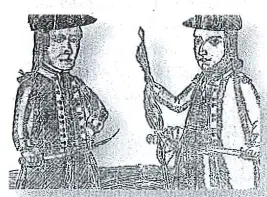
The illustration on the left, from a popular almanac in 1787, shows Captain Daniel Shays. Why did his rebellion send a wave of fear among wealthy merchants and landowners?
Officers worried about losing their back pay.
Shays planned to take money from the rich and give it to the poor.
There was no national army to put down domestic unrest if it spread.
Bankers and other lenders feared the loss of their loans to the national government.
Which weakness of the Articles of Confederation was addressed by the Constitution?
the continuation of slavery
the lack of a national court system
the absence of a balanced budget
the need to strengthen the power of the states
Below are two opposing views expressed at the Constitutional Convention: “As delegates from small states, we insist on a national legislature in which each state receives equal representation.” and “As delegates from large states, we believe that representation should be based on population. States with more people should have more representatives.” Which feature of American government today was the outcome of this disagreement at the Constitutional Convention?
A Bill of Rights was added to the Constitution to protect individual rights.
Each state can decide how its own representation in Congress is determined.
Representation in both our federal and state legislatures is now based on population.
States have equal representation in one house of Congress and representation based on their population size in the other.
Why did the Preamble to the Constitution begin with the phrase, "We the People"?
to indicate that the national government had limited powers
to indicate that the states had been associated in a confederation
to indicate that federal power was separated among three branches
to indicate that the American people were the ultimate source of its authority
Which identifies one of the goals of government listed in the Preamble?
to guarantee employment to all citizens
to expand the nation’s frontiers westward
to establish independence from Great Britain
to protect the rights and freedom of all citizens

The chart shows the organization of the government of the United States, based on the Constitution: Legislative Branch makes laws — Article I: Congress; Executive Branch enforces laws — Article II: Presidency; Judicial Branch applies laws and settles disputes — Article III: Supreme Court. Which way in which the Constitution limited the power of government is illustrated by the chart?
individual rights
due process of law
checks and balances
separation of powers
When the President nominates an individual to serve as Secretary of State, the Senate must confirm the appointment. Which feature of the Constitution, limiting the power of government, does this illustrate?
checks and balances
separation of powers
popular sovereignty
due process of law
The list provides three examples of actions by the U.S. government: The President meets with the Prime Minister of the United Kingdom; The Supreme Court applies an existing law to a new situation; Congress passes a new environmental law. Which feature of the Constitution do these examples illustrate?
limited government
due process of law
separation of powers
checks and balances
Which example illustrates the system of checks and balances?
The President vetoes legislation proposed by Congress
The President confers with the members of the Cabinet
The Supreme Court interprets the application of a law passed by Congress
A state sets its own student learning standards while Congress regulates trade between states
Which part of government in the U.S. Constitution was given the role of enforcing national laws?
Congress
the President
the Supreme Court
the House of Representatives
What was one of the Anti-Federalists’ strongest arguments against the Constitution?
It did not create a national executive
It did not include a list of protected rights for individuals
The new central government would be too dependent on the states
The new central government would be too weak to protect American interests abroad
What was one outcome of the debate between Federalists and Anti-Federalists over the ratification of the Constitution?
the addition of the Bill of Rights
the state governments won the right to secede
the creation of a second house in Congress
the Federalists agreed to weaken the powers of the Presidency
Which individual could qualify as a candidate for President of the United States?
Max is 67 years old; he has lived in Ontario, Canada for all of his life; he was born in Detroit.
Martha is 45 years old; she has lived in Chicago for the last 18 years; she was born in Tampa.
Samuel is 27 years old; he has lived in New York City for the past 3 years; he was born in Israel of American parents.
Karen is 42 years old; she has lived in Boston for the last 26 years; she was born in Ireland of Irish parents.
Which constitutional power provides the basis for the President’s day-to-day control of U.S. foreign relations?
the power to appoint and receive ambassadors
the power to appoint Justices of the Supreme Court
the power to inform Congress of the "State of the Union"
the power to summon Congress in times of national emergency
The War Powers Act of 1973 restricted the powers of the President as Commander in Chief. Which principle of constitutional government did passage of this law illustrate?
federalism
limited government
checks and balances
separation of powers
Which power does the Constitution give to the President to check Congress?
the power to appoint heads of departments
the power to veto proposed federal legislation
the power to pardon offenders for federal crimes
the power to inform Congress of the "State of the Union"
Which of the following is an example of an administrative agency?
U.S. Army
U.S. Supreme Court
Federal Reserve Board
U.S. House of Representatives
During the 1976 Presidential campaign, Jimmy Carter promised to pardon draft evaders from the Vietnam War to help heal the wounds of the war. Shortly after he was elected, President Carter pardoned about 100,000 of them. How was he able to pardon so many at once?
by exercising an implied power
by exercising a customary power
by exercising an emergency power
by exercising a power found in the Constitution
Which argument is often raised against the Electoral College?
Many electors do not honor the choice of most of their state’s voters.
The Electoral College encourages the growth of too many "third parties."
A candidate can win the Presidency without a majority of the popular vote.
Presidential elections are too often decided by the House of Representatives.
Which is an important task of an administrative agency?
passing federal laws
making detailed regulations
running the United States armed forces
resolving court cases between private parties
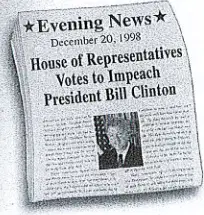
The headline shown appeared in newspapers on December 20, 1998: "House of Representatives Votes to Impeach President Bill Clinton." Which step is next in the impeachment process?
The President is tried in the Supreme Court.
The President is tried by the United States Senate.
The President can appeal to the U.S. Supreme Court.
Three-fourths of the states must agree to the impeachment.
How does an executive order differ from a federal law?
Executive orders are not subject to judicial review.
Executive orders are not limited by the Constitution.
Executive orders do not need to be approved by Congress.
Executive orders are limited to military and foreign affairs.
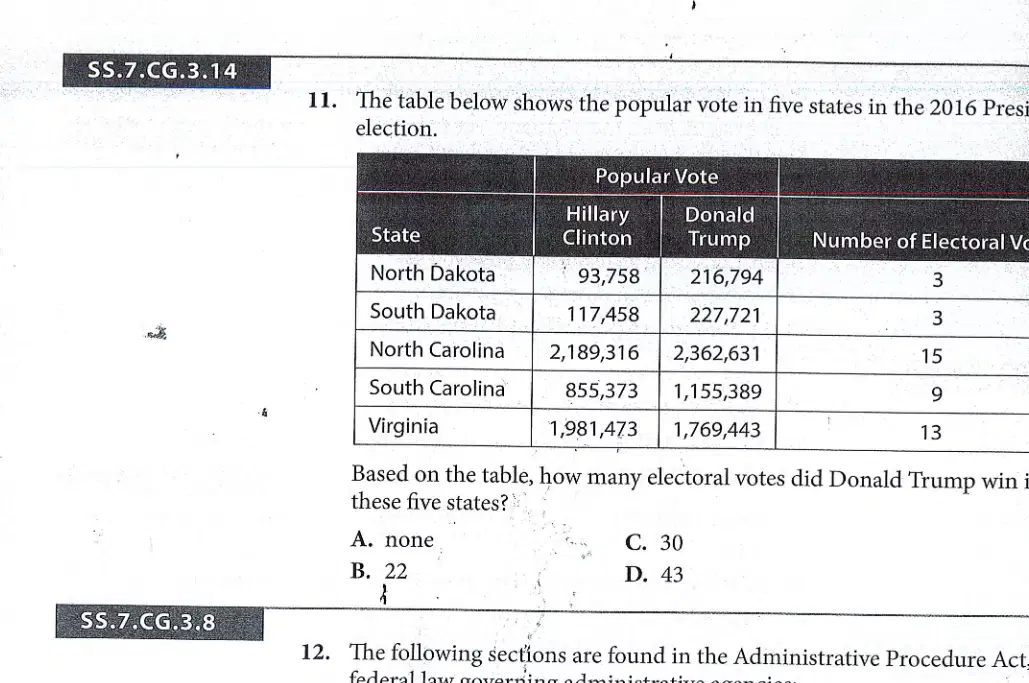
Based on the table, how many electoral votes did Donald Trump win in these five states?
none
22
30
43
The following sections are found in the Administrative Procedure Act, a federal law governing administrative agencies: Section 533(b) requires general notice of proposed rule making to be published in the Federal Register. Section 533(c) requires agencies to give interested persons an opportunity to participate through written data, views, or arguments, with or without opportunity for oral presentation. Which statement best explains the reason for these sections?
Administrative agencies are required to advise the President.
Administrative agencies have the power to issue their own executive orders.
Administrative agencies must consider public views before issuing enforceable regulations.
Administrative agencies often enforce their own regulations in court-like settings.
Under the U.S. Constitution, which of the following tasks is assigned to the executive branch?
ratifying treaties with foreign countries
appointing Justices to the U.S. Supreme Court
determining whether a new law is constitutional
voting on funds to support U.S. armed forces stationed abroad
Sam Morgan is convicted of committing mail fraud by the U.S. District Court for the Southern District of Florida. Sam believes the judge was unfairly biased against him. To which court should he send his appeal?
U.S. Supreme Court
Florida Circuit Court
U.S. Court of Appeals
Florida Supreme Court
Article III of the Constitution established the U.S. Supreme Court. Why does this article refer to this court as "supreme"?
It hears more cases than any other court.
It has authority over all other courts in the United States.
Its officers are appointed by the President of the United States.
It has authority over both the executive and legislative branches.
Why did the Constitution establish that federal judges be appointed for life?
to ensure the system of checks and balances
to strengthen their jurisdiction over state courts
to limit the power of the legislative and executive branches
to maintain the independence of the judiciary and separation of powers
An oil barge belonging to the State of Alabama has a massive oil leak in the Gulf of Mexico. The leaked oil damages the beautiful beaches of Destin, Panama City, and Ft. Walton. The oil also endangers the shrimp and crab industry of Florida. The State of Florida sues the State of Alabama. Which court has jurisdiction over the case?
U.S. Supreme Court
Florida Supreme Court
U.S. Court of Appeals for the 11th Circuit
U.S. District Court for the Northern District of Florida
How does an appellate court differ from a trial court?
An appellate court usually has a jury.
An appellate court decides issues of fact.
An appellate court examines more witnesses.
An appellate court reviews another court's decision.
The Rio Grande forms the international border between Texas and Mexico. Over the years, the Rio Grande has changed its course several times. This has led to a number of disputes between Texas, New Mexico, and Mexico. The Country Club dispute between Texas and New Mexico was decided by the U.S. Supreme Court in 1927. Why did the Supreme Court follow a trial process in this case?
The case involved federal law.
The case was between several states as parties.
The case was between citizens of different states.
The case involved foreign ambassadors and other diplomats.
Which are the only federal courts to have juries?
U.S. District Courts
U.S. Supreme Court
U.S. Courts of Appeals
U.S. District Courts of Appeals
What kind of court order does the U.S. Supreme Court issue to indicate that it will review a case?
writ of certiorari
majority opinion
summary judgment
writ of habeas corpus
The headline on the left appeared in a newspaper. Which statement would most likely follow this headline?
"Justice discovered to be ruling on cases solely to win votes."
"Justice found to be opposing the President's views on the case."
"Justice accused of accepting secret payments from a party in the case."
"Justice committed treason by ruling in favor of a foreign diplomat against the United States."

The diagram below provides details about the U.S. court system. Which court completes the diagram? U.S. District Court → U.S. Court of Appeals → U.S. ?
Circuit Court
Supreme Court
Municipal Court
Court of Veterans Appeals
The list below identifies several activities: Attending a school board meeting; Voting in a primary election; Sending a petition to local officials; Putting a candidate’s sign in your yard; Registering voters at a community college. What do these activities illustrate?
ways that citizens can meet their citizenship obligations
opportunities for citizens to participate in national elections
ways in which citizens can meet their citizenship responsibilities
opportunities for citizens to influence political action committees
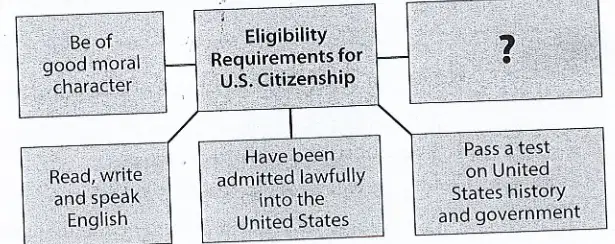
The diagram shows the requirements for becoming a naturalized citizen. Which statement completes the diagram?
Pay federal income tax
Have an annual income of $20,000 or more
Have resided in the United States for five years
Have a parent, spouse or child who is a U.S. citizen
Which practice is part of the obligation of a U.S. citizen to help defend the nation?
serve on a jury
register for Selective Service
vote in all national elections
keep informed about national issues
The document shown was part of a summons to perform an important civic duty. Why is it important for citizens to meet the obligation indicated in this document?
to guarantee our right to confront witnesses
to preserve constitutional limits on governmental power
to guarantee our right to be judged by a jury of our peers
to protect our right to petition for a writ of habeas corpus
Which is a constitutional means of obtaining U.S. citizenship?
paying U.S. income taxes
being born in the United States
buying real estate in the United States
agreeing to obey the laws of the United States

The photograph shows an accomplishment of Ms. Ester Tua Caballa becoming a citizen in the U.S. District Court in Pensacola, Florida. What are three of the requirements she had to fulfill for this accomplishment?
reside in the United States for five years; be of "good character"; pass a U.S. history test
be of "good character"; pass a test of general knowledge; have a high school diploma
be of "good character"; enter the United States lawfully; earn more than $20,000 annually
reside in the United States for five years; enter the United States lawfully; serve in the armed forces
The notice shown was posted by Florida Americorps. What statement best describes the notice?
Florida Americorps is asking Floridians to fulfill their citizenship obligations.
Florida Americorps is encouraging Floridians to take action to promote the common good.
Florida Americorps is urging Floridians to demand the rights of citizenship.
Florida Americorps is advising Floridians to apply to local government agencies to provide assistance.
The sign shown was placed in public view by members of United Way. Why would citizens volunteer to perform some of the activities listed on the sign? Activities include: Bagging & distributing food; Stocking shelves; Tutoring a homeless child; Mentoring children ages 4–12 facing homelessness; Helping sand and stain bunk beds inside the Thomas House Family Shelter.
to earn more money
to promote the common good
to earn additional citizenship rights
to fulfill their obligations under the law
Which act is considered a citizenship responsibility rather than an obligation?
paying taxes
obeying the law
attending civic meetings
registering for Selective Service
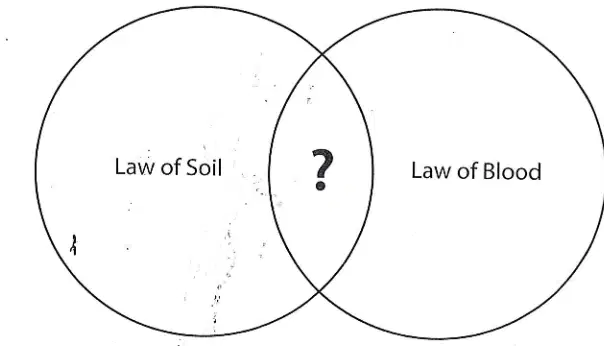
The Venn diagram below compares two means of becoming a U.S. citizen. Which characteristic completes the Venn diagram?
Obtained at birth
Does not include voting rights
Obtained through naturalization
Requires residence in the United States
What would be the most likely consequence to society if citizens began refusing to fulfill their citizenship responsibilities?
People would face the threat of losing their individual rights and freedoms.
People would have more free time because they would have fewer social obligations.
People would benefit from the direction of strong leaders who would guard their freedoms.
People would find that society was able to look after itself without the help of civic participation.
What is an important impact of the naturalization process?
More foreign residents in the United States obtain green cards.
Permanent residents in the United States are required to pay taxes.
An increased number of illegal immigrants come to the United States.
Immigrants to the United States see the possibility of becoming citizens.
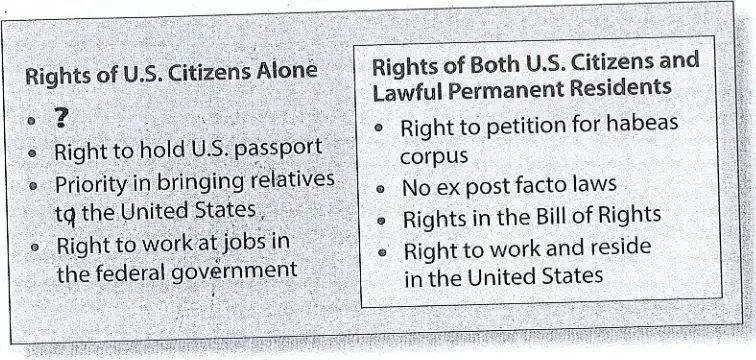
The diagram below shows some of the rights of U.S. citizens and of lawful permanent residents. Which completes the diagram?
Right to vote
Right to refuse to pay taxes
Right to freedom of speech
Right to freedom of religion
Which of these is a legal obligation of U.S. citizenship?
to reside in the United States
to save money for retirement
to vote in Presidential elections
to serve on a jury when summoned
Which of these is one of the legal requirements for becoming a citizen?
registering to vote
paying income taxes
having relatives in the United States
living in the United States at least five years
The list below identifies several responsibilities of U.S. citizens. Which phrase completes the list?
Voting in elections
Paying federal income tax
Answering a jury summons
Registering with Selective Service
What is the impact on society when citizens fail to perform their citizenship obligations?
Citizens are still able to maintain their protected rights.
Most citizens benefit from not having to pay taxes or obey laws.
Government leaders seize control because of the lack of civic participation.
Governments can no longer perform services, maintain order or defend citizens.
Which statement identifies a positive impact of the naturalization process on American society?
It increases American power and influence overseas.
It leads to greater divisiveness on domestic political issues.
It attracts talented immigrants who contribute knowledge and skills.
It costs taxpayers money to enforce immigration and naturalization laws.

The diagram below shows the naturalization process. Which statement completes the diagram?
Pay income tax for five years
Serve in the U.S. armed services
Be sponsored by an American employer
Pass a test on American history and government

The U.S. Congress is divided into two chambers (houses). What are they?
Senate and Assembly
Assembly and House of Representatives
Senate and House of Representatives
Supreme Court and High Council

True or False: Federal, state, and local governments have legislative branches.
True
False


Based on the excerpt, it can be concluded that the United States has which of the following types of government?
theocracy
monarchy
democracy
dictatorship
This act lowered the tax on molasses in order to stop colonial smuggling.
The Townshend Acts
The Sugar Act
The Coercive Acts
The Proclamation of 1763
This act allowed England to make all decisions for the colonists and tax anything they wanted.
The Declaratory Act
The Townshend Acts
The Sugar Act
The Stamp Act
This law restricted colonists from moving past the Appalachian Mountains.
The Townshend Acts
The Intolerable Acts
The Proclamation of 1763
The Declaratory Act
This act allowed British soldiers to live in colonial homes.
The Quebec Act
The Stamp Act
The Declaratory Act
The Quartering Act
This law placed a tax on all printed material in the colonies including wills, contracts, newspapers, and playing cards.
The Declaratory Act
The Stamp Act
The Intolerable Acts
The Coercive Acts
This act gave an unfair advantage to a the British East India Company by allowing the British company to not pay tax on tea.
The Tea Act
The Townshend Act
The Coercive Act
The Declaratory Act
These acts placed a tax only on imported goods like paper, glass, tea, and lead.
The Intolerable Acts
The Coercive Acts
The Townshend Acts
Writs of Assistance
These very harsh acts were designed after the Boston Tea Party and included closing Boston Harbor until the colonists paid for the ruined tea.
The Townshend Acts
The Stamp Act
The Sugar Act
The Coercive Acts
What was the COLONIAL name for the acts that closed Boston Harbor, banned town meetings, and other harsh penalties?
The Coercive Acts
The Townshend Acts
The Intolerable Acts
The Proclamation of 1763
What is the Bill of Rights?
The document signed giving us our independence from Great Britain.
The first 10 amendments added to the Constitution.
The 8 most important amendments added to the Constitution.
The first 11 amendments added to the Constitution.
Which amendment gives us the Right to Bear Arms?
The 2nd amendment
The 8th amendment
The 1st amendment
The 3rd amendment
We are allowed to speak our opinion about the government without getting in trouble because of the...
9th amendment
10th amendment
4th amendment
1st amendment
Which amendment tells you that you do not have to house, or quarter, soldiers without your consent?
2nd amendment
3rd amendment
4th amendment
5th amendment
Which amendment protects you from having police officers come in to search your home without a warrant?
5th amendment
3rd amendment
8th amendment
4th amendment
Which amendment allows you to see a judge in a short amount of time?
8th amendment
7th amendment
6th amendment
5th amendment
1st Amendment
Ensures due process, protects against self-incrimination, and double jeopardy. Government can take property through eminent domain.
No force quartering of Soldiers in peace time
The right to be secure in their person's , houses , papers, and effects, against unreasonable searches and seizures.
Freedom of religion , assembly, petition , press, speech
Fifth amendment
Ensures due process, protects against self-incrimination, and double jeopardy. Government can take property through eminent domain.
Trial by jury in Civil suits where money exceeds 20 dollars.
Any rights not given to federal government are given to the states and people.
No excessive bail, fines nor cruel and unusual punishments inflicted.
The right to be secure in their person's , houses , papers, and effects, against unreasonable searches and seizures.
Fourth amendment
Right to speedy and public trial, right to lawyer.
The enumeration in the Constitution, of certain rights, shall not be construed to deny or disparage others retained by the people.( just because these rights are listed, it does not mean that you don't have other rights too).
Any rights not given to federal government are given to the states and people.
No force quartering of Soldiers in peace time
First amendment
Seventh amendment
Second amendment
Third amendment
Seventh amendment
Any rights not given to federal government are given to the states and people.
Trial by jury in Civil suits where money exceeds 20 dollars.
Right to bare arms
Religion, Speech , Press, Assembly, Petition
The enumeration in the Constitution, of certain rights, shall not be construed to deny or disparage others retained by the people.( just because these rights are listed, it does not mean that you don't have other rights too).
Ensures due process, protects against self-incrimination, and double jeopardy. Government can take property through eminent domain.
No excessive bail, fines nor cruel and unusual punishments inflicted.
Right to speedy and public trial, right to lawyer.
Ninth amendment
Sixth amendment
Trial by jury in Civil suits where money exceeds 20 dollars.
Right to speedy and public trial, right to lawyer.
Right to bare arms
Any rights not given to federal government are given to the states and people.
What does the Supreme Court do?
make laws
give advice to the president
look at laws and make sure they work
look after Congress and the Cabinet
Where does the Legislative Branch work?
the White House
the U.S. Capitol
the Supreme Court
the National Mall
Why does the Congress debate laws?
to make the best laws for the United States
to tell the courts what to do
to make the president happy
to make work for the judicial branch
Who can veto laws?
Congress
the Supreme Court
the president
the vice president
Who can make laws?
the Supreme Court
the president
Congress
all the above
Why does the government need checks and balances?
to keep laws from being put in place
so that no branch has all the power
so the branches work alone
to let Congress debate laws
Where is the White House located?
Tallahassee, Florida
Washington, DC
New York City, New York
Detroit, Michigan
What branch is responsible for creating laws?
Executive
Legislative
Judicial
Educational
What branch is responsible for interpreting the law?
Legal
Executive
Judicial
Legislative
What branch is responsible for enforcing the law?
Executive
Legal
Judicial
Educational
Which branch decides if laws are constitutional?
Legislative
Executive
Legal
Judicial
The ability of one branch of government to limit the power of the other branches of government is known as what?
Executive Order
Checks and balances
Amendment Process
Which is an example of a U.S. citizen's obligation?
serving on juries
running for office
voting in elections
attending civic meetings
When police inform suspects of their rights before questioning them, which constitutional right is demonstrated?
due process
eminent domain
double jeopardy
peaceably assemble
Which is a power of appellate courts?
to provide the final verdict in a trial
to interview the witnesses in a case
to decide if a lower court made errors
to start the jury trial process over again
The statement below is from a jury's decision in a court case.
We, the jury, rule in favor of Mrs. Madison, and
order Mr. Washington to pay the sum of twenty
thousand dollars, plus attorney fees and court
costs....
civil
military
juvenile
constitutional
Which of the following is a system of law based on precedent and customs?
statutory law
tort law
common law
civil law
How did the Supreme Court decisions in Gideon v. Wainwright and Miranda v.
Arizona affect individual liberties?
by eliminating the poll tax as a voting requirement
by preventing the use of organized prayer in public schools
by expanding the constitutional rights of people accused of crimes
by requiring equal pay for men and women performing the same job
Use the scenario to answer the following question.
Ben was prosecuted and convicted in state court
for speaking out publicly against the governor.
During his trial, he was denied the counsel of a
lawyer. Two years later, the U.S. Supreme Court
overturned his conviction, explaining that the state
had not guaranteed Ben’s constitutional rights.
Which individual rights were safeguarded by the Supreme Court?
Free speech as well as due process
Free press as well as search and seizure
Unenumerated rights as well as due process
Unenumerated rights as well as search and seizure
What is a long term result of judicial review on the government?
The courts are unable to overturn precedent.
The courts are bound by legislative decisions.
The courts are able to overturn previous court decisions.
The courts can create new laws based upon their rulings.
Which of the following cases would the federal court system have original jurisdiction over?
violation of state laws
disputes between two states
violations of local ordinances
disputes between two citizens of the same state
Use the scenario to answer the following question.
Doug’s 16 year old son backed into Liz’s car while it was parked in front of her
house. Liz sued Doug for $1500 to cover the cost of repairing the car.
Which court would have original jurisdiction?
county court
appellate court
Florida Supreme Court
Circuit Court of Appeals
Which U.S. Supreme Court case resulted in juveniles accused of crimes being provided many of the same due process rights as adults?
In re Gault (1967)
In re Greene (1930)
Hazelwood v. Kuhlmeier (1988)
District of Columbia v. Heller (2008)

Use the image to answer the question.
Which of the following is a similarity between criminal and military laws?
both may include trials by jury
both types of laws deal with all citizens
both may include cases of crimes and punishments
both types are divided into felonies and misdemeanors
Use the scenario below to answer the following question.
Sarah was arrested and convicted in a federal
court for publicly threatening to harm the President
of the United States. Sarah was sentenced to five
years in prison.
Which individual right was limited in this case?
right to bear arms
right to an attorney
right to free speech
right to petition the government
Use the scenario below to answer the question.
John Walker was charged with perjury. After a lengthy trial and jury deliberation, John was found to be not guilty of all charges. After a few months authorities found new evidence that they could have used to get a guilty verdict. They submit a request to the courts to have John tried again for the same offense.
Which constitutional right would best help John in this situation?
speech
privacy
bear arms
double jeopardy
Use the headline below to answer the following question.
U.S. Supreme Court deems legislation unconstitutional.
Which landmark decision established the judicial powers referenced in the headline?
Marbury v. Madison
Tinker v. Des Moines
United States v. Nixon
Brown v. Board of Education
What are the Magna Carta and the Code of Hammurabi examples of?
Landmark Court Decisions
Reasons for Colonial Independence
Functions of State and Federal Courts
Sources of Law for the U.S. Government

