
 Worksheets
Workplace Safety and Procedures Quiz
Total questions: 37
Worksheet time: 19mins
What is the main legislation relating to the wellbeing of all employees?
British standards.
Factories Act.
Health and Safety at Work Act.
Public Health Acts.
On reaching the designated emergency assembly point, what is the correct procedure that must be followed?
Wait and be accompanied back to the premises.
Wait for the roll call then return immediately to the premises.
Report and return immediately to the premises.
Report and remain until instructed to return to the premises.
At what point must employees report defects in work equipment?
By the end of each day.
As soon as the fault is identified.
At routine safety committee meetings.
Following an accident.
Where can the appropriate first aid procedures for a hazardous substance always be found?
An invoice.
A job card.
A data sheet.
A delivery note.
What is the best means of preventing exposure to a harmful substance in the workplace?
Enclose the process.
Provide correct PPE.
Isolate the worker.
Allow ventilation.
What must a company do before introducing a hazardous substance into the workplace?
Carry out a risk assessment.
Service the fire extinguishers.
Use it in small amounts to begin with.
Ensure there is a COSHH storage area.
Which one of the following may be given a Maximum Exposure Level (MEL)?
A woodworking machine.
A hand tool.
A chemical/substance.
A powered hand tool.
What must employers assess under the Control of Substances Hazardous to Health Regulations (COSHH)?
Dust.
Eating.
Overhead lighting.
Uneven floors.
What is the role of a health and safety representative in a furniture company?
Discipline staff who fail to work safely.
Raise staff concerns about health and safety issues.
Find ways to avoid health and safety legal requirements.
Always disagree with management policy on health and safety.
What must employees do when they hear the fire alarm?
Lock all doors behind them.
Move calmly to the assembly point.
Collect all their personal belongings.
Isolate all the electrical equipment.
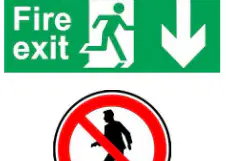
Which one of the following signs indicates the direction of the fire exit?
Fire exit sign with downward arrow.
Fire symbol.
No entry sign.
Hazard warning sign.
What is the main objective of the Health and Safety Regulations with regard to lighting in the workplace?
To ensure lighting is aesthetically pleasing.
To reduce energy consumption.
To provide adequate lighting for safe working conditions.
To eliminate the need for artificial lighting.
What legislation governs control of pollution into the atmosphere?
Factories Act
Environmental Protection Act
Workplace Regulations
Provision and Use of Equipment Regulations
Companies analyze accidents to:
Show every accident that occurs.
Highlight areas that require action.
Calculate cost incurred on loss of production.
Report to rate of injuries to management.
Which one of the following is an advantage of using forklift trucks to move pallets?
Anyone can operate them.
They reduce the risk of manual handling.
They have a maximum load restriction.
Accidents never happen when they are used.
In relation to COSHH, place the following three statements in order of priority: 1. Make an assessment of any hazardous manual handling operations that cannot be avoided. 2. Avoid hazardous manual handling operations so far as reasonably practicable. 3. Reduce the risk of injury from manual handling operations so far as reasonably practicable.
1,3,2.
3,2,1.
2,1,3.
3,1,2.
What must employees do if they have not received training on the safe use of a piece of equipment?
Find the instruction book.
Work slowly until they are confident.
Tell their superior immediately.
Write to the safety committee.
To whom of the following individuals should differences between manufacturers and workplace instructions be reported to?
A colleague.
A senior person.
The manufacturer.
Which one of the following items of protective clothing (PPE) must be used in a machine workshop?
Gloves
High-visibility jacket
Face shield
Ear defenders

Which one of the following signs means that eye protection must be worn?
Protective footwear sign
Head protection sign
Respiratory protection sign
Eye protection sign
Why must ear plugs not be used by more than one person?
To ensure they fit correctly.
To prevent them from getting lost.
To reduce the possibility of spreading infection.
To increase the amount of times they can be worn.
The preferred method of noise reduction is to:
Reduce the noise at source
Use ear defenders
Increase the distance from the noise source
Use soundproof barriers
What must an employee do when a new piece of equipment is introduced to manufacturing?
Read the instruction book.
Work slowly until they are confident.
Seek appropriate training before use.
Write to the safety committee.
Why must dust masks not be shared between colleagues?
To reduce the possibility of spreading infection.
It increases how regularly the filters have to be changed.
It increases the speed in which they become blocked.
To reduce the number of masks that needs to be purchased.
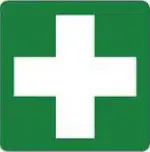
What should be located near the following sign?
A first aid box.
A fire extinguisher.
A safety manual.
A toolbox.
Which of the following is covered in terms of the Control of Substances Hazardous to Health (COSHH) Regulations?
Wood dust
Machinery
Electricity
Powered hand tools
Which of the following should be done if a machine develops a defect?
Report the defect and continue to use the machine.
Report the defect and take the machine out of use.
Keep the machine running till it fails.
Switch the machine on and off and start the task again.
An employee suffers a back injury when placing components on a shelf above shoulder height. What should the accident be reported as?
Not wearing appropriate PPE.
Stretching to reach a high shelf.
Failing to ask for assistance.
Inadequate lighting conditions.
Which of the following acts and regulations covers the use of powered machinery?
Health and Safety at Work Act and Portable Appliance Testing Regulations.
Health and Safety at Work Act and Provision and Use of Work Equipment Regulations.
Electricity at Work regulations and Portable Appliance Testing Regulations.
Provision and Use of Work Equipment Regulations and Control of Substances Hazardous to Health regulations.
How are substances assigned a maximum Exposure Limit (MEL) managed?
The level of exposure must be reduced.
A COSHH assessment is not required.
Personal protection equipment must be issued.
Health surveillance is not necessary.
Which one of the following is affected by occupational asthma, which can end working life?
Breathing
Moving
Hearing
Seeing
What is the main reason for checking tools and equipment regularly?
To ensure they are clean.
To ensure they are safe to use.
To ensure they are stored properly.
To ensure they are used correctly.
Why is it important for employees to report risks?
In case it affects the individual.
In case it affects a lot of people.
Because it is the responsibility of everyone.
It speeds up production.
How do operators receive Personal Protective Equipment? They must:
Be provided with an allowance.
Receive training in the use of the equipment.
Sign to show they have received the equipment.
Sign to show they know how to use the equipment.
Which action level equates to a daily (8 hour) personal noise exposure of 85 dB?
First.
Second.
Third.
Peak.
With reference to a risk assessment, which one of the following could be described as a hazard?
Failure to display safety signs.
Anything with the potential that could cause harm.
Possessing no nearby canteen facilities.
Keeping flammable materials in a locked store.
Under the Control of Substance Hazardous to Health Regulations (COSHH), what must an employer consider when making an assessment?
Sources of heat.
Type of work equipment being used by employees.
Measures taken to avoid risks from chemicals.
Daily work routines.

